
IMD AI Safety Clock moves closer to midnight
IMD’s AI Safety Clock shows tension between rapidly expanding artificial intelligence capabilities and lack of meaningful oversight, raising risk. ...

by Frédéric Dalsace, Goutam Challagalla, Julia Binder, Florian Hoos , Sara Ratti, Adrian Dellecker, Howard H. Yu, Michael R. Wade, Vanina Farber, Karl Schmedders Published December 29, 2025 in Sustainability • 12 min read
2026 marks the shift from sustainability ambition and reporting toward execution, financial realism, and measurable business value across net zero, nature, and supply chains.
Circularity, AI-enabled energy systems, climate adaptation, and sustainable product design are becoming core strategic levers for resilience, cost control, and growth.
ESG backlash and regulatory simplification are driving smarter materiality, sharper reporting, and greater reliance on professional judgment over box-ticking compliance.
After years of bold commitments, expanding disclosures, and rising expectations, corporate sustainability is entering a far more demanding phase. In 2026, the focus shifts decisively from ambition to execution. Companies now face the hard realities of cost, infrastructure, geopolitical risk, and climate impact. What once sat on the strategic horizon has become an immediate operational challenge, reshaping how leaders think about growth, resilience, and competitiveness.
At the same time, a reordering is underway. Sustainability is shedding its identity as a moral overlay or reporting exercise and emerging as a core driver of business strategy. From circular supply chains and climate adaptation to AI-enabled energy systems and smarter reporting, the question is no longer whether sustainability matters, but rather how directly it creates value, reduces risk, and strengthens competitive position.
Still, the path forward is anything but linear. Net-zero plans are colliding with execution constraints. Nature and biodiversity are proving difficult to measure and manage. Regulatory regimes are tightening even as political backlash grows. New technologies promise solutions while simultaneously creating new resource pressures, from power grids to water systems. Leaders must now operate in a far more complex, volatile, and interconnected sustainability landscape.
In 2026, sustainability will be tested as a true engine of competitiveness, embedded in core business models, investment priorities, and innovation roadmaps, rather than treated as a parallel ESG function. The expert perspectives that follow explore how this transition is unfolding and what it will take for companies not just to comply, but to compete in a sustainability-constrained world.
By Frédéric Dalsace and Goutam Challagalla
The first era of corporate sustainability is collapsing under its own contradictions. After years of ESG spending, green branding, and climate promises, most companies are sitting on weak returns, retrenching budgets, and facing growing political and consumer backlash. The problem isn’t ambition. It’s strategy.
For too long, sustainability has been sold as a moral upgrade – a bolt-on feature customers were expected to reward with loyalty and price premiums. In practice, they didn’t. Virtue doesn’t trigger purchases. Performance does.
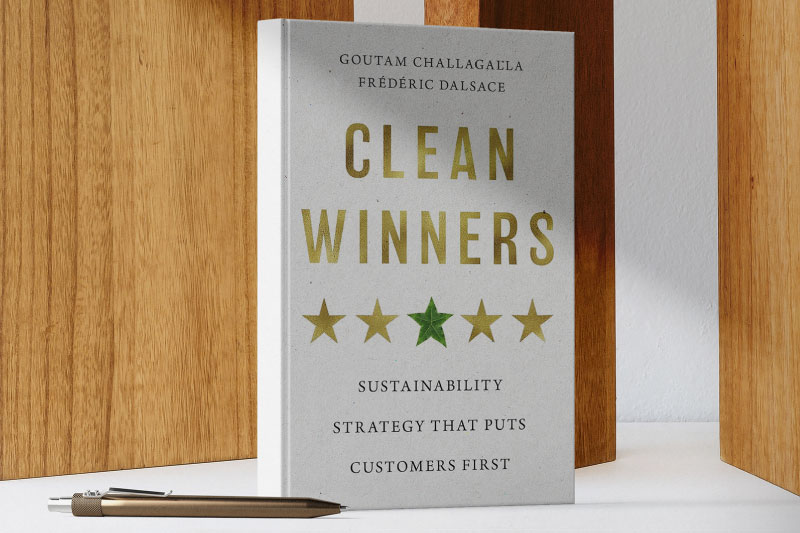
That’s the core argument behind our book, Clean Winners: Sustainability Strategy That Puts Customers First (Harvard Business Review Press, March 2026). Our research shows that sustainability doesn’t succeed by appealing to ethics – it succeeds when it makes products work better, last longer, cost less to run, and solve bigger customer problems.
This is the big trend for 2026: sustainability is shifting from marketing story to operating system. From price premium to cost disruptor. From CSR wallpaper to design logic. When energy efficiency lowers bills, when digital cuts waste and downtime, when circularity slashes input volatility, then adoption becomes automatic, even among customers who don’t “care” about sustainability at all.
The winners of the next decade will not be the loudest virtue signalers. They will be the quiet engineers of superior economics. The old sustainability was about doing less harm. The new sustainability is about building better businesses. The first one is dying. The second one is just getting started.

By Julia Binder
What if the real driver of sustainability in 2026 wasn’t climate policy, but geopolitics?
Circularity is no longer a green initiative on the sidelines. It is becoming a core strategy. The upheavals of 2025 exposed the fragility of global supply chains. China’s renewed signals to restrict rare earth exports forced a hard rethink across industries reliant on critical materials.
Business leaders are no longer simply diversifying suppliers. They are turning to circular solutions. Product take-back programs, advanced recycling, and designing for reuse are no longer just about environmental impact. They are about securing access to materials, controlling costs, and reducing exposure to geopolitical risk.
Circularity is moving from pilot projects to large-scale implementation and from moral values to business value.
In 2026, the smartest companies are not asking whether circularity fits into their sustainability plans. They are embedding it into their core operations because in a resource-constrained, uncertain world, circularity is no longer optional. It may be the most strategic move your company has yet to fully leverage.
The long-term result will be shorter, sharper sustainability reports centered on strategically important topics that genuinely matter for long-term value creation and backed up by credible data and reliable metrics.
By Florian Hoos and Sara Ratti
In 2026, amid geopolitical uncertainty and shifting regulations, the backlash against ESG and the EU’s Omnibus reporting simplification will mark a turning point for corporate sustainability.
Bloated disclosures and immaterial metrics diluted the business relevance of sustainability reporting in 2025. Executives and investors were left with too much data and too little insight.
The backlash is not a retreat from sustainability ambitions. It is a reset toward strategic materiality: focusing on the sustainability topics that really matter for business value creation.
Rather than treating every sustainability matter as material, under pressure from external consultants and auditors, companies now have the license to return to the original intent of mandatory sustainability reporting: enterprise-specific materiality, grounded in professional judgment and hard strategic trade-offs.
The long-term result will be shorter, sharper sustainability reports centered on strategically important topics that genuinely matter for long-term value creation and backed up by credible data and reliable metrics.
Leading companies are already moving in this direction. Some used CSRD not to expand, but to sharpen their materiality focus. They understand that smart simplification, not maximal disclosure, is the next frontier of value-creating sustainability. AI will increasingly enable this shift by cutting through data complexity, identifying what matters most, and streamlining reporting.
In 2026, leadership will hinge less on compliance and more on professional judgment – based on evidence, science, and strategic context. This is how credibility, integrity, and coherence to sustainability efforts can be rebuilt.

By Adrian Dellecker
The consequences of a warming planet are increasingly visible around us: higher intensity storms, rising sea levels, droughts, and forest fires are happening with increased frequency, costing the global economy $328bn in 2024, a 6% increase from the previous year. Natural catastrophes are already creating uninsurable areas worldwide, driving up infrastructure costs and risk exposure.
Four out of five supply chain professionals already recognize the supply chain challenge as a factor impacting growth. Food and commodity supply chains in particular are emerging as a flashpoint, with coffee, cocoa, maize, rice, soy, and wheat particularly vulnerable. In 2026, any of these crops could experience severe price shocks, triggering cascading effects if businesses fail to act.
Consumers will not remain insulated for long. Coffee prices surged 40% in 2024, mostly driven by inclement weather, though retail prices rose only 5%, a gap that will close. Cocoa prices have climbed 400% in recent years, as climate-driven heatwaves in West Africa become 10 times more likely, leading to a potential chocolate crisis in Europe and elsewhere.
In 2026, businesses cannot afford to wait. The scale is known. At COP30 in Brazil, countries called for a tripling of adaptation finance by 2035, recognizing $310bn will be needed annually.
Adaptation must now move to the top of the strategic agenda to safeguard resource access, protect infrastructure, and maintain competitiveness. The solutions will often be nature-based, requiring companies to build expertise in ecosystem restoration, water management, and biodiversity strategies. Climate adaptation is no longer a distant concept. Those who delay risk disruption and loss.
The hopeful news is that this reckoning is sparking innovation.
By Howard Yu
When we talk about the tech “cloud,” we imagine something weightless. In truth, the cloud is a physical beast with a massive thirst. A single large data center can guzzle about two million liters of water a day just to cool its servers. That’s as much water as 6,500 homes use daily. As AI and cloud computing explode, this hidden water appetite is becoming apparent.
In drought-prone regions from Arizona to Chile, communities are starting to push back. Locals are asking why their shrinking aquifers should cool Netflix binges or ChatGPT’s servers instead of sustaining crops and homes. Protests and policy pressure are mounting. The cloud’s growth can’t come at the expense of local water security.
The hopeful news is that this reckoning is sparking innovation. Regulators in Europe now mandate data centers to report water usage, and companies are beginning to adapt. Some are redesigning cooling systems to sip recycled wastewater instead of chugging drinking water, and a few are even testing data centers with zero water use.
In 2026, we expect these ideas to move from experiment to mainstream. The tech leaders will be those who deliver computing without draining the planet dry.
By Michael Wade
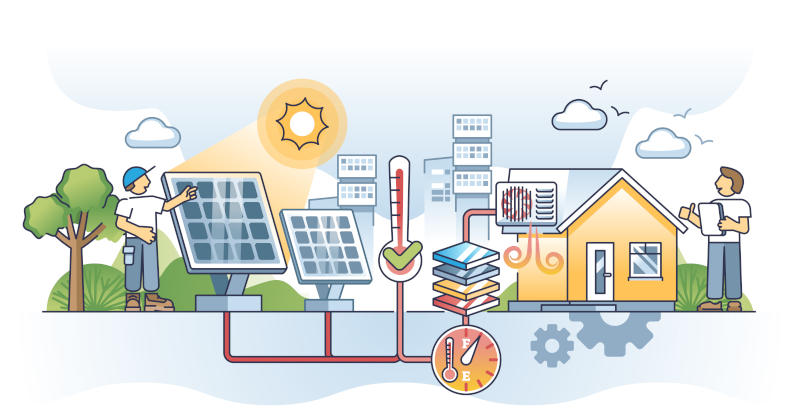
In 2026, the energy sector’s focus will shift from simple capacity expansion to intelligent integration of renewable power into the grid. The headline story will no longer simply be to generate green power, but to synchronize it in real time with consumption needs. Here’s how:
The era of passive annual renewable offsets is fading, replaced by a rigorous standard of 24/7 Carbon-Free Energy (CFE). Organizations will move to match their consumption with generation on an hourly basis, ensuring that a data center running at midnight is powered by actual wind or storage, rather than merely offset by solar credits generated at noon. This shift will birth a new market for “granular certificates” that validate true, real-time sustainability.
Artificial Intelligence (AI) will become the power grid’s central nervous system. In 2026, we will see the widespread deployment of autonomous AI systems that execute actions to optimize sustainable power distribution around the clock. These agents will manage distributed assets like EV chargers and Heating, Ventilation, and Air Conditioning (HVAC) systems in real-time, autonomously selling flexibility back to the grid to stabilize volatility.
Beyond balancing, AI will revolutionize reliability through predictive maintenance. Utilities will deploy machine learning models that detect subtle anomalies in transformers and transmission lines weeks before failure, effectively self-healing the grid before outages occur.
With a focus on the stable power needed by data centers, 2026 will mark a breakout year for long-duration energy storage pilots. Technologies such as flow batteries, thermal storage, and perovskite-tandem solar cells will move toward commercial viability. These assets will be critical for bridging the multi-hour gaps in renewable generation, providing the capacity needed to hit aggressive 24/7 CFE goals.
In summary, 2026 will be defined by granularity: the precise matching of supply and demand, down to the second and the electron, to ensure more green and zero-carbon electricity makes it to end users in real time.
Moving away from harmful practices is non-negotiable. Yet real transitions rarely begin in a state of perfection.
By Vanina Farber
In 2026, sustainability leadership is no longer defined by managing trade-offs. Trade-offs assume a zero-sum logic: limited resources, competing goals, and clear choices where gains in one area require losses in another. That logic no longer fits the challenges companies face.
Today’s sustainability dilemmas are persistent, interconnected, and self-reinforcing. Progress in one domain rarely resolves tension in another; it often intensifies it. We have entered the age of paradox, where opposing forces coexist, and leadership is measured by the ability to navigate, not eliminate, contradiction.
Consider the Global-Local Paradox. Climate, biodiversity, and migration demand coordinated global action. Yet legitimacy, trust, and execution remain fundamentally local. Companies must operate at scale while staying rooted in context. You need reach and relevance at the same time.
The Innovation–Risk Paradox is equally acute. The climate transition demands new solutions: circular systems, regenerative models, and AI-enabled efficiency. Yet innovation depends on experimentation, and experimentation entails failure and uncertainty. Organizations are expected to move fast and prove outcomes in advance. To disrupt without destabilizing.
Then there is the Transition Paradox. Moving away from harmful practices is non-negotiable. Yet real transitions rarely begin in a state of perfection. If companies wait for purity, progress stalls. If they move too fast, they risk accusations of greenwashing. The path forward runs through unavoidable gray zones.
Finally, the Regulatory Paradox is becoming more visible. Stakeholders call for bold first movers, while regulatory frameworks are still evolving. Regulation demands clarity and comparability; sustainability solutions emerge from complexity and experimentation. The tension can unintentionally suppress the very innovation systemic change requires.
These are not contradictions to solve. They are tensions to hold. The defining challenge of sustainability leadership in 2026 is no longer choosing sides but building the capacity to operate across them: to balance speed with integrity, ambition with legitimacy, experimentation with accountability. To act and reflect. To lead and learn, all at the same time.
The message for 2026 is clear: CBAM preparation is no longer optional or theoretical.
By Karl Schmedders
On 1 January 2026, the EU’s Carbon Border Adjustment Mechanism (CBAM) moves from reporting to real financial impact. What has so far been a compliance exercise becomes a cost obligation: importers will be required to purchase and surrender CBAM certificates reflecting the embedded carbon in covered goods.
CBAM was created to prevent carbon leakage by aligning the carbon costs faced by foreign producers with those paid by EU companies under the EU Emissions Trading System (EU ETS). During the transitional phase (2023–2025), companies only had to report emissions for key sectors such as cement, steel, aluminum, fertilizers, electricity, and hydrogen. From 2026 onward, reporting turns into payment.
To smooth the shift, the EU adopted a simplification package in 2025. It introduced a 50-ton de-minimis threshold per importer per year, exempting small importers while still capturing the vast majority of emissions. It also extended the annual compliance deadline to give companies more time to collect, verify, and submit emissions data. Additional flexibilities include wider use of default emissions values when verified data is unavailable, and the ability to continue importing while registration is pending.
These changes reduce friction, but they do not change the strategic impact. In 2026, CBAM becomes a material cost factor tied directly to volatile EU ETS prices. For exporters to the EU and for European companies with carbon-intensive supply chains, the financial exposure can be significant.
The message for 2026 is clear: CBAM preparation is no longer optional or theoretical.
Companies must finalize robust emissions-data systems, map supply-chain carbon exposure with precision, and integrate carbon pricing into procurement and sourcing decisions. And while CBAM currently touches six sectors (cement, aluminum, fertilizers, iron and steel, hydrogen, and electricity), the goal is for it to ultimately cover all products in the future. So, even companies not producing in one of these six sectors should start planning.
Those who treat CBAM as a narrow compliance task will be caught off guard. Those who treat it as a core strategic variable will be better positioned in a carbon-constrained global market.

Professor of Marketing and Strategy at IMD
Frédéric Dalsace focuses on B2B issues sustainability, inclusive business models, and alleviating poverty. Prior to IMD, he spent 16 years as a Professor at HEC Paris where he held the Social Business / Enterprise and Poverty Chair presided by Nobel Laureate Professor Muhammad Yunus. Prior to his academic life, Frédéric accumulated more than 10 years of experience in the business world, both with industrial companies (Michelin and CarnaudMetalbox) and as a strategy consultant with McKinsey & Company. At IMD, he is Director of the Integrating Sustainability into Strategy program.

Professor of Marketing and Strategy and dentsu Group Chair in Sustainable Strategy and Marketing at IMD
Goutam Challagalla is Professor of Strategy and Marketing and dentsu Group Chair in Sustainable Strategy and Marketing at IMD. His teaching, consulting, and research focuses on strategy with a focus on digital transformation, business-to-business commercial management, value-based pricing, sales management, distribution channels, and customer and service excellence. At IMD, he is Director of the Advanced Management Program (AMP), Integrating Sustainability into Strategy, and Strategy Governance for Boards.

Professor of Business Transformation at IMD
Julia Katharina Binder, Professor of Business Transformation, is a renowned thought leader recognized on the 2022 Thinkers50 Radar list for her work at the intersection of sustainability and innovation. As Director of IMD’s Center for Sustainable and Inclusive Business, Binder is dedicated to leveraging IMD’s diverse expertise on sustainability topics to guide business leaders in discovering innovative solutions to contemporary challenges. At IMD, Binder serves as Program Director for Creating Value in the Circular Economy and teaches in key open programs including Transition to Business Leadership (TBL), and Leading Sustainable Business Transformation (LSBT). She is involved in the school’s EMBA and MBA programs, and contributes to IMD’s custom programs, crafting transformative learning journeys for clients globally.

Professor of Sustainability and Accounting
Florian Hoos is Professor of Sustainability and Accounting, Program Director of Managing and Measuring Sustainability Impact, and served as IMD’s Managing Director of the Enterprise for Society Center (E4S) from 2022-2026.

Researcher at IMD
Sara Ratti is a researcher at IMD. She explores how companies can effectively implement their sustainability strategies through rigorous impact measurement and management tools. Her mission is to make sustainability understandable, actionable, and at the core of what truly matters in business.

Senior Researcher and Writer at IMD
Adrian Dellecker is a political scientist, environmental advocacy expert and innovator. He previously worked as Head of Strategy and Development at the Luc Hoffmann Institute, and has driven and managed a large number of innovative projects and ventures for environmental conservation. He is passionate about helping conservation generate new revenue streams and new audiences to help reverse current trends, and build a future for his and all the world’s children to thrive on a healthy planet. Before joining the Luc Hoffmann Institute, Dellecker was Head of Policy and Advocacy in WWF International’s Global and Regional Policy Unit from 2008 to 2016.

LEGO® Chair Professor of Management and Innovation at IMD
Howard Yu, hailing from Hong Kong, holds the title of LEGO® Professor of Management and Innovation at IMD. He leads the Center for Future Readiness, founded in 2020 with support from the LEGO Brand Group, to guide companies through strategic transformation. Recognized globally for his expertise, he was honored in 2023 with the Thinkers50 Strategy Award, recognizing his substantial contributions to management strategy and future readiness. At IMD, Howard Yu co-directs the Strategy for Future Readiness program and the Future-Ready Enterprise program, which is jointly offered with MIT.

Professor of Strategy and Digital
Michael R Wade is Professor of Strategy and Digital at IMD and Director of the Global Center for Digital and AI Transformation. He directs a number of open programs such as Leading Digital and AI Transformation, Digital Transformation for Boards, Leading Digital Execution, Digital Transformation Sprint, Digital Transformation in Practice, Business Creativity and Innovation Sprint. He has written 10 books, hundreds of articles, and hosted popular management podcasts including Mike & Amit Talk Tech. In 2021, he was inducted into the Swiss Digital Shapers Hall of Fame.

elea Professor of Social Innovation, IMD
Vanina Farber is an economist and political scientist specializing in social innovation, sustainability, impact investment and sustainable finance. She also has almost 20 years of teaching, researching and consultancy experience, working with academic institutions, multinational corporations, and international organizations. She is the holder of the elea Chair for Social Innovation and is the Program Director of IMD’s Executive MBA program and IMD’s Driving Innovative Finance for Impact program.

Professor of Finance at IMD
Karl Schmedders is a Professor of Finance, with research and teaching centered on sustainability and the economics of climate change. He directs the Strategic Finance (SF) program and teaches in the Executive MBA programs. Passionate about sustainable finance, Schmedders believes that more attention needs to be paid to on the social (S) and governance (G) aspects of ESG to ensure a fair transition and tackle inequality.
March 16, 2026 • by Michael R. Wade, Konstantinos Trantopoulos in Energy
IMD’s AI Safety Clock shows tension between rapidly expanding artificial intelligence capabilities and lack of meaningful oversight, raising risk. ...

January 20, 2026 • by Faisal Hoque, Paul Scade , Pranay Sanklecha in Energy
For multinationals, especially in strategically sensitive sectors such as energy, finance, and technology, traditional defense policies offer inspiration as they develop robust AI strategies. ...

November 27, 2025 • by Amanda Williams in Energy
Companies have buckled under pressure from the Trump administration and challenging economic conditions, but now's not the time to abandon sustainability goals....
 Audio available
November 11, 2025 • by Roberto Bocca in Energy
Brazil, India, and Nigeria, among others, present opportunities and challenges for business in a rapidly developing energy landscape. Companies should tailor their approaches to tap into growth markets....
Audio availableExplore first person business intelligence from top minds curated for a global executive audience