Vanina Farber
Vanina Farber is elea Professor of Social Innovation. Farber is an award-winning economist and political scientist who specializes in social innovation and the mobilization of private capital for impact investing. Her research focuses on innovative, practical, sustainable, and inclusive market-oriented approaches that have the potential to change the world by eliminating the root causes of social ills. She is particularly interested in social innovation, social entrepreneurship, impact investing, sustainable finance, and ESG, and applies a gender lens in all her research projects.
A key element of her work is to explore how the private sector can embed the idea of impact in the investment decision-making process, particularly in relation to risk-adjusted return calculations and resource allocation. She seeks to understand the social innovation landscape through a holistic approach that examines both the supply of and demand for social innovation initiatives.
At IMD, she leads the elea Center for Social Innovation which is carrying out important research in this area. Among other topics, the Center looks at how the private sector can deploy capital at scale for investments in projects with real social impact, and how private, public sector, and philanthropic investors can collaborate effectively.
The Center was created by a donation from the family of Peter Wuffli with the aim of inspiring leaders in business, government, and civil society to create social innovation in their respective areas of responsibility.
Aligning economic incentives with social innovation is increasingly the fastest path to accelerate the impact economy.
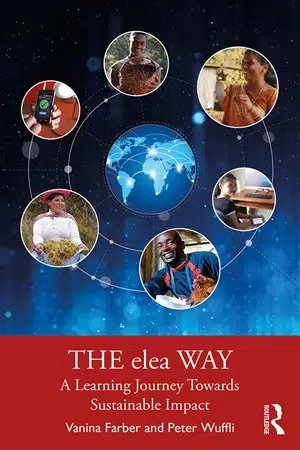
In 2020, Farber co-authored the book The elea Way: A Learning Journey towards Sustainable Impact, with Peter Wuffli, the Founder and Chairman of the elea Foundation for Ethics and Globalization. The book summarizes insights from the foundation’s 15-year journey and is aimed at entrepreneurs, investors, executives, philanthropists, policymakers, and anyone curious about entrepreneurship and inclusive capitalism. Using real-life examples, it includes suggestions on how to lead impact enterprises in such areas as developing strategies, plans, and models, building effective teams and organizations, managing resources, and handling crises.
Farber’s work involves collaboration with a range of financial institutions and corporate clients, and in 2022 launched IMD’s Driving Innovative Finance for Impact open program in partnership with the International Committee of the Red Cross, Lombard Odier, and the World Economic Forum. She also plays an active part in the Swiss Lab for Sustainable Finance and Gender Lens Initiative for Switzerland research networks and is an advisory board member at the Impact Finance Forum and an international academic advisory board member at the Católica Porto Business School in Portugal.
She also teaches courses on impact investing in IMD’s MBA and Executive MBA programs and leads the pioneering Discovery Expedition to Peru for EMBA participants, where they perform due diligence on Peruvian social enterprises for Swiss and local impact investors.
Farber was named Outstanding Case Writer in The Case Centre’s 2022 Awards for her study on pay-as-you-go technology company Angaza. She also won the EFMD Case Writing Competition 2022 in two categories: African Business for Angaza, and Responsible Leadership for Nia Impact Capital, and the responsible leadership category in the 2019 EFMD Case Writing Competition for her case on Philip Morris International’s vision of a smoke-free future.
Before joining IMD in 2018, Farber was Professor and Chair of Sustainable Entrepreneurship and Social Inclusion at Universidad del Pacífico, Peru. From January 2022 until 2025 she was appointed as the fifth Dean of the IMD EMBA program.