The business case for social capital
Discover how bonding and bridging capital fuel change. Insights from Raising Social Capital show why trust is your company's hidden engine...
July 14, 2026 • by Mark Greeven in The Interview
How COFCO International rebuilt trust across cultural fault lines under Chi Jingtao (Johnny) with alignment, values, and visible leadership....
COFCO International’s integration into a global agricultural trader was shaped by three leadership principles:
By 2014, China was importing close to 100 million tons of grain annually, with soybeans alone accounting for the bulk. As Chinese living standards rose, demand had shifted decisively from rice, flour, and oil toward meat, eggs, and dairy. Behind every kilogram of protein sat demand for feed grain that China’s domestic supply couldn’t fill. Food security had become structurally dependent on global supply chains that China did not control.
What Johnny Chi navigated in the 2010s now looks like a dress rehearsal for the fault lines visible in 2026 – tariffs, supply-chain fragmentation, and the strategic weaponization of food security – all turning trust into a strategic currency.
COFCO, China’s state-owned grain and food giant, had been a grain trader since its inception. But trading is not the same as controlling. To actually shape supply, China’s largest food company needed to be global in a different way. In 2014, it made two concurrent acquisitions: a 51% stake in Nidera, the century-old Dutch commodities trader headquartered in Rotterdam, and a 51% stake in Noble Agri, the agricultural arm of the Singapore-listed Noble Group, operating out of Geneva. Together, they created COFCO International.
The logic was straightforward. Acquiring established traders meant inheriting teams, market access, and origination infrastructure. While faster than building from scratch, owning assets is not the same as running them.
With all the senior management of our two companies in the same place, we embarked upon our strategic journey.
Chi formally took over COFCO International in January 2017, arriving in Geneva with explicit mandates to control risk, complete the integration of the two acquisitions, and return the business to profitability. At the time, the company was still losing money, the integration of the two entities was incomplete, and the people he was supposed to lead were openly skeptical of him.
Chi’s first move was to acknowledge the trust gap. He walked into a town hall at Noble Agri’s Geneva offices and sensed the doubt in the room. “I could feel that not everyone trusted me. They were probably questioning whether a Chinese person could lead the company to become a world-class grain merchant,” he shared.
The unspoken question was whether a Chinese executive could actually run a Western trading company operating across five continents. The risk was not just underperformance, but misalignment. Lean too heavily toward Chinese management practices and risk losing international talent; defer too much and risk losing direction.
He chose to slow down and re-clarify direction. In April 2017, he called the combined senior leadership of COFCO Agri and Nidera, consisting of over 50 Chinese and international executives, to Rotterdam for a strategy workshop. The goal wasn’t team building in the conventional sense. It was to make the company’s direction something that had been collectively produced rather than handed down.
As he recalls, “With all the senior management of our two companies in the same place, we embarked upon our strategic journey. Through that team training, we discussed and formed COFCO International’s new mission, strategy, and vision, including our values.”
The positioning that emerged – anchored in China’s domestic market strength while building genuinely global trading capability – was one that both sides had shaped, and therefore both sides owned. For Chi, the process was also a way of testing alignment. “Team learning helps us unify our thinking and reach a consensus.” Without consensus, execution would fragment. If the strategic direction is wrong or unclear, the more effort you put in, the further you stray from the goal. In a cross-cultural business, alignment has to be built, not announced.
Around the same time, an international HR executive, who was learning Mandarin, encountered the character 合 (hé). When he brought it to the team, asking what it meant, Chi immediately recognized the structure of the character as organizationally useful. 合 is composed of three elements: 人 (person) on top, 一 (the number one, or unity) in the middle, and 口 (mouth, meaning both the food business and word‑of‑mouth) at the base.
Chi seized on this as a management framework. For him, the logic was practical. In a company with the size and geographical reach of COFCO International, direct oversight has limits. Culture was a way to ensure decisions could be made consistently even when leadership was not physically present. It was the mechanism that allowed the organization to function without constant top-down intervention.
Person on top means the company is people-centered. Unity in the middle encodes the integration principle: “one team, one voice, one COFCO, one dream.” The mouth at the base connects the work to its purpose – food, and the stories that travel through an organization when culture is genuinely functioning. Coined ‘Sunshine Culture,’ 合 became the foundation for a comprehensive cultural integration program rolled out across 36 countries where COFCO operated.

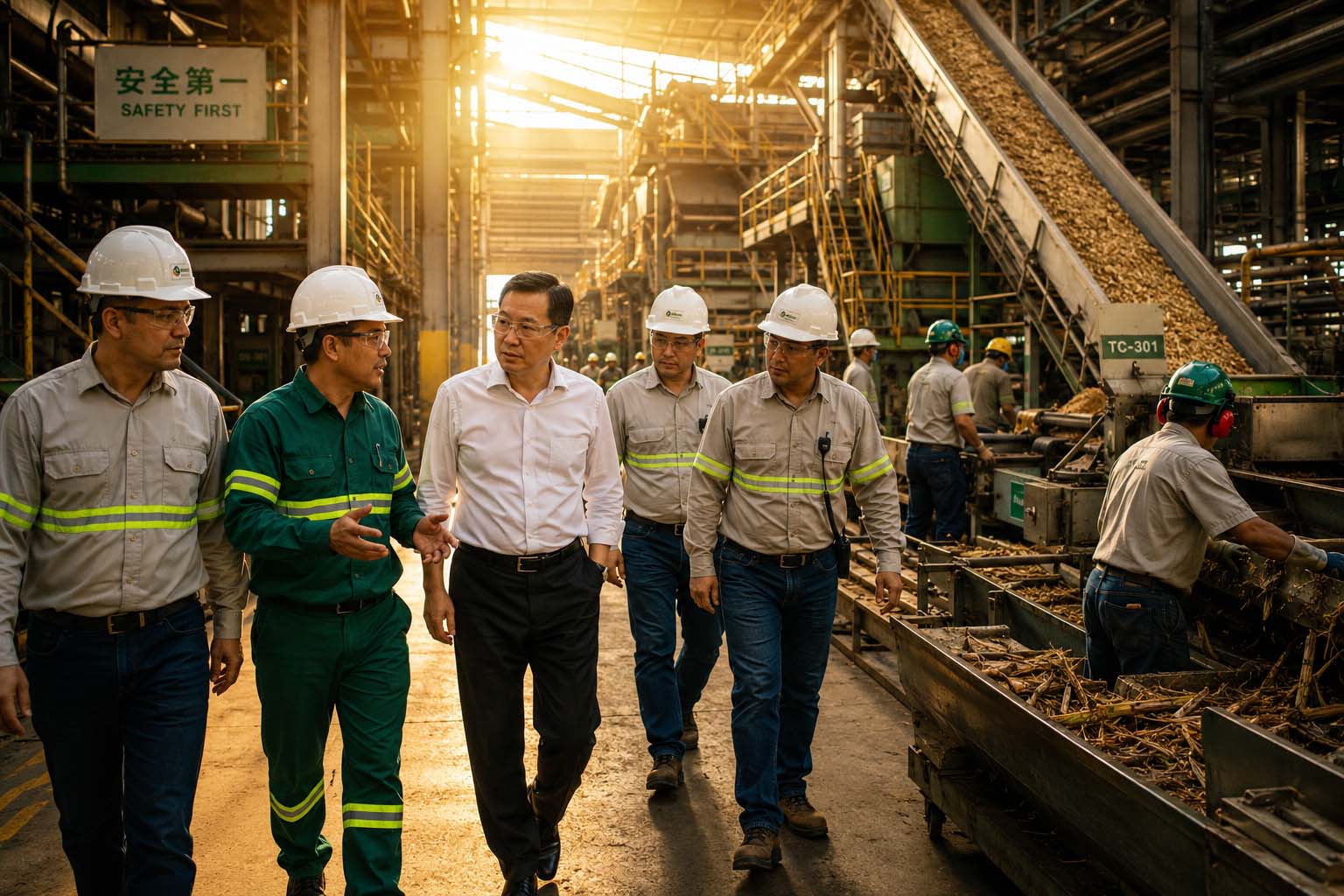
However, none of this would have landed without Chi’s approach to proximity. He was explicit about the trust gap and how he intended to close it by showing up. This was also a practical response to constraint. With language limitations and a geographically dispersed organization, visibility and repetition became substitutes for control.
On International Labor Day 2017, shortly after Chi took over COFCO International, he spent the holiday visiting all four of COFCO International’s Brazilian sugar mills, including the cane fields, processing facilities, and the operational stretches between them.
The visits signaled a CEO present in the business and not just reporting on it. Stories like this travel through large organizations faster and further than any internal communication could. Chi’s own explanation was straightforward: “Going onto the front lines of the business and pitching in on the work with our employees helps me to truly understand what problems they are facing, and help them solve these problems. This reduces the distance between us.”
Back in Geneva, he introduced practices imported from Chinese management culture that the company had never used: quarterly operational review meetings with all senior leaders present, investment committees, risk committees, and performance frameworks tied to individual accountability. The instinct in a Western trading firm, he found, was to manage through small rooms and informal conversations. Chi opened the rooms.
He also introduced WeChat groups for real‑time communication across time zones, navigating his own language limitations through a trusted assistant. “Although I’m limited by language, with the help of my assistant, and through WeChat groups and various regular meetings, I’m able to communicate with everyone without barriers, anytime, anywhere,” he explains. The system worked because it was consistent. That consistency, in an environment full of geopolitical volatility and cultural distrust, becomes credibility over time.
By 2018, COFCO International had turned profitable. The shift came from cumulative consistency – in governance routines, shared direction, and repeated execution gradually closing the initial trust gap.
Today, COFCO International operates across 36 countries with more than 12,000 employees and reported $38.5bn in revenue in 2024. Roughly 30-40% of its grain sourcing flows to China, while the rest serves global markets. That balance is the architecture Chi built: anchored enough in its Chinese mandate to have purpose, global enough in its operations to be credible across markets beyond it.
Cultural integration becomes a management architecture when people can explain how it shapes the way they make decisions.

Develop key leadership capabilities and accelerate your impact as a leader
As geopolitical tensions continue to reshape global trade, Chi’s experience reads less like a singular corporate turnaround, and more like a playbook for multinational firms whose home‑country identity is always visible and scrutinized.
The Rotterdam sessions were a deliberate transfer of ownership. When executives across 14 countries are operating under strategic direction they helped produce, the friction of cultural difference is reduced. Back in their roles, they are not following the CEO’s vision – they are executing their own. This is the way to build trust without relying on authority alone.
合 worked because it encoded a legible theory of how the organization was supposed to function – people first, unified direction, shared purpose. Cultural integration becomes a management architecture when people can explain how it shapes the way they make decisions and run the business. Without this, alignment would require constant intervention.
Presence carries disproportionate weight in volatile environments. The quarterly reviews and in-person visits travel farther than the annual strategy document or the internal memo. Showing up is not just relationship management – it is the mechanism that accumulates trust in environments where it might not arrive automatically.
In 2026, when CEOs are asked to manage global operations under thicker geopolitical fog and diminishing trust, these three principles offer a clear, practice-based template: build strategy together, treat culture as infrastructure, and let presence do the work of earning trust.

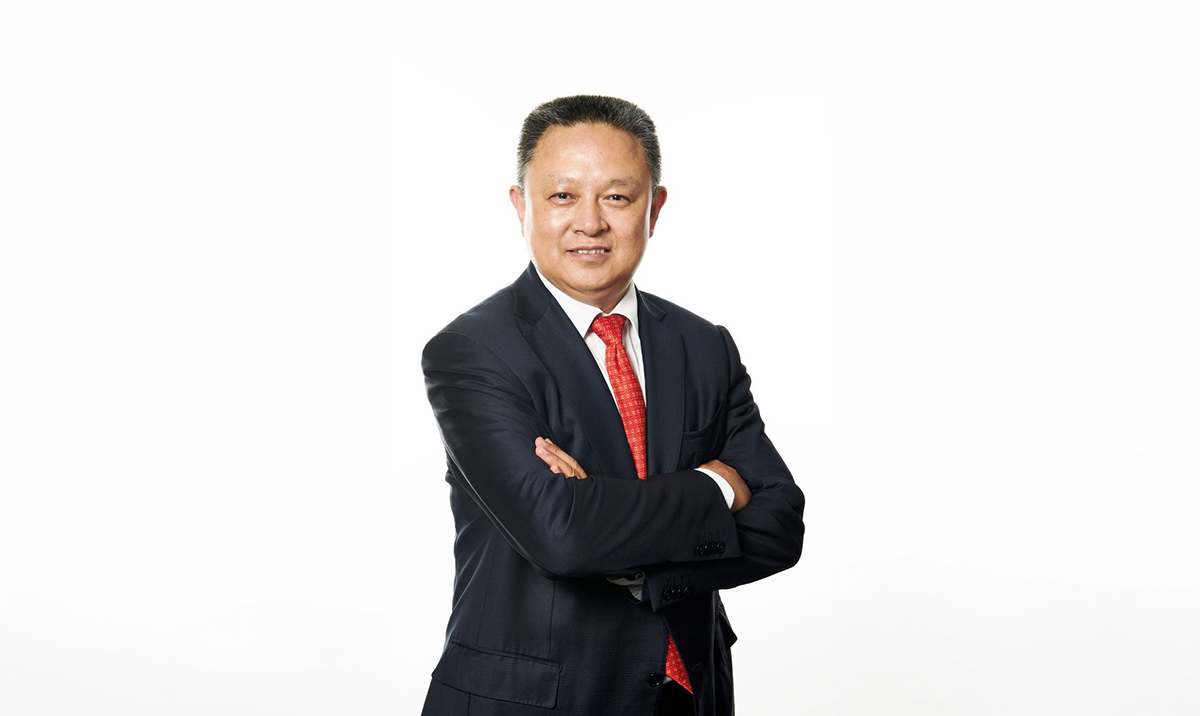
Former Chairman of COFCO International
Chi Jingtao is the former Chairman of COFCO International. He was appointed in October 2018. He was previously CEO of COFCO International and Executive Vice-President of COFCO Corporation.

Professor of Management Innovation
Mark Greeven is Professor of Management Innovation at IMD, where he co-directs the Building Digital Ecosystems program and the Strategy for Future Readiness program, and the Future-Ready Enterprise program, which is jointly offered with MIT. Drawing on two decades of experience in research, teaching, and consulting in China, he explores how to organize innovation in a turbulent world. Greeven is a founding member of the Business Ecosystem Alliance. He is ranked on the Thinkers50 list of global management thinkers (2025, 2023).
June 16, 2026 • by Sophie Bacq in Videos • 5 min read
Discover how bonding and bridging capital fuel change. Insights from Raising Social Capital show why trust is your company's hidden engine...
May 28, 2026 • by Karl Schmedders in Videos • 4 min read
A new book challenges the conventional belief that sustainability alone drives customer purchases. In a webinar hosted by Karl Schmedders, the book’s co-author, Goutam Challagalla, explains how companies can make sustainability...
May 12, 2026 • by Jean-François Manzoni in Videos • 6 min read
Niels B. Christiansen tells Jean-François Manzoni how he streamlined the leadership and targeted adult customers to re-energize the toy giant. ...
April 28, 2026 • by Murat Tarakci in Videos • 4 min read
Terence Mauri says leaders can turn disruption from a source of risk into a source of opportunity ...
April 21, 2026 • by Marleen Dieleman in Videos • 8 min read
Chef Pam transformed a 120-year-old family business into a Michelin-starred restaurant, showing how heritage can fuel innovation and competitive edge...
March 23, 2026 • by Winter Nie in Videos • 7 min read
The greatest barrier to women’s advancement emerges early in a career, not at the top. Kweilin Ellingrud examines how the first promotion to manager shapes long-term progression....
March 11, 2026 • by Heather Cairns-Lee in Videos • 9 min read
AI may become one of the most significant leadership opportunities for women in decades. Its impact will depend on how capability, governance, and leadership are built around it....
March 10, 2026 • by Jean-François Manzoni in Videos • 10 min read
Slawomir Krupa, CEO of Societe Generale, tells Jean-François Manzoni how restoring financial discipline and protecting the bank’s capacity to innovate under pressure helped restore faith in one of Europe’s oldest institutions...
March 9, 2026 • by Peter Vogel, Etienne Eichenberger in Videos • 6 min read
The four things successful families do to navigate the uncertainties of the modern world. ...
March 2, 2026 • by Knut Haanaes, Luc de Brabandere in Videos • 7 min read
IMD’s Professor Knut Haanaes was joined by friend and former Boston Consulting Group colleague, Luc de Brabandere, corporate philosopher and senior advisor at BCG, to discuss his book ‘The Art of Thinking...
Explore first person business intelligence from top minds curated for a global executive audience