Share
Facebook Facebook icon Twitter Twitter icon LinkedIn LinkedIn icon Email
What-geopolitical-maturity-looks-like--2

Geopolitics

What geopolitical maturity looks like – and why it pays off

Published January 12, 2026 in Geopolitics • 9 min read

In turbulent times, companies can justify their investments in geopolitical assets by moving beyond risk mitigation and using foresight to gain competitive advantage and create value.

Corporate leadership faces relentless demands – digital transformation, sustainability transitions, talent wars, activist investors. Now, geopolitics is muscling into an overcrowded agenda. This poses a hard question: With senior executives stretched thin, how do geopolitical teams demonstrate enough strategic value to justify their budgets?

The answer emerges from firms that turned geopolitical disruption into commercial opportunities. Take one logistics operator that captured business when competitors retreated from volatile markets. EU sanctions on Belarusian potash in 2021 and tariffs on Belarusian and Russian fertilizers in 2025 disrupted supply chains but also opened market opportunities for Western European producers who anticipated the shift. “Clients trust us because we’ve proved we can operate even in hostile environments,” explained an executive we interviewed.

The firms that justify geopolitical investment aren’t those with the biggest teams; they’re the ones that turn foresight into advantage, a more favorable market position, and new customers.

This article draws on Building Geopolitical Muscle: How Companies Turn Insights into Strategic Advantage, a white paper issued by the World Economic Forum in collaboration with IMD Business School and Boston Consulting Group. That report examines how leading companies institutionalize geopolitics within their organizations and build the capability to sense, plan, and act amid uncertainty. Based on more than 55 executive interviews across industries and geographies, it is the third in a series, following papers on how executives understood unfolding geopolitical dynamics and on enhancing geopolitical radar.

Less than approximately 60 companies we interviewed have dedicated geopolitical functions, with the majority relying on ad hoc responses.

The maturity gap and its cost

When it comes to geopolitics, most firms remain stuck building “awareness,” where many have opinions, but few have the capabilities that drive decisions. Less than approximately 60 companies we interviewed have dedicated geopolitical functions, with the majority relying on ad hoc responses.

The cost shows up in financials. One automotive company disclosed that, despite preparation, tariffs would cut around $4bn from its bottom line, with only around 35% of that mitigable. In another case, an opportunity was missed when a country manager Firms with geopolitical awareness but a lack of capability ask, “What happened?” while competitors ask, “How do we capitalize?”

Firms cannot create commercial opportunities if they don’t spot triggers for market shifts. For example, one company used geopolitical insights to calibrate its commercial pitch for a Southeast Asian tender and secured part of a split-order contract. The journey begins with structured radar (external scanning) and sonar (internal contextualization), moving beyond headlines to systematic sensing, synthesis, and scaling of what’s at stake.

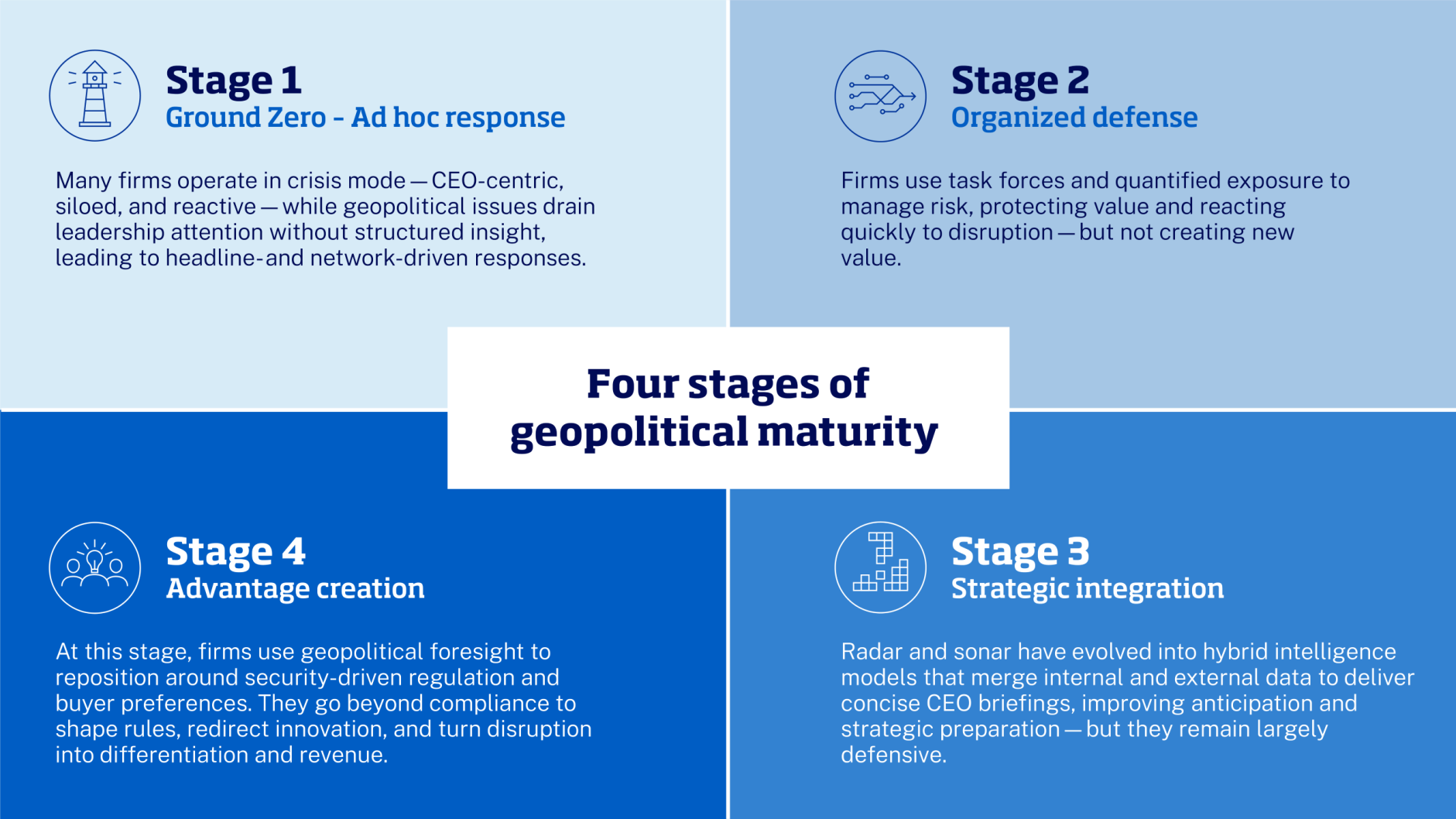
Looking across the companies interviewed, the path to maturity runs from reactive crisis management to value creation in four stages:

Geopoltical Maturity

Stage 1: Ground zero – ad hoc response

Firms operate in crisis mode – they are CEO and board-dependent, siloed, and typically fighting the last war. Geopolitical developments consume leadership bandwidth without creating value and lack structured radar and sonar. Responses are shaped too much by headlines and personal networks.

Stage 2: Organized defense

Firms build systematic risk management through task forces and by quantifying exposure. Firms at this stage of maturity seek to protect value but don’t create it. They can act fast when disruption hits, but remain reactive.

In practice: When tariff risks emerged in 2025, Teva Pharmaceutical’s Command Centre (created in April 2025, convening 30 to 50 professionals) identified as vulnerable a critical oncology drug manufactured in India. They built up US inventories ahead of potential duties, ensuring supply continuity for cancer patients.

Nissan structures risk through a three-tier framework: below ¥10bn (around $64m), below ¥100bn, or above ¥100bn ($640m) in operating profit impact. Its tariff task force of 30 to 40 members meets twice monthly, with direct reporting to the CEO and CFO.

Siemens established its dedicated geopolitics function in 2020.

Stage 3: Strategic integration

Radar and sonar have matured into hybrid intelligence models, combining internal data with external sources and delivering concise CEO briefings through established information flows. These firms better anticipate and prepare, shaping strategy accordingly. However, they remain primarily defensive.

In practice: Allianz ran a one-year scenario-planning process ahead of the 2024 US election. Working across functions, including economic research and risk management, the team ensured strategic responses were aligned, proactive, and board-ready. The company’s Political Stability Grid tracks risk across 25-plus markets and is delivered at least twice yearly.

Siemens established its dedicated geopolitics function in 2020. The team created proprietary methodologies: Geopolitical Trends and Scenarios, GA Intelligence Tool, and Value at Stake to quantify financial impact across market access, revenue, profit, technology exposure, and country attractiveness. Geopolitical insights are embedded directly in enterprise risk management, strategy planning, and investor calls. “Internal demand consistently grows. Today, we get requests from board level to businesses’ product line,” reports the company’s Global Head of Geopolitics and International Relations.

Sovereignty concerns, supply chain transparency, and national champion preferences shape buyer preferences and influence the revision of value propositions.

Stage 4: Advantage creation

At this critical stage, firms recognize that geopolitical foresight reveals where and how consumer behavior and regulatory compliance are being shaped by state security imperatives and seek to reposition themselves accordingly. Sovereignty concerns, supply chain transparency, and national champion preferences shape buyer preferences and influence the revision of value propositions.

Stage 4 firms do more than just comply with regulations; they help shape the regulatory environment and rethink innovation trajectories, turning disruption into differentiation and foresight into revenue, capturing first-mover advantages through regulatory influence and market positioning.

In practice: One healthcare company used geopolitical analysis of the US “most-favored nation” drug pricing proposals to anticipate that entering certain markets would set floor prices too low to replicate globally. Based on this insight, it fundamentally revised the product launch strategy and market sequencing.

A critical infrastructure company maintains regular dialogue with at least 10 governments on infrastructure resilience regulation, contributing to inform standards while positioning commercially.

EDF’s network-based model, led by a former diplomat as trusted adviser to the CEO, supports business units in business-to-government interactions and bidding while engaging French and EU institutions to shape the regulatory environment. This proved critical during recent mergers and acquisitions. The team was involved from the outset, navigating political complexities, aligning with state actors, and securing deals after months of negotiations.

LATC shifted from firefighting to developing its own “house view” on geopolitical developments. The company added a chief trade officer role to the chief strategy officer’s responsibilities, enabling it to shape conversations with regulators and trade bodies, creating differentiation.
Your board mandate should explicitly identify geopolitical opportunities alongside risk management, and track both. 

The three non-negotiables for advancing your maturity

Three practices support the investment case in geopolitical capabilities regardless of your starting point.

1 – Mandate must demonstrate value creation, not just risk avoidance

It can become hard to justify your budget when you purely focus on risk, especially since it’s hard to prove value when disasters don’t occur, and, in the worst cases, you can lose credibility. “Our legacy approach was reactive; built to defend, not to anticipate,” one global investor executive reflected.

The shift: Frame geopolitical muscle as enabling market opportunities that others miss, regulatory engagement that shapes outcomes, and strategic positioning before competitors recognize the opening. Your board mandate should explicitly identify geopolitical opportunities alongside risk management, and track both. 

US ATariffs
When US tariffs struck, pre-existing scenario planning enabled immediate task force mobilization

2 – Putting numbers on geopolitics is the price of admission to the C-suite conversation

Leadership bandwidth is precious, and it can be hard to gain attention and compete with other priorities if you lack hard data.

Rio Tinto shifted from generalist political advisers to a business-integrated model. “We had good conversations,” their Head of Group Government Relations and Civil Society recalls. “But it was not always in a language that the business could act on.” Now, cross-functional task forces, typically comprising around 10 people, quantify risk in business terms – volumes, cost, and margin impact. “The business absolutely quantifies the risk, and we aggregate that view for the board.”

When US tariffs struck, pre-existing scenario planning enabled immediate task force mobilization. “We didn’t panic. We zoomed in on which businesses were affected and proceeded to manage the risks.”

Siemens’ Value at Stake methodology quantifies financial impact across market access, revenue, profit, technology exposure, and country attractiveness.

The shift: Convert geopolitical developments into metrics that compete for the same airtime as other strategic priorities. Even imperfect quantification beats narrative-only assessment.

Pair external expertise with internal business veterans from day one.

Talent must translate, not just inform

Airbus initially considered former ambassadors and generals for their credibility and reputation, but integration challenges led to an internal hire with deep business knowledge and an external network. “It’s a different vocabulary. Ministers and heads of state do not speak the same language as procurement teams,” the company’s Head of International Business Growth explains.

The recipe for success? Business-fluent leadership supported by specialist translators. The company engages sanctions lawyers, trade negotiators, and regional security analysts. Siemens’ multidisciplinary team evolved from geographic to thematic expertise, encompassing geopolitics, geoeconomics, global trade, investment, technology, and conflicts.

The shift: Pair external expertise with internal business veterans from day one.

The economic security bridge

Governments increasingly frame geopolitics through the lens of economic security. They seek to protect national stability and growth against external and internal threats, safeguarding key assets, maintaining critical infrastructure, and ensuring access to energy, food, and technology.

Understanding economic security framing helps anticipate both regulatory direction and possible shifts in voter and customer sentiment. After all, government actions don’t happen randomly; they often respond to the fears and aspirations of influential voter and societal groups. Let’s be frank: for better or for worse, many opinion leaders blamed the shortages of 2020 on cross-border supply chains – and local sourcing and production pressures grew. Philips’ geopolitical setup emerged during the COVID-19 pandemic when health tech became strategically sensitive. Their Trade Policy and Geopolitics Committee coordinates across procurement, trade compliance, tax, legal, government affairs, and supply-chain strategy.

Public-private learning flows both ways. Governments may need your value-chain perspective. You gain early signals of regulatory direction. For Stage 4 firms, this isn’t just stakeholder management; it’s about linking corporate and public sector intelligence systems.

Geopolitical rivalry isn’t going away.

Geopolitics must earn its place on the agenda

Both of these realities matter: executives must accept that geopolitics now claims leadership bandwidth, and geopolitical teams must pass the test of demonstrated value creation.

It’s best to begin with one discipline based on your stage. If current practice is essentially ad hoc, establish a quantification methodology that speaks your leadership’s language. If organized defensively, try adding the capabilities to develop scenarios that identify opportunity, not just risk. If you’ve achieved strategic integration of geopolitical drivers, identify one market or regulatory shift ahead of your competitors and position accordingly.

Firms that build these capabilities now will accumulate advantages, not just in resilience but also in market position, regulatory and policymaker influence, and value capture. Geopolitical rivalry isn’t going away. The question isn’t whether these capabilities deserve a place on the leadership agenda; it’s whether your geopolitical team can prove they’ve earned it by turning foresight into performance.

Authors

Simon Evenett

Simon J. Evenett

Professor of Geopolitics and Strategy at IMD

Simon J. Evenett is Professor of Geopolitics and Strategy at IMD and a leading expert on trade, investment, and global business dynamics. With nearly 30 years of experience, he has advised executives and guided students in navigating significant shifts in the global economy. In 2023, he was appointed Co-Chair of the World Economic Forum’s Global Future Council on Trade and Investment.

Evenett founded the St Gallen Endowment for Prosperity Through Trade, which oversees key initiatives like the Global Trade Alert and Digital Policy Alert. His research focuses on trade policy, geopolitical rivalry, and industrial policy, with over 250 publications. He has held academic positions at the University of St. Gallen, Oxford University, and Johns Hopkins University.

Related

Learn Brain Circuits

Join us for daily exercises focusing on issues from team building to developing an actionable sustainability plan to personal development. Go on - they only take five minutes.
 
Read more 

Explore Leadership

What makes a great leader? Do you need charisma? How do you inspire your team? Our experts offer actionable insights through first-person narratives, behind-the-scenes interviews and The Help Desk.
 
Read more

Join Membership

Log in here to join in the conversation with the I by IMD community. Your subscription grants you access to the quarterly magazine plus daily articles, videos, podcasts and learning exercises.
 
Sign up
X

Log in or register to enjoy the full experience

Explore first person business intelligence from top minds curated for a global executive audience