“Geopolitics isn’t just for diplomats. It needs to be a top priority for business leaders.”
Shaping business strategy
Trade tensions, ongoing wars, and weakening economies aren’t just headlines anymore. They’re shaping business strategies every day.
Trade disputes and tech rivalries are now the norm. But here’s the challenge. Leadership focus can shift, so teams dedicated to geopolitics need to prove their value. How?
-
- First, by moving beyond risk avoidance. External validation matters – that can be positive signals from capital markets or investor confidence. Building strong partnerships and engaging with governments can help build trust and influence.
- Second, it’s about showing real business impact. That means anticipating changes in buyer preferences and regulations, turning security concerns into competitive advantages, and providing insights that help navigate government policies.
Geopoltical readiness is a core strength
Companies that treat geopolitical readiness as a core strength will not only manage risks – they’ll unlock new opportunities and drive long-term growth.
Read more on how your organization can mitigate risk and drive impact by accessing the full report.
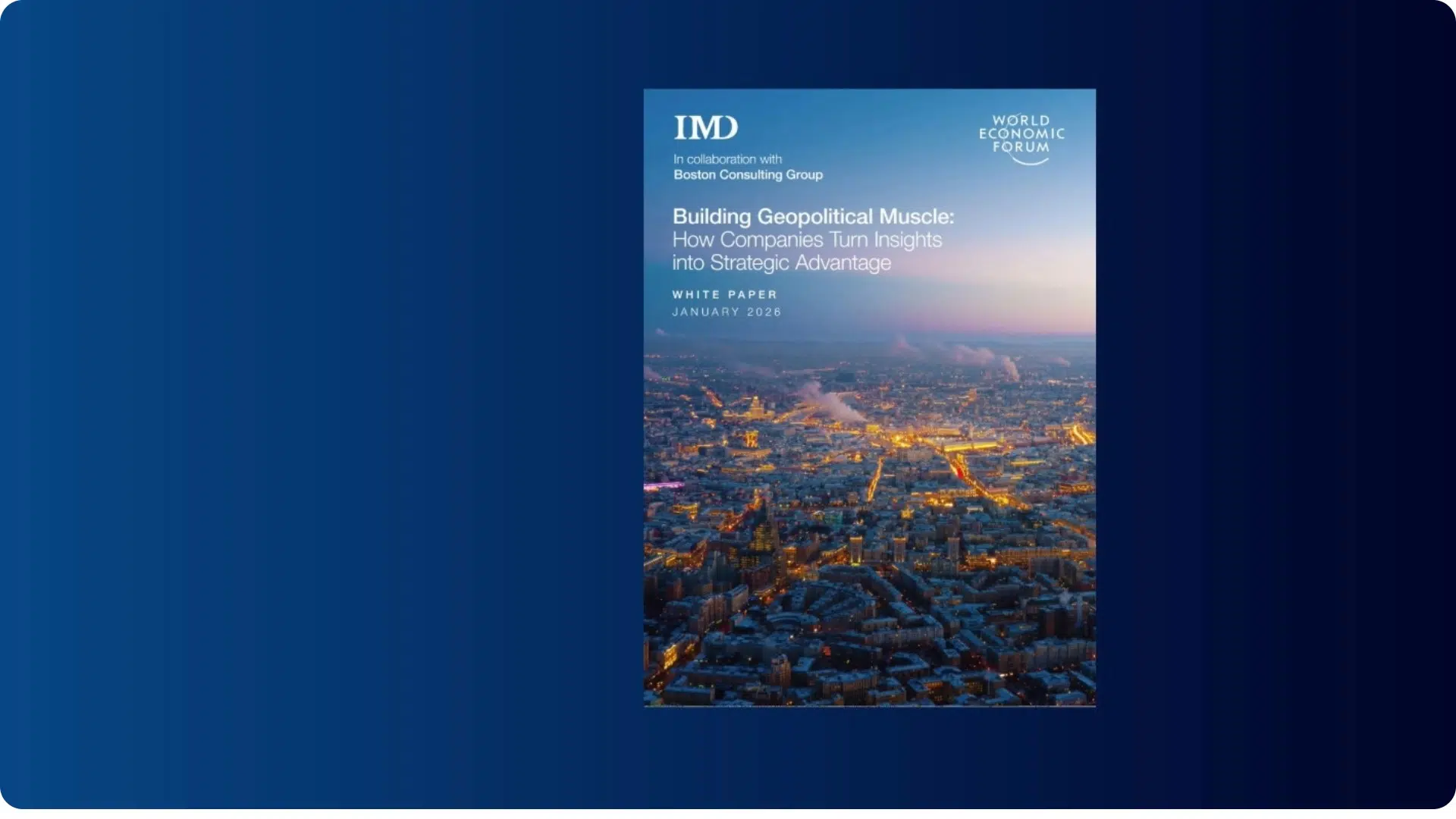
This white paper, Building Geopolitical Muscle, is the third edition in a series developed by the World Economic Forum in collaboration with IMD Business School and Boston Consulting Group. The first paper examined the costs of deglobalization; the second explored how firms strengthened their geopolitical radar.
Lead authors
- Thomas Bedouet – Consultant, Boston Consulting Group; Project Fellow, World Economic Forum
- Simon J. Evenett – Professor of Geopolitics and Strategy, IMD Business School; Co-Chair, Global Future Council on Trade and Investment
- Nikolaus Lang – Global Leader, BCG Henderson Institute; Chair, BCG Center for Geopolitics; Managing Director and Senior Partner, Boston Consulting Group
- Cristián Rodríguez Chiffelle – Partner and Director, Trade, Investment and Geopolitics, Boston Consulting Group








Research Information & Knowledge Hub for additional information on IMD publications
Research Information & Knowledge Hub for additional information on IMD publications
Research Information & Knowledge Hub for additional information on IMD publications
Research Information & Knowledge Hub for additional information on IMD publications
Research Information & Knowledge Hub for additional information on IMD publications
Research Information & Knowledge Hub for additional information on IMD publications
Research Information & Knowledge Hub for additional information on IMD publications
Research Information & Knowledge Hub for additional information on IMD publications
Research Information & Knowledge Hub for additional information on IMD publications
Research Information & Knowledge Hub for additional information on IMD publications