What your geopolitical briefings are missing
A new generation of scenario-monitoring tools such as the Iran Conflict Scenario Monitor can bring structure, transparency, and continuous updating to expert assessments. ...

by Simon J. Evenett, Oliver Jones Published December 3, 2025 in Geopolitics • 8 min read
Today’s geopolitical landscape presents three distinctive challenges that fundamentally alter how businesses must operate: unprecedented speed of change, broad geographical impact, and extensive sectoral reach. Tariffs can now be imposed with hours’ notice; nearly every country and trading bloc can generate instability, and virtually every industry faces geopolitical pressures – not just traditionally exposed sectors like energy and logistics.
Despite continual news coverage and examples of disruption occurring across sectors and geographies, many organizations remain perilously unprepared for geopolitical upheaval. One-third of global executives were surprised by most or all political risks that impacted their companies in the past 24 months. More telling still, barely half perform geopolitical risk assessments during critical transaction evaluations – a glaring oversight in an era where geopolitical factors can make or break strategic investments overnight.
This reality demands a fundamental shift in how business leaders approach geopolitical dynamics. The question is no longer whether your organization will face geopolitical disruption, but whether you’ll be prepared to transform that disruption into strategic advantage through systematic preparation and internal realignment.
Meanwhile, shifting geopolitical rivalries reshape alliance structures and trade relationships, demanding recalibration of global strategies and supply chains.
Three fundamental trends are reshaping the current geopolitical landscape and demand particular attention from business leaders. Populism’s growing influence on government policies creates unpredictable policy shifts that can rapidly alter business environments, often with little warning or consultation with affected industries. Rising economic sovereignty concerns drive nations to prioritize domestic interests over traditional free-trade principles, creating new barriers to cross-border commerce while simultaneously opening opportunities for locally based firms. Meanwhile, shifting geopolitical rivalries reshape alliance structures and trade relationships, demanding recalibration of global strategies and supply chains.
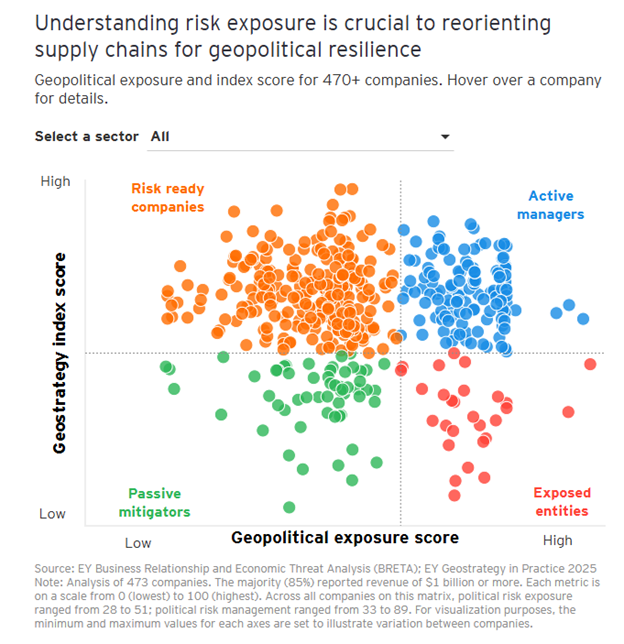
Organizations should realistically calibrate their geopolitical risk exposure against their management capabilities, assessing themselves as either ‘risk-ready enterprises’, ‘active managers’, ‘passive mitigators’, or ‘exposed entities’. Only the last category represents true vulnerability – the others can navigate turbulence through alternate strategic responses. Companies that understand their position on this spectrum can make informed decisions about where to invest in defensive capabilities versus where to pursue aggressive market opportunities.
The speed of contemporary geopolitical change means traditional annual planning cycles are insufficient. Business leaders must develop capabilities for continuous environmental scanning and rapid strategic pivoting that can respond to developments measured in days or weeks rather than quarters or years.
The Australian corporate response to Chinese economic sanctions in 2020 offers a useful blueprint for effective adaptation under extreme geopolitical pressure. When faced with very high tariffs following Australia’s call for an investigation into the origin of COVID-19, companies demonstrated remarkable tactical innovation rather than simply accepting defeat or retreating from international markets entirely.
Barley exporters to China successfully pivoted to Middle Eastern markets, discovering untapped demand and building new long-term partnerships that ultimately proved more lucrative than their original Chinese relationships. Timber producers converted whole timber products into chipped products, reducing exposure to tariffs through creative product transformation while maintaining revenue streams. Wine companies pursued sophisticated market-specific strategies, differentiating approaches for premium and commodity segments to maximize resilience across price points and consumer demographics.
These adaptations reveal several insights that transcend the specific Australia–China context. Companies can navigate sudden, sector-wide disruptions through searching re-examination of available options and constraints. The key lies in developing systematic capabilities to make rapid, informed responses rather than hoping to predict inherently unpredictable geopolitical events. Companies that had already invested in market diversification and operational flexibility were best positioned to capitalize on forced changes, turning disruption into competitive advantage.
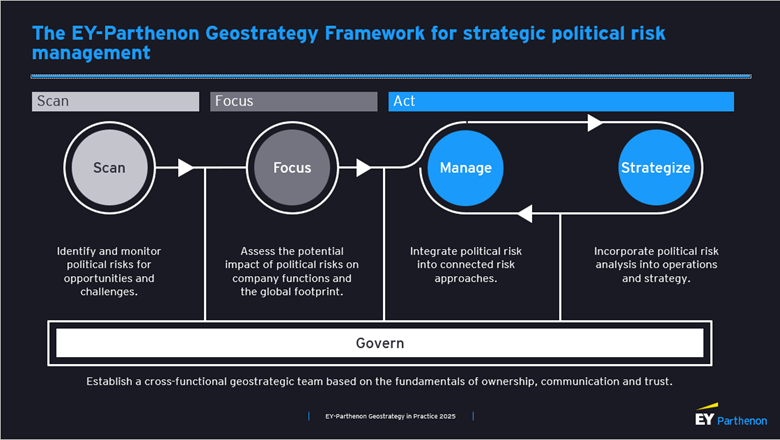
Developing systematic geopolitical capabilities may require a comprehensive framework encompassing five components: scan, focus, manage, strategize, and govern. Effective management begins with distinguishing meaningful signals from background noise amid constant global volatility, requiring sophisticated filtering mechanisms and analytical frameworks.
Forward-looking firms recognize that effective geopolitical intelligence demands both internal capabilities and external validation. While external experts can help fill knowledge gaps and interpret events within broader historical contexts, the vital task of assessing a company’s current and future exposure to geopolitical developments must be executed internally. Third parties simply cannot possess the requisite understanding of your specific business model, operational dependencies, and strategic priorities to properly execute exposure analyses that drive meaningful decision-making.
The most successful organizations develop what can be termed a “geopolitical radar” – sophisticated capabilities to identify, track, and assess commercially material policy dynamics across multiple time horizons and geographical regions. This involves multiple interconnected activities, with analytical tasks performed in-house to ensure proper understanding of business-specific implications and opportunities. Companies must invest in dedicated internal geopolitical intelligence teams or systematically embed such expertise across relevant business functions, ensuring these capabilities represent diverse cultural and geographic perspectives to avoid dangerous blind spots.
Institutional memory and knowledge retention mechanisms are essential in the geopolitical domain, as they are in other areas. Companies must establish systems to record insights from discussions, interviews, and analyses, making them available to successors and other relevant colleagues while protecting sensitive information. This reduces key person risk and builds cumulative organizational intelligence that strengthens over time.
In short, a leader who knows that they don’t know all the answers will run a thorough, inclusive, and focused political risk management process.
Executive leadership’s role in geopolitical risk management extends far beyond traditional risk assessment methodologies toward comprehensive strategic integration. Business leaders must focus on preparing organizations for extreme scenarios rather than attempting to predict specific outcomes, recognizing that scenario planning and organizational resilience provide more value than forecasting accuracy.
This represents a significant evolution from traditional optimization-based corporate thinking toward developing capabilities that ensure organizational survival and prosperity amid maximum downside risk. The shift requires leaders to embrace uncertainty as a strategic planning input rather than treating it as a temporary analytical limitation to be overcome through better data or more sophisticated modeling. In short, a leader who knows that they don’t know all the answers will run a thorough, inclusive, and focused political risk management process.
Quantifying geopolitical impact moves beyond qualitative risk assessment to rigorous financial modeling of scenario implications across all business functions. When executives can clearly see seven-, eight-, or nine-digit commercial opportunities or risks at stake, they gain a useful prompt to prioritize investments in defensive capabilities versus offensive market opportunities. This quantification enables informed resource allocation decisions and can justify necessary investments in geopolitical resilience to skeptical stakeholders.
Broadening and deepening cultural and geographic perspectives in analytical teams proves essential for avoiding regional blind spots when interpreting global developments and their potential business implications. Companies that systematically embed diverse viewpoints in their geopolitical analysis consistently outperform those relying on homogeneous perspectives, particularly when operating across multiple continents, cultures, and regulatory environments.
Understanding what motivates national security officials and other key policymakers enables more effective stakeholder engagement and better anticipation of policy directions.
Despite the oft-noted challenges, geopolitical volatility creates substantial opportunities for strategically prepared organizations willing to move decisively when competitors retreat or hesitate. Research indicates that 14% of companies report net positive effects from political risks that disrupted competitors, creating market openings for those ready to capitalize on temporary dislocations and long-term shifts in global trade patterns.
Capitalizing on geopolitical opportunities requires deliberate investment in organizational capabilities that function effectively amid constant change and uncertainty. This means building strategic flexibility through systematic diversification of markets, suppliers, and production bases – creating “option value” that enables rapid adaptation to changing geopolitical conditions while maintaining operational efficiency and competitive positioning.
The integration of geopolitical considerations into core business processes, rather than siloing them in specialized government affairs or traditional risk management functions, distinguishes market leaders from laggards in volatile environments. When geopolitical thinking becomes embedded in strategic planning, investment decisions, operational protocols, and regular management practices, organizations can respond swiftly and decisively to emerging opportunities while competitors remain paralyzed by uncertainty.
Understanding what motivates national security officials and other key policymakers enables more effective stakeholder engagement and better anticipation of policy directions. The growing availability of high-quality open-source intelligence resources, including specialized podcasts and analytical publications, helps executives develop a sophisticated understanding of officials’ worldviews, strategic priorities, and decision-making frameworks. This knowledge facilitates more productive interactions with government stakeholders and enables better anticipation of regulatory or policy changes that create competitive advantages for prepared organizations.

Professor of Geopolitics and Strategy at IMD
Simon J. Evenett is Professor of Geopolitics and Strategy at IMD and a leading expert on trade, investment, and global business dynamics. With nearly 30 years of experience, he has advised executives and guided students in navigating significant shifts in the global economy. In 2023, he was appointed Co-Chair of the World Economic Forum’s Global Future Council on Trade and Investment.
Evenett founded the St Gallen Endowment for Prosperity Through Trade, which oversees key initiatives like the Global Trade Alert and Digital Policy Alert. His research focuses on trade policy, geopolitical rivalry, and industrial policy, with over 250 publications. He has held academic positions at the University of St. Gallen, Oxford University, and Johns Hopkins University.

EY-Parthenon Global Client Insight and Research Leader and EY-Parthenon Global Geostrategic Business Group Leader
Oliver Jones has been a partner at EY-Parthenon for over 14 years. He was based in Sydney, Australia, from 2010 to 2018 and is now located in London, England. He currently holds three senior global leadership positions: EY-Parthenon Global Markets Leader for Strategy and Transactions, Sustainability Leader, and Head of the EY-Parthenon Geostrategic Business Group, the firm’s specialist global geopolitical advisory team.
Before beginning his consulting career, Jones served as a senior civil servant in the UK Government, working across four departments: the former Department of Trade and Industry, the Prime Minister’s Office, HM Treasury, and the Department for Transport.
He holds an MA in Geography from the University of Cambridge.
March 18, 2026 • by Simon J. Evenett, Johannes Fritz in Geopolitics
A new generation of scenario-monitoring tools such as the Iran Conflict Scenario Monitor can bring structure, transparency, and continuous updating to expert assessments. ...

February 11, 2026 • by Simon J. Evenett in Geopolitics
The great-power rivalry between China and the US is structural, not an aberration: zero-sum thinking, tech rivalry, and weaponized trade will outlast leaders and reshape business. ...
February 10, 2026 • by Winter Nie, Yunfei Feng in Geopolitics
China's economy shows contradictory signals – macro headwinds yet surging innovation investment and competitive intensity. To decode this evolving reality, here are the nine key trends global businesses must understand about operating...

February 2, 2026 • by David Bach, Huda Al Hashimi in Geopolitics
Countries building ecosystems where government vision, business innovation, and investor confidence reinforce each other to gain competitive advantage through strategic optimism. ...
Explore first person business intelligence from top minds curated for a global executive audience