Share
Facebook Facebook icon Twitter Twitter icon LinkedIn LinkedIn icon Email
Chinas-2026-playbook-2

Asian hub

China’s 2026 playbook: Redefining global tech, industry, and governance 

Published December 22, 2025 in Asian hub • 8 min read

As China enters its 15th Five-Year Plan, a sharper focus on innovation, resilience, and security signals a structural shift in how the country develops, competes, and engages globally.

China enters its 15th Five-Year Plan period in 2026. This next chapter has been framed as a bridge to the country’s ambitious 2035 modernization goals, and puts new weight on innovation, resilience, and security amid evolving geopolitical dynamics and domestic economic pressures. For global executives, it marks the beginning of a different way China will build technology, run its economy, and engage with the world.

Here are four shifts to watch.

1 – Tech sovereignty moves from rhetoric to system

Beijing isn’t just talking about tech self-reliance anymore; they’re making it real. The 15th Five-Year Plan puts New Quality Production Forces front and center, pushing for indigenous R&D, supply chain resilience, and advanced manufacturing. Future industries like AI, robotics, quantum, biomanufacturing, and 6G get targeted support aimed at getting them to commercial viability faster. This can already be seen in the way national centers and firms are scaling up humanoid robots and industrial AI systems for real-world deployment.

To operationalize this further, China is tightening its regional model. Where previous years saw more decentralized experimentation, the Plan now signals a shift toward a centralized approach. In practice, regions still specialize based on their strengths, but with stronger alignment with national priorities. Cities and clusters compete for pilot status, funding, and regulatory flexibility, which helps to drive differentiated innovation. Shanghai integrates multinationals into its robotics, biotech, and AI push, embedding them as local R&D and supply chain partners. The Greater Bay Area, with Shenzhen at its core, leans into EVs, AI, and hardware at full speed, driven by dense supplier networks. Chengdu, Chongqing, and other cities are positioned as specialized hubs to build out advanced manufacturing and services. The outcome is a centralized, yet distributed, competitive landscape.

Executive implication: Winning in China depends on building partnerships across these hubs and ecosystems. Don’t bet everything on one region or a single partner. Map out your dependencies, build in backup plans, and spread your risk.

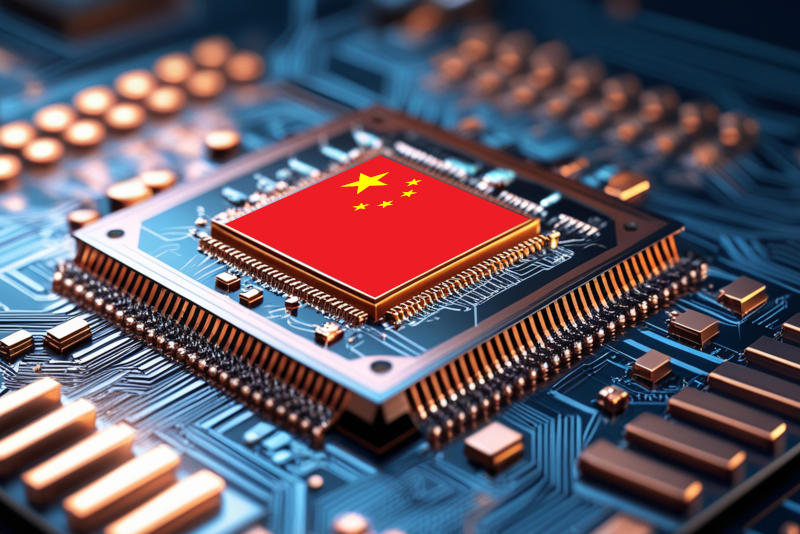
Chinese chips Chinese artificial intelligence China AI Computer motherboard computer chip Technology
Where Chinese AI systems, platforms, or infrastructure spread, Chinese technical rules follow, increasingly shaping what “safe AI” looks like in practice

2 – AI goes vertical while standards go global

Headlines about AI often focus on who has the biggest models or the fastest chips. But China is playing the game differently. Chinese companies are building AI that goes deep into specific industries, such as e-commerce, travel, logistics, and healthcare. These models are trained on proprietary operational data, structured domain knowledge, and real-world feedback loops, making them more accurate and compliant for enterprise use.

The aim with these models is less about the wow factor, but reliable tools that fit tightly into business workflows and regulations, and which are immediately deployable. Merchants on Alibaba.com use AI Mode to automatically generate product descriptions, ad copy, and multilingual listings for cross-border orders. In logistics, SF Express uses AI to plan routes and loads, cutting last-mile costs and increasing delivery efficiency. In healthcare, China’s new national AI healthcare strategy is rolling out AI-assisted diagnosis across hospitals, with tools tuned to disease patterns and regulatory rules. Many of these capabilities are now exported by being bundled into Chinese platforms and services moving into Southeast Asia and other regions, which allows Chinese ecosystem players to compete abroad not just on cheaper hardware, but on deeply embedded, domain-specific AI.

At the same time, China is also tightening governance. The AI Safety Governance Framework 2.0, adopted in September this year, takes a full lifecycle approach to risk, from model design to deployment. The framework explicitly calls out issues like misuse in sensitive domains and open-source model risks. It also embeds principles such as human control, transparency, sovereignty, and proactive risk response into technical requirements for developers and deployers.

What this creates is a template for future national standards and sector-specific rules. Chinese standards bodies are already mapping follow-on standards to the framework’s risk taxonomy and inviting industry to help draft implementation rules. Where Chinese AI systems, platforms, or infrastructure spread, Chinese technical rules follow, increasingly shaping what “safe AI” looks like in practice.

Executive implication: You cannot treat AI as a single global ecosystem. Western AI leads on frontier research while Chinese AI leads on real-world deployment at scale. The strategic question is how to integrate both without creating internal fragmentation in technology stacks, compliance, and talent.

global with data of biohardzard coronavirus crisis outbreak in wuhan china network futuristic 3d illustration flag background
“Beijing sent a clear signal that China is ready to operate as a major trading power under tighter scrutiny. ”

3 – Managed competition and bounded rivalry

Managed competition is a useful way to think about 2026. The Trump–Xi meeting at October’s APEC 2025 made one thing clear – the rivalry between the US and China isn’t going anywhere, but both sides are sticking to certain guardrails such as rolling back some tariffs, hitting pause on new export controls, and reopening military hotlines. Both countries have learned how to push hard against each other without tipping into open conflict or systemic collapse. Technology, investment screening, supply chains, and industry capacity are still the main battlegrounds, while allowing space for tactical deals on specific issues.

China’s decision to forgo “special and differentiated treatment” in future WTO negotiations fits this pattern. By renouncing fresh privileges reserved for developing economies, Beijing sent a clear signal that China is ready to operate as a major trading power under tighter scrutiny. China continues to keep its status as a developing member and has indicated that it will use the move to argue for broader WTO reform and modernization of rules. This is a strategic decision that is both a gesture of confidence and a way to shape the agenda.

At the same time, China is strengthening its own toolkit. Export control laws, data and cybersecurity regulations, and screening mechanisms for outbound and inbound investment provide Beijing with more ways to manage risk and exert pressure when needed. For businesses, this means operating in a world where integration and fragmentation happen at the same time.

Executive implication: A political reset is not coming, and those who wait for it will fall far behind. Instead, plan for a phase of bounded rivalry where trade, technology, and finance stay entangled after pressure. To succeed in such a landscape, the key is to build resilience by embedding optionality into your business footprint, such as multi-hub manufacturing and R&D setups, and governance structures that can handle fast regulatory shifts in both systems.  

Treating Chinese firms as rivals to be kept at arm’s length is no longer realistic.

4 – Globalization 2.0: Platforms, ecosystems, and the rise of ‘hidden champions’

Amid talks of deglobalization, Chinese firms are not pulling back from global markets but changing how they go out. The old model of scaling up manufacturing at home and exporting cheap products no longer works. Price wars at home, described as “neijuan” or involution, have squeezed margins and shown that competing on cost alone hits a dead end.

Leaders like BYD, Huawei, and Haier are betting big on brand, design, software, and ecosystem partnerships both domestically and abroad. BYD’s global push in EVs and batteries, Huawei’s focus on cloud and enterprise solutions, and Haier’s user-centric ecosystem strategy exemplify this shift. The common thread? Moving up the value chain to compete on tech, reliability, and user experience, alongside unit price.

Consumers are evolving, too. Mixue and Haidilao, for example, are expanding quickly across Southeast Asia, using Singapore and other hubs as launch pads. They’re not just copying what worked at home. Menus get local tweaks, store designs and apps reflect local culture, and loyalty, delivery, and payment systems link physical outlets with apps and platforms that people already use every day. Supply chains are local, but still tap into Chinese scale and procurement where it makes sense to.

But the more interesting story for 2026 is the rise of “hidden champions.” These are mid-sized firms that have built strong positions in niches inside China, such as components, industrial equipment, specialized software, or consumer verticals. Now, they are stepping onto the world stage for the first time. Backed by national policies and targeting Southeast Asia, Europe, and the Middle East, these companies move fast, plug into local ecosystems, and benefit from the wider Chinese platform presence. The key is not to look at this as another export wave, but a shift that could change how global value chains are organized.

Executive implication: Treating Chinese firms as rivals to be kept at arm’s length is no longer realistic. If you’re operating in Southeast Asia, the Gulf, or Africa, you are likely to share platforms, suppliers, or customers with Chinese ecosystems. The practical question is who you could partner with, where you could differentiate, and how deep you should embed in the local systems that Chinese players are also shaping.

China’s 2026 playbook is not just about China.

Looking forward: 2026 as a turning point

2026 will be a year of deepening trends – accelerated regionalization, standards becoming geopolitical, managed competition defining bilateral relationships, and Chinese firms globalizing on their own terms. For executives, the main shift is mental. China cannot be treated as a black box to decouple from or double down on. It’s now a system that actively shapes technology trajectories, industrial structures, and trade rules beyond its borders. Understanding this system and learning to work alongside it is critical. Ignoring it, or viewing it through just a risk lens, is its own kind of risk.

What do organizations that will thrive in this environment look like? They will map their dependencies in detail and stress test them. They build parallel options across regions and suppliers instead of betting everything on one system. They invest in people who understand how Chinese and Western systems work.

In that sense, China’s 2026 playbook is not just about China. It’s a test of global firms’ readiness to operate in a world where technology, industry, and governance rules are being rewritten in real time.

Authors

Mark Greeven

Mark J. Greeven

Professor of Management Innovation and Dean of Asia, IMD

Mark Greeven is Professor of Management Innovation and Dean of Asia at IMD, where he co-directs the Building Digital Ecosystems program and the Strategy for Future Readiness program, and the Future-Ready Enterprise program, which is jointly offered with MIT. Drawing on two decades of experience in research, teaching, and consulting in China, he explores how to organize innovation in a turbulent world. Greeven is responsible for the school’s activities and outreach across Asia and is a founding member of the Business Ecosystem Alliance. He is ranked on the 2023 Thinkers50 list of global management thinkers.

Related

Learn Brain Circuits

Join us for daily exercises focusing on issues from team building to developing an actionable sustainability plan to personal development. Go on - they only take five minutes.
 
Read more 

Explore Leadership

What makes a great leader? Do you need charisma? How do you inspire your team? Our experts offer actionable insights through first-person narratives, behind-the-scenes interviews and The Help Desk.
 
Read more

Join Membership

Log in here to join in the conversation with the I by IMD community. Your subscription grants you access to the quarterly magazine plus daily articles, videos, podcasts and learning exercises.
 
Sign up
X

Log in or register to enjoy the full experience

Explore first person business intelligence from top minds curated for a global executive audience