Create a place for your customers to play
Gaming has become one of the world’s most powerful consumer ecosystems. Stefan Michel explores why every company now needs a strategy for play to stay competitive. ...
5 hours ago • by Ginka Toegel in Videos
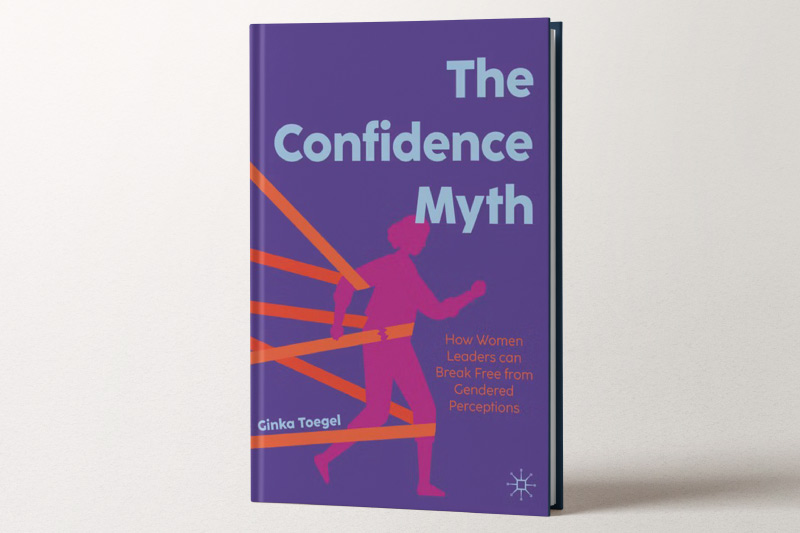
In her latest book, The Confidence Myth, IMD Professor Ginka Toegel examines why confidence is so often misinterpreted at work – and how organizational systems shape who is seen as confident and...
Throughout their careers, highly capable female leaders often hear the same description from their peers and superiors: you’re brilliant, but you need to work on your confidence.
In many organizations, this feedback is delivered almost reflexively to women – even when their performance, expertise, and leadership ability are not in doubt.
What makes this feedback striking is not how often it appears, but to whom it is directed. The women being told to work on their confidence are frequently among the most grounded, thoughtful, and capable participants in leadership programs. Their track records are strong. Their judgment is sound. Their performance is not in question.
This pattern is the starting point for The Confidence Myth: How Women Leaders can Break Free from Gendered Perceptions. The book challenges the deeply ingrained assumption that female leaders struggle with confidence. Instead, it shows how confidence is often misread at work – shaped less by inner belief than by perception, interpretation, and the organizational systems in which women lead.
The result is a familiar paradox. Women who run teams, manage complexity, and deliver results are still encouraged to “work on their confidence.” Yet research consistently shows that women’s confidence levels are no lower than men’s – and in some stages of life, are even higher.

The data is clear. Female leaders do not lack confidence.
Large-scale studies show that while a small confidence gap may appear early in women’s careers, it closes quickly. By mid-career, women and men report nearly identical levels of confidence. Later in life, women often rate their confidence higher than their male peers.
From a practical standpoint, these differences are negligible. They do not explain why women continue to be perceived as less confident – or why confidence remains such a persistent theme in feedback given to female leaders.
This suggests that the issue is not confidence itself, but how it is interpreted.
One reason the confidence myth endures is the way self-doubt has been framed. What is now widely referred to as imposter syndrome began as a description of observed behavior, not a diagnosis. It was introduced as a phenomenon, not a psychological condition.
Over time, however, the concept became medicalized and closely associated with women, despite evidence showing that around 70% of people – regardless of gender – experience significant self-doubt at some point in their lives.
By focusing attention on women’s internal doubts, attention is often diverted from a more uncomfortable question: how workplace dynamics, expectations, and evaluation criteria shape who is seen as confident – and who is not.
Research shows that women do not systematically underestimate their leadership ability.
For female leaders, confidence is often less about how capable they feel and more about how they believe they are perceived.
Research shows that women do not systematically underestimate their leadership ability. What they are less confident about is whether others recognize and value their contribution. This distinction is critical.
A woman may feel fully ready for a promotion but decide not to apply because she assumes the decision has already been made. Another may choose not to push an idea after it goes unnoticed once. These decisions are often labelled as signs of low confidence, when they are more accurately understood as rational responses to experience and context.
In many cases, these assumptions turn out to be wrong. But relying on them still limits visibility, opportunity, and progression for female leaders.
Organizational norms further distort how confidence is interpreted. The double bind means that behaviors rewarded in men are often penalized in women.
Assertiveness, for example, may be praised as leadership potential in male leaders, while the same behavior in women is criticized as abrasiveness. Speaking with certainty can signal authority in one context and overconfidence in another – depending on who is speaking.
Emotional expression is filtered in similar ways. Anger expressed by men is often interpreted as gravitas or conviction. The same emotion expressed by women can reduce perceived status. Tears follow a comparable pattern. While crying at work generally lowers perceptions of authority, women’s tears are more likely to confirm stereotypes about emotionality.
These dynamics have real consequences. Managers may hesitate to give women critical feedback out of concern for how it will be received. As a result, female leaders miss opportunities to learn, adjust, and grow – reinforcing the very perceptions that triggered doubts about confidence in the first place.
Female leaders may ruminate, be self-critical, aim for perfection, or hesitate to self-promote.
Certain behaviors are routinely interpreted as signs of low confidence, even when they reflect professionalism or strategic judgment.
Female leaders may ruminate, be self-critical, aim for perfection, or hesitate to self-promote. They may apologize frequently, soften requests, or take on a disproportionate share of “office housework.” Each of these behaviors can reduce visibility – not because they signal insecurity, but because they are easily misinterpreted.
Not taking credit is a common example. Leaders may downplay their role out of modesty or a desire to highlight team effort. But when contributions go unclaimed, others fill in the narrative. Silence is often mistaken for a lack of confidence.
Confidence, however, is not about dominating the room. Even asking questions signals engagement and leadership. Waiting for the perfect contribution often means missing the opportunity to be seen and heard.
While confidence is shaped by systems, female leaders are not powerless. There are practical ways to interrupt self-defeating thought patterns without turning confidence into another personal shortcoming to fix.
One approach is the ABC model from cognitive behavioral therapy, which distinguishes between an activating event, the beliefs attached to it, and the consequences that follow. It is rarely the event itself that causes distress, but the interpretation layered on top of it.
Other techniques – such as keeping a record of positive feedback, questioning automatic negative thoughts, or rehearsing difficult conversations – help rebalance perception and reduce rumination.
These tools can be effective. But they are not a substitute for organizational responsibility.
Confidence does not exist in isolation.
The central insight of The Confidence Myth is not that confidence is unimportant. It is that confidence is often misunderstood.
When confidence is framed as an individual flaw, organizations default to advice that asks women to adapt to biased systems rather than questioning those systems themselves. In doing so, they overlook how consistently competence, authority, and leadership potential are filtered through gendered expectations.
Reframing confidence requires a shift in focus – away from fixing female leaders and toward examining context. Confidence is shaped by interaction, feedback, visibility, and how behavior and emotion are interpreted at work.
Confidence does not exist in isolation. It takes shape at the intersection of women and the systems in which they lead – and it is there that meaningful change begins.

Professor of Organizational Behavior and Leadership at IMD
Ginka Toegel is a teacher, facilitator, and researcher in the areas of leadership and human behavior. Specialized in providing one-to-one leadership coaching and team-building workshops to top management teams in both the public and private sector, her major research focuses on leadership development, team dynamics, and coaching. She is also Director of the Strategies for Leadership program and the Mobilizing People program.
December 1, 2025 • by Stefan Michel in I by IMD Book Club • 4 min read
Gaming has become one of the world’s most powerful consumer ecosystems. Stefan Michel explores why every company now needs a strategy for play to stay competitive. ...
October 31, 2025 • by Paul Vanderbroeck, Susan Goldsworthy in I by IMD Book Club • 5 min read
IMD's Susan Goldsworthy was joined by Paul Vanderbroeck, whose unique book, Lead Like Julius Caesar: Timeless Leadership Lessons from History's Most Influential Leader, dissects the leadership style and career of the Roman...
September 1, 2025 • by Andrew Sharman , Amy Walters Cohen in I by IMD Book Club • 5 min read
IMD’s Andrew Sharman sits down with Amy Walters Cohen, whose award-winning book Ruthlessly Caring challenges conventional leadership – and offers a paradoxical path forward in a world in flux....
July 30, 2025 • by Julia Binder, Cass R. Sunstein in I by IMD Book Club • 5 min read
In his book Climate Justice: What Rich Nations Owe the World – and the Future, Cass R Sunstein delivers a timely exploration of the moral and practical obligations that wealthy nations have...
June 20, 2025 • by Knut Haanaes, Martin Reeves in I by IMD Book Club • 5 min read
BCG’s Martin Reeves traces the messy human journey behind one of tech’s most contagious features – and what it reveals about innovation, behavior, and unintended consequences. ...
May 30, 2025 • by Brian Evergreen, Stefan Michel in I by IMD Book Club • 5 min read
Brian Evergreen shares radical insights from his book Autonomous Transformation: Creating a More Human Future in the Era of AI with IMD’s Stefan Michel....
May 1, 2025 • by Albrecht Enders, Christoph Glaser in I by IMD Book Club • 8 min read
Mindfulness expert Christoph Glaser shares insights from Breathe, his best-selling book on how simple, breath-based techniques can reduce stress, sharpen focus, and help leaders stay centred under pressure....
March 28, 2025 • by Jim Pulcrano, Matthew C Weinzierl, Brendan Rosseau in I by IMD Book Club • 7 min read
Authors of Space to Grow, Matthew Weinzierl and Brendan Rosseau, tell IMD's Jim Pulcrano that one of the central aims of their book is to inspire industries, businesses and individuals...
February 26, 2025 • by Heather Cairns-Lee, Eugene Sadler-Smith in I by IMD Book Club • 8 min read
Heather Cairns-Lee from IMD and leadership expert Eugene Sadler-Smith discuss why intuitive intelligence is a critical skill in a data-driven world....
January 17, 2025 • by Julia Binder, Knut Haanaes in I by IMD Book Club • 7 min read
IMD's Julia Binder and Knut Haanaes explore how aligning purpose with profit, fostering innovation, and building resilience, can help companies embed sustainability into business strategy....
Explore first person business intelligence from top minds curated for a global executive audience