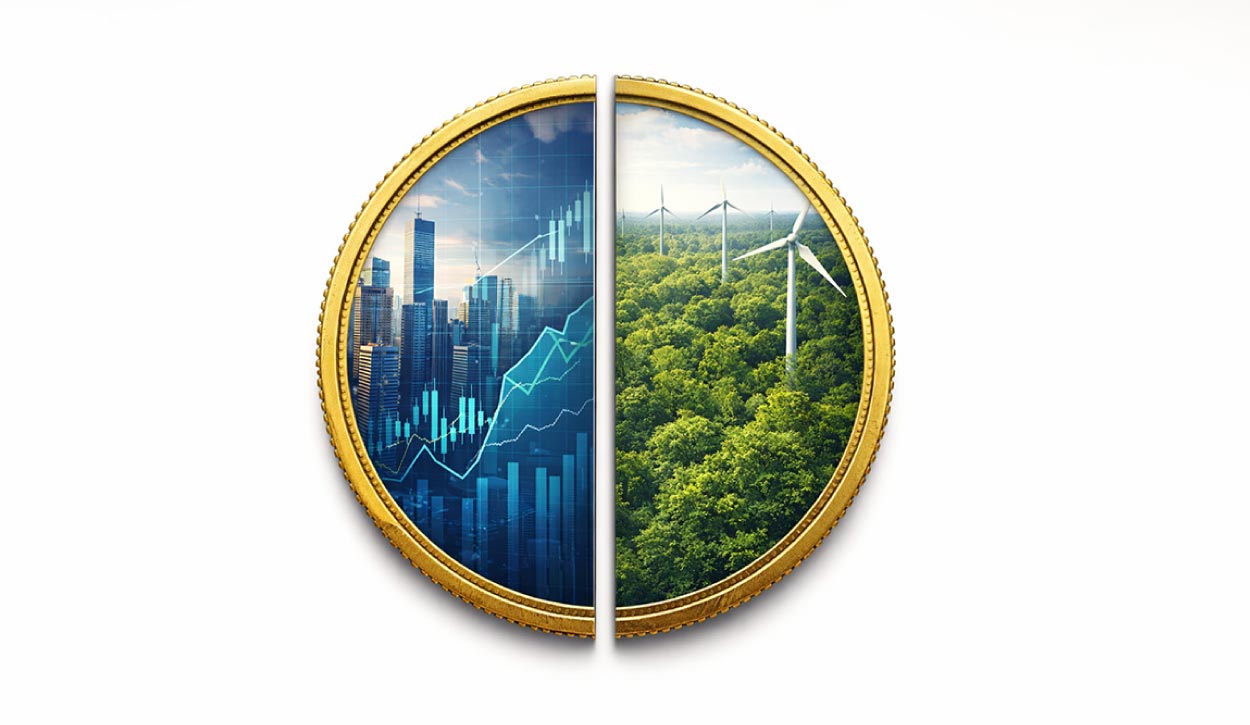
Economic success and sustainability: Two sides of the same coin
Why boards must reframe sustainability as a mechanism for long-term survival....

by Julia Binder Published February 16, 2026 in Sustainability • 9 min read •  Audio available
Longevity is among the most captivating ideas of our age, not only because it speaks to science and health, but because it taps into something deeply human – the desire for more time to create, contribute, and enjoy the people and places we love. In boardrooms and research labs alike, the discussion often centers on what might soon be possible: precision interventions, powerful new therapies, and data-rich tools that promise to reshape the arc of human aging.
But beneath the excitement sits a quieter, more complex reality. We are celebrating the prospect of extending individual lives at the very moment the systems that sustain life – environmental, social, and planetary – are under increasing strain. Life expectancy is rising for some but falling for others. Health is improving in certain pockets while deteriorating in places that lack the basic conditions needed to support well-being. The more we focus on what technology can do for a few, the more we risk neglecting what environments must do for the many.
This is the essential duality of longevity: we are striving for ever-longer human lifespans in an era when the foundations to support such a goal are at their most fragile. Recognizing this tension does not diminish scientific progress; in fact, it strengthens it by broadening the conversation from personal optimization to societal design, from short-term interventions to long-term stewardship, and from individual gain to collective possibility.
The dominant narrative of longevity is built around a particular kind of protagonist, someone who has turned their body into a full-time project. Picture an executive who wakes before dawn to analyze the latest data from his smart ring, straps on a continuous glucose monitor before breakfast, cycles through a dozen supplements with names that sound like they belong in a laboratory, and insists on a precisely engineered workout that pushes heart-rate variability to its optimal zone. His days are governed by numbers: resting heart rate, VO₂ max, micronutrient levels, biomarker fluctuations. He is disciplined, committed, and in many ways admirable.
Yet in his quest to perfect every physiological metric, something quietly erodes. His longevity routine, while impressive, begins to crowd out the basic elements of life that consistently support long-term health: meaningful relationships, everyday experiences, and simple contact with the natural world. The narrative he embodies – indeed, the narrative many people admire – reduces longevity to numbers and optimization, leaving little room for the social, emotional, and ecological foundations of well-being.
A powerful yet underappreciated factor in determining longevity is social connection. Chronic loneliness, increasingly common across industrialized societies, raises the risk of premature death by up to 26% – a magnitude similar to smoking or obesity. Isolation intensifies stress, erodes resilience, and accelerates physiological decline. In contrast, strong relational networks buffer adversity, support mental health, and foster the sense of belonging that contributes directly to longer, healthier lives. The longest-lived people are rarely those who optimize alone; they are those held in webs of sustained human connection.
Longevity is shaped far more by the conditions we live in than by the supplements we take. It’s a more consequential story of how longevity is actually achieved – one that is visible in the everyday lives of people who will never track their sleep cycles or algorithmically calculate their morning routines.
Consider a single city at sunrise: two children waking up in different parts of Washington, DC, one surrounded by stability and opportunity, the other by scarcity and stress. One child eats breakfast from a fridge stocked with fresh fruit, whole grains, and meals prepared in advance by adults with the resources to plan. The other eats what’s available, often packaged, ultra-processed food from the corner store, chosen not for its nutritional value but for its price and convenience. One child walks or bikes to school through safe streets and shaded parks, greeted by familiar neighbors. The other navigates roads where violence is a daily possibility, where sirens replace birdsong, where parents worry more about their kids coming home safely than homework.
Their futures diverge not because of the choices they make in midlife but because of the environments that shape them from the beginning. This becomes painfully clear when we look at the neighborhoods they grow up in. The residents of Barry Farm, predominantly Black, have an average life expectancy of just over 63 years, as reported in 2018. In Friendship Heights, mainly white, it exceeds 95 years. This represents a 30-year difference in life expectancy. The difference is not lack of effort, but the cumulative impact of clean or polluted air, proximity to parks or concrete heat, access to fresh or limited food, safety or chronic stress, and well-resourced or struggling schools. These are the conditions that shape health trajectories long before any device, supplement, or blood test enters the picture.
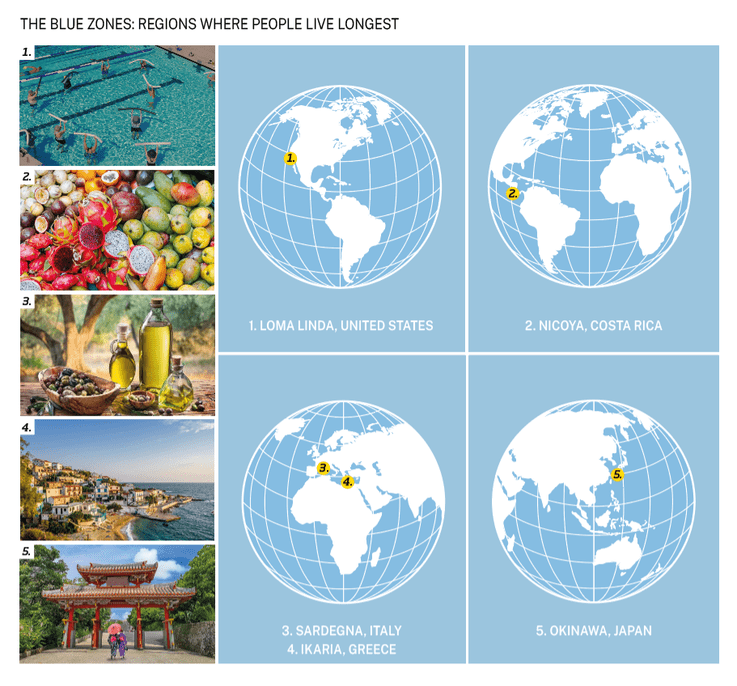
When we shift attention from the exceptional to the everyday, longevity looks very different. It becomes a story about context rather than personal discipline. This becomes especially clear when we look at the so-called Blue Zones, five regions of the world identified through demographic and medical research where people routinely live to 100 and beyond in good health (see map). These communities were not selected for their technology or wealth, but because they naturally produce the highest concentrations of healthy, long-lived people. Their longevity is not an anomaly, but a pattern: daily movement woven naturally into routines, plant-forward and minimally processed diets, strong intergenerational ties, and communities that ensure no one drifts into isolation.
These regions show that long life emerges from environments intentionally or culturally shaped to support well-being. They are not perfect societies, nor are they insulated from modern pressures, but they provide compelling evidence that longevity is the outcome of consistent, reinforcing systems – systems that make healthy choices easy, social connection routine, and purpose part of everyday life.
When we look at longevity through this broader lens, a clearer picture emerges. The factors that most powerfully shape lifespan are not futuristic technologies; they are the social, environmental, and structural conditions that define our daily lives.
The duality of longevity reveals something profound and unexpectedly hopeful: the path to longer, healthier lives is the same one that leads to a more stable planet, more cohesive communities, and more equitable societies. These aims rise (or fall) together. What strengthens ecosystems strengthens people. What reduces inequality extends lifespan. What fosters connection builds resilience. And what protects the planet protects every future human who will depend on it.
For business, a longevity mindset does more than influence well-being. It changes the logic of value creation itself. A society built for longer lives requires longer-lived systems, which means rethinking the timescales of innovation, investment, and design. Short-lived products, fragile supply chains, and extractive business models are not simply environmental liabilities; they are strategic risks in a world that depends on durability, resilience, and regeneration. The future of longevity calls for companies to act not only as economic engines but as architects of long-term stability.
When longevity is recast not as an individual achievement but as a shared, collective horizon, it becomes more than a health aspiration. It becomes a strategic compass that pushes leaders, organizations, and societies into prioritizing decisions that generate value over decades rather than quarters. It turns sustainability from a compliance exercise into a health imperative and community from a social aspiration into a biological necessity. It reframes regenerative practices not as moral choices but as investments in human potential.
Ultimately, the true measure of progress will not be how many people manage to optimize themselves into extended lifespans, but whether we can build a world where long, healthy lives are possible for all. That is the promise of longevity reimagined, not a race to escape individual decline, but a collective undertaking to create the conditions in which life, in all its forms, can thrive.

While societal forces shape longevity, leaders occupy a uniquely influential position within those forces. They design organizations where millions of people spend most of their waking hours. They influence supply chains that touch ecosystems and communities across the globe. And their decisions signal what we value and what we are willing to protect. Leadership alone cannot solve the longevity challenge, but it can meaningfully shift the conditions that make longer, healthier lives possible.
Leading self: modeling the shift toward long-horizon health
For many leaders, longevity has come to mean self-improvement – refining habits, tightening routines, and optimizing every available metric. But the more consequential shift is not about perfecting the self; it is about expanding the horizon. At its core, longevity is a way of thinking – a commitment to prioritizing what endures over what accelerates.
This shift requires leaders to model healthier relationships over time. It means resisting cultures that valorize exhaustion, demonstrating that rest and recovery are strategic rather than indulgent, and cultivating a leadership presence grounded in clarity rather than constant urgency. When leaders practice this orientation, they not only extend their own potential but also signal to their organizations that longevity is a shared
value, not a private privilege.
Leading organizations: designing environments that shape health
Organizations profoundly influence the conditions that determine health across a lifetime. They shape stress levels, daily movement patterns, exposure to nature, access to nutritious food, and the quality of social connection – all foundational determinants of longevity.
Leaders can bring longevity to life by fostering cultures where belonging reduces the silent epidemic of loneliness; by rethinking office design to integrate nature, light, and movement; by strengthening food environments so that healthy choices become accessible, appealing, and normalized; and by establishing rhythms of work that protect rather than deplete sustained performance. These actions are not benefits layered onto a strategy; they are strategy, strengthening the workforce’s capacity, creativity, and resilience.
Such a reorganization calls for operational choices that anticipate longer time horizons. Supply chains must be diversified and resilient, able to absorb shocks and adapt to climate instability. Product lifecycles must extend rather than shrink, emphasizing longevity, repairability, and circularity. Innovation pipelines must account for the long-term social and environmental consequences of what is brought into the world. A leadership mindset attuned to longevity naturally gravitates toward durability, regeneration, and systems that strengthen over time.
Leading society: extending influence beyond organizational walls
Leaders do not operate solely within their organizations. Their decisions shape broader social and environmental systems. They influence how products are made and distributed, how cities evolve, which innovations receive investment, and which narratives gain public legitimacy.
Through this wider lens, leadership becomes a catalyst. Leaders can support regenerative supply chains that nourish ecosystems rather than deplete them; advocate for policies that expand access to health-enabling resources; invest in innovations that strengthen social cohesion and environmental resilience; and use their platforms to advance a narrative in which longevity is tied to justice, sustainability, and shared
opportunity. In doing so, they help build the societal foundations upon which long life depends.

Professor of Business Transformation at IMD
Julia Katharina Binder, Professor of Business Transformation, is a renowned thought leader recognized on the 2022 Thinkers50 Radar list for her work at the intersection of sustainability and innovation. As Director of IMD’s Center for Sustainable and Inclusive Business, Binder is dedicated to leveraging IMD’s diverse expertise on sustainability topics to guide business leaders in discovering innovative solutions to contemporary challenges. At IMD, Binder serves as Program Director for Creating Value in the Circular Economy and teaches in key open programs including Transition to Business Leadership (TBL), and Leading Sustainable Business Transformation (LSBT). She is involved in the school’s EMBA and MBA programs, and contributes to IMD’s custom programs, crafting transformative learning journeys for clients globally.
March 25, 2026 • by Goutam Challagalla, Matthias Altendorf in Sustainability
Why boards must reframe sustainability as a mechanism for long-term survival....

March 19, 2026 • by Goutam Challagalla, Frédéric Dalsace in Sustainability
Innovation, value creation, and improved performance should replace ‘virtue signaling’ and ill-defined ‘purpose’, argue Goutam Challagalla and Frédéric Dalsace...
 Audio available
March 17, 2026 • by Mark J. Greeven in Sustainability
Ecosystems promise a new way to compete, yet most squander the opportunity by bolting them onto old strategic logic. Mark Greeven makes the case for putting ecosystem thinking at the heart of...
Audio available
March 13, 2026 • by Peter Vogel, Julia Binder in Sustainability
André Hoffmann has reshaped a 125-year legacy by redefining Roche’s identity, modernizing its governance, and anchoring the company in a renewed sense of purpose....
Explore first person business intelligence from top minds curated for a global executive audience