How China’s innovation system really works
As debate grows over whether China is winning the technology race, executives should focus instead on how its innovation system is designed – and what that means for competition....

by Howard H. Yu, Jialu Shan, Lawrence Tempel Published February 16, 2026 in Innovation • 11 min read
In February 2026, I walked into the visitor center at BYD’s headquarters in Shenzhen expecting to see electric cars. I walked out understanding why the entire auto industry should be terrified. The visit and my impressions are necessarily personal and subjective, but I would like to share what I witnessed and some of my conclusions, and the four main lessons we can learn from their history, R&D, technology, and business model innovation.
In 2011, Elon Musk was asked on Bloomberg TV if a little-known Chinese company called BYD could ever rival Tesla. He roared with laughter. “Have you seen their car?” he scoffed. As I explored the visitor’s center at BYD’s headquarters in Shenzhen to see for myself, I witnessed things that changed everything I thought I knew about the auto sector.
BYD’s Blade Battery nail penetration test could easily be mistaken for a scene from a sci-fi thriller. Inside a glass enclosure, a robotic press drives a long steel nail straight through a large conventional lithium-ion cell (nickel-rich NCM chemistry)., which immediately goes into violent thermal runaway. Flames burst forth from the cell with a gut-punch whoomp, and thick black smoke billows as its temperature shoots past 500 °C. Had this battery been in a car, it would have been a total inferno.
Next, the BYD Blade Battery (a slim, elongated lithium iron phosphate cell) is pierced in the same way. No fire. No explosion. Not even visible smoke. This was no mere lab stunt; the company started as a battery maker in 1995, long before it built cars.
As other EV makers fixated on squeezing out higher energy density (often using volatile nickel-cobalt chemistries), BYD chose the more stable LFP (lithium iron phosphate) chemistry and reimagined the structure of the battery itself. By reshaping the cell into a long, thin blade, BYD dramatically increased surface area while reducing the chance of internal short circuits spreading. It’s the kind of insight that seems obvious in retrospect, which is exactly why it stings for the competitors who didn’t think of it first.
Watching the nail test, I came to appreciate the importance of this unglamorous focus on batteries. The boring, beneath-the-floor stuff is exactly how BYD leapfrogged the competition. They mastered what others treated as commoditized.
While Musk was producing Teslas, streaming rocket launches, and selling flamethrowers, BYD engineers in Shenzhen were testing millions of battery cycles. They learned how cells failed in bus fleets, delivery vans, and e-bikes before ever putting one in a luxury sedan.
BYD spent 15 years climbing a ladder of capabilities, each rung building
on the last.
Standing in BYD’s Design Center, surrounded by floating cars, jumping supercars, and roof-mounted drones, I kept asking myself one question: How did they get here?
The answer, I believe, is in what they didn’t do.
They didn’t chase disruption. They didn’t moonshot. They didn’t bet everything on revolutionary technology in the hope that it would work.
Instead, BYD spent 15 years climbing a ladder of capabilities, each rung building on the last.
Phone batteries taught them about energy storage and cell chemistry. E-bikes and scooters taught them about electric drivetrains and real-world durability. Buses taught them about system integration at scale. Commercial fleets taught them about reliability under brutal operating conditions.
Each step was boring. Unglamorous. And each step gave them capabilities their competitors didn’t have.
When they finally turned those capabilities toward passenger vehicles, they weren’t starting from scratch. They were extending a system they’d spent a decade perfecting.
This is the classic playbook of low-end disruption. But BYD added something else – vertical integration so complete it feels almost obsessive. They don’t just assemble cars; they make the batteries, the motors, the semiconductors, the software. They make the robots that build the robots. When the European executives asked how BYD could expand globally while being so vertically integrated – “Which is very budget heavy, right?” – the BYD executives simply said: “It’s a big task.”
Not a big gamble. A big task. The difference in framing tells you everything.
Bets can fail. Tasks get done.
Research we undertook into the automobile sector for the 2025 Future Readiness Indicator points to Chinese domination of the sector by companies with a strong EV and software focus. BYD leads with a score of 100, followed closely by Tesla at 98.1. Geely Automobile (82.0) and Li Auto (56.1) complete the top four positions. These companies share a common trait: they prioritize software architecture and digital integration in their vehicle designs.
BYD also outstripped Tesla in EVs sold in 2025 for the first time, selling 2.26 million cars to Tesla’s 1.64 million.
Meanwhile, traditional auto manufacturers are experiencing concerning trends. Companies like Stellantis, Volkswagen, BMW, and Mercedes-Benz have reported declining revenues, while, in addition to BYD, Chinese manufacturers XPeng and Li Auto also demonstrated substantial growth. This divergence highlights the fundamental shifts occurring in consumer preferences and technological approaches.
BYD, Li Auto, and XPeng are surging ahead not only due to cost advantages but also through software-first vehicle architecture. These companies have reimagined cars, enabling over-the-air updates that recalibrate everything from suspension systems to safety features.
Tesla’s early lead in this domain is being eroded as BYD’s R&D intensity (23.35% CAGR) and innovation output – in the first four months of last year, BYD obtained 1,880 new patent authorizations, representing a surge of 113.64% compared to the same period in 2023 – far outpacing Western rivals. Further, BYD’s revenue growth (52.8% 3Y CAGR) and inventory turnover (6.17) reflect operational excellence, whereas Tesla’s stagnation (-9.4% Q1 2025 sales growth) highlights vulnerability when innovation slows. In comparison, traditional OEMs like Mercedes (-7.0% sales growth) and Stellantis (-8.8%) lag in software-driven R&D.
If BYD’s Shenshan site feels immense, its next move sounds made up: a greenfield megacampus in Zhengzhou planned to span nearly 50 square miles with its own deep-water port. It would be larger than the entire city of San Francisco, 10 times the size of Tesla’s Nevada Gigafactory, and projected to produce a million vehicles per year.
The U8 – a luxury, full-size plug-in hybrid electric off-road SUV from BYD’s high-end sub-brand, Yangwang – is roughly the size of a Land Rover. When sensors detect water has risen past the door sills, the car engages survival mode: sealing doors and windows, raising the suspension, shutting off motors to avoid short circuits. The sunroof pops open as an escape hatch. In flotation mode, the U8’s four wheel motors spin slowly, acting like paddle wheels to propel the car through water at 3km/hr for up to 30 minutes.
“We asked ourselves what would kill our customers,” my tour guide said. “Floods kill people. So we built a car that floats.” No other production SUV can do this. The U8 is not just a concept; it’s already in production.
If the floating SUV showcased BYD’s seriousness, the next demo showed their playfulness. The Ling Yuan in-car drone system, developed with DJI, sits in a roof-mounted hangar. At the touch of a button, the hangar opens, the drone takes off and follows your vehicle as it shoots 4K aerial footage, then returns to recharge automatically. It can scout ahead to check traffic or road conditions.
My first reaction was that this was a gimmick. But then I thought about what it demonstrates. BYD isn’t just building cars. They’re building integrated technology platforms where the boundaries between vehicle, drone, smartphone, and cloud simply don’t exist. The system requires tight coordination between automotive engineering, aerospace technology, computer vision, and consumer electronics. The drone is available on numerous BYD vehicles, proving it’s matured beyond a concept into a product line.
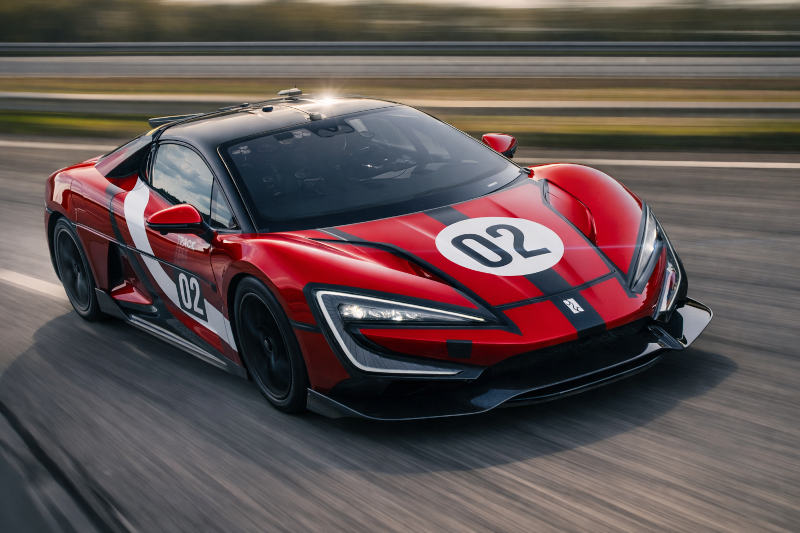
The next exhibit was straightforward: a speed record. On 14 September 2025, BYD’s YangWang U9 Xtreme reached 496.22km/hr (308.4mph) at Germany’s Automotive Testing Papenburg proving ground, making it the fastest production car ever clocked in an independently measured test, surpassing the Bugatti Chiron Super Sport 300+ (490.48km/h) and the SSC Tuatara (455.3km/h).
A Chinese electric vehicle, from a company that Elon Musk laughed at 15 years ago, just became the fastest car on Earth. I stood in front of the U9’s display for a long time. Low, wide, and menacingly sleek, it looked like someone crossbred a Lamborghini with a spacecraft.
For decades, the hypercar segment belonged exclusively to European houses: Bugatti, Ferrari, Porsche, McLaren, Koenigsegg. These were symbols of engineering supremacy, requiring not just money, but pedigree – not to mention generations of accumulated expertise. BYD entered this world and, on its first real attempt, set the record. The company that started making phone batteries now builds the fastest production car in human history.
BYD saved the wildest for last. Just when I thought I’d seen it all, I watched in wonder as a Yangwang U9 suddenly jumped off the ground – all four wheels in unison, hovering a few inches, settling back down, thanks to the DiSus Intelligent Body Control System. Footage of the U9 showed it encountering spike strips and potholes at 120km/h. Instead of hitting them, the car launched itself over them in a controlled leap.
In another demonstration, the same car balanced on three wheels while one was removed entirely. It drove. It turned. It “danced,” performing coordinated movements that shouldn’t be physically possible for a vehicle weighing over two tons. In one marketing clip, passengers applied makeup while the car traversed rough terrain. The vehicle remained so stable that the eyeliner was applied flawlessly without a smudge.
On certain Denza models, “Crab-Walk Mode” uses rear-axle steering and independent motor control to slide diagonally into tight parking spaces.
By the end of the demo, I was convinced: BYD isn’t content with catching up to the state of the art; it wants to define the new state of the art. The company is throwing down challenges in every domain: batteries (solving thermal runaway), off-roading (floating an SUV), infotainment (integrated drones), performance (top-speed records), and chassis control (jumping and crab-walking). Seeing them all under one corporate roof is almost unbelievable. It’s as if BYD absorbed the ambitions of Tesla, Ferrari, Land Rover, and DJI into one brand.
Surprisingly, nothing felt frivolous. There is a unifying theme: expand what vehicles can do and eliminate their historical limitations. EVs have opened up the design space, and BYD is hell-bent on exploring every corner of that space before its competitors do.
At Tesla, he saw the “Musk method” in full swing; a massive structure built in 12 months, spitting out a car every 37 seconds.
To understand what I saw at the BYD Design Center, you have to understand how the company builds.
My colleague Mark Greeven had previously toured BYD’s manufacturing complex in Shenshan and came away stunned. He had also visited Tesla’s Gigafactory in Shanghai just months earlier, giving him a rare firsthand comparison.
At Tesla, he saw the “Musk method” in full swing; a massive structure built in 12 months, spitting out a car every 37 seconds. Tesla used a “hybrid automation” approach: 95% for Model 3 automated, but with humans handling specific tasks where people still outperformed robots. During lunch, he saw a line worker writing C++ code. Not a manager, but a factory-floor operator. “Elon always says, ‘Show me your code, and if it’s good, you have a future at Tesla,’” the guy told him.
Impressive.
But then Mark visited BYD.
BYD’s Shenshan site spans 3.79 million square meters. It’s four-and-a-half times the footprint of Tesla’s Shanghai plant, and the company has permits to keep expanding. The site also includes an employee village with football pitches and tennis courts.
But this isn’t just a car assembly site.
BYD casts its own motors, laminates Blade Battery cells, prints circuit boards, and presses power-module wafers. They design their own IGBT and SiC chips through BYD Semiconductor, located just a few hundred meters from the main vehicle line. Inside the battery wing, fewer than a dozen people oversee an entire production hall. The Blade line operates with about 50 workers per gigawatt-hour, a fraction of the labor required at a typical Western battery plant. Autonomous mobile robots shuttle trays between stations. Overhead, warehouse drones scan QR codes to reorder stock automatically.
In the final assembly, technicians still tweak torque programs on the fly – a flexibility that Tesla learned the hard way during its Model 3 “production hell.” And where manual labor still matters, BYD has begun deploying UBTech’s Walker S1 humanoid robots for assembly tasks.
The message is clear: the machine that builds the machine now speaks Mandarin.
BYD’s rise reveals a profound truth about competitive strategy: the tortoise can beat the hare. Not through speed, but through a relentless, methodical focus on execution.
I think about Elon Musk, throwing back his head in 2011. “Have you seen their car?”
I have now.
Have you?
LEGO® Chair Professor of Management and Innovation at IMD
Howard Yu, hailing from Hong Kong, holds the title of LEGO® Professor of Management and Innovation at IMD. He leads the Center for Future Readiness, founded in 2020 with support from the LEGO Brand Group, to guide companies through strategic transformation. Recognized globally for his expertise, he was honored in 2023 with the Thinkers50 Strategy Award, recognizing his substantial contributions to management strategy and future readiness. At IMD, Howard Yu co-directs the Strategy for Future Readiness program and the Future-Ready Enterprise program, which is jointly offered with MIT.
Research fellow at the Global Center for digital business transformation
Jialu Shan is a research fellow at the Global Center for Digital and AI Transformation, and an associate research director at the Center for Future Readiness at IMD Business School. Her research areas include digital business transformation, business model innovation and new practices, and corporate governance practices. She is particularly interested in the Asian market. Jialu has a PhD in economics (management) from the Faculty of Business and Economics at the University of Lausanne. Before joining IMD she worked as a lecturer at the International Hotel School of César Ritz Colleges in Brig, Switzerland.

Data Specialist and Communications Coordinator, IMD
Lawrence Tempel holds a Master’s degree in International Business and is a Data Specialist and Communications Coordinator at IMD’s Center for Future Readiness. His research and professional interests include innovation, future trends and data processing.
February 16, 2026 • by Mark J. Greeven in CNY 2026
As debate grows over whether China is winning the technology race, executives should focus instead on how its innovation system is designed – and what that means for competition....

February 16, 2026 • by Zhike Lei in CNY 2026
Some of China’s most profitable companies have thrived by piling pressure on workers – sometimes with tragic results. Zhike Lei outlines how multinationals can design work that avoids burnout and exploitation. ...
February 13, 2026 • by Stéphane J. G. Girod in CNY 2026
The next decade will bring significant changes for China's luxury sector. But to see where it's heading, we need to understand where it's been....

February 11, 2026 • by Simon J. Evenett in CNY 2026
The great-power rivalry between China and the US is structural, not an aberration: zero-sum thinking, tech rivalry, and weaponized trade will outlast leaders and reshape business. ...
Explore first person business intelligence from top minds curated for a global executive audience