Share
Facebook Facebook icon Twitter Twitter icon LinkedIn LinkedIn icon Email
Chinas-primacy-challenge-2

Geopolitics

China’s primacy challenge: Government security imperatives override business logic

Published February 11, 2026 in Geopolitics • 6 min read

The great-power rivalry between China and the US is structural, not an aberration: zero-sum thinking, tech rivalry, and weaponized trade will outlast leaders and reshape business.

This disconnect – executives thinking in positive-sum terms while governments act on zero-sum calculations – reveals a corporate blind spot that urgently needs correcting.

For decades, global executives operated on a straightforward assumption: global economic integration supported scale and cost reduction and delivered mutual prosperity. A German automotive supplier could source components from China, sell finished products to American customers, and reinvest profits in Brazilian manufacturing – all within a stable, rules-based framework that rewarded efficiency and innovation over geography.

China capitalized on this open world economy and, in the process, reordered the global economic landscape. So much so that the mindsets of many officials in Western capitals shifted. They now view China through a zero-sum lens where relative advantage matters more than absolute gains, where national security concerns override market efficiency, and where technological leadership translates directly into geopolitical power. This disconnect – executives thinking in positive-sum terms while governments act on zero-sum calculations – reveals a corporate blind spot that urgently needs correcting.

China represents the third and most serious challenge to American primacy in over a century. The Soviet Union’s collapse in 1991 ended one contest. Japan’s economic stagnation in the 1990s defused another. China’s challenge differs in both scale and persistence. Unlike the Soviet Union, China is deeply integrated into the world economy. Unlike Japan, China possesses nuclear weapons, a massive domestic market, and global technological ambitions backed by state resources.

The structural drivers behind this competition – technological rivalry, the weaponization of economic interdependence, and military modernization – will persist for decades regardless of leadership changes in Washington or Beijing. The next three sections reveal the sheer scale of China’s primacy challenge.

Chinese paper currency Yuan renminbi bill banknotes on white background Banknote one hundred yuan More chinese yuan background China or economy of Asia growth US trade war concept
China’s economic clout defies simple characterization

Economic primacy: Beyond GDP statistics

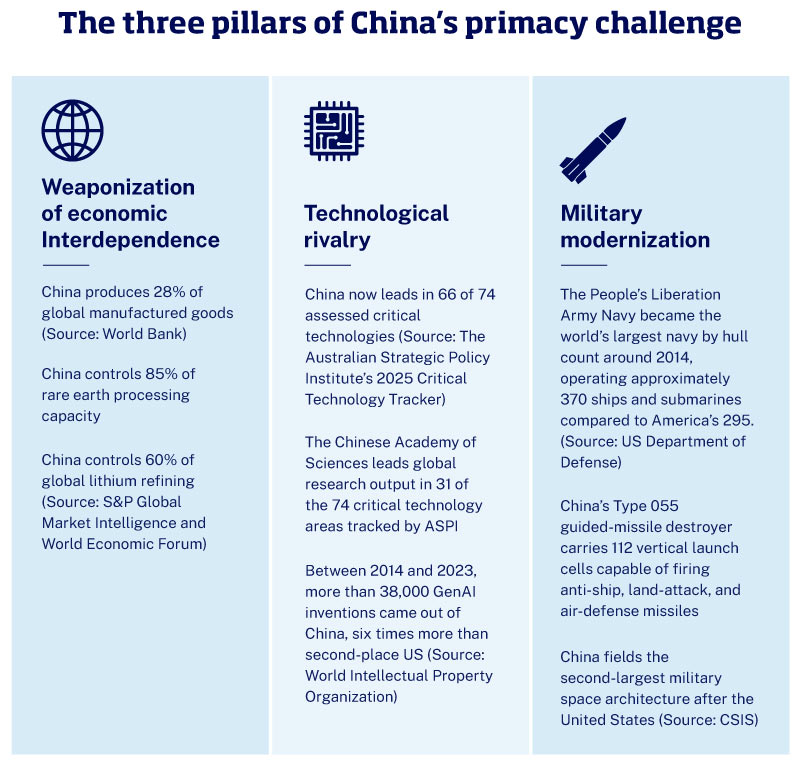
China’s economic clout defies simple characterization. At purchasing power parity, China’s economy reached $35tn in 2024, surpassing America’s $28tn. But aggregate numbers obscure more consequential realities. China produces 28% of global manufactured goods, giving Beijing leverage over supply chains. When China restricted gallium and germanium exports in 2023 – materials critical for semiconductors and military applications – global prices shot up 20% in a few weeks. China controls 85% of rare earth processing capacity, 60% of global lithium refining, and holds dominant positions in antimony, tungsten, and other strategic materials that underpin modern military systems and clean energy technologies.

To understand Beijing’s perspective, context matters. For 18 of the past 20 centuries, China ranked among the world’s largest economies, frequently holding the top position. As recently as 1820, China generated roughly one-third of global GDP – a share that collapsed during the “century of humiliation” as foreign industrialization and internal strife devastated Chinese economic capacity. By 1950, China’s share of world output had fallen to near 5%.

The post-1978 reform era reversed this decline with unprecedented speed. From Beijing’s perspective, this trajectory represents restoration of China’s natural position in the global economic order – a framing that shapes how Chinese leaders justify their sustained pursuit of primacy. This economic foundation enables China’s most significant challenge to US primacy: a comprehensive effort to dominate the technologies that will define the 21st century.

Electronic circuit board on background of Yuan currency sign coin stack and China map Growth stock market graph Mainboard of computer Electronic industry in China Chip shortage and trade war
“China’s technological trajectory defies Western assumptions about authoritarianism being a crimp on innovation.”

Technological competition: Racing to the frontier

China’s technological trajectory defies Western assumptions about authoritarianism being a crimp on innovation. According to the Australian Strategic Policy Institute’s 2025 Critical Technology Tracker, China now leads in 66 of 74 assessed critical technologies – a reversal from two decades ago when America led in over 90% of these domains. These aren’t incremental advances in mature technologies but leadership in fields that define future economic and military power: quantum computing, hypersonic systems, advanced materials, synthetic biology, and artificial intelligence applications. China’s graduation of four times as many STEM students as America provides the human capital foundation for sustained technological competition.

The Chinese Academy of Sciences leads global research output in 31 of the 74 critical technology areas tracked by ASPI, which observed that “China’s exceptional gains in high-impact research are continuing, and the gap between it and the rest of the world is still widening. In eight of the 10 newly added technologies, China has a clear lead in its global share of high-impact research output. Four – cloud and edge computingcomputer visiongenerative AI and grid integration technologies – carry a high technology monopoly risk rating, reflecting substantial concentration of expertise within Chinese institutions.”

Moreover, the 2025 Annual Threat Assessment of the US Intelligence Community characterized China’s AI ambitions bluntly: Beijing pursues a “multifaceted, national-level strategy to displace the United States as the world’s most influential AI power by 2030,” backed by “hundreds of billions of dollars in priority technologies.” According to a 2024 report from the World Intellectual Property Organization, “Between 2014-2023, more than 38,000 GenAI inventions have come out of China, six times more than second-place US.” Such statistics reveal that China is defining the technological frontier in some domains, not just catching up with the West.

Military modernization: Potential power projection

The same US Threat Assessment describes China as representing the “most comprehensive and robust military threat to US national security.” The People’s Liberation Army Navy became the world’s largest navy by hull count around 2014. China’s Type 055 guided-missile destroyer carries 112 vertical launch cells capable of firing anti-ship, land-attack, and air-defense missiles – giving it firepower exceeding most American surface ships. The CV-18 Fujian, China’s third aircraft carrier, underwent sea trials in 2024 with electromagnetic catapult systems that match American capabilities, suggesting that China may soon be able to project power far beyond its coastal waters.

Cyber capabilities represent another dimension where boundaries blur. Chinese outfits like Volt Typhoon, which some contend has sought to place malware in American critical infrastructure, and Salt Typhoon, which apparently penetrated telecommunications networks in 2024, demonstrate capabilities that could prove disruptive during hybrid and kinetic warfare.

China’s space capabilities multiply these terrestrial advantages. Although estimates vary, China fields the second-largest military space architecture after the United States. China’s successful testing of hypersonic glide vehicles demonstrated technology that could strike targets globally with limited warning time. China’s Military-Civil Fusion strategy guides such developments and seeks to advance civilian economic as well as military goals, backed by an official defense budget of $247bn in 2025. As China’s economy grows, it can raise this budget further – although presently it is around a third of American military spending.

Governments now prioritize relative advantage over absolute gains and will sacrifice commercial gains for security and strategic advantage.

The executive mindset required

The structural drivers behind the latest battle for global primacy – technological rivalry, the weaponization of economic interdependence, and military modernization – will persist regardless of which party controls Washington or who leads Beijing. Success for executives and board members requires internalizing policymakers’ shift to zero-sum thinking. Governments now prioritize relative advantage over absolute gains and will sacrifice commercial gains for security and strategic advantage.

This reality requires a fundamental shift in mindset for many executives. First, treat geopolitics as a permanent driver to capitalize on, not as a temporary external shock to manage.

Second, view government engagement as solving officials’ security concerns in mutually beneficial ways, not merely lobbying for favorable treatment.

Third, accept that ensuring operational continuity involves hitherto rejected cost burdens – “redundant” suppliers, higher inventory, and parallel development tracks – and market that reliability as a competitive advantage to customers facing supply uncertainties.

Key to the mindset shift is that the contest for primacy creates options, too. Fortune favors the prepared mind: executives who build geopolitical muscle retain agency to act decisively when opportunities emerge, while those who scramble to understand events lose strategic choice.

The-three-pillars-of-Chinas-primacy-challenge

Authors

Simon Evenett

Simon J. Evenett

Professor of Geopolitics and Strategy at IMD

Simon J. Evenett is Professor of Geopolitics and Strategy at IMD and a leading expert on trade, investment, and global business dynamics. With nearly 30 years of experience, he has advised executives and guided students in navigating significant shifts in the global economy. In 2023, he was appointed Co-Chair of the World Economic Forum’s Global Future Council on Trade and Investment.

Evenett founded the St Gallen Endowment for Prosperity Through Trade, which oversees key initiatives like the Global Trade Alert and Digital Policy Alert. His research focuses on trade policy, geopolitical rivalry, and industrial policy, with over 250 publications. He has held academic positions at the University of St. Gallen, Oxford University, and Johns Hopkins University.

Related

Learn Brain Circuits

Join us for daily exercises focusing on issues from team building to developing an actionable sustainability plan to personal development. Go on - they only take five minutes.
 
Read more 

Explore Leadership

What makes a great leader? Do you need charisma? How do you inspire your team? Our experts offer actionable insights through first-person narratives, behind-the-scenes interviews and The Help Desk.
 
Read more

Join Membership

Log in here to join in the conversation with the I by IMD community. Your subscription grants you access to the quarterly magazine plus daily articles, videos, podcasts and learning exercises.
 
Sign up
X

Log in or register to enjoy the full experience

Explore first person business intelligence from top minds curated for a global executive audience