Share
Facebook Facebook icon Twitter Twitter icon LinkedIn LinkedIn icon Email
Ecosystem Inc: How the nature of competition is evolving

Sustainability

Ecosystem Inc: How the nature of competition is evolving

Published March 17, 2026 in Sustainability • 13 min read • Audio availableAudio available

Ecosystems promise a new way to compete, yet most squander the opportunity by bolting them onto old strategic logic. Mark Greeven makes the case for putting ecosystem thinking at the heart of how leaders set direction, govern value, and build advantage

Ping An, one of the largest and most digitally advanced financial services groups in the world, didn’t set out to build an ecosystem. It wanted to digitally transform an insurance business. It was only after more than a decade of that difficult process that the possibility of an ecosystem emerged. It gradually became a strategic necessity.

Almost a quarter of a century ago, the Chinese insurance giant embarked on the unglamorous grind of digital transformation: centralizing siloed back offices into a shared “kitchen” to serve every business line, digitizing customer journeys, arming a vast front line with tools, and building the data and AI capabilities that would become Ping An Technology, serving more than 500 million users. As its former co-CEO Jessica Tan recalled, it was “difficult just building everything” in the early years. Platforms take time to reach scale.

But by the mid-2010s, those platforms started to gain momentum – and the logic of the firm changed. Ping An was no longer just an insurer, nor was it just an “integrated finance” group. Under Tan’s leadership, Ping An realized that its newfound reach had opened opportunities in adjacent arenas. Crucially, its newly adopted technology could now attract customers before they might traditionally buy its financial products. It expanded across healthcare, auto, property, and smart city services to create earlier entry points for engagement.

With this broader reach, however, there was inevitable pressure. Not the pressure of ambition, but of size and interdependence. Health decisions started to reshape risk models. Automated services rewired distribution. Smart city projects pulled in governments, hospitals, developers, and tech vendors: actors no organization chart could command. Value no longer came from optimizing each business as an isolated arm, but from orchestrating how they interacted, shared data, and mobilized partners at speed.

The Ping An ecosystem wasn’t designed from a blueprint; it crystallized as the company discovered what activities could be coordinated thanks to its new digital infrastructure. The company’s real innovation wasn’t “going digital” or “going broad.” It was learning to govern a system of autonomous businesses connected through shared digital infrastructure, where strategy has to shift from directing everything from the center to enabling interactions across a growing network.


Ecosystem_PingAn_Jessica_Tan_final_innen
Jessica Tan, former Ping An CEO, helped transform the company


Ping An is not an exception. It is an early signal of the changing nature of business and what is possible in an interconnected world. Across industries, leaders are discovering that scale, once a source of strength, can become a source of friction and stagnation. They have more data, resources, and capabilities than ever – and yet decision-making slows, coordination frays, and the distance between the organization and its customers quietly grows.

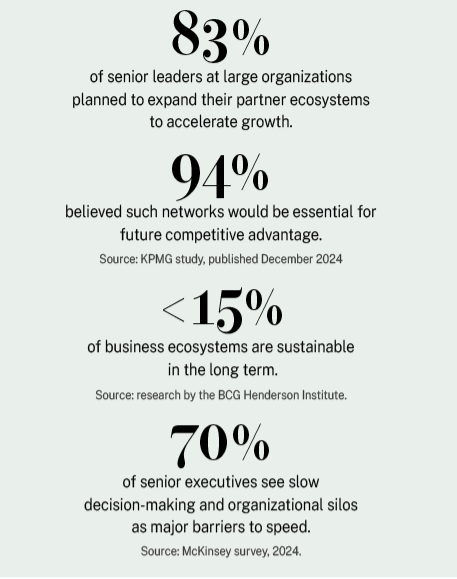
In this environment, the concept of ecosystems has moved from the margins to the center of strategic and boardroom conversations. A KPMG study published in December 2024 found that 83% of senior leaders at large organizations planned to expand their partner ecosystems to accelerate growth, and 94% believed such networks would be a key enabler of future growth and competitive advantage.

Why? Ecosystems promise a way to regain speed, access capabilities beyond the firm, and respond to markets that no longer respect industry boundaries. However, and this is where many stumble, they are easy to misunderstand, and deceptively hard to lead. Most will fail. Fewer than 15% of business ecosystems are sustainable in the long term, according to research by the BCG Henderson Institute.

So, are ecosystems just another business model to try from the corporate toolkit, or do they represent a more fundamental shift in how corporate strategy itself must be designed and led? Are we witnessing a game-changing evolution in the way companies compete, not just how they function? And, if so, how can executives avoid the common pitfalls to build ecosystems that will transform their businesses?

Ecosystem thinking starts from the reality that value creation is already
distributed.

Ecosystem thinking is on the rise

The renewed interest in ecosystems has been attributed to external disruption. Trade fragmentation, geopolitical uncertainty, and regulatory pressure have weakened long-standing assumptions about global integration. Digital technologies and data are dissolving industry boundaries. But external pressure alone cannot explain why ecosystem thinking is gaining traction.

Across many large organizations, internal coordination has become one of the biggest constraints on performance. McKinsey research has found that more than 70% of senior executives see slow decision-making and organizational silos as major barriers to speed. As companies grow, the cost of aligning people, processes, and decisions inside the firm often rises faster than the cost of working across its boundaries. What once looked like control now feels like a burden.

Traditional responses are proving inadequate. Vertical integration, the strategy where firms seek to control more of their supply chains, is time-consuming and capital-intensive. Purely transactional partnerships lack the depth or flexibility required to solve complex, interdependent problems. Platform investments may improve efficiency without changing how decisions are made.

As we saw with Ping An, ecosystems emerge from necessity and opportunity when conditions allow and require coordination to be redistributed from a monolithic center to networks of actors who can interact, adapt, and recombine capabilities more quickly to create value. Rather than assuming value can be designed and delivered within one organization, ecosystem thinking starts from the reality that value creation is already distributed.

This is why ecosystems are no longer confined to digital platforms or technology companies. They are reshaping manufacturing at companies such as Haier, agriculture at Bayer Crop Science, finance and healthcare at Ping An, mobility at Tesla, and the energy transition at Ørsted. These are not experiments in novelty; they are responses to structures struggling to cope with complexity.

What an ecosystem is, and what it is not

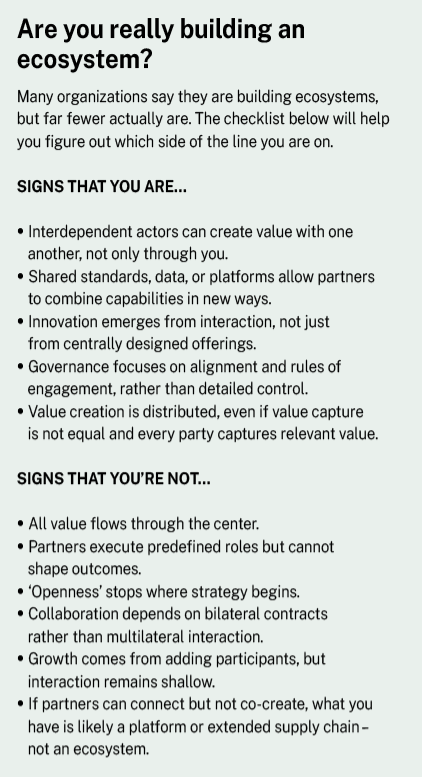
As ecosystem thinking spreads, we see the term increasingly applied to almost any form of collaboration. This blurs an important distinction that is fundamental to the success of any ecosystem: Not every platform, partner network, or alliance is an ecosystem. A true business ecosystem brings together independent actors who create value through their interactions with one another, not only through a central firm. Shared standards, governance, and digital infrastructure make those interactions repeatable and scalable. Ecosystems do not eliminate complexity. They change how it is governed, shifting authority away from hierarchy and across a network of interdependent actors.

If all value flows through the center, you don’t have an ecosystem (nor its scalable benefits); you have a sophisticated supply chain or platform. In those scenarios, partners execute predefined roles. In an ecosystem, they shape outcomes. That difference is strategic.

Many companies struggle with these distinctions. They invest in portals, digital interfaces, or innovation hubs, thinking they are unleashing the potential of ecosystem thinking, yet they retain tight control over how value is created and captured. Partners can connect to the ecosystem – but they cannot co-create. The result is a network in form, not in function. How, then, does genuine ecosystem strategy show up in practice?

Let’s look at ASML, the Dutch semiconductor equipment leader. Its extreme ultraviolet machines depend on coordinated advances across optics suppliers, chip designers, materials scientists, and fabrication plants. No single firm controls the system from design to production. Advantage emerges from deep interdependence rather than isolated optimization.

Bayer Crop Science’s digital agriculture platform connects farmers, agronomists, equipment makers, and software providers around shared data and services. Coordination is distributed across the network rather than centralized within a single organization. Value emerges across the network.

Or consider the case of global home appliances and consumer tech giant Haier. Facing slowing growth, Haier transformed itself into thousands of microenterprises – each one focused on a specific user need, each one accountable for its own survival. Digital platforms provide shared services, but the individual units operate with the autonomy of startups. The aim was not to eliminate complexity, but to metabolize it.

In each case, an ecosystem is not a layer added to the firm. It is a redesign of how coordination happens at scale.

Ecosystem archetypes and trade-offs

These examples illustrate another crucial point: ecosystems do not come in a one-size-fits-all form. By necessity, they are diverse and come with different trade-offs that must incentivize participation, not stifle it.

Platform archetype: concentrated platform power in return for reach

Some are built around digital platforms that scale fast but concentrate power. Think of Alibaba or Salesforce’s partner cloud. These systems scale rapidly because one actor sets the rules. The standards are clear. Interfaces are defined. Value flows efficiently, but so does control.

In this kind of ecosystem, partners gain reach, and, in return, they accept dependency. When governance changes, they adjust or exit. These ecosystems prioritize speed and coherence over shared authority.

Industrial archetype: no single point of control for industrial resilience

In industries such as mobility and energy, companies like Tesla and Ørsted operate within and help orchestrate ecosystems where no single actor controls the system from end to end. Charging networks, grid operators, regulators, suppliers, and customers must coordinate. Governance is negotiated. Progress is slower – but resilience increases.

User-centered archetype: users, not platform, as foundation

Then, there are ecosystems built around users rather than platforms. Haier’s microenterprise model is a case in point. Teams form around specific customer problems. Authority sits closer to demand. Digital infrastructure provides shared services, but decision rights move outward. Speed increases at the edge – coherence must be earned, not imposed.

Each archetype redistributes power, risk, and learning differently. Platform ecosystems centralize control and accelerate scaling. Industry ecosystems trade speed for shared resilience. User-centered ecosystems decentralize authority in exchange for adaptability.

Each archetype requires distinct strategic tradeoffs. Who defines the standards? Who controls the data? Who captures the upside – and absorbs the downside? Ecosystems are not neutral architectures; they are governance systems.

An ecosystem built for dominance will not look like one built for coordination. One designed for rapid scale will not resemble one built for systemic resilience. Confuse those objectives, and what emerges is not an ecosystem, but a compromise that satisfies no one.

What changes for strategy in an ecosystem

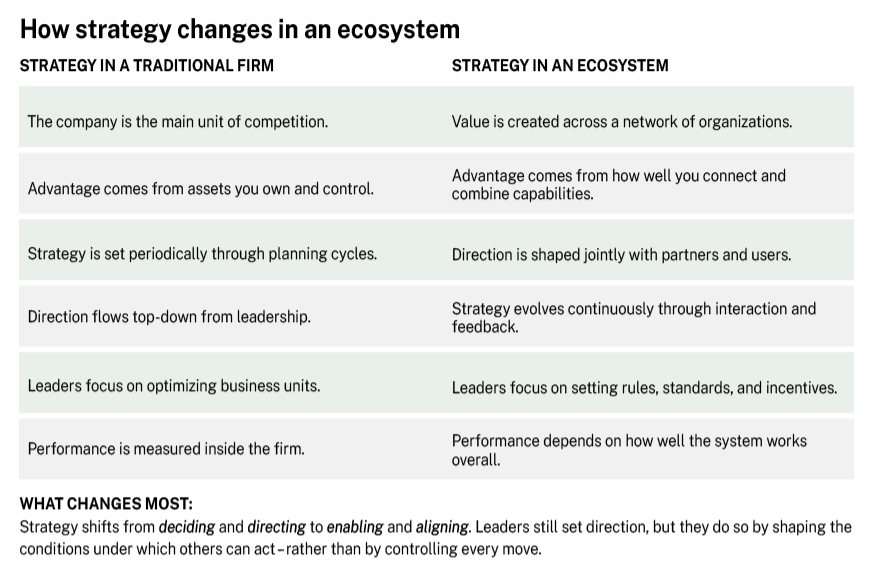
Ecosystems do not just change how companies collaborate; they change what strategy means. Traditionally, strategy has focused on positioning your company within an industry and building advantages based on scale, cost, or differentiation. It was treated as a periodic exercise: analysis, planning, and execution. The organization was assumed to be the primary unit of competition.

Ecosystems challenge all three assumptions.

Competitive advantage increasingly depends not only on what a firm owns, but on the quality of its connections. Value is created through complementarities, network effects, and shared infrastructures that no single organization fully controls. The advantage is less about defending a position and more about enabling interaction.

How strategy is made also begins to change. It becomes less a top-down plan and more a continuous coordination process. Decisions in one part of the system reshape options elsewhere. Partners, complementors, and even customers influence outcomes in ways that cannot be fully predicted or directed in advance.

Ping An illustrates this shift clearly. As its businesses became more interconnected, strategic decisions in one area increasingly affected those in other areas. Its foray into healthcare influenced its insurance models. Financial services interacted with real estate and urban infrastructure.

Strategy could no longer be designed and executed solely within each business unit, nor could it be fully dictated from the center. Instead, it became codependent. Shared digital infrastructure enabled real-time data flows across units. Governance mechanisms focused less on control and more on enabling alignment. Strategic direction emerged through interaction, feedback, and adjustment across the ecosystem.

In an ecosystem, strategy does not disappear; it moves. Instead of optimizing business units, leaders focus on setting boundaries and governing interfaces as interactions across the system evolve. Rather than taking command from the center, leaders shape the conditions for co-evolution.

Consider Haier. Microenterprise leaders are not evaluated by their superiors; they are evaluated by the users they serve. If a unit fails to attract customers, it dissolves. Leadership authority flows from proximity to the problem, not a traditional hierarchy.

In traditional hierarchies, leaders direct, allocate, and monitor. In ecosystems, leaders frame, enable, and connect.

Why many ecosystems fail

Let’s return to that uncomfortable truth: despite all the enthusiasm and potential, most ecosystem initiatives fail to reach scale or deliver meaningful returns. Why does this happen, and how can you avoid failure? The reasons are rarely technical. They are strategic and deeply human.

Can you decentralize power?

Perhaps the most common mistake happens when companies try to build an ecosystem while maintaining traditional control. Organizations might adopt the language of openness, but they design structures that keep decision-making, data, and value tightly centralized. Partners quickly recognize when they are participants in name only. What emerges is not an ecosystem, but a tightly managed network with limited shared value and cautious actors.

The contrast with companies that redistribute authority is instructive. Microenterprise leaders answer to users, not to layers of hierarchy. Authority moves outward. Without that shift, ecosystems will stall. Partners might plug into a platform, but without shared authority, they rarely shape outcomes.

Are you sharing value with partners?

Another pitfall to avoid is an unclear or one-sided value proposition for partners. Ecosystems depend on reciprocal value creation. If participants cannot see how they benefit – through access to customers, data, capabilities, or revenue – their commitment weakens. When the dominant player focuses primarily on extracting value, the system gradually loses vitality.

Are you moving too fast?

Others pursue breadth before depth, adding partners faster than they build foundations for collaboration. Without alignment and clear integration mechanisms, scale amplifies complexity. The result is scale without substance.

Is your ecosystem just an experiment?

Organizational design can compound the problem. Ecosystem initiatives are often confined to innovation labs or digital units, disconnected from core business processes and incentives. Without integration into the core, they remain peripheral experiments rather than drivers of transformation.

At the heart of these failures is a mindset problem. Ecosystems are approached as extensions of, or alterations to, existing business models and operations rather than as a shift in strategy: how value is created and governed. Leaders try to apply familiar tools – tight control, bilateral contracts, short-term financial metrics – to systems that depend on trust, multilateral interaction, and longer time horizons. The structure looks new. The logic remains old.

Competitive advantage increasingly depends not only on what a firm owns, but on the quality of its connections.

Leadership, trust, and culture in an ecosystem

With all this talk of shared control and dispersed decision-making, you would be forgiven for thinking that ecosystems greatly dilute the role of the CEO or leader. This would be a costly miscalculation. Ecosystems do not remove the need for leadership. They change its focus and raise the demands.

In traditional hierarchies, leaders direct, allocate, and monitor. In ecosystems, leaders frame, enable, and connect. Their role shifts from making most of the decisions to shaping the conditions in which others can make good ones.

Leaders must thrive in ambiguity

This requires an enhanced tolerance for ambiguity. Ecosystem leaders cannot see or control every interaction. They must rely more on shared purpose, clear principles, and transparent information flows than on detailed supervision. As Haier’s long-time chairman Zhang Ruimin put it in one speech, Haier removed layers of middle management to move toward “zero approvals” and make the customer the only real supervisor. This shift from control at the center to accountability at the edge is at the heart of ecosystem leadership.

Trust matters even more in an ecosystem

Trust, and the ability to foster and sustain it, becomes a strategic asset. Ecosystems rely on relationships that cross organizational boundaries, often without the safeguards of ownership or formal authority. Leaders must invest in building credibility, fairness, and long-term commitment with partners.

Leaders as pioneers of ecosystem culture

Culture plays a critical role, too. Teams must be willing to collaborate beyond organizational boundaries, share information responsibly, and balance local goals with system-level outcomes. Incentives and performance measures need to reflect ecosystem success, not just internal metrics. This shift can be demanding. It challenges deeply held assumptions about ownership, competition, and control. Without it, ecosystem structures become expensive theater – new organization charts draped over old reflexes.

Designing and leading an ecosystem

Ecosystems are not built by declaration. They emerge as a necessity when coordination inside the firm can no longer keep pace with the complexity outside it. The first question is not, “How do we build an ecosystem?” but, “Where is coordination already breaking down?”

Which customer problems exceed your boundaries? Which capabilities sit beyond your control? Where does internal alignment slow response more than external collaboration would?

Only then does the future become clear. Some firms orchestrate the ecosystem. Others specialize. Not every organization should lead. In many ecosystems, the strongest position is the expert contributor, not the central hub.

From there, the work is structural: deciding what to share and what to protect, investing in the kind of digital infrastructure and governance that allows ecosystems to function without excessive friction, and adopting metrics that reflect ecosystem health – participation, partner satisfaction, and innovation rates – not just internal financials.

This is not a structural adjustment. It is a shift in leadership logic. Leadership becomes less about directing activity and more about shaping an environment in which others can create value. Strategy moves from optimizing units to governing interfaces; from commanding resources to orchestrating relationships; from ownership to interaction. This is the ecosystem mindset that offers a strategic answer, not just another business model, for an interconnected world.

The real risk is not choosing the wrong ecosystem model. It is applying a hierarchy mindset to a system that no longer runs on hierarchy alone. Leaders who understand what ecosystems are – and are not – can turn complexity into advantage.

Authors

Mark Greeven

Mark J. Greeven

Professor of Management Innovation and Dean of Asia, IMD

Mark Greeven  is Professor of Management Innovation and Dean of Asia at IMD, where he co-directs the Building Digital Ecosystems program and the Strategy for Future Readiness program, and the Future-Ready Enterprise program, which is jointly offered with MIT. Drawing on two decades of experience in research, teaching, and consulting in China, he explores how to organize innovation in a turbulent world. Greeven is responsible for the school’s activities and outreach across Asia and is a founding member of the Business Ecosystem Alliance. He is ranked on the Thinkers50 list of global management thinkers (2025, 2023).

Related

Learn Brain Circuits

Join us for daily exercises focusing on issues from team building to developing an actionable sustainability plan to personal development. Go on - they only take five minutes.
 
Read more 

Explore Leadership

What makes a great leader? Do you need charisma? How do you inspire your team? Our experts offer actionable insights through first-person narratives, behind-the-scenes interviews and The Help Desk.
 
Read more

Join Membership

Log in here to join in the conversation with the I by IMD community. Your subscription grants you access to the quarterly magazine plus daily articles, videos, podcasts and learning exercises.
 
Sign up
X

Log in or register to enjoy the full experience

Explore first person business intelligence from top minds curated for a global executive audience