
AXA’s 2026 people priorities: AI, mental health, and learning
AXA CHRO Sandrine Girszyn outlines 2026 HR priorities: embracing AI, supporting employee wellbeing, and fostering a culture of continuous learning....

by Iana Kouris, Mark Abraham Published January 12, 2026 in Wellness • 8 min read •  Audio available
At some point, everyone has a moment of truth about their health: a parent falls ill, a friend receives a diagnosis, a doctor gently but firmly tells you it’s time to make a change. It’s often only when these moments arrive that we shift our mindset from assuming “I’m fine for now” to suddenly caring very much about the future. By then, the focus has moved from prevention to desperately catching up.
Why do we wait? Most of us want to live longer, healthier lives, yet we carry an underlying assumption that our final years will inevitably be marked by decline. We hope for vitality but quietly accept the prospect of frailty.
We call this the longevity paradox: the gap between what we aspire to and how we actually behave. This isn’t simply a matter of willpower. Our environments, incentives, and systems are built for treatment, not prevention – making it far easier to react to decline rather than invest in our health earlier on.
At the same time, the longevity economy is booming. Social media feeds have turned optimization into aspiration: early-morning cold plunges, high-protein diets, creatine in coffee, wearable-driven sleep scores, and fitness routines are built around the idea of adding years to your life. Clinics offer full-body MRI scans as part of annual check-ups. Continuous glucose monitors and gut microbiome tests – once reserved for patients with medical conditions – are marketed as proactive longevity tools.
We know more about health science than any generation before, and we have more ways to measure, track, and improve our health. Our behavior, however, tells a different story. For all the talk of prevention, most people still act only when something goes wrong.
This gap isn’t just personal – it’s economic. As consumers rethink how they invest in their health, industries from food to finance are being reshaped around the concept of longevity. What was once a niche wellness trend has now become a strategic frontier touching healthcare, technology, and the workplace.
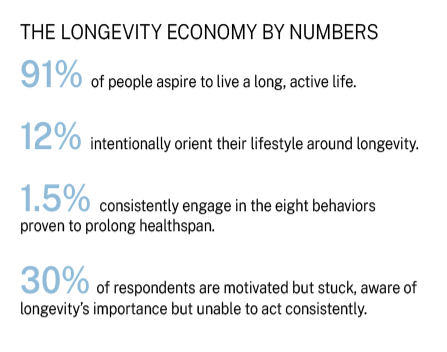
To understand how people truly think and behave when it comes to longevity, we surveyed 9,350 consumers across 19 countries for BCG’s Global Study on Longevity, conducted in partnership with the St Moritz Longevity Forum. The results were striking. Nearly everyone aspires to live a long, active life, but only 12% say they are intentionally orienting their lifestyle around longevity.
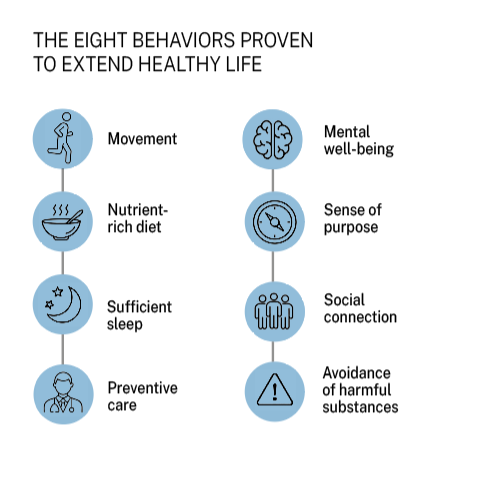
When we look at what people actually do, the gap widens even further. Only 1.5% of respondents are consistently engaging in all eight of the proven behaviors that add the most healthy years to life – from movement, diet, and sleep to purpose, connection, and preventive care. Fewer than half of respondents in any age group reported regularly exercising, eating well, or getting enough sleep – the most basic foundations of healthy aging.
The disconnect between intention and action runs deep. Longevity feels abstract and distant: a “future me” problem. Most people genuinely believe they’ll make better choices later. The science is clear: the earlier we start, the greater the gains. Every year of delay shortens the runway.
Among young adults, the paradox comes into even sharper focus. They are the healthiest and the unhealthiest generation in history: counting their steps and meditating more than older adults – while doomscrolling late into the night, vaping, guzzling sugary drinks, and reporting burnout at record levels. The healthiest behaviors and the most harmful habits are not happening in separate groups – they’re happening within the same individuals. We strive for longevity, yet actively undermine it every day.
The challenge is clear: how can we turn longevity from a cultural conversation or social media aspiration into a lived reality – one supported by systems, environments, and choices that make healthy living easier for everyone?
At the heart of the longevity paradox lies a deeper behavioral issue: people confuse outcomes with means. Many of us focus on what we think we should do – eat better, exercise more – without a clear sense of why. The “why” is deeply personal. For some, it is dancing at a grandchild’s wedding, traveling into their 80s, or continuing a career that brings purpose and identity. We refer to these as “health ambitions” – a concept at the heart of our research.
Our research revealed that motivation lives in that “why”. When health becomes part of a story we care about, rather than a checklist of self-improvement tasks, behavior starts to change. However, the systems in place, from food environments to healthcare pathways, are not designed for proactive health. No one is taking care of you until you appoint yourself the CEO of your own health and well-being. This mindset shift is often what separates intention from action.
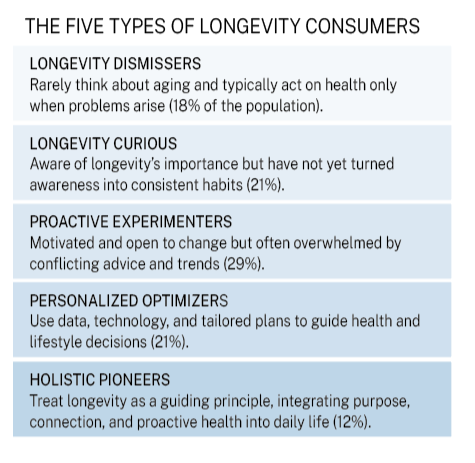
To better understand where people are on their longevity journey, we mapped the five stages of engagement defined in our Longevity Engagement Ladder – from those who rarely think about aging to those who fully organize their lives around it.
At one end are the Longevity Dismissers, who don’t consider longevity at all and tend to think of health only when problems arise. Next are the Longevity Curious, who understand its importance but haven’t yet turned that awareness into action. The middle of the spectrum is made up of the Proactive Experimenters – individuals who are motivated and open to change, trying new approaches but often becoming overwhelmed by conflicting information. The most engaged are the Personalized Optimizers and Holistic Pioneers, who have made longevity a guiding principle, making deliberate and sustained choices that support long-term health.
The steepest drop-off sits among the curious and the experimenters. They struggle to tell what’s credible from what’s merely trendy, and without trusted support, they often lose momentum. As our data shows, this group makes up roughly 30% of the population – highly motivated but stuck in an “infodemic” of health advice. Younger generations are especially concentrated here.
Podcasters, remarkably, have become top-ranked sources of health advice, ahead of doctors. That alone should be a wake-up call. The longevity market is booming, encompassing supplements, wearables, and personalized health apps, yet it remains fragmented and uneven in quality.
What’s missing isn’t more data, but more direction. AI can help – but only if it is trained on credible, evidence-based sources and used to guide, not manipulate. When healthy choices become the easy, default ones – embedded in workplaces, communities, and daily life – information overload gives way to informed action.
Platforms, brands, and healthcare providers that can translate reliable science into practical, personalized advice will become the trusted anchors in this noisy ecosystem.
For business leaders, our research underlines that longevity is not a niche wellness concern; it’s a significant strategic opportunity. Demographics are reshaping demand. By 2050, the number of people aged 60 and above is expected to reach two billion, and more than half of global purchasing power is already held by consumers in this demographic.
Entire industries must rethink how they design for and benefit from longer, healthier lives. Healthcare must shift from reactive sick care to proactive prevention. Financial services will need to support 100-year life planning and offer new models for phased careers rather than traditional retirements.
Food and beverage companies must address the need for genuinely nutritious choices and credible guidance. Insurers such as Vitality are rewarding healthy behavior with lower premiums. Food companies, including Nestlé and Danone, are reformulating portfolios around nutrient-rich products, while technology leaders like Philips and Apple are embedding health tracking into everyday life.
But the longevity opportunity extends far beyond serving older consumers – it’s about designing for vitality at every age. Thriving organizations will enable long-term well-being by building trust through transparency, utilizing data responsibly, and cultivating lifelong customer relationships.
Companies that embed longevity principles into their design, culture, and value propositions will not only open new markets but also build brands that stay relevant as their customers and workforces age.
The future of longevity is personalized, data-driven, and increasingly powered by artificial intelligence. Every individual starts from a different place. Biology, guidance, access, stress levels, lifestyle, and culture all shape what works and what doesn’t. Personalization makes healthy behavior more attainable and sustainable. Motivation lies in the “why” and personalization is how we reach it.
New technologies make that possible. Platforms like Noom, SonderMind, and Ovum show how AI-driven personalization can turn data into behavioral change. Diagnostic innovators such as Vitract, Eternami, and Fountain combine biomarker tracking with AI-powered scans to deliver early insight into potential risks. Wearables capture continuous data about our bodies, and AI-powered health coaches translate that information into practical guidance. These tools can help shift behavior from inconsistent experimentation to sustained engagement – especially when health becomes social, fun, and tied to a sense of progress.
As with all tech innovations, trust will ultimately determine adoption. Consumers will only share their most intimate data if they feel protected, respected, and in control. Decisions around privacy, transparency, and independence from commercial bias will shape who wins in the longevity ecosystem – and how much positive impact tech can have on people’s lives.
Promoting and enabling healthier aging is also a leadership and workforce challenge. For the first time, five generations coexist in the workplace. A longevity-ready organization enables people to remain engaged, healthy, and capable through every phase of life. This means adapting learning pathways, redesigning work models, and offering more proactive support for physical and mental health. Companies like Nestlé and Unilever are experimenting with mid-career reskilling and well-being programs that sustain energy and purpose over longer careers.
Meeting people where they are and removing friction step by step is the way to make progress. It will take technology, human-centered design, and empathy.
The most profound idea we uncovered during our research was also the simplest: make healthier choices easier. Longevity must shift from being a wellness trend to becoming a core part of daily infrastructure, where healthier options are the default rather than the exception.
This is a once-in-a-generation strategic opportunity for business. The organizations that shape the longevity economy will drive growth and innovation, and help millions of people live better, longer lives. The question is no longer whether longevity matters – it’s how quickly leaders will choose to act. Healthy aging may start with personal choices, but its future will be shaped by the leaders who design for it.
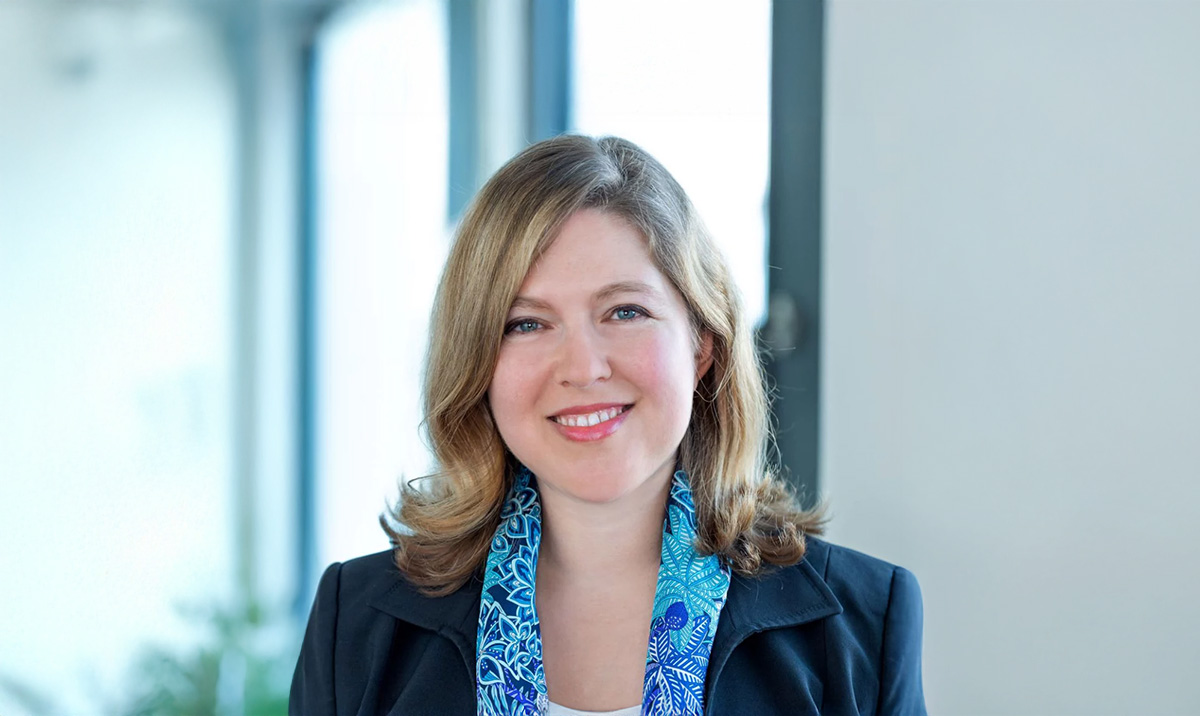
A managing director at Boston Consulting Group
Iana Kouris is a managing director at Boston Consulting Group and a core member of BCG X, the firm’s tech build and design unit, where she leads customer experience transformations as part of BCG’s marketing, sales, and pricing practice. Her current focus includes supporting healthcare, insurance, and consumer companies to tap into the rapidly growing longevity economy.
A managing director and senior partner at Boston Consulting Group
Mark Abraham is a managing director and senior partner at Boston Consulting Group, where he leads the firm’s marketing, sales, and pricing practice globally. He helps global consumer and retail companies use data and technology to deliver personalized customer experiences and large-scale business transformation. Abraham is also co-author of Personalized: Customer Strategy in the Age of AI.
March 27, 2026 in Wellness
AXA CHRO Sandrine Girszyn outlines 2026 HR priorities: embracing AI, supporting employee wellbeing, and fostering a culture of continuous learning....

February 23, 2026 • by Gladys Moran in Wellness
The physical, mental, and emotional well-being of your people is an often overlooked metric that will lead to improved results for your organization, suggests Gladys Moran...
 Audio available
January 30, 2026 • by Qi Zhang in Wellness
David learns to see conflict not as an end, but as a cycle of renewal - embracing tension, repair, and trust to transform his work relationships...

January 19, 2026 • by Roland Liebscher-Bracht, Petra Bracht, Christoph Glaser in Wellness
Roland Liebscher-Bracht, Petra Bracht and Christoph Glaser share a three-part formula for daily leadership practice....
Explore first person business intelligence from top minds curated for a global executive audience