Rethinking Europeās capital markets strategy: Lessons from Swedenās model
European households hold trillions in bank deposits while participation in capital markets remains underdeveloped. Sweden offers an alternative approach. ...

by Mischa Riedo, Karl Schmedders Published March 27, 2026 in Finance ⢠7 min read
In recent months, equity markets have repeatedly reached record highs. When major indices reach such levels, many investors instinctively begin to question their next move: whether caution is now warranted, whether it is time to take profits, or whether those still on the sidelines have already missed their opportunity.
New highs are often portrayed in sensationalist terms, framed as moments when markets have overshot reality. Yet this interpretation is misleading. All-time highs are better understood as a natural feature of functioning capitalist systems. In economies shaped by population growth, technological progress, reinvestment, and moderate inflation, corporate earnings tend to rise over time. Equity indices, which ultimately reflect those earnings, therefore spend a considerable portion of their history near or at record levels.
This perspective is familiar to senior executives in their own domains.
Companies rarely abandon expansion plans simply because revenues or profits have reached new highs. Record results are more often a reflection of successful strategy, rising demand, and improving productivity, rather than excess. Financial markets, for all their noise, are no different. Importantly, this argument only applies to diversified equity markets in economies with positive long-run growth, not to individual stocks, narrow sectors, or speculative manias.
Despite this logic, many investors struggle emotionally with investing at market highs. Two well-documented behavioral biases are at work.
Together, these biases create the impression of being too late. Yet markets do not know or care where an individual investor last considered investing. Prices reflect the collective assessment of future cash flows, not regret over missed opportunities.
Of course, not every all-time high is identical.
Of course, not every all-time high is identical. But whether markets are expensively valued cannot be inferred from index levels alone. It requires an examination of underlying fundamentals, particularly earnings.
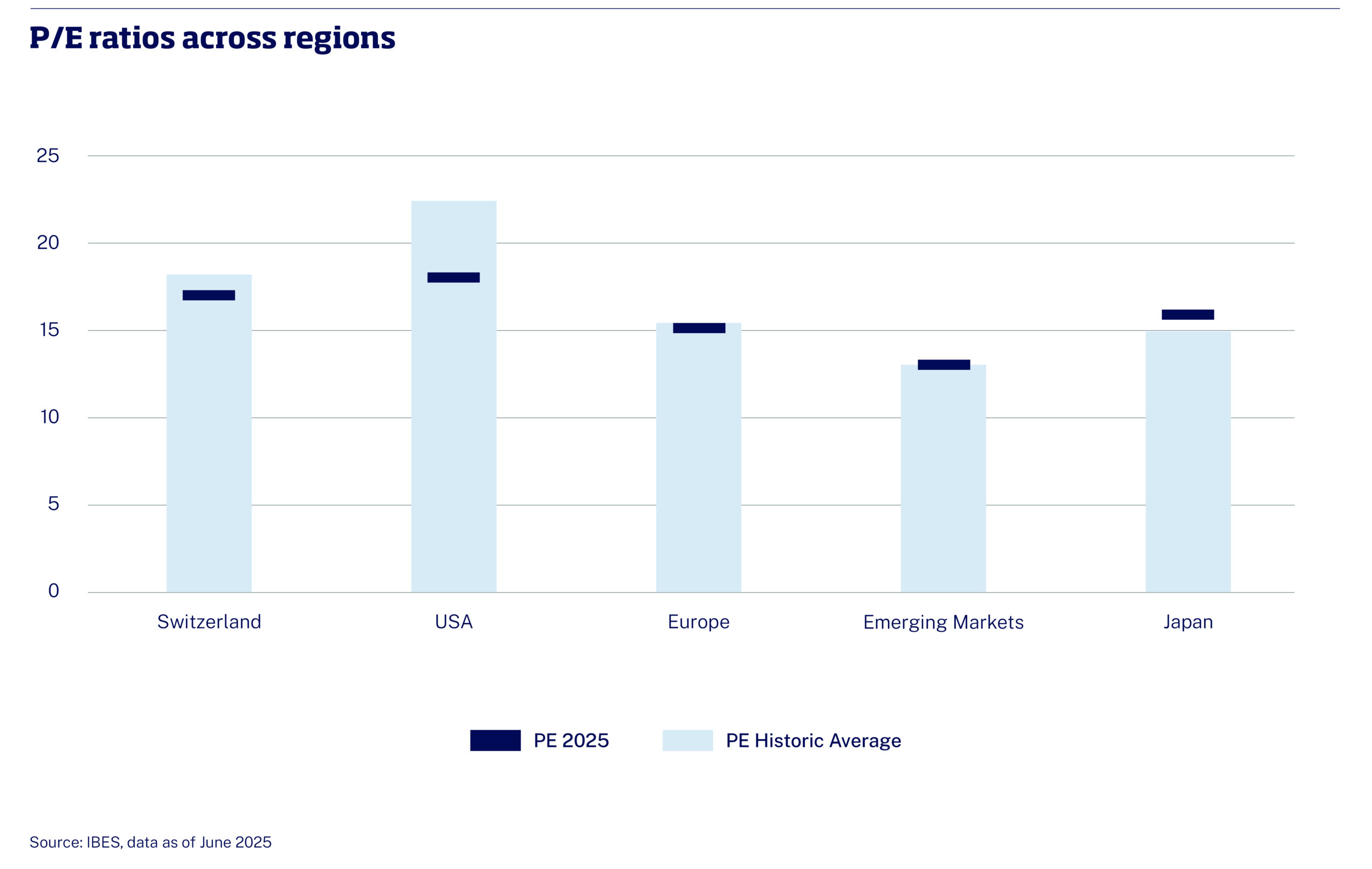
By this measure, much of the global equity market currently trades close to long-term valuation averages (see Chart 1). The Swiss Performance Index (SPI), for example, is valued at a price-to-earnings (P/E) ratio of about 18, broadly in line with its historical norm. Since 2020, the index has risen by roughly 30%, while aggregate corporate earnings have grown by more than 40% over the same period.
Prices have followed profits, not outrun them.

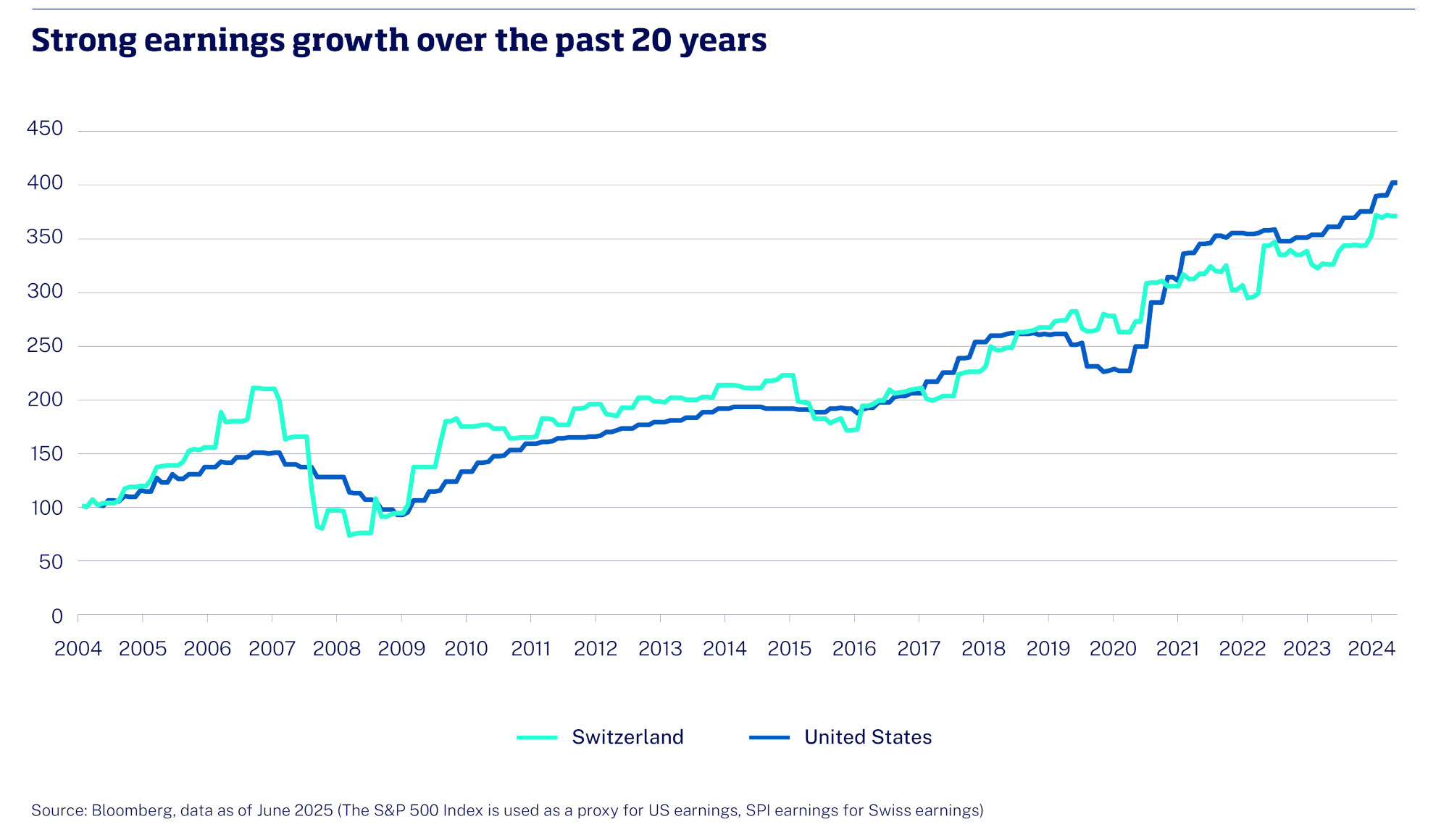
The US stands out as the main exception, with valuations meaningfully above long-term averages. Yet this, too, requires context. Since 2020, earnings among companies in the S&P 500 Index have more than doubled, by far the strongest growth among major regions (Chart 2). It is therefore unsurprising that the index itself has roughly doubled over that period. Moreover, a lot of the companies driving this growth have strong balance sheets, high returns on capital, and favorable long-term growth prospects.
High valuations may temper long-term expected returns and increase sensitivity to disappointments, but they do not, in themselves, imply imminent reversals.

History offers a powerful corrective to investor intuition. Far from being rare or destabilizing events, all-time highs are a recurring feature of equity markets over long periods of economic expansion. In the US, where the S&P 500 Index provides a particularly rich historical record, an estimated 7% of all trading days since 1950 have closed at a new all-time high; that is, roughly every 14th trading day.
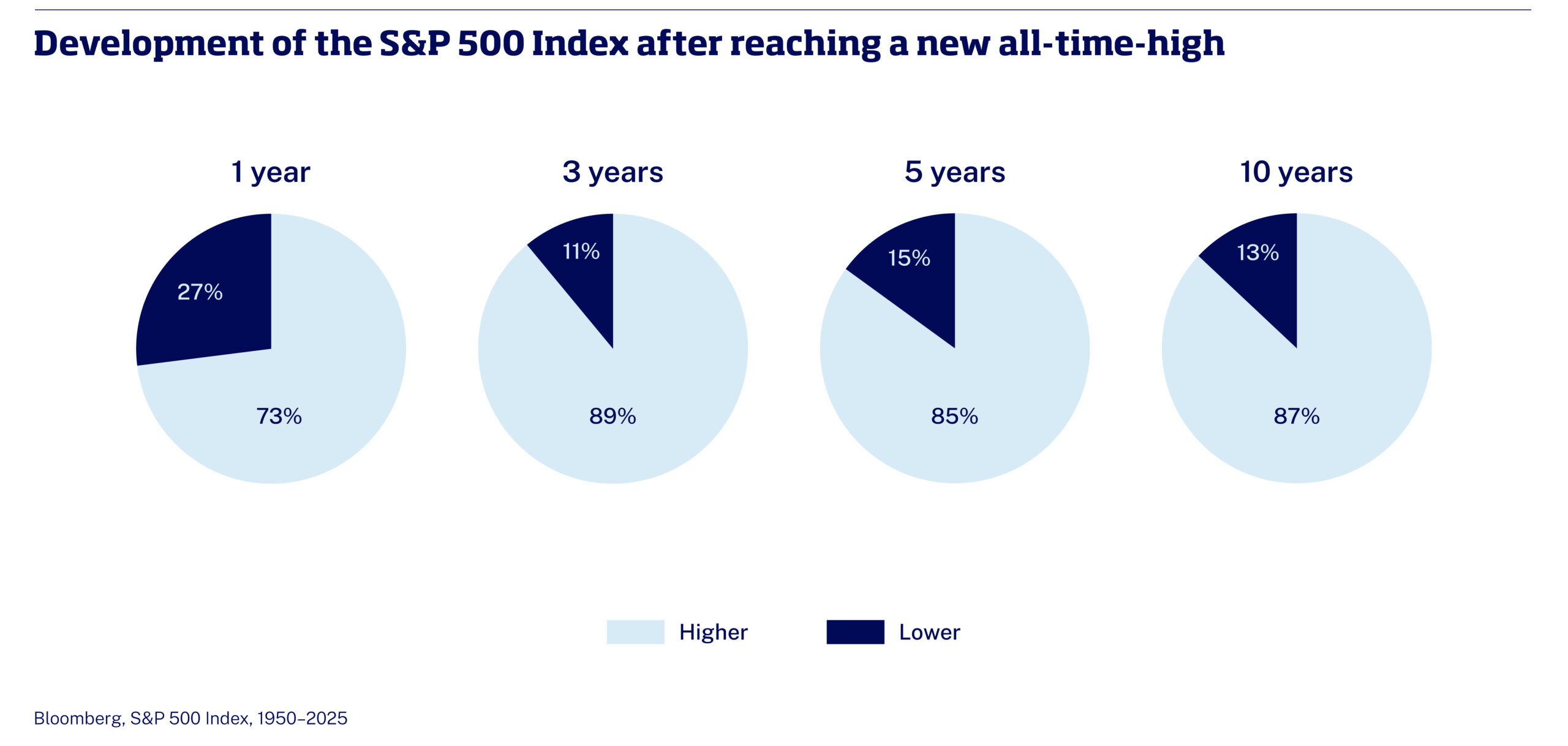
Furthermore, the data directly contradict the notion that investing at such moments leads to poor outcomes. Across short, medium, and long horizons alike, investors who entered the market at an all-time high have historically fared well. As shown in Chart 3, investments made at record levels have resulted in positive returns after one, three, five, and even 10 years in the vast majority of cases.

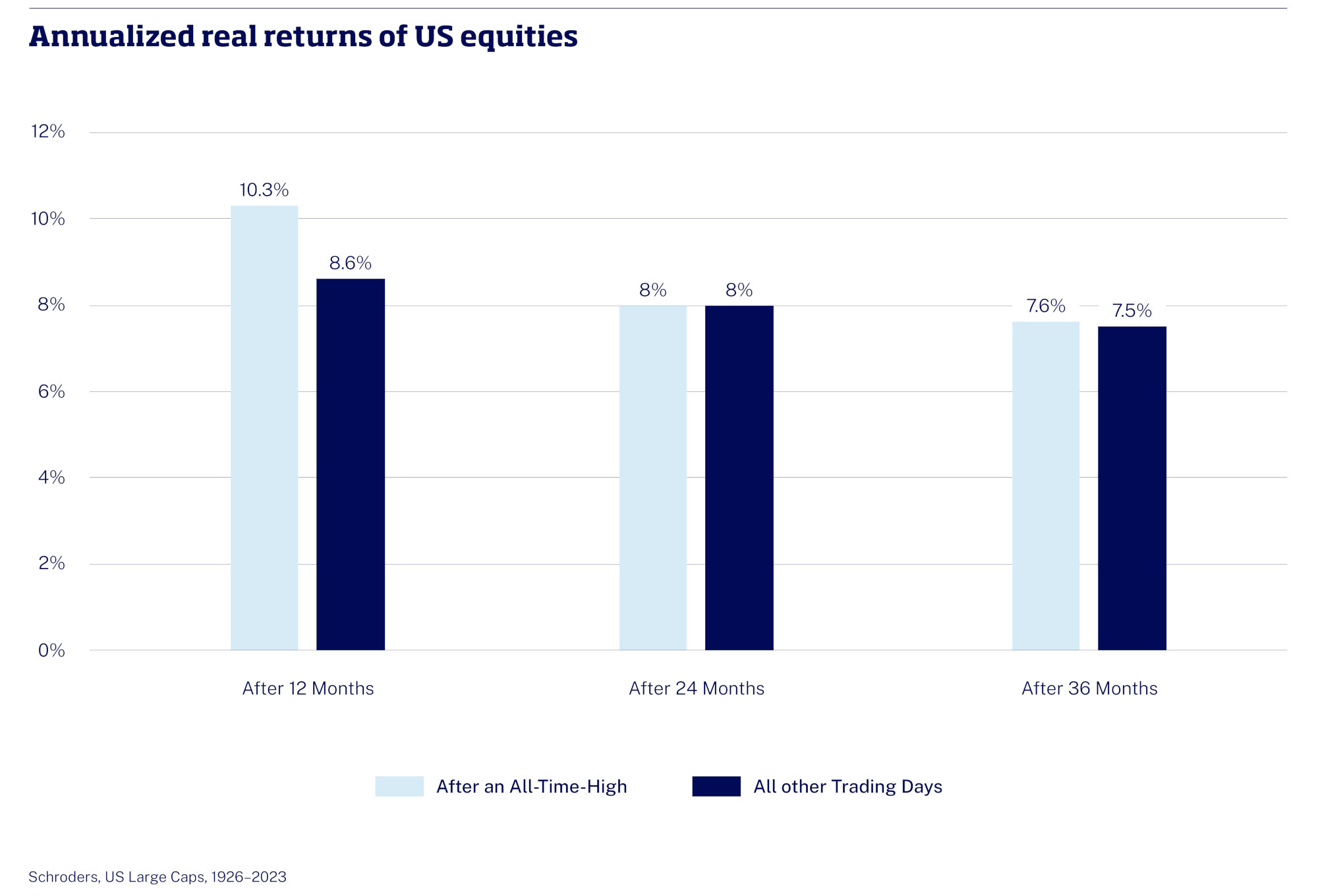
Extending the analysis further back strengthens this conclusion. Using US equity data going back to 1926, the average annual returns one and three years after an all-time high have been higher than the average returns following all other possible entry points (see Chart 4). Contrary to the intuition that new highs should prompt caution or retreat, they have historically coincided with periods of above-average subsequent performance. Similar dynamics can be observed in Swiss equities, based on SPI data since 1987, as well as in global markets as represented by the MSCI World since 1986.

Statistics alone, however, are only part of the story. What matters just as much is why markets often continue to perform well after reaching new highs.
New record levels typically coincide with improving fundamentals: earnings revisions trend upwards, balance sheets strengthen, investment increases, and confidence among corporate decision-makers rises. Such developments tend to unfold over years rather than weeks. The forces that push markets to new highs, such as innovation, productivity gains, or scale effects, rarely reverse abruptly.
In this sense, all-time highs are often less a signal of speculative excess than a confirmation that a favorable economic and corporate earnings environment is in place.
Attempts to time markets around perceived ātopsā rarely succeed.
For those allocating capital in such environments, a few principles have proved consistently useful.
All-time highs are neither default warning signals nor evidence of irrational exuberance.
All-time highs are neither default warning signals nor evidence of irrational exuberance. More often, they reflect cumulative progress: growing economies, rising productivity, and expanding corporate earnings.
For long-term investors, the key question is not whether markets are at record levels today, but whether they are likely to be higher years from now. History suggests that, by far more often than not, they are.
Markets will continue to experience setbacks and corrections. That is their nature. But they will also, if history is any guide, continue to reach new highs. Those who remain disciplined, diversified and focused on long-term fundamentals are best placed not merely to endure these episodes but to benefit from them. For disciplined investors, all-time highs are not a reason to step aside but instead a reminder that markets reward participation, not perfect timing.

Head of Portfolio Management and Deputy Chief Investment Officer at Valiant
Mischa Riedo is a Chartered Financial Analyst (CFA) and an investment professional with more than 15 years of experience in wealth and asset management. As Head of Portfolio Management and Deputy Chief Investment Officer at Valiant, the largest regional bank in Switzerland, he is responsible for the investment oversight of discretionary mandates and multi-asset strategies serving retail, high net worth, and institutional clients.Ā RiedoĀ completed his MBA at IMD in 2019.

Professor of Finance at IMD
Karl Schmedders is a Professor of Finance, with research and teaching centered on sustainability and the economics of climate change. He directs the Strategic Finance (SF) program and teaches in the Executive MBA programs. Passionate about sustainable finance, Schmedders believes that more attention needs to be paid to on the social (S) and governance (G) aspects of ESG to ensure a fair transition and tackle inequality.

March 18, 2026 ⢠by Ismaël Otsmani in Finance
European households hold trillions in bank deposits while participation in capital markets remains underdeveloped. Sweden offers an alternative approach. ...
March 9, 2026 in Finance
CFO Raphael Savalle explores how finance leaders can unite sustainability, AI, and human leadership to drive strategy in a fast-changing world....

February 24, 2026 in Finance
Schindler CFO Carla De Geyseleer explains how todayās CFO acts as a strategic co-pilot, uses sustainability to drive growth, and develops future finance leaders....

February 11, 2026 ⢠by Catherine Agamis, Hischam El-Agamy in Finance
How banks can position themselves across multiple futures to deliver on sustainability commitments while maintaining ļ¬nancial performance...
Explore first person business intelligence from top minds curated for a global executive audience