
Economics
Adam Smith and the miracle of your caffè latte
by Stefan Michel Published March 9, 2026 in Economics • 6 min read
First published 250 years ago, The Wealth of Nations remains a cornerstone of economic thought. Adam Smith’s treatise on free trade is still highly relevant for today’s fracturing global economy, argues Stefan Michel.
Walk into any coffee shop and you will witness a quiet miracle of coordination. The beans may come from Colombia, the milk from a Swiss valley, and the cup from China. Yet no one planned this complex dance.
Each actor in this value constellation, the farmer, the roaster, the barista, is pursuing their own livelihood. There seems to be an “invisible hand” that coordinates all these activities. Adam Smith described it perfectly 250 years ago in his book The Wealth of Nations.
Perhaps no phrase is more misunderstood in economics than this “invisible hand.” It is not a mystical force guiding the economy but a social mechanism. When individuals act to improve their own situations, they often promote the welfare of society as a whole.
The baker does not bake to feed strangers, Smith observed, but to earn a living. Yet the result, fresh bread for the community, becomes a public benefit.
In its modern form, the same logic governs how Uber drivers, online merchants, and gig economy workers coordinate without central direction. It is the invisible hand in digital form.
Trade creates wealth
The book was not called The Wealth of Firms, and for good reason. In Smith’s time, European nations measured wealth in terms of gold reserves and tried to accumulate it through trade restrictions. The prevailing idea was mercantilism, a zero-sum game in which one nation’s gain was another’s loss. Smith dismantled this notion. Wealth, he argued, is not the amount of treasure stored in vaults but the capacity to produce and exchange goods. When trade is free, both sides benefit. It is ironic that in the year of the book’s 250th anniversary, this well-proven economic axiom is being challenged by nationalist politicians. While global trade certainly creates winners and losers, Smith would remind us that closing borders rarely makes a nation richer. It usually just changes who pays the price.
The foundation of economics, strategy, marketing, and more
Smith tied the wealth of nations to the activities of firms and consumers. A baker or a coffee shop owner, on their own, does not create wealth, nor does a city full of Uber drivers. To create more wealth, two conditions must be met: first, each actor should focus on tasks in which they are very good (i.e., division of labor), and then exchange those goods for other goods they need.
While global trade certainly creates winners and losers, Smith would remind us that closing borders rarely makes a nation richer.
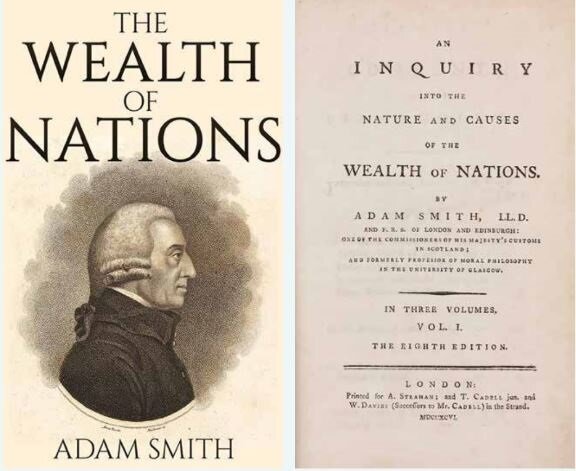
Adam Smith, born in Kirkcaldy in 1723, was a child of the Scottish Enlightenment. He attended the University of Glasgow from the age of 14, where he was exposed to influential philosophical thinking, and continued his studies at Balliol College, Oxford.
Smith built an academic career and became Professor of Moral Philosophy at the University of Glasgow. During this period, he published The Theory of Moral Sentiments in 1759, a work that
established his reputation as an important moral philosopher long before he became known as an economist. In 1764, he left academia to serve as tutor to a young duke, a role that allowed
him to travel extensively across France and Switzerland. These travels proved decisive for his intellectual development. It is widely believed that he met Voltaire and Benjamin Franklin, whose ideas influenced his emerging views on commerce, society, and political economy. Smith later returned to Kirkcaldy, where he spent roughly a decade writing The Wealth of Nations, published in March 1776.
In his later years, Smith lived in Edinburgh and served as a customs commissioner, an appointment often noted for its irony given his advocacy of free trade. He lived quietly as a lifelong bachelor and reportedly donated much of his wealth to charitable causes before his death in 1790.
Smith illustrated his insight for the first condition through the famous example of the pin factory. Ten workers, each performing one narrow task – drawing wire, cutting, sharpening, and packaging – could produce thousands of pins a day, far more than if each worked alone. The lesson has echoed through centuries: specialization yields exponential efficiency. From Ford’s assembly line to today’s software development sprints, dividing tasks lets individuals perfect their expertise, drives down costs, and raises productivity – the cornerstone of economic
progress. It makes sense that I am focusing on teaching, research, and consulting, while someone else is doing the cooking. The same is true for every repair in our house, but please let’s not go there!
What is true for individual factory workers also applies to businesses. It makes no sense for a car producer to own mines to excavate steel, aluminum, and other raw materials, process those materials, and then assemble all 30,000 parts required to build a car.
Focusing on what you are good at remains one of the core principles of strategy, and Smith’s book laid the foundations for it. The second condition, that wealth is created through exchange, can be viewed as the foundation of marketing as we know it today. The American Marketing Association defines marketing as “the activity, set of institutions, and processes for creating, communicating, delivering, and exchanging offerings that have value for customers, clients, partners, and society at large.” I think Adam Smith would be proud to see how his propositions remain relevant 250 years later.
The moral foundations of the market
Contrary to caricature, Adam Smith was not an apostle of greed, arguing that the invisible hand in absolutely free markets will create wealth for society as a whole. The same man who wrote The Wealth of Nations also penned The Theory of Moral Sentiments, which explored empathy, fairness, and the bonds of community. He believed markets could only function if participants respected basic justice. A trading society collapses, he warned, when fraud and exploitation replace trust: a warning that resonates at an inflection point of a global economic war today.
Other concurrent debates about corporate ethics, sustainability, and fair labor practices are a development of Smith’s insight: efficiency without virtue endangers the very system it depends on. Profit motives must coexist with moral sentiments – a balance upon which the legitimacy of capitalism rests. Smith rejected the view of profit as mere excess. To him, profit was the engine of growth. When business owners earn returns,they reinvest in better tools, hire more workers, and expand production. This cycle – investment, innovation, reinvestment – creates the upward spiral of productivity that raises living standards.
Profit motives must coexist with moral sentiments – a balance upon which the legitimacy of capitalism rests.
Wealth as a standard of living
Ultimately, Smith measured success not by the riches of kings but by the comfort of ordinary people. True national wealth, he said, was “universal opulence extending itself to the lowest ranks of the people.” By that benchmark, progress means a rising standard of living shared broadly, which is a vision still at the heart of modern economic policy.
When we queue for a coffee made possible by a web of unseen division of labor and exchanges stretching across continents, we experience Smith’s book in practice. Each decision – to buy, produce, or innovate – feeds into a vast system of interdependence whose goal is not perfection, but continuous improvement. In that sense, the global economy remains the living embodiment of his great idea: that the pursuit of individual gain, within moral and institutional bounds, can weave prosperity for all.
This article appears in the new issue of I by IMD Magazine available on 12 March 2026.
Authors

Stefan Michel
Professor of Management and Dean of Faculty and Research
Professor Stefan Michel‘s primary research interests are AI’s impact on strategy, pricing, and customer-centricity. He has written 13 books, numerous award-winning articles and ranks among the top 40 bestselling case study authors worldwide by The Case Centre. He is currently Dean of Faculty and Research at IMD. He co-directs the Breakthrough Forum for Senior Executives and is also Program Director for two IMD programs: the 10-day Breakthrough Program for Senior Executives (BPSE), guiding leaders in defining their next breakthrough; and Strategic Thinking, an 8-week online program with 1-1 coaching, helping professionals become better strategists while working on a concrete strategic initiative for their organizations.