Share
Facebook Facebook icon Twitter Twitter icon LinkedIn LinkedIn icon Email
Generational leadership

Family business

What the Odyssey teaches us about generational succession

Published August 17, 2026 in Family business • 7 min read

The real hero of The Odyssey isn’t Odysseus – it’s Telemachus, and every family business should know why.

Rapid read:

  • Succession is about legitimacy, not inheritance.
    Successors must earn authority by developing their own leadership identity, not by replicating the founder.
  • Prepare your people, not just your assets.
    The strongest succession strategies build judgment, autonomy, and leadership capability long before ownership or responsibility changes hands.
  • Continuity requires an ecosystem.
    Successful transitions depend on more than founder and successor. Mentors, family members, advisors, and other guardians create the trust, guidance, and cohesion that allow the next generation to lead.

The release of Christopher Nolan’s new take on The Odyssey has cast one of the greatest stories of Western civilization back into the spotlight. It paints Odysseus as a master strategist, an exceptional leader, an innovator, and a symbol of resilience. Yet there is another reading of The Odyssey which is surprisingly relevant and still largely unexplored today: one that gives valuable lessons on generational succession.

As a scholar of family business, every time I return to Homer’s epic, I am struck by the feeling that the true protagonist is not only Odysseus. It is also Telemachus.

For 20 years, the son of the King of Ithaca lives in the shadow of a father who has become a legend. Everyone speaks of Odysseus, but no one speaks of Telemachus. His father is everywhere precisely because he is absent – present only in stories, comparisons, and expectations belonging to an entire kingdom.

This is a familiar situation in the world of family enterprise. Many successors grow up alongside extraordinary founders – individuals who built companies from nothing and who, for that very reason, become mythical figures. The risk is believing that succession simply means taking their place. The Odyssey tells us the opposite. Athena does not teach Telemachus how to imitate his father. She teaches him how to become independent, make decisions, assume responsibility, and develop his own authority. This distinction is fundamental.

Nearly 3,000 years later, the epic continues to offer remarkable lessons for the management of generational transitions. Here are my four takeaways for business families.

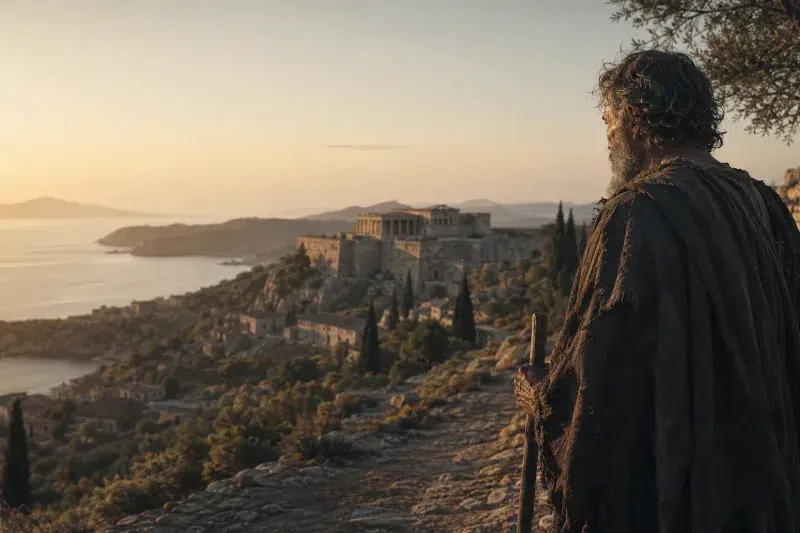
Odysseus Return
When Odysseus returns to Ithaca, he observes, listens, and seeks to understand what has changed during his absence

1 – Succession is not about transferring power; it is about building legitimacy

This is precisely the difference between inheriting authority and earning it. The former can be handed down but the latter must be earned over time through decisions, achievements, and the ability to gain the trust of employees, customers, and stakeholders.

My research has consistently shown that the most successful generational transitions are those in which successors do not attempt to replicate the founder but instead reinterpret the founder’s legacy in light of the challenges of their own time. They do not simply inherit a role – they develop their own entrepreneurial identity.

Odysseus seems to understand this. When he finally returns to Ithaca, he does not immediately reclaim his throne. He observes, listens, and seeks to understand what has changed during his absence. Most importantly, he tests Telemachus, fighting alongside him rather than replacing him. It is an extraordinarily modern lesson in leadership.

Succession, therefore, is not about handing over a business to the next generation. It is about preparing the next generation to lead it.

2 – The true legacy is not the business itself, but the ability to lead it

The most valuable asset one generation can pass on is not economic – it is the capacity to assume the responsibility of leadership. Succession, therefore, is not about handing over a business to the next generation. It is about preparing the next generation to lead it.

This is the message that emerges from The Odyssey. Odysseus does not return to Ithaca simply to reclaim his throne. His return marks the culmination of Telemachus’s journey. The father does not replace the son; rather, he creates the conditions that allow his son to become a leader in his own right.

In family businesses, this means investing in education, exposure to diverse experiences, and the development of the next generation’s autonomy, judgment, and leadership capabilities, long before succession takes place. The family firms that navigate generational transitions most successfully are not those that excel at transferring wealth, but those that excel at preparing people.

Driving generational success

Family business programs

For generations, IMD has been guiding family enterprises to success, equipping leaders with the skills and strategies to navigate these complexities with confidence.

Explore programs

3 – No one becomes a leader alone – even Telemachus had a mentor

There is a detail in The Odyssey that often goes unnoticed. During Odysseus’s absence, Telemachus is entrusted to Mentor, the faithful friend of the King of Ithaca. It is no coincidence that, to this day, we use the word mentor to describe someone who guides another person’s growth and development.

Athena herself chooses to assume Mentor’s appearance when she encourages Telemachus to embark on his journey, make decisions, and take responsibility. It is a powerful image: leadership is not transmitted by birthright, but cultivated through learning, guidance, dialogue, and experience.

The same principle applies to family businesses. Mentorship is one of the most effective practices for preparing the next generation. Successors need trusted individuals who help them develop autonomy, critical thinking, sound judgment, and self-confidence. Sometimes this role is played by the founder and at other times by independent directors, non-family executives, or trusted family advisors. Regardless of who serves as the mentor, the principle remains the same: succession is not merely about transferring knowledge. It is about developing leaders who can think independently and make decisions with confidence.

Research on family businesses consistently shows that continuity depends not only on those who lead the firm, but also on those who hold the family together.

4 – Continuity is not sustained by visible leadership alone

Without Penelope, there would most likely have been no continuity to preserve.

For 20 years, Penelope safeguards the household, preserves the family’s legitimacy, protects its legacy, and holds the kingdom together while awaiting Odysseus’s return. She does so without formally exercising power – relying instead on patience, resilience, wisdom, and an extraordinary capacity for mediation.

Family businesses often rely on similar figures. They do not necessarily occupy formal leadership positions and, for that very reason, frequently remain invisible to outside observers. Yet they perform an indispensable role: they keep the family united, foster dialogue across generations, mediate conflicts, and preserve the trust upon which every successful generational transition depends.

Research on family businesses consistently shows that continuity depends not only on those who lead the firm, but also on those who hold the family together. Penelope reminds us that leadership takes many forms. Some are highly visible and associated with authority and decision-making. Others operate quietly behind the scenes, creating, day after day, the conditions that allow the leadership of others to emerge.

Why the Odyssey speaks to us
The Odyssey still speaks to us nearly three millennia after it was written

Transforming change into continuity

Continuity is never the product of standing still. It is achieved by changing while remaining uncompromisingly faithful to what matters most. The longest-lasting family businesses do not resist change; they turn change into continuity. In these firms, tradition is not a constraint but the platform from which innovation emerges.

That is why The Odyssey still speaks to us nearly three millennia after it was written. It is not simply the story of a founder finding his way home. It is the story of a successor discovering the confidence to lead.

For family enterprises, this distinction is profound. Great founders build extraordinary businesses. Great entrepreneurial families build something even more valuable: the conditions that allow every generation to redefine leadership without abandoning the family’s identity.

Succession, therefore, is never the responsibility of a single individual. It is the product of a leadership ecosystem. Odysseus, Telemachus, Mentor, and Penelope each represent an essential role – the founder who creates, the successor who evolves, the mentor who prepares, and the guardian who preserves continuity. Remove any one of them, and the transition becomes significantly more fragile.

The ultimate test of generational success is not whether a family produces another Odysseus. It is whether every Telemachus is given the confidence, capability, and freedom to become a leader unlike any who came before. The families that achieve this do more than survive succession – they ensure that every generation writes the next chapter of the story.

Authors

Alfredo De Massis

Professor of Entrepreneurship and Family Business

Alfredo De Massis is ranked as the most influential and productive author in the family business research field in the last decade in a recent bibliometric study. De Massis is an IMD Professor of Entrepreneurship and Family Business at IMD where he holds the Wild Group Chair on Family Business and works with other universities worldwide.

Related

Learn Brain Circuits

Join us for daily exercises focusing on issues from team building to developing an actionable sustainability plan to personal development. Go on - they only take five minutes.
 
Read more 

Explore Leadership

What makes a great leader? Do you need charisma? How do you inspire your team? Our experts offer actionable insights through first-person narratives, behind-the-scenes interviews and The Help Desk.
 
Read more

Join Membership

Log in here to join in the conversation with the I by IMD community. Your subscription grants you access to the quarterly magazine plus daily articles, videos, podcasts and learning exercises.
 
Sign up

Log in or register to enjoy the full experience

Explore first person business intelligence from top minds curated for a global executive audience