Share
Facebook Facebook icon Twitter Twitter icon LinkedIn LinkedIn icon Email

CEO Dialogue Series

Focus, bold bets, and a bit of fun: How a pharma chief is going for growth 

5 hours ago • by Jean-François Manzoni in CEO Dialogue Series

Ipsen CEO David Loew tells Jean-François Manzoni how relentless focus, the Pareto principle, and having fun helped energize a mid-sized specialty pharma player to take on bigger rivals....

Ipsen CEO David Loew tells Jean-François Manzoni how relentless focus, the Pareto principle, and having fun helped energize a mid-sized specialty pharma player to take on bigger rivals

People will watch you all the time – what you reward and how you behave during ‘moments of truth’. You cannot hide as a CEO

David Loew is a believer in the Pareto principle – the idea that 80% of outcomes come from 20% of inputs. As a high-school student, he put in just enough effort to pass, preferring to play music with friends rather than chasing top marks. As CEO, he is ruthless about his own agenda, carving out the first 15 minutes of each day to reflect whether his attention is truly focused on what creates the biggest impact.

“It’s so easy these days to get diverted by any email, an urgency here, something geopolitical happening there,” said Loew. “You always need to take a step back and think, ‘Does this really impact me or the company?’ Yes or no? And then think, ‘OK, am I on the right priorities?”

That philosophy has shaped the transformation of France-based Ipsen from a mixed pharma consumer group facing a looming patent cliff with its blockbuster cancer drug into a more focused, growth-driven biopharma player.

Since taking the helm in 2020, the Swiss executive has sharpened Ipsen’s strategy with a clear sense of where to compete and what to license in. He laid the foundations by tightening costs and instilling a purpose-led culture that cuts across silos. Now focused on oncology, neuroscience, and rare diseases, sales have grown more than 40% over five years, reaching €3.68bn in 2025, while the share price has more than doubled.

One of his biggest challenges was strengthening Ipsen’s R&D pipeline.

 Rebuilding the pipeline through disciplined bets

One of his biggest challenges was strengthening Ipsen’s R&D pipeline. The company refined its licensing-in strategy, focusing on late-stage molecules with a higher probability of success and market potential that would not attract larger competitors. Over the past five years, Ipsen has signed more than 35 deals – several of which have delivered tangible results.

To support this shift, Ipsen invested in expanding and upgrading its external innovation team, separating it from business development to reduce the risk of overpaying for assets.

With the pipeline refreshed, the next priority was to extract more value from existing products – starting with its flagship neurotoxin, Dysport.

“As a CEO, you occasionally need to do real deep dives,” said Loew. “You need to go out and talk to customers and patients yourself because, as a CEO, there is always the danger that the information reaches you filtered several times over.”

During one such visit to an injection center near Paris, Loew discovered that only around 10% of patients with post-stroke spasticity (PSS) – a condition in which disrupted brain signals trigger painful muscle contractions – were being treated. He saw an opportunity and pushed his teams to revisit Dysport’s positioning, sharpening its differentiation against the market leader, Botox, a blockbuster for AbbVie.

That effort paid off. Results from a head-to-head trial presented in May showed that Dysport delivers a longer duration of response than Botox in PSS. For Loew, this example shows that Ipsen can compete with Big Pharma by being selective, identifying winners, and understanding how to differentiate.

Loew also recognized that breaking down silos meant creating occasions for leaders to connect on a personal level.

Culture change fueled by consistency – and fun

Strategy alone is not enough to enable those bets. It requires an agile, collaborative culture. After joining, Loew brought together Ipsen’s 150 top leaders to define the culture they wanted and how to influence it.

Changing an organization’s culture is hard work, Loew observed. It requires strong consistency between stated values and everyday behavior.

“People will watch you all the time, including at town halls, in meetings, and during business reviews,” he said. “They will also watch what you reward and how you behave during ‘moments of truth”. And they will assess how authentic you are. If they feel you’re authentic, they will trust you and they will want to do something with you. If they don’t trust you and they think you say something, but you mean or do something else, people will immediately pick it up. You cannot hide as a CEO.”

Loew also recognized that breaking down silos meant creating occasions for leaders to connect on a personal level. He believes in building in moments of fun – especially within senior leadership teams – and he’s seen how they release an unexpected energy, strengthen connection, and spark a genuine desire to collaborate across functions that had previously been lacking.

An agile and collaborative culture must start at the top.

Building a world-class leadership team

An agile and collaborative culture must start at the top. Accordingly, Loew is actively involved in hiring senior leaders, including leadership team members, and then spends time and attention ensuring the top team operates at a high level of individual and collective performance.

The leadership team, which includes 13 direct reports to ensure fast decision-making, meets in person six times a year, with agendas designed to allow enough time to discuss longer-term issues.

During three of these meetings, significant time is set aside to work on the way the team works together and to strengthen relationships. “Liking each other is a very important piece of having trust,” Loew said. This trust capital, as he describes it, can be drawn on when pressures rise. “The trust capital and ‘I like you’ capital can be used when the going gets rough, and the forgiveness needs to kick in because people can be stressed, they can be stressed at home, they can be stressed by things that happen in the world.”

Loew demands integrity and has little patience for fiefdoms. “You want to have a leadership team and not a team of leaders where they’re all thinking about their function, but they don’t think about Ipsen,” he said. “So, it’s Ipsen first – not your budget, not your headcount, it’s Ipsen first and the patient first.”

Against a backdrop of social media feeds dominated by geopolitical tensions, Loew believes focus has never been more critical to energize an organization. Such uncertainty can leave people distracted, anxious, and emotionally strained. In this environment, “you need to really bring it back to what do you stand for – focusing on what creates impact is going to become even more important for the future.”

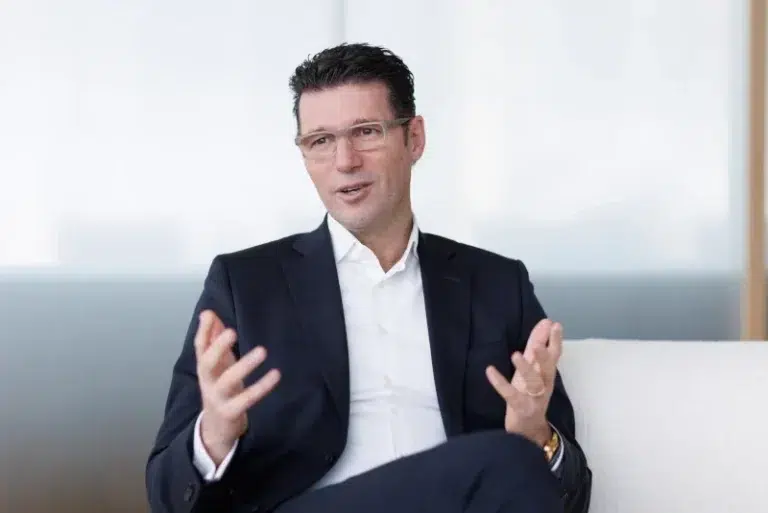
Loew has ambitions to double, or even triple, the company’s size over the next decade as part of a new strategy

Avoiding complacency with a ‘big hairy goal’

After six years as CEO, having led Ipsen beyond the patent cliff and built new franchises in rare diseases and neuroscience, Loew is mindful that success could breed complacency. He believes this can be avoided by setting a high bar.

“Setting a big hairy goal will trigger the appetite of wanting to get there, the energy, the passion,” he said. “And, of course, you need to explain the why, that if we have fantastic drugs, we can serve more patients and there are still so many unmet medical needs. If our employees see the connection between our purpose and what we can do as a company, that really lights up the fire. And that’s what we see in our engagement surveys and Glassdoor scores, where we are now way above average in the pharma industry.”

Loew has ambitions to double, or even triple, the company’s size over the next decade as part of a new strategy. Doing so will require making carefully targeted bets and ensuring that the roughly 6,000-strong workforce increases more slowly than sales growth.

That means ensuring the pace of growth is sustainable. “You don’t want to burn out people and just have them work longer hours. You want to really focus on what makes the biggest impact,” he said. “So, it’s the old Pareto: 20% of the effort gives you 80% of the results, which, the older I’m getting, the more I think this is so true.”

Expert

Photo_D_Loew

David Loew

David Loew has been Chief Executive Officer of Ipsen since July 2020. He brings nearly 30 years of international experience across oncology, CNS, cardio-metabolism, and consumer healthcare, with leadership roles spanning the US, Europe, and global markets.

Loew began his career at Coopers & Lybrand and Hewlett-Packard before joining Roche in 1992. Over two decades at Roche, he held a range of senior leadership roles, including Global Head of Oncology, Global Chief Marketing Officer, Head of Global Product Strategy, and Region Head for Eastern Europe, the Middle East, and Africa.

In 2013, he joined Sanofi as Senior Vice President, Commercial Operations Europe, with responsibility for prescription medicines, consumer healthcare, and generics across the EU. He was subsequently appointed CEO of Sanofi Pasteur Vaccines in 2016.

Loew serves on the boards of IFPMA, EFPIA, and G5 Santé. He holds a BA and an MBA from the University of St. Gallen.

Authors

Jean-François Manzoni

Professor of Leadership, Organizational Development and Corporate Governance

Jean-François Manzoni (JFM) is Professor of Leadership, Organizational Development and Corporate Governance at IMD, where he served as President and Nestlé Professor from 2017 to 2024. His research, teaching, and consulting activities are focused on leadership, the development of high-performance organizations and corporate governance. In recent years JFM has also been increasingly focused on finding ways to ensure leadership development interventions have lasting impact, particularly through the use of technology-mediated approaches, and on closing the growing managerial “knowing-doing gap”, i.e., the gap between what managers kind of know they should be doing and the extent to which they actually behave that way in practice.

More to explore

Learn Brain Circuits

Join us for daily exercises focusing on issues from team building to developing an actionable sustainability plan to personal development. Go on - they only take five minutes.
 
Read more 

Explore Leadership

What makes a great leader? Do you need charisma? How do you inspire your team? Our experts offer actionable insights through first-person narratives, behind-the-scenes interviews and The Help Desk.
 
Read more

Join Membership

Log in here to join in the conversation with the I by IMD community. Your subscription grants you access to the quarterly magazine plus daily articles, videos, podcasts and learning exercises.
 
Sign up

Log in or register to enjoy the full experience

Explore first person business intelligence from top minds curated for a global executive audience