How a new generation of negative electricity prices creates opportunities for consumers
Subsidies for renewables have led to electricity prices frequently falling to less than zero, creating opportunities for consumers....

by Benoit F. Leleux Published March 19, 2024 in Sustainability • 8 min read
As the global population grows, our food system is struggling to keep up. Coconut production is no exception: the value of the global coconut market was estimated to grow by 7.3% between 2020 and 2026. But supply was growing at just 1% per year.
This gap threatens the supply chains of products across the food and beverage and cosmetics industries. To make matters worse, coconut production is a fragmented industry that is dominated by small producers and intermediaries, which causes opaque supply chains.
About 95% of coconut trees are grown in small farms that are less than 5 hectares, and an International Labour Organization (ILO) report suggests that the typical farmer in the Philippines is in their late fifties and runs a farm of about 1.25 hectares. These smallholders are struggling financially, trapped without any bargaining power because their only access to the market is through an intermediary. This leaves them unable to raise the funds to replace trees and start using more productive modern farming techniques, which is a problem: it is estimated that up to 90% of Asia’s coconut trees are nearing the end of their productive lives.
Christian Eyde Moeller, Henrik Haagen and Anders Haagen, the founders of Lionheart Agrotech, decided that sustainability was the solution. Since they founded the company in 2015, they have trained hundreds of workers in sustainable agriculture, and have reduced the poverty rate in the municipality of Rizal from 65% to 25%. The founders claim that when the farm is complete, it is expected to capture and store the equivalent of the emissions from the entire power sector of the province of Palawan, where the farm is located. How did they do it?
The key to Lionheart’s business model is the hybrid coconut tree, (the product of hybrid and dwarf coconut trees, which combine the benefits of both varieties). Co-Founder Anders Haagen was convinced that using these trees to produce coconut sugar rather than oil and whole nuts could produce drastically more calories per hectare of land – all while using 20 times less water than coconut oil.
(based on estimates by Lionheart Agritech)

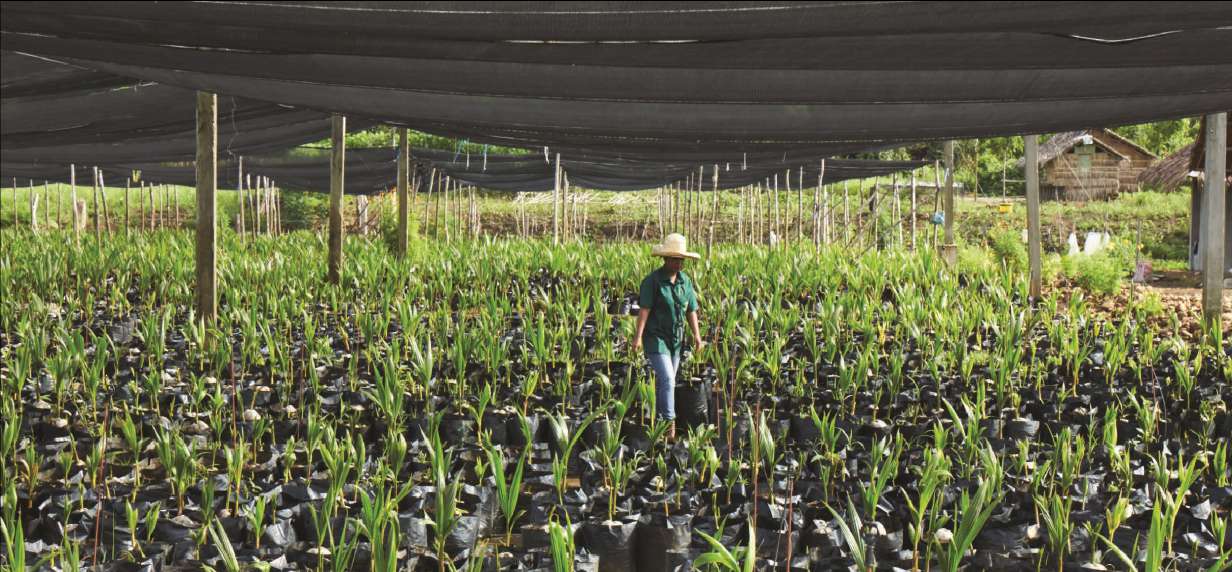
Lionheart’s business case was solid, but it struggled to source the hybrid coconut trees that were essential to the plan, as seedlings were rare, and demand was high. Their efforts to source seedlings led to unexpected discoveries. When importing seedlings proved difficult, the business identified an overlooked breeding garden in the Phillippines, giving the project access to planting material and information on how to select the best genetic material.
Agribusiness has traditionally been characterized as environmentally damaging, with businesses contributing to deforestation, soil degradation, diminished biodiversity, water contamination and air pollution. Lionheart set out to avoid all of these pitfalls – and even make a positive environmental contribution.
The company estimates that their coconut palms capture and store 350kg of CO2 per tree per year, which is four times more than a tropical rainforest. When the farm is complete,the founders expect it to capture and store the equivalent of the emissions from the entire power sector of the province of Palawan where the farm is located.
When it chose its farming system, Lionheart decided to try something new: Korean natural farming, which is a form of regenerative agriculture that reintroduces indigenous microorganisms to depleted soil. Regenerative farming is commonly used for other crops, but no one had tried it at scale with coconuts.

“We are a team of 1,500 people who all share the vision of creating more output on less land via smart agrotechnology solutions.”— Lionheart Agrotech
Lionheart also made its own biofertilizers with ingredients grown on the farm or bought locally. The company built its own laboratory where it researched how to boost yields and stop pests using natural methods, along with which biopesticides and biofertilizers to use at each stage of a coconut’s life.
Lionheart developed its business with the welfare of the workforce as a guiding principle, and respect for indigenous culture and practices forms a central part of this. Lionheart had to work closely with indigenous communities from the very beginning of the process because the farm was going to be built on ancestral land owned communally by the indigenous people living in local villages.
In a survey of 789 indigenous households, 785 had a positive opinion of the project. When Lionheart arrived, 65% of the population was living in poverty; now, it is 25%. And the company is working to reduce this even more. It currently employs about 1,300 people, and plans to increase this to about 4,000 when the farm is fully operational. The company does not plan to import labor because of the community’s ties to the land, so it plans to create full employment among its host communities and no more.

Benoît Leleux is the Stephan Schmidheiny Professor of Entrepreneurship and Finance at IMD. He is Co-Director of the Foundations for business leaders program and Program Director of the Winning sustainability strategies program.
March 27, 2025 • by Robert Earle, Karl Schmedders in Sustainability • 7 min read
Subsidies for renewables have led to electricity prices frequently falling to less than zero, creating opportunities for consumers....
March 21, 2025 • by Natalia Olynec in Sustainability • 6 min read
Once viewed as corporate activists championing green initiatives, today’s CSOs are business integrators – balancing financial performance with societal impact....
March 13, 2025 • by Cedrik Neike in Sustainability • 6 min read
Digital technologies, and artificial intelligence in particular, allow us to extract insights from data. This will allow industrial companies, the backbone of our economy, to be more resource-efficient, more productive, and more...
February 25, 2025 • by Salvatore Cantale, Christos Cabolis in Sustainability • 6 min read
While some firms may look to exploit regulatory arbitrage in response to the Corporate Sustainability Reporting Directive (CSRD), long-term trends point to regulatory alignment and technology advances making EU sustainability reporting rules...
February 18, 2025 • by José Parra Moyano in Sustainability • 7 min read
As AI continues to reshape industries, businesses must navigate the balance between automation and human contribution. This article explores how AI can drive sustainability while empowering both employers and employees through data...
February 18, 2025 • by James Welch in Sustainability • 8 min read
A five-step approach to help leaders foster sustainable legacies and social progress, while supporting financially sound futures for their organizations....
February 17, 2025 • by Salvatore Cantale in Sustainability • 5 min read
More than simply a compliance exercise, sustainability reporting regulations offer a chance to develop and strengthen your business, says IMD’s Salvatore Cantale...
February 4, 2025 • by Julia Binder, Michael R. Wade in Sustainability • 6 min read
Artificial intelligence (AI) is widely recognized as a driver of productivity, while sustainability, despite its benefits to the environment, is often seen as a cost burden. When combined, however, we believe they...
February 3, 2025 • by Natalia Olynec in Sustainability • 8 min read
Warnings about alcohol’s harms by medical experts are nothing new. But the drinks industry is now taking sobriety seriously by investing in a growing range of alternative products....
January 30, 2025 • by Stéphane J. G. Girod in Sustainability • 10 min read
CEO Manuel Reman blends Krug’s tradition with innovation, fostering deeper connections with global audiences and emphasizing authenticity to keep the champagne house relevant amid shifting tastes and sustainability challenges....
Explore first person business intelligence from top minds curated for a global executive audience