Why you need to agree to disagree
Elizabeth faces a career crossroads and works with a coach to clarify her ambitions, negotiate her future, and harness the power of constructive disagreement...

by Jennifer Borrer, Lisa Casper, Saule Serikova Published February 20, 2026 in Leadership • 10 min read • Audio available
The longevity sector is at a transformative inflection point, but the leadership capabilities needed to translate scientific promise into market success are not yet clearly established. This nascent industry stage offers an opportunity to redefine impactful leadership for a new world: what kind of leader is required to ensure the longevity industry reaches its economic and social potential?
Drawing on interviews with longevity sector CEOs, founders, scientists, marketers, and investors, we explored and uncovered the new leadership phenotype required for this emerging market.
Here, we offer a blueprint for boards, investors, and executives to identify, cultivate, and empower the leaders who can build thriving longevity-oriented organizations and realize the potential of the healthspan century.
Leaders in longevity markets are tested by a unique crucible of strategic, financial, and regulatory challenges. The central one is cutting through the noise to establish credibility with investors, regulators, and consumers. Unlike mature industries, there is no well-trodden path. To navigate this complexity, leaders must master three market frontiers.
The first frontier arises from a mismatch between science and capital markets. Longevity research is a long-term endeavor requiring steady investment, while many venture and private equity models are geared toward faster returns. This paradox has led to a diversification of funding models: deep biotechnology ventures pursue long-term, platform-based strategies aimed at eventual reimbursement, while consumer-focused companies often seek faster market entry. Regardless of the model, the leader’s task is to translate complex science into a compelling, long-term value-creation story to secure patient capital.
Finding a strategic capital partner is crucial. Sophisticated investors utilize their own end-to-end portfolio of longevity therapeutics, diagnostics, and care services as a competitive advantage. By integrating a new venture into their portfolios, they can short-circuit the typical decade-long diffusion of new solutions into the clinical space, accelerating the company’s path to market impact.
The second frontier is a regulatory landscape that is still being written. A pivotal debate centers on whether aging can be classified as a treatable condition rather than inevitable decline. A formal designation would unlock established pathways for clinical trials and reimbursement, accelerating the field and the path to market. In the absence of clarity, leaders must build their case for legitimacy without waiting for permission.
Scientific fluency is the primary leadership tool. Successful pioneers are contributing to the science while building credibility through peer-reviewed publications in respected journals, not just marketing claims. This commitment to science serves a dual purpose. Internally, it defines the ambition, moving beyond fixing the “tires” to rebuilding the “engine” of health. Externally, it creates a body of evidence that de-risks the field for regulators and partners, establishing a benchmark for consumer trust.
The final frontier is accessibility. For the sector to deliver on its promise, it must move beyond a niche market for the privileged few. Without affordability, the benefits of longevity science could deepen health divides rather than close them. Companies must recognize longevity as a public health issue, not just a revenue stream. They should tailor multiple, easy-to-understand entry points for consumers, whether through lifestyle changes, wearable devices, or clinical interventions.
To overcome barriers to mass adoption, self-pay pathways can act as a bridge, enabling companies to design holistic, patient-centered experiences and rapidly refine operations. This self-pay model generates evidence of efficacy and value. This is leverage for eventual payer integration: early revenue funds innovation, while outcomes data builds the case for broader reimbursement, ultimately achieving the democratization of longevity.
The longevity sector requires more than a new strategy; it demands a new phenotype of leader. To define this phenotype, we interviewed executives and investors across the value flow, from biotechnology and nutritional science to consumer platforms and clinical wellness, as well as a behavioral scientist. These conversations revealed a consistent set of foundational competencies for leaders in longevity:

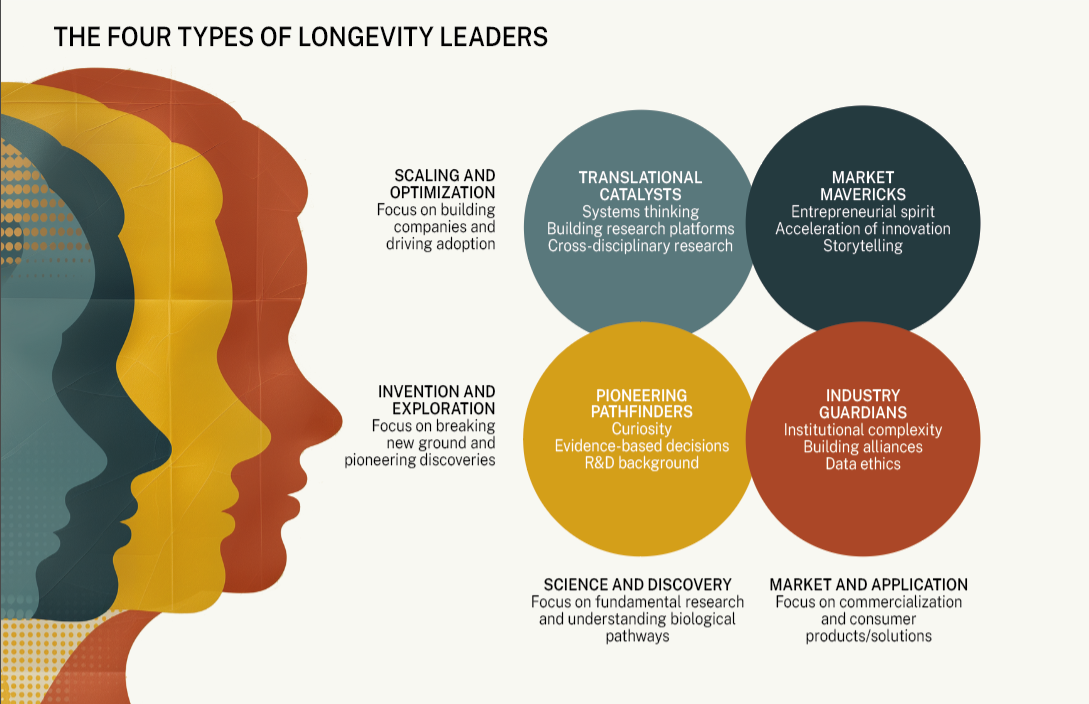
Leadership in longevity is not monolithic. As a company progresses from early-stage innovation to commercial launch and market expansion, evolving and emerging challenges call for distinct leadership capabilities. The practice of strategically adapting the team to align with evolving imperatives is known as “milestone leadership”. To master it, leaders must understand four leadership phenotypes, which we map across two dimensions: the primary focus (from science and discovery to market and application) and the operational stage (from invention and exploration to scaling and optimization).
An explorer, driven by curiosity and a commitment to evidence-based discovery, who operates on the frontiers of science to understand the mechanisms of aging. They include researchers, scientists, and academicians. Motivated by the pursuit of knowledge and scientific integrity, they provide the scientific proof that serves as a bedrock of trust for the company and the industry.
A systems-thinker who, while rooted in science, is focused on scaling innovation. They are adept at building research platforms, standardizing data infrastructure, and forging collaborations to move research into commercial development. Often found in roles like head of R&D, chief technology/data officer, or leading translational efforts and technology transfer functions, they are motivated by the challenge of making science accessible and scalable.
An entrepreneurial accelerator who is fast-moving, opportunistic, and skilled at calculated risk-taking. They excel at translating science into a narrative that builds a brand and drives adoption. CEOs, founders, or marketing experts, they are motivated by achievement and the thrill of building new things. They are storytellers who can capture the market’s imagination and secure a commercial foothold.
Steward of the sector’s integrity and skilled at navigating institutional complexity. They focus on the market-making activities that do not fit neatly into a single company’s P&L. As public advocates and policy shapers, they build alliances, establish ethical frameworks, and forge the regulatory pathways necessary for the sector to thrive. Whether heads of regulatory affairs, leading public policy, or acting as opinion leaders, they are motivated by integrity and the need to build lasting public trust in a stable, ethical environment.
The search for a unicorn leader in the longevity sector is misguided. The new face of talent is not a single portrait, but a dynamic mosaic. It begins with the non-negotiable foundation of purpose, a polymath mindset, ecosystem architecture, and integrity. Upon this foundation, the most successful organizations will master the art of milestone leadership, assembling and evolving their teams with the right combination of phenotypes at each stage of growth.
Impactful leadership requires the construction of a thriving longevity ecosystem, built on interdependent pillars.
Attracting the best minds requires more than just competitive compensation; it demands vision. Successful leaders create a compelling value proposition rooted in mission-driven purpose. They articulate a future of meaningful impact that top talent wants to be a part of.
The talent required to launch a company is not necessarily the same as that needed to scale it. Pioneering pathfinders often dominate early-stage ventures. As the organization matures, milestone leadership becomes critical. Leaders must anticipate the need for translational catalysts, market mavericks, and industry guardians. This strategic foresight prevents the common pitfall of a company’s growth outpacing its team’s capabilities.
Longevity innovation does not emerge from a single discipline but at the intersection of its outer circles, where fields like biotechnology, nutrition, consumer health, beauty, wellness, and technology converge. A leader must cultivate an environment that fosters this innovation through a shared mission, a willingness to listen across disciplines, and an ability to check egos at the door. Impactful leaders get their teams excited about the future and empower them to handle the ambiguity of a nascent field.
Innovation must be institutionalized through a structured framework that encourages exploration and rapid learning. This “fail fast” mentality is put into operation through structures: innovation must be scheduled with roadmaps and resources to prevent “shiny object syndrome”. It must be supported by a risk-stratified project portfolio that balances long-term, high-risk goals with what is achievable in the short term.
The challenge is acute for legacy organizations. Their core strengths – a focus on science, medicine, and compliance – are differentiators, but established structures can hinder innovation. The solution is to build an innovation framework around those structures, enabling experimentation without disrupting core operations by carving out space for new initiatives, especially when they clash with traditional activities. Some organizations formalize innovation through a project-based model where cross-functional teams operate like small ventures on missions lasting three to six months. This fosters the organizational habit of incubating concepts and, critically, discontinuing ideas that do not work.

The complexity of the longevity sector makes it impossible to master every vertical in-house. Building an external ecosystem with a win-win mentality and a commitment to mutual growth is a necessity. Identifying partners with complementary capabilities, such as diagnostic technology, therapeutic interventions, or data analytics, allows the company to stay at the forefront.
Effective leaders excel in building collaborative networks and strategic alliances. They find agile partners who share their values, pace, and commitment to scientific rigor. Alignment on mission and transparency are critical. This vetting process involves a three-dimensional filter: evaluating the scientific and clinical strength of the partner’s offering, assessing its accessibility and impact on the consumer experience, and gauging its operational flexibility and willingness to integrate.
In a field of emerging technologies and shifting timelines, partners must communicate clearly about their capabilities and limitations. Such partnerships, built on trust and a shared vision for the greater good, allow companies to innovate faster, de-risk development, and strengthen value propositions.
This approach extends to licensing and acquisitions. Transactions are often driven not by market share but by innovation, such as novel technologies or unique capabilities. Acquired assets must be integrated with internal and partnered efforts without destroying the creativity that made the acquisition attractive.
Technology is accelerating the longevity ecosystem, from wearables and at-home genetic testing to AI in drug discovery and personalized health plans. Leaders do not have to be data scientists (though these are needed). They should be tech-fluent and have the strategic vision to identify and integrate the tools most relevant to their business. Geographic scalability matters too: navigating degrees of digital adoption and fragmented regulatory landscapes across markets.
With power comes responsibility: leaders must champion the ethical and effective use of technology, ensuring a commitment to data privacy, transparency, and minimizing environmental impact.
AI is a tool to augment, not replace, the human touch of clinicians, but it can help individuals navigate an overwhelming amount of information. This raises critical questions about who will guide the journey: consumers, healthcare professionals, or new roles for managing human-AI communication. Ultimately, leaders must bridge the gap between providing data-driven insights and inspiring the long-term behavior change that extends healthspan.
The longevity (r)evolution will not happen by accident. The journey requires a conscious effort to identify, cultivate, and empower a new generation of leaders.
For boards and investors: Look beyond traditional CEO profiles. When hiring, identify ecosystem architects: leaders with the vision and collaborative mindset to build internal teams and external partnerships. When investing, build a balanced portfolio of talent. A company aspiring to achieve its market potential needs a diverse leadership team that includes all four phenotypes.
For leaders: Identify your phenotype and seek roles that align with your strengths and motivators. The most impactful careers will be built by contributing unique expertise within a complementary, mission-driven team.
Success will not be defined by a single company or a lone genius, but by the strength of the collaborative ecosystem we build together. By embracing this multifaceted model of leadership, we can move beyond the hype and begin the real work of reimagining careers, family, and society for a future where a longer, healthier life is not a privilege for the few but a reality for all.
The following interviewees participated in research for this article:
Tancrède Amacker, CEO, Cellcosmet; Som Banerjee, PhD, CEO and co-founder, Juvion Health Sciences; Christoph Bremen, SVP, Global Commercial Acceleration, Bayer Consumer Health; Corinne Briaud, Co-CEO and Co-founder, LongHER; Shawn Buchheit, President, Fountain Life; Patrick Carroll, MD, Chief Medical Officer, Hims & Hers; Steve Colling, longevity expert and behavioral scientist; Théo Copolata, President, N Lab Group (Nutrimuscle and Nutrielement); Virginie Couturaud, PharmD, Scientific Communication Director, Parfums Christian Dior; Amber Edwards, healthcare CEO and investor; Simone Gibertoni, Group CEO, Clinique La Prairie (CLP), Co-chairman, Longevity Fund by CLP; Philipp Gut, MD, Adult Health Platform and Healthy Longevity Research Lead, Nestlé Research; Federico Luna, Chief Marketing and E-Commerce Officer, Timeline (Amazentis); Catherine Rochat, PhD, CEO, CRB Cosmetics (Intercos Group); Bimal Shah, MD, Venture Partner, RA Ventures; Jérémie Soeur, PhD, Chief Science Officer, Cellcosmet.

Managing Director at WittKieffer Switzerland
Jennifer Borrer is a Managing Director at WittKieffer Switzerland, with a Global Practice affiliation to Consumer Health and Wellness. With two decades of experience in senior executive talent management roles, she has operated across global markets, bridging cultures and functions to deliver international leadership solutions at board and executive committee levels. Her focus on consumer health centers on longevity and healthy aging science.

A Managing Director at WittKieffer.
Lisa Casper is a Managing Director at WittKieffer. She has over two decades of dedicated service in the executive search field. Her professional journey encompasses a range of sectors, including direct-to-consumer, healthcare, wellness, retail, and technology, providing her with a unique perspective in addressing leadership challenges within the longevity landscape.

Global Leader for Commercial Strategy and Insights at WittKieffer
Saule Serikova is the Global Leader for Commercial Strategy and Insights at WittKieffer, transforming market and talent intelligence into strategic advantages for organizations across healthcare, science, and education. Previously steering commercial operations at a global executive search firm and leading business and market analytics at Sandoz and McKinsey, she brings over two decades of leadership experience at the intersection of data-grounded decision making, executive talent, organizational advisory, and corporate strategy.

2 hours ago • by Nathalie Ducrot in Leadership
Elizabeth faces a career crossroads and works with a coach to clarify her ambitions, negotiate her future, and harness the power of constructive disagreement...

February 13, 2026 • by David Sluss, Katie Badura, Yufei Zhong in Leadership
Passion for the product is vital to launch a startup, but it’s not enough to lead a scaling enterprise. David Sluss, Katie Badura, and Yufei Zhong share a two-step approach to...

February 6, 2026 • by Lea Wang , Jung Eung Park, Benoit F. Leleux in Leadership
Why the way you leave a company can shape your legacy as much as your tenure....

February 4, 2026 in Leadership
HR leadership will require a balance of frontline experience and a business-first outlook, argues Pandora CHRO Byron Clayton ...
Explore first person business intelligence from top minds curated for a global executive audience