From data to decision-making
The evidence for a signal-based communication strategy is compelling. However, its true value lies in its application. Here is a framework for implementation.
Our analysis uncovered two counterintuitive dynamics that have profound implications for corporate communication strategy: the executive hierarchy effect and the paradox of scale.
The executive hierarchy effect: Our data shows that non-CEO executives (such as CFOs, COOs, and division heads) consistently outperform their CEOs in driving engagement. The average engagement rate for these operational leaders was 0.73%, 73% higher than the CEO average of 0.43%. This is not a reflection of individual charisma but of proximity to the raw materials of our framework. Operational leaders are closer to the metrics (Proof), customer interactions (People), and market-specific challenges (Place) that constitute high-signal content. A CEO’s strategic vantage point, while essential for running the business, can be a disadvantage in the world of social media if it leads to overly broad and abstract pronouncements.
Happily, this gap is entirely bridgeable. When we isolated CEOs who did use the proof, people, and place framework, their engagement rates rose to parity with their non-CEO peers. The lesson is clear: CEOs and their communication teams must establish systematic processes to draw out specific, signal-rich content from across the organization, rather than relying on high-level strategic messaging.
The paradox of scale: Conventional wisdom assumes that a larger audience is always better. Our data refutes this. While executives with massive followings (>250k) have the greatest reach, they registered the lowest median engagement rates. The highest engagement was found among the “micro-tier” of leaders, who had 10,000-50,000 followers. This suggests that as an audience grows, the sense of direct connection and community relevance erodes, leading to diminished engagement efficiency.
For global leaders and major brands, this presents a significant challenge. However, our signal-stacking analysis points to the solution. The positive impact of adding more signals to a post was most pronounced for executives in the largest-follower tiers. While a simple post may suffice for a smaller niche audience, leaders speaking to a global audience must deliberately layer their content with multiple signals of credibility and context to maintain resonance across diverse segments.
An implementation framework: systematizing signal-based communication
Moving from insight to action requires a shift from an ad-hoc, personality-driven content model to a systematic, process-oriented one. The following framework provides a practical pathway for organizations to embed these findings into their communication workflows.
1 – The three-question pre-publication review. Before an executive post is published, it must pass a simple three-question quality assurance check.
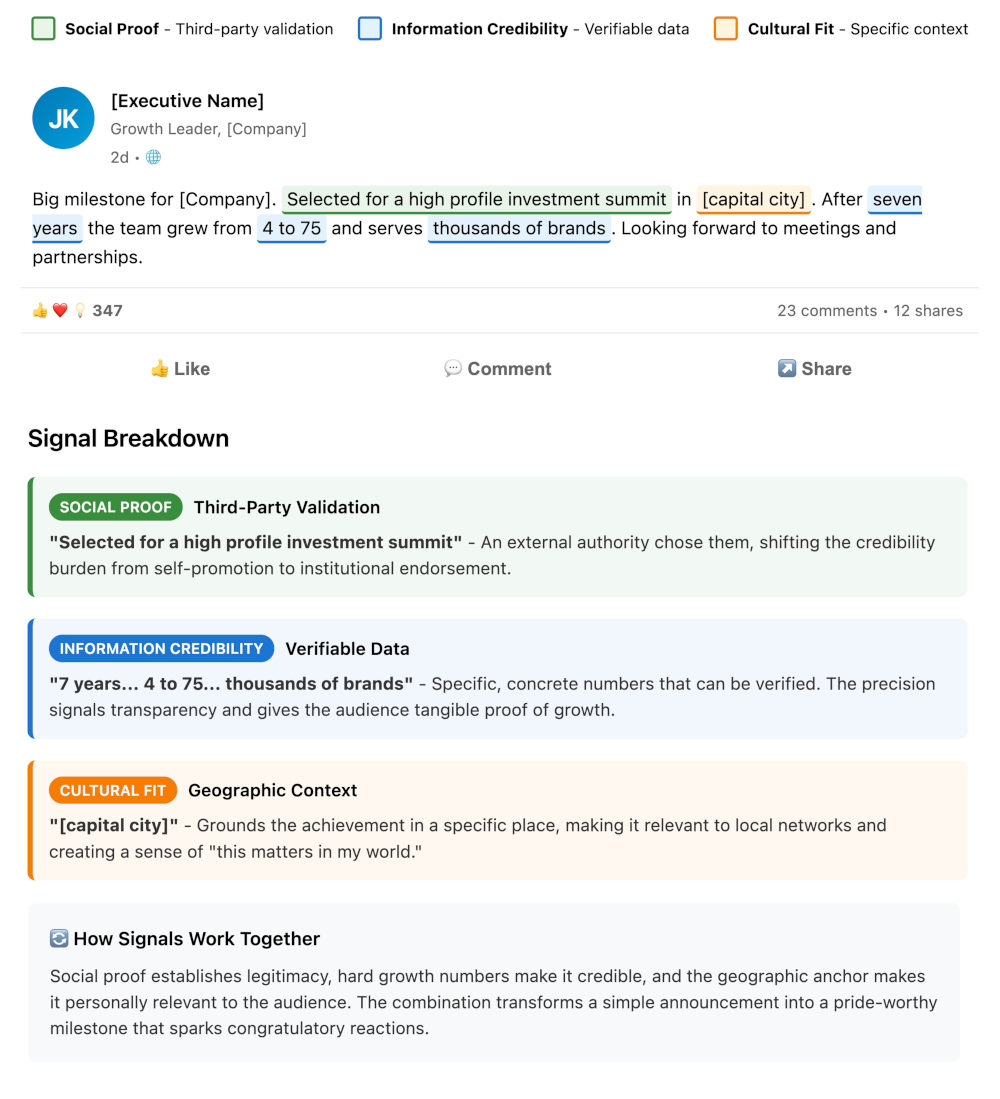
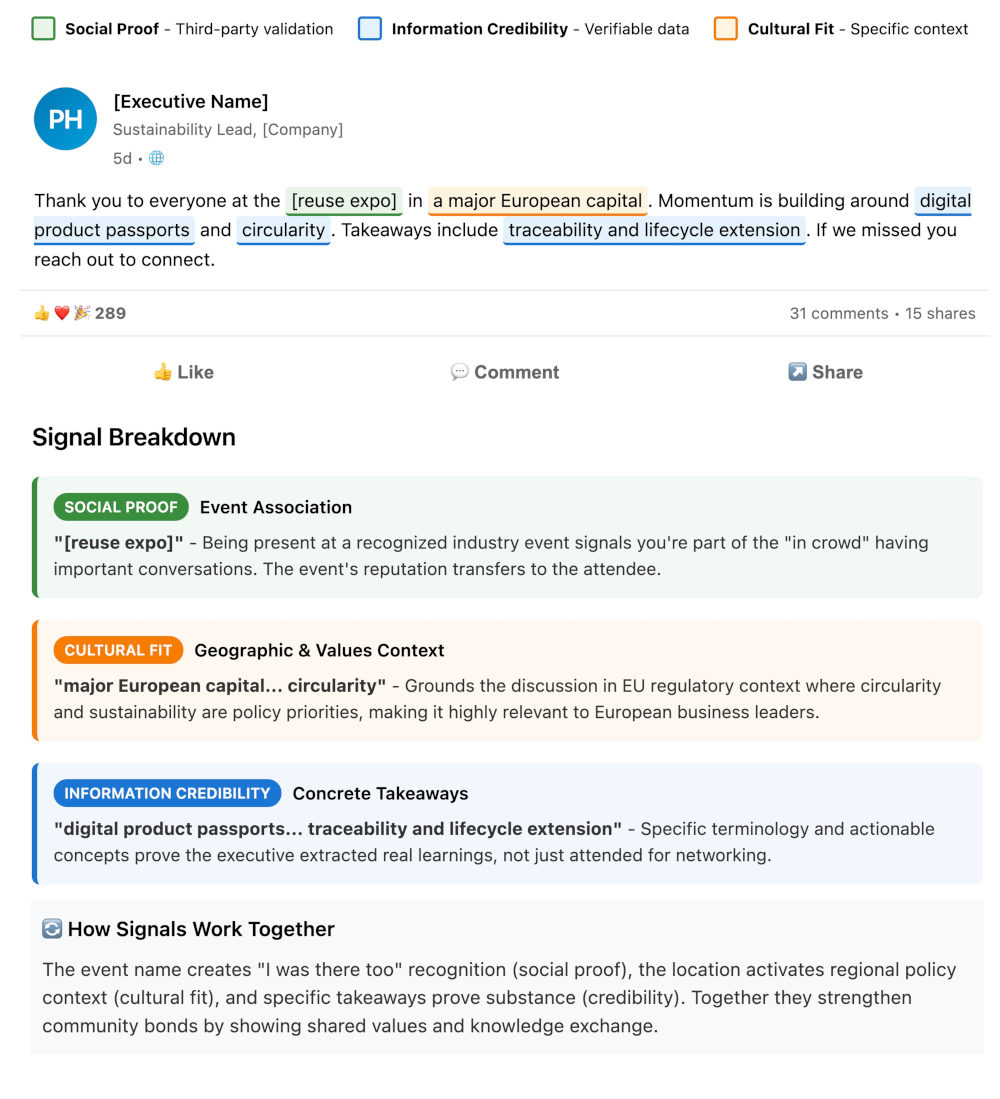
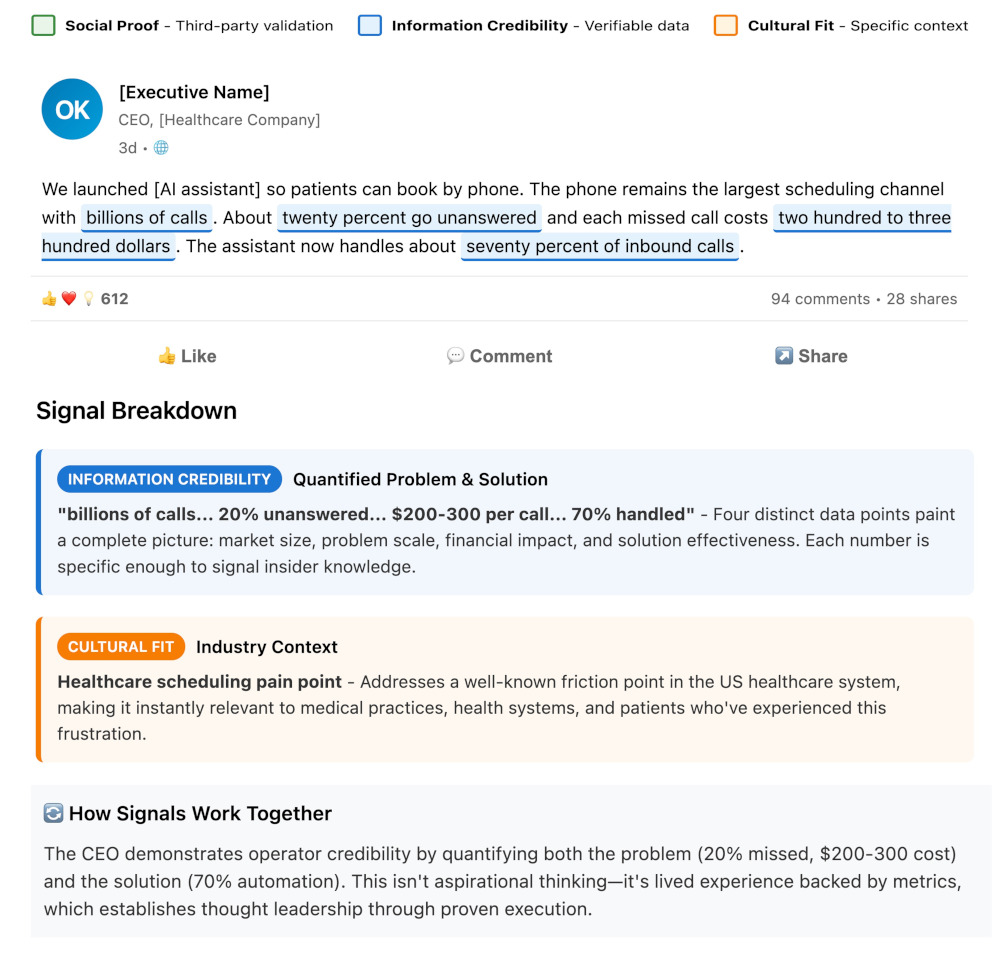
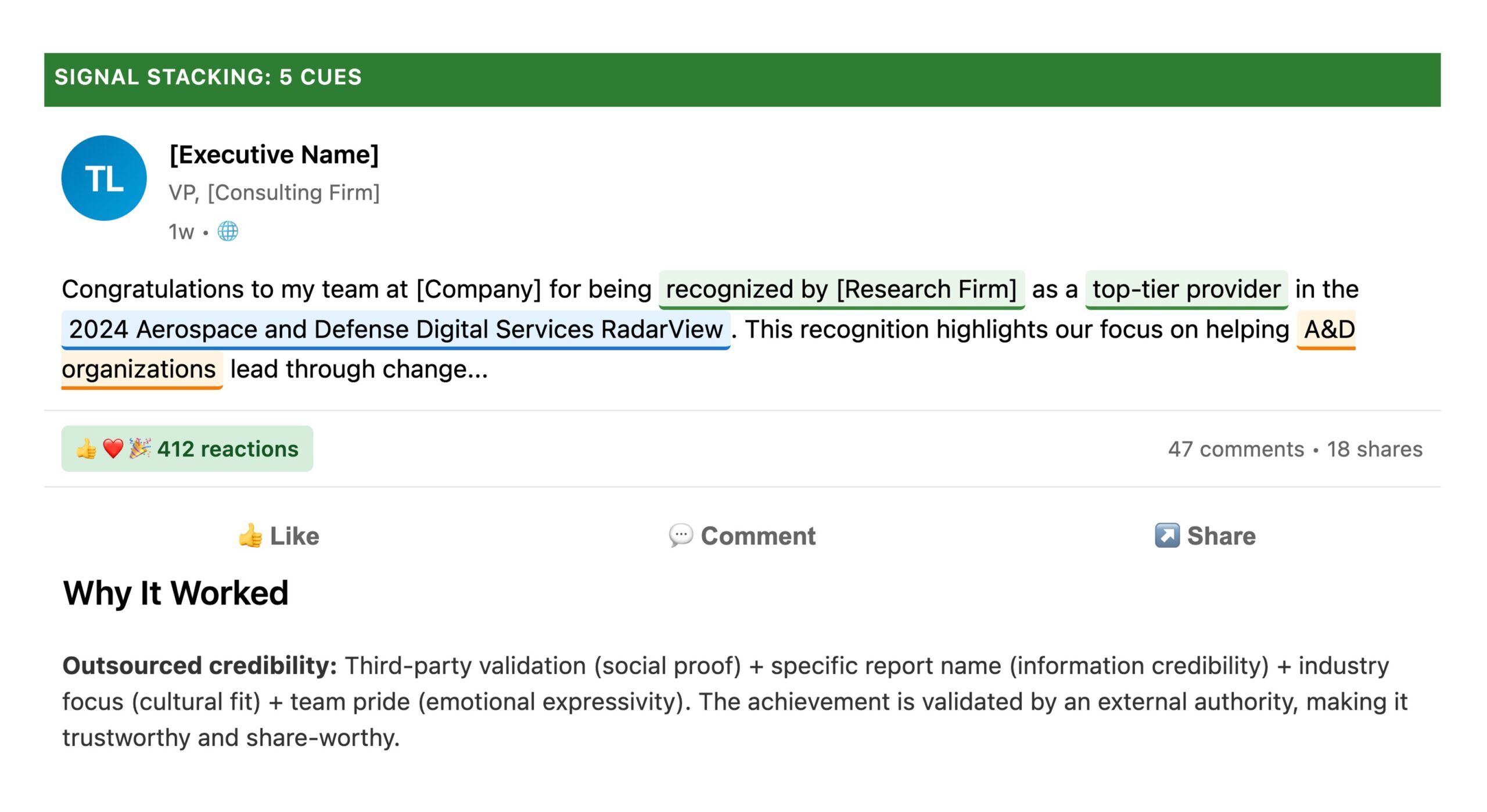
- Is there verifiable proof? Does the post contain a specific, verifiable number, fact, or outcome?
- Is there any external validation? Does the post include the voice or perspective of a customer, partner, or independent third party?
- Is there a specific context? Does the post ground the message in a particular community, location, or stakeholder group?
2 – A cross-functional content development process. Communications teams cannot create high-signal content in isolation. It requires a workflow that draws information from the parts of the business closest to the action.
- The analytics/finance/strategy teams should be tasked with regularly supplying communicators with validated data points and performance metrics that can anchor executive posts.
- The sales/customer success/partnership teams should maintain a channel to share compelling customer quotes, success stories, and partner testimonials suitable for public use.
- Regional or functional leaders must provide the specific context needed to make a global message relevant to a local market or a particular industry vertical.
Communication teams will weave these diverse elements into a coherent narrative.
3 – Redefining success: measuring what matters. Finally, organizations must adopt a more sophisticated measurement framework that moves beyond superficial vanity metrics.
- Conversation quality: Track not just the number of comments but their average length and sentiment. A high share-to-like ratio is a strong indicator that the content was valuable enough to pass on.
- Relationship-building outcomes: The goal is not just engagement but impact. Success should be measured by the tangible outcomes that result from these online conversations: follow-up meetings with potential clients, inbound inquiries from investors, invitations to speak at key industry events, and amplification by other credible third parties.






 Audio available