5 ways to kick bad habits
In this month’s I by IMD Book Club, best-selling author Faisal Hoque explains how the concepts in his new book, Reinvent: Navigating Business Transformation in a Hyperdigital Era, can help us all...
YouTube
November 21, 2025 in Sustainability
Sustainability can no longer be separated from geopolitics. In this webinar, our experts discuss how rising security risks, disrupted supply chains, and circularity are redefining strategy for global leaders....
As wildfires, water shortages, and resource conflicts intensify across the globe, conversations about sustainability can no longer be separated from geopolitics. This was the focus of the presentation by Julia Binder and Simon Evenett, co-hosted with IMD’s TOGETHER Community, for a webinar on how geopolitical fragmentation is reshaping the sustainability agenda.
Moderated by IMD alumnus and TOGETHER leadership team member, Diego Sperduti (EMBA 2018), the session painted a stark picture: the world is breaching critical environmental limits at the same time as governments are retreating from cooperation, weaponizing trade, and reshaping global markets. The intersection of these forces is fundamentally rewriting the strategic playbook for companies.
“This convergence is not theoretical anymore,” said Binder. “Sustainability and geopolitics now reinforce, and often undermine, each other in real time.”
Putting it more bluntly, Evenett said: “The global order appears to be falling apart.”
Businesses should pay attention not just because of environmental risk but because these pressures directly influence resource availability, supply-chain security, and the stability of operating environments.
Binder opened the discussion with a science-based reality check: the latest data from the Planetary Boundaries Framework shows that the world had crossed 7 of 9 environmental thresholds considered essential for a stable, livable planet.
And climate change, Binder pointed out, is only one of them.
“Water has now moved outside the safe operating space,” she noted for example. “That has enormous geopolitical implications. If people cannot access fresh water, tensions and conflicts escalate very quickly.”
Other breached boundaries (biodiversity loss, nitrogen and phosphorus overload, ocean acidification, and novel chemical entities like PFAS and microplastics) compound each other. Crucially, many of these shifts have happened in less than a decade.
Businesses should pay attention not just because of environmental risk but because these pressures directly influence resource availability, supply-chain security, and the stability of operating environments. “Climate is not the whole story,” she said. “It’s the tip of the iceberg.”
Collective action is possible. For instance, the global agreement that successfully restored the ozone layer “shows what is possible when the world cooperates,” Binder reminded the audience. “But today, that level of coordination feels increasingly unlikely.”

If the environmental picture was sobering, Evenett’s geopolitical assessment was equally urgent. Major powers, he argued, are retreating from multilateral cooperation and recalibrating their strategies around national security and domestic control.
“The United States has fundamentally changed its view of globalization,” he said. Once a champion of open markets, it now sees interdependence as a vulnerability, especially where it benefits China. This reassessment has led to a pullback from clean energy commitments, the imposition of hefty reciprocal tariffs, and greater readiness to weaponize market access.
Europe is also feeling the strain. Elections and shifting public sentiment have weakened political support for the green transition and triggered calls to scale back or simplify key sustainability regulations. Meanwhile, a growing coalition of autocratic states openly challenges the US-led global order, forming new alliances and competing spheres of influence.
“When trust collapses between major powers, cross-border sustainability efforts become very difficult—and in some cases impossible,” Evenett said.
The consequences are profound: markets fragment, supply chains are disrupted, and the cost of capital rises as governments boost defense spending and run larger deficits. The old global business anchor (open markets, low inflation, cheap capital) no longer holds.
“We are now in a security-driven economic environment,” he said. “And businesses must adjust.”
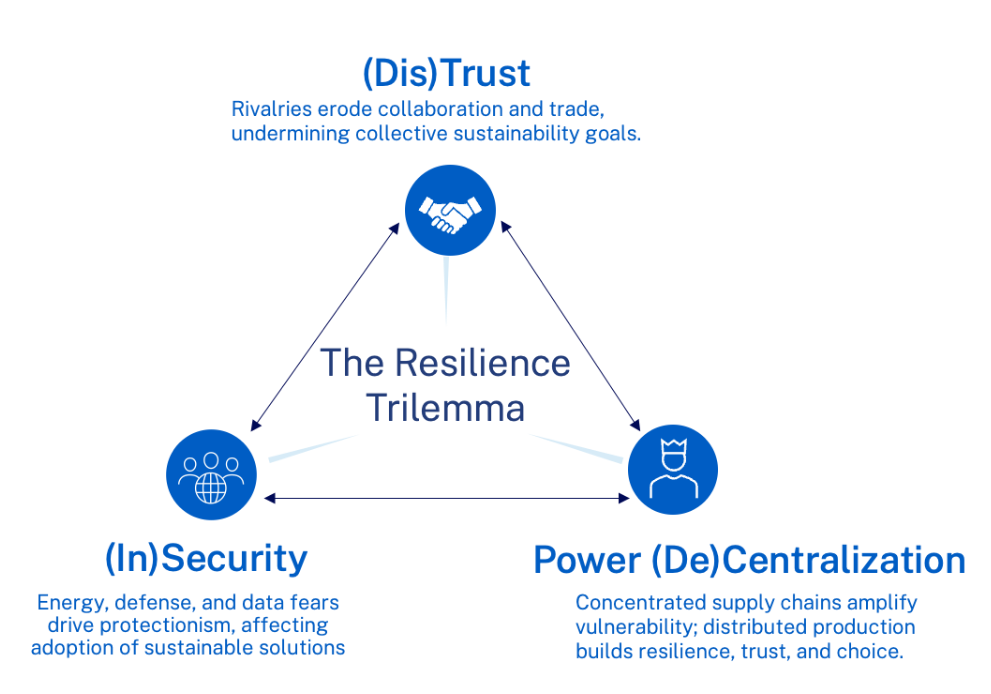
Binder and Evenett highlighted how sustainability and geopolitics converge in what they call a resilience trilemma:

In the past, global supply chains optimized for efficiency and cost. Today, the erosion of trust, the fear of supply disruptions, and the concentration of critical resources, from rare earths to batteries, create systemic fragility.
“Concentrated control creates dependencies,” Binder said. “And dependencies create leverage.”
The result: countries and companies are scrambling to reduce exposure, diversify suppliers, and bring key production closer to home. But these shifts come with higher costs and slower decarbonization progress.
“Security considerations now trump commercial ones,” Evenett said. “Once governments start worrying about continuity of supply, the economics of sustainability change dramatically.”
To illustrate how geopolitics is infiltrating everyday business decisions, Evenett offered three recent examples of trade weaponization:
These examples underscore how governments increasingly scrutinize technology for vulnerabilities, creating new requirements for companies to demonstrate trustworthiness and cybersecurity integrity.
The winning business models will be the ones that offer not only sustainability, but security and resilience.- Simon J Evenett
The combined forces of environmental stress and geopolitical fragmentation are fundamentally reshaping the economic landscape:
“The anchor of globalization has moved,” Evenett said. “The winning business models will be the ones that offer not only sustainability, but security and resilience.”
Companies that can credibly guarantee continuity of service, data integrity, and freedom from political interference will enjoy new competitive advantages, supported by government incentives and growing market demand.
Binder closed the core discussion with an argument that circular economy models, long seen as a sustainability ideal, are fast becoming a geopolitical necessity.
“Circularity helps reduce dependency on vulnerable global supply chains,” she said. “It keeps valuable materials in the system and under our control.”
In a world where rare earths, metals, and critical minerals can be weaponized, circular business models offer compelling strategic benefits:
Companies like Siemens, Schneider Electric, and others in manufacturing and fashion are already integrating circularity as a core strategic pillar.
But Binder cautioned that circularity still faces structural barriers, most notably the lack of reverse logistics and recycling infrastructure. “We’re trying to build circular models in a linear world,” she said. “The system needs to evolve.”
Both professors agreed that in this fragmented landscape, business leaders, not governments, will likely carry the mantle of positive change.
During the Q&A, audience questions turned to regulation, particularly the EU’s moves to soften or delay sustainability reporting requirements. Binder warned that while simplification is welcome, weakening rules sends the wrong signal.
“It creates uncertainty at a time when we need clarity,” she said. “And it undermines trust in regulation itself.”
Evenett added that poor regulatory design often stems from insufficient understanding of industry realities. “If policymakers don’t grasp the commercial implications, they create backlash. And that’s what we’ve seen.”
Both professors agreed that in this fragmented landscape, business leaders, not governments, will likely carry the mantle of positive change.
“The most compelling stories will come from companies that deliver both security and sustainability,” Evenett said. “Those examples will build trust—and they will shape public opinion.”
The webinar closed with a clear message: sustainability strategy can no longer be separated from geopolitics. Leaders who fail to integrate the two will risk falling behind and exposing their organizations to severe shocks. Specifically, four takeaways stand out:
The world is entering an era defined by uncertainty and fragmentation. But for leaders who understand the dynamics at play, this moment also brings opportunities to innovate, differentiate, and build more resilient business models. As Binder put it, “The challenges are immense. But the solutions exist, and companies that embrace them will shape the future.”

Professor of Business Transformation and Director of IMD’s Center for Sustainable and Inclusive Business

Professor of Geopolitics and Strategy at IMD
Simon J. Evenett is Professor of Geopolitics and Strategy at IMD and a leading expert on trade, investment, and global business dynamics. With nearly 30 years of experience, he has advised executives and guided students in navigating significant shifts in the global economy. In 2023, he was appointed Co-Chair of the World Economic Forum’s Global Future Council on Trade and Investment.
Evenett founded the St Gallen Endowment for Prosperity Through Trade, which oversees key initiatives like the Global Trade Alert and Digital Policy Alert. His research focuses on trade policy, geopolitical rivalry, and industrial policy, with over 250 publications. He has held academic positions at the University of St. Gallen, Oxford University, and Johns Hopkins University.
October 19, 2023 • by Faisal Hoque in I by IMD Book Club • 8 min read
In this month’s I by IMD Book Club, best-selling author Faisal Hoque explains how the concepts in his new book, Reinvent: Navigating Business Transformation in a Hyperdigital Era, can help us all...
October 13, 2023 in I by IMD Book Club • 4 min read
IMD professors recommend books to help you think differently about the challenges posed by sustainable business transformation....
September 29, 2023 in I by IMD Book Club • 6 min read
Author and business founder Cindy Candrian’s new book AI & You: A Guide to Understanding How Artificial Intelligence Is Shaping Our Lives is a deep dive into the history and impact of...
September 1, 2023 in I by IMD Book Club • 7 min read
Bernie Jaworski, author of Creating the Organization of the Future, discusses the critical importance of crafting a clear mission, vision, and purpose for your firm....
May 25, 2023 in I by IMD Book Club • 7 min read
In the quest for efficiency many organizations have forgotten the human side of customer service, says John Sills, author of The Human Experience. If in doubt, be human...
April 21, 2023 in I by IMD Book Club • 6 min read
Fostering curiosity and considering people’s lived experience can increase well-being, motivation, and productivity in the workplace....
March 24, 2023 • by Mohan Subramaniam in I by IMD Book Club • 7 min read
Traditional manufacturing and service companies need to leverage the new and explosive power of data and digital ecosystems to be competitive in the future, says IMD Professor of Strategy and Digital Transformation...
October 21, 2022 • by Salvatore Cantale in I by IMD Book Club • 5 min read
The next generation of business leaders can play a vital role in speeding up progress on sustainability, according to leadership expert Clarke Murphy....
September 9, 2022 • by Silke Mischke in I by IMD Book Club • 4 min read
To be an agile leader, you must foster your emotional intelligence. While many executives find it frightening to allow themselves to be emotional in a professional setting, it’s required to have the...
July 1, 2022 • by Anand Narasimhan, Stefan Michel, Karl Schmedders, Robert Hooijberg, Susan Goldsworthy, Alyson Meister, Katharina Lange, Shlomo Ben-Hur in I by IMD Book Club • 7 min read
From dealing with burnout and bullsh*t to the joys of friendship and climbing mountains, IMD professors offer a varied choice of summer reading material...
Explore first person business intelligence from top minds curated for a global executive audience