Share
Facebook Facebook icon Twitter Twitter icon LinkedIn LinkedIn icon Email
How-to-successfully-exit-a-business-2

Leadership

How to successfully exit a business

Published February 6, 2026 in Leadership • 7 min read

Why the way you leave a company can shape your legacy as much as your tenure.

Most leaders believe they will decide when it’s time to leave a business, but in reality, it is rarely planned for and occurs when illness strikes, a financial shock hits, or their board loses patience. By that point, it is too late for a smooth transition.

Our research with 19 French SME owner-managers shows that succession unfolds in two very different ways: forced by crisis or chosen by conviction. The path you take determines whether you leave with scars or strength and can shape your legacy as much as your time working within the business.

This article applies learnings from our 2025 paper in the International Journal of Entrepreneurial Behavior & Research, “Psychological perspectives of owner-managers on voluntary retirement,” and offers a glimpse into the two types of succession and what they mean for leaders and the businesses they leave behind. We also offer the next steps you can take to start your onward journey.

Why waiting backfires

Many SME owner-managers falsely reassure themselves that succession can wait. Be it an unwillingness to relinquish control, a lack of an onward plan, or a belief that the business still depends on them, leaders convince themselves that planning beyond their tenure isn’t necessary, and the consequences can be catastrophic for all involved.

When succession begins only because of poor health, age, or sudden financial stress, the transition tends to be fragile: decisions are taken late and under pressure, leaving owners torn, successors uncertain, boards confused, and employees doubtful about the future. What looks like buying time often ends up borrowing trouble.

Succession cannot be flipped on like a switch. It takes years of preparation – recognizing the trigger, adapting the organization, and preparing personally to leave. The longer leaders put this off, the heavier the psychological and organizational toll becomes.

Identity at stake, not just a job

On the surface, the hesitation feels rational, but underneath, it masks a deeper fear – the loss of identity, purpose, or relevance.

Psychological research in organizational settings, built on John Bowlby’s attachment theory (1969), suggests that over time, many owner-managers develop a strong emotional bond with their firms and therefore see themselves not just as assets but as part of their identity.

Stepping away feels less like giving up a role and more like giving up a piece of themselves. As one owner admitted during our research: “I no longer know who I am if I retire.” Another said, “The worst day of the week is Sunday.” Both voices reveal the same anxiety: without the rhythm of leading, they fear losing their sense of self. This explains why some leaders hold on until the very end or even return after stepping aside. Successors in our study described this as “haunting back,” referring to former leaders who, though officially retired, still show up on the shop floor, reasserting their influence and undermining those who follow. The challenge is not about operations but about psychology. Letting go forces leaders to separate their sense of self from the company they built, a transition few prepare for, but one that no leader can avoid.

“My dad didn’t want to let go. He is one of those leaders who doesn’t know what to do if he has to leave the firm tomorrow. ”
– Second-generation successor in construction, frustrated by a father’s reluctance

Two paths, two outcomes

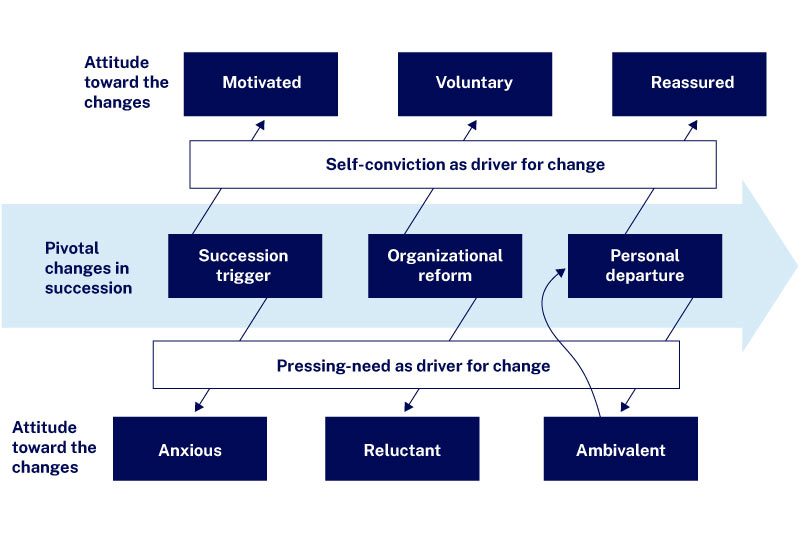
Our findings highlight two distinct ways in which retirement unfolds: one is driven by pressing need, the other by self-conviction.

When succession is triggered by pressing need, owner-managers often feel anxious, reluctant, or ambivalent. Conversations start too late, power remains blurred, and organizational reforms stall. Even after stepping down, many stay psychologically attached, clinging to influence. The result is uncertainty for employees, weakened legitimacy for successors, and growing instability for the firm.

When retirement is chosen with self-conviction, the psychological tone is different. Owners feel reassured and motivated. They begin to share power earlier, introduce clearer decision-making structures, and prepare successors with greater transparency. Many anchor themselves in new projects, be they personal, civic, or entrepreneurial, that make departure voluntary and meaningful. In this path, successors gain authority, organizations renew, and founders leave with confidence.

The choice of path matters because it shapes not only the organizational outcome but also the leader’s personal experience. Pressing-need retirements often activate attachment defenses, fueling anxiety and reversals. Self-conviction retirements enable detachment, fostering continuity, renewal, and peace of mind.


Pivotal-Changes-in-succession-3
Grounded model for incumbent attitude toward the pivotal changes in succession. (Wang, Park, and Leleux, 2025)
I have accompanied three or four friends to the cemetery recently… I must prepare for succession.
– First-generation logistics founder in his early 60s

Lessons from life stories

The contrasting paths came to life in the stories we collected from 19 French SMEs across various industries, including construction, logistics, food, and finance.

On the pressing-need path, owners tended to delay succession until a shock left them with no choice. A logistics founder admitted he had never thought seriously about retirement until several friends passed away, forcing him to confront his own mortality. He rushed into succession with little preparation. Successors were unready, and the transition was fragile.

He can’t let go of the company!
He keeps showing up at all the manufacturing lines.
– Daughter succeeding her father in a manufacturing firm

Others showed similar patterns of reluctance. In a construction company, the founder stepped down in name only, retaining 51% of voting rights and returning daily to the factory. Employees were confused, successors undermined, and the process stalled – a textbook case of haunting back.

Having enough time was fortunate and valuable. It brought a sense of tranquility and ensured the process was done correctly.
– Second-generation food business owner

These leaders were not simply clinging to formal power; psychologically, they struggled to separate their identity from the company. Even when age, health, or fatigue made departure necessary, attachment pulled them back. Our interviews showed that this ambivalence often left boards uncertain, successors insecure, and organizations destabilized.

By contrast, owners on the self-conviction path began planning earlier and were able to anchor themselves in new roles. A second-generation food business family prepared the ground well in advance, experimenting with sociocracy and gradually shifting authority. This created calm for the parents and legitimacy for the children.

We started to try out a decision-making process based on consensus. Today, our children feel good about this governance. It avoids making decisions alone.
– Same family, experimenting with sociocracy

Another example came from finance. Instead of resisting departure, one entrepreneur invested in his daughter’s agricultural venture. This new project gave him purpose beyond the firm and reassured him about letting go.

I’m participating in this project – land, cultivation, processing. I will continue after transitioning from my company.
– First-generation finance entrepreneur

These cases illustrate more than governance mechanics; they reveal psychological dynamics. When triggered by a crisis, leaders often respond with anxiety, reluctance, or reversals, remaining tied to the business and confusing those around them. When guided by conviction, they felt reassured and motivated, delegating earlier, embracing new activities, and leaving space for successors.

Steps to take today

Leaders of listed firms, startup founders, and even political figureheads will one day face the same truth: someone else must take the helm. Mindsets are psychological, but they can be shaped. Four immediate steps to take if you are waiting in succession limbo: 

  • Talk early. Succession is inevitable. Early informal conversations with family, boards, or advisors spark momentum and build conviction that continuity matters and only comes through anticipation, preparation, and letting go.
  • Share power. Gradual delegation gives successors room to learn, adapt, and build legitimacy while the incumbent is still present to guide. It reassures both sides and reduces resistance.
  • Prepare your own exit. Anchor yourself in new projects: civic roles, family ventures, mentoring. Retirement is not the end of identity, but the start of another.
  • Strengthen governance. Clear structures, transparent rules, and professional boards reduce anxiety and support leaders in letting go. Governance is not bureaucracy; it is peace of mind.

Importantly, our research shows that leaders respond to different triggers. Those on the pressing-need path are often jolted by failure stories – peers whose disrupted transitions left scars. Conviction-driven leaders, by contrast, are inspired by success stories that show how smooth and voluntary departures can be designed. Both kinds of stories matter because the right narrative can tip a leader from hesitation to preparation.

The legacy you choose

Delaying succession out of obligation or avoidance narrows options, weakens successors, and leaves behind a fragile legacy. By contrast, approaching succession with conviction and choosing the moment intentionally creates renewal, strengthens continuity, and secures a lasting legacy.

Letting go is not weakness; it may just be the hardest and final test of leadership. What leaders leave behind is not only what they built, but the way they chose to step aside.

This article is based on the research paper by Léa Wang, Jung Park, and Benoit Leleux, “Psychological perspectives of owner-managers on voluntary retirement,” published in the International Journal of Entrepreneurial Behavior & Research (2025).

Authors

Lea Wang

Lea Wang

Research director at Transmission Lab

Lea Wang leads research at Transmission Lab, a non-profit organization in Paris committed to raising awareness, facilitating discussions, and providing support for business transmission and succession planning. She also holds a Professorship at CBS International Business School in Cologne, Germany. She obtained her Ph.D. in work and organizational psychology from Paris 8 University and Tsinghua University in China.

Jung Eung Park

Jung Eung Park

Associate professor at ISG Paris

Jung Park is an Associate Professor of Entrepreneurship and Innovation at ISG Paris and an Adjunct Researcher at HES-SO/HEG-Genève. His current research interests include venture governance and startup ecosystems. Prior to that, he worked for five years at IMD as a research fellow for entrepreneurship, innovation, and family business governance.

Benoit Leleux

Benoit F. Leleux

Benoît Leleux is the Stephan Schmidheiny Professor of Entrepreneurship and Finance at IMD. He is Co-Director of the Foundations for Business Leaders program and Program Director of the Winning Sustainability Strategies program.

Related

Learn Brain Circuits

Join us for daily exercises focusing on issues from team building to developing an actionable sustainability plan to personal development. Go on - they only take five minutes.
 
Read more 

Explore Leadership

What makes a great leader? Do you need charisma? How do you inspire your team? Our experts offer actionable insights through first-person narratives, behind-the-scenes interviews and The Help Desk.
 
Read more

Join Membership

Log in here to join in the conversation with the I by IMD community. Your subscription grants you access to the quarterly magazine plus daily articles, videos, podcasts and learning exercises.
 
Sign up
X

Log in or register to enjoy the full experience

Explore first person business intelligence from top minds curated for a global executive audience