Holcim’s Ram Muthu: Can circular construction scale?
Holcim’s Ram Muthu on circularity, EU regulation, and what it really takes to decarbonize cement at industrial scale....

by April Rinne Published January 15, 2026 in Strategy • 10 min read
How do I navigate a career path on a map that’s being redrawn in real time? How do I stop feeling so fearful about the future? What value do I have, and what skills should I be focusing on as AI redefines the way we work? These are the types of questions I am increasingly being asked by individuals and organizations. I attempt to answer these based on decades of research and writing on change and how to shift your mindset so that you learn to see it as an opportunity, as opposed to a threat, which is all too often the default for most of us.
Even as a young child, the concept of a career ladder felt odd to me. When I was asked, “What do you want to do when you grow up?” I never had one answer. I wanted to do things that hadn’t been done before, and constantly learn, and be open to change!
Sadly, when I was twenty years old, I was forced to confront change in the worst possible way. I was studying overseas when I got the call that no one ever wants to imagine receiving – both my parents had been killed in a car accident. In an instant, my entire world flipped upside down, and everything changed: from my sense of self to my support system and my ideas about my career. From this very traumatic experience, I learned that I couldn’t fit life into an equation, a promotion, or a title. I had to look beyond. This wasn’t about external metrics of success, but rather, did I have the inner strength and abilities to move forward? I realize that this is an extreme example, but it forced me, at an age when I had my entire professional life ahead of me, to confront massive change in a very real way.
Since that tragic yet life-defining day, I have spent over twenty years in over 100 countries working on different aspects of flux. Today, much of what I do is to help leaders, teams, and organizations see change and uncertainty differently – not as a threat or nuisance, but rather as a never-ending opportunity to embrace and level up.
So, what do I advise them? And what advice do I have for you as you sit at your desk and wonder where your career is going as corporate ladders crumble? What can you do to face the future with hope, not fear, in a world where uncertainty is the order of the day?

We need to start by adopting what I call a Flux Mindset™. A Flux Mindset™ sees change consistently as an opportunity, not a threat, by being clear and grounded in your values.
So how do you do this? The first important step is awareness of what I call your relationship to change and uncertainty. What are your typical responses and defaults? What kinds of change and uncertainty do you tend to struggle with more than others? Being aware of change and how it affects us enables us to prepare for it and be better at it. The best thing about change is that you don’t need to make any investment in training or technology to practice dealing with it; life gives you almost infinite opportunities to do so every day.
Think about it: minor changes happen constantly, from your schedule changing to the weather changing to your mood changing. Obviously, there are also big changes that happen less frequently, like a retrenchment or loss of a loved one. Being aware of how you cope with small changes and practicing awareness of change daily will help you be better prepared for the big changes.
An important first step is every time change happens to step back and ask how you are reacting to this change. Often, our default reaction is fear. Many humans are inclined to catastrophize. Once we recognize that fear is driving our response, it’s important to ask: Is this life-threatening? If it’s not, which it almost always won’t be, then it can be extremely powerful to flip the question and ask instead: what’s the best possible outcome that could come because of this change?
Asking this question does not take a special credential or secret wisdom; all it takes is to stop and pause for a moment. Change can happen at any point in the day or night; you simply need to take the opportunity to do the work when change presents itself to you. Dealing with change is like a mental muscle: The more you practice it, the stronger it becomes, and the easier uncertainty is to understand. Moreover, don’t just do this alone. When teams develop a shared practice to pause together and take time to reflect on change in this way, it can bring about exponential benefit.
It is also important to work out what changes you are relatively better at managing and what changes you struggle with more than others. Every human excels at some kinds of change and struggles (sometimes disproportionately) with others, because we are all unique and have different personalities and life experiences to build upon. This should be celebrated! At the same time, there are some types of responses to change that are almost universal amongst humans. For example, most humans love the changes we choose or opt into in some way; I am still looking for the human that loves change that blindsides them. It is important to realize that how we deal with change at work often has little to do with work. Helping people understand how their attitudes to change were shaped is often the first step in understanding how to help them deal with change. These attitudes are often shaped in childhood – long before any job, employer, or workplace challenge – and they are not typically on one’s CV. As a result, we rarely know such things about even our closest colleagues, yet fewer things matter more to effective teamwork and to flourishing in the workplace. If we can take time to reflect on the stories of change in our lives, both the joyful and the difficult, we can work out why we respond the way we do and then try and reframe our negative responses to change in our day-to-day lives. When we do so together with colleagues, truly amazing things can happen. Unfortunately, most organization systems have overlooked this very human aspect of change; – there is no line item in the budget for it, yet it often yields outsized returns.
Instead, we have tried to put change into a framework. But traditional change management frameworks don’t acknowledge how people actually feel about the change, and they are not designed to help someone’s response to change shift from fear to hope, for example. Rather, as I have written about before, Change Management requires a Change Mindset. Rather than relying on checklists or rigid plans, to thrive in today’s world, it is far more important to build capacity within your team to cope with ambiguity than it is to put a change management process in place.
These practices are dramatically new and powerful because they are designed specifically for a world in flux.
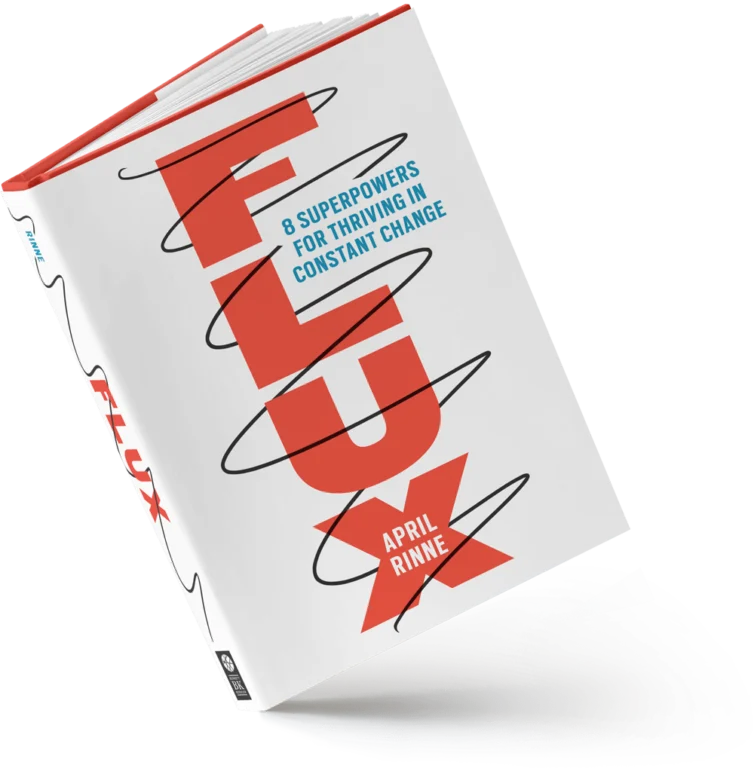
In my book, Flux, 8 Superpowers for Thriving in Constant Change, I share mindset shifts and practices to develop for individuals, teams, and organizations to better navigate uncertainty and change. These practices are dramatically new and powerful because they are designed specifically for a world in flux. With them, you can “make change and uncertainty suck less” and move forward with clarity, confidence, and resolve.

I always encourage people to make each of the 8 Flux Superpowers their own. I cannot predict exactly what set of changes you are dealing with. I also don’t know what your attitudes are about change. However, I do know that everyone can improve their relationship to change and uncertainty in some way – and these superpowers help you do just that. I see them as a menu of practices that consistently work, not merely to survive a world in constant flux, but to thrive in it. What is more, they offer an opportunity to improve – to show up better for the present and the future – every day!
AI is replacing jobs at a rapid rate, particularly entry-level jobs, which is having a massive impact on career prospects for young graduates.
Several Flux Superpowers can help talent navigate a future of work full of change and uncertainty. AI and its impact on our organizations and on the future of work and careers is a change that none of us can escape. When it comes to this change, the opportunity lies in maintaining the human connection, not replacing it. This is at the heart of what I call “Be All The More Human.” Use AI to augment what humans are doing, not replace what they are doing. Rather, expose people to it, use it to try new things, with no guarantee that it will be adopted. Create a culture of curiosity around it.
AI is replacing jobs at a rapid rate, particularly entry-level jobs, which is having a massive impact on career prospects for young graduates. But here is where many organizations are getting it wrong. They are running at full speed into AI and not realizing that if they don’t get the human part right and employ and train young people, they will end up with no future leaders. Many companies don’t realize that now, because it’s all so new, but often by the time you realize a problem, it may not be fixable.
Another Flux Superpower that plays an outsized role in today’s AI-driven world is knowing how to create your career portfolio. AI makes the value of creating a career portfolio (versus climbing a career ladder) clearer than ever. I have been working on the concept of a career portfolio for more than 20 years. It is the idea of looking at who we are and the skills we have, not just in terms of how they enable us to climb a career ladder, but rather how we navigate life. It’s far wider than merely one’s career trajectory, and it incorporates many more aspects of who we are and how, through multiple roles and pursuits, we can add value to society. It is far more holistic, diverse, and uniquely you than what is typically included on one’s resume. A career portfolio approach enables independents and employees alike to better understand that no matter what the future holds, you have agency to shape your own career. By adopting this mindset, even when a career change happens, which it inevitably will, you are equipped to feel as if you have more control over the next steps.
When organizations embrace this kind of portfolio thinking, they in turn build teams that are more curious, creative, and resilient. By helping people grow their career portfolios through encouraging them to learn new things, explore side projects, and experiment in other roles, you gain fresh energy, perspective, and stronger networks. You don’t lose people to burnout; you gain loyalty and trust. This is where mutual growth happens and where the future of work looks far more like an exciting opportunity for employees and organizations alike.
This article was produced from an interview conducted at the Nordic Business Forum 2025.

Futurist, speaker, and author
April Rinne is a change navigator who helps individuals and organizations rethink and reshape their relationships with change, uncertainty, and a world in flux. She’s a trusted advisor, speaker, investor, lawyer, global development executive, adventurer (100+ countries), and insatiable handstander. She is ranked one of the 50 leading female futurists in the world and is a Harvard Law School graduate, a Young Global Leader at the World Economic Forum, a member of the Silicon Guild and Thinkers50 Radar, and author of the international bestseller Flux: 8 Superpowers for Thriving in Constant Change.

January 27, 2026 • by Julia Binder, Knut Haanaes in Strategy
Holcim’s Ram Muthu on circularity, EU regulation, and what it really takes to decarbonize cement at industrial scale....

January 23, 2026 • by David Bach, Julia Binder in Strategy
Live from Davos: IMD’s Julia Binder and David Bach cut through the headlines on geopolitics, AI, energy – and competing visions for the international order....

January 23, 2026 • by David Bach, Julia Binder, Arturo Bris, Frédéric Dalsace, Simon J. Evenett, Florian Hoos , Jennifer Jordan, Sara Ratti, Karl Schmedders, Sarah E. Toms, Ginka Toegel in Strategy
From Trump and transatlantic tensions to AI’s reality check and sustainability’s reinvention, Davos 2026 signals a shift toward values-based pragmatism....

January 16, 2026 • by José Caballero in Strategy
South Korea continues to invest heavily in science and technology, yet a climate of entrepreneurial decline envelops it. What takeaways are there across the board for leaders in other economies?...
Explore first person business intelligence from top minds curated for a global executive audience