
Europe AI teardown: strengths, adequacies and dangerous gaps
Discover Europe's AI strengths across voice, translation, video, and defense—and the critical gaps slowing adoption and sovereignty....

by Murat Tarakci Published January 13, 2026 in Strategy • 7 min read
Shift from ego-system to ecosystem: Satya Nadella transformed Microsoft’s inward-looking, lock-in strategy into an ecosystem-centric approach, fostering openness, cross-platform collaboration, and partnerships, even with competitors.
Ecosystem strategy drives growth: By embracing interdependent relationships and joint value creation, Microsoft and Philips achieved significant market gains, suggesting that ecosystem leadership accelerates innovation and resilience.
Leadership imperative: Success in today’s interconnected markets requires leaders to map ecosystems, build focused partnerships, and sustain them through empathy and shared success, not domination.
When former Microsoft CEO Steve Ballmer announced his departure in 2014, Wall Street cheered with a 7.5% jump in the share price. Few could have predicted just how much higher the share price would climb under his successor. Since Satya Nadella took the helm in February 2014, Microsoft’s stock has surged from $32.05 on the day of his arrival to over $500 today. This meteoric rise reflects how Nadella has reimagined Microsoft as a cloud and AI powerhouse by shifting its internal culture from one of competition to one of collaboration. But the lesser-known secret supercharging Microsoft’s growth is that Nadella also changed its strategy toward external stakeholders from a ‘Microsoft-first’ strategy to an ‘ecosystem-centric’ one.

Steve Ballmer became the CEO of Microsoft on 13 January 2000. During his 14-year tenure, he tripled annual revenue to $78bn, more than doubled profits to $22bn, and made Microsoft the largest software maker in the world. Yet, Microsoft’s market capitalization dropped from $604bn to $269bn during this time, attributed mainly to the company’s failure to adapt to the decline of the PC market and the rise of mobile devices because of its inward-looking strategic approach.
If you look at Microsoft’s share price growth over the last 25 years, you may put it down to the development of new products and services over the last decade. But the truth is that XBox, SharePoint, SQL Server, Azure, Windows Phone, and Office 365 had all come to fruition under Ballmer.
So, what changed?
Under Ballmer, Microsoft tried to lock users into its own products and services, notably Windows and Office. While this strategy worked in the PC era, it did not work in the mobile and cloud era, where openness, cross-platform accessibility, and ecosystems matter more than lock-in. Even though Satya Nadella is himself a Microsoft “lifer”, having joined the company as a young engineer in 1992, he brought a fresh approach.
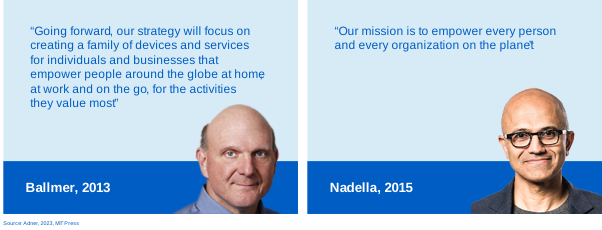
nConsider the following statements in this image. While both statements highlight empowering people, Nadella’s vision places people and their needs at the center. It does not specify that these needs should be met by the Microsoft family of services or devices. This shift of “empowering” users across platforms required working more closely with other ecosystem partners. Ron Adner, in his book Winning the Right Game: How to Disrupt, Defend, and Deliver in a Changing World, succinctly describes this difference as an ‘ego-system’ versus ‘ecosystem’ leadership approach.
Nadella’s leadership approach toward ecosystem partners is evidenced by the Azure platform – a core part of his strategy, which embraces open-source software, including Linux – as well as his willingness to partner with competitors like Apple and Salesforce, and the cross-industry alliances he has forged for Microsoft with the likes of OpenAI and Nvidia.
Under Nadella’s leadership, Microsoft has repositioned itself as a leader in cloud computing and artificial intelligence and achieved a market capitalization of more than $3.8tn (October 2025). What Nadella demonstrates is that the future is no longer about dominating an ecosystem but about enabling it to thrive.
The ecosystem strategy is not confined to the software world but applies to other industries too.
The ecosystem strategy is not confined to the software world but applies to other industries too. Consider Philips’ successful transformation into a health technology leader during the tenure of its CEO, Frans van Houten. After floating its historic lighting business in 2016, Philips embraced an ecosystem strategy for the remaining healthcare business, with a focus on “long-term strategic partnerships” to “unlock value for our customers and us,” as explained in its financial reports. This approach meant moving beyond an original equipment manufacturer. Philips began to work with hospitals and care providers not just as customers, but as partners in “joint commitment and collaborative innovation.” This created deeper, more integrated relationships and delivered better outcomes for patients and providers. The doubling of its stock price was the direct result of this deliberate ecosystem strategy.
This is why the way an organization approaches the alignment of partners and secures its role in a competitive ecosystem is becoming an increasingly important part of the business strategy.
As the Microsoft and Philips cases highlight, businesses today operate in an environment of ecosystems, which is a constellation of interdependent relationships.
In this era, traditional competitive strategies, such as Porter’s Five Forces, do not work because these strategies advocate that to get ahead, you need to battle customers and suppliers while fending off competitors, new entrants, and substitutes. Today, to continue to create value for their customers, organizations need to increasingly rely on interdependent relationships with a multilateral set of partners. By working within an ecosystem, companies can combine complementary capabilities, technologies, and expertise to deliver richer, more holistic solutions.
This is why the way an organization approaches the alignment of partners and secures its role in a competitive ecosystem is becoming an increasingly important part of the business strategy.
Here are the three steps you, as a business leader, can take to harness ecosystems strategically:
Realize that your organization is embedded in an ecosystem, and you should see beyond the organizational boundaries to serve your customers better. You should begin by mapping the business ecosystem. Start by clearly defining the specific value or experience you promise to deliver. With this promise at the center, you can then identify and place all the partners who are essential to making it a reality on a map.
This map includes more than just your direct suppliers. It must also feature partners who stand between you and the customer. If these adoption partners, such as distributors, retailers, or installers, don’t embrace your innovations, no value will ever reach the end user. Your map will also include complementors: other businesses whose offerings make your product more useful and valuable. Think of the universe of apps on your smartphone or the growing network of charging stations for an electric car. The more high-quality complements that exist, the more indispensable your own innovative product or service becomes. The resulting picture is not a simple, linear value chain. It is a dynamic map of interconnected partners, all orbiting your central value proposition to the customer.
With your ecosystem map complete, it is time to build the partnerships that bring it to life. A successful ecosystem is not built by approaching every partner at once. Instead, the process requires a focused, iterative approach.
Begin by identifying your most critical partners, then engage them one at a time. This process starts with empathy, long before the first contact. You must deeply understand each potential partner’s world: their strategy, their needs, their aspirations, and the specific jobs they are trying to get done. With this insight, you can build a value proposition that clearly explains how your innovation helps the partner achieve their own goals. This approach allows you to seize partnership opportunities deliberately, building your ecosystem – one strong, mutually beneficial relationship at a time.
Building an ecosystem is as much a leadership challenge as a strategic one. To see why, let’s return to Microsoft. In 2000, CEO Steve Ballmer famously chanted “Developers! Developers! Developers!” at a conference, showing he understood the importance of complementors (app developers in this case). But shouting about it would not be enough to build a mobile app ecosystem.
True ecosystem leadership requires empathy and a relentless focus on joint value creation. It entails a genuine commitment to understanding a partner’s needs and ensuring their success. This approach is critical because everything changes: CEOs are replaced, strategies pivot, and markets morph. An ecosystem built on shared success is the only kind resilient enough to survive these shifts.
By implementing this ecosystem playbook, you can position your organization to succeed in increasingly interconnected and dynamic business environments.

Professor of Innovation Strategy
Murat Tarakci is Professor of Innovation Strategy at IMD. His research focuses on the social and psychological foundations of innovation and strategy, examining how organizations adapt to and shape their environments.
Tarakci’s work highlights that winning strategies stem from individuals and teams who think, feel, and care. Hence, understanding why strategies thrive or fail must consider individuals’ cognition, emotion, and motivation. His work also aims to create a positive impact by helping organizations better address societal challenges through a deeper understanding of their behavioral dynamics and mechanisms.
October 14, 2026 • by Michael R. Wade in Innovation
Discover Europe's AI strengths across voice, translation, video, and defense—and the critical gaps slowing adoption and sovereignty....

October 13, 2026 • by Michael R. Wade, Konstantinos Trantopoulos , Mark J. Greeven in Innovation
Uncover what truly drives value in digital ecosystems: debunk myths and learn governance, data practices, and collaboration strategies...

September 30, 2026 • by Dorotea Brandin in Innovation
Use the AAA framework to assess tasks and projects: 1–10 scores per criterion guide smarter, calmer workplace decisions....

September 22, 2026 • by Michael Yaziji in Innovation
Question central planning: why a unit-focused hybrid approach may outperform both centralized control and chaotic AI adoption....
Explore first person business intelligence from top minds curated for a global executive audience