
Three ways in which CFOs can drive digital transformation
How CFOs can lead digital transformation by focusing investments, aligning strategy with execution, and embracing agile planning to drive resilience and growth....

by Julia Binder, Manuel Braun Published March 3, 2026 in Strategy • 10 min read
Over the past two years, a similar conversation has been unfolding in boardrooms that otherwise have very little in common: How to rethink supply chain resilience in the face of a critical minerals crisis. Automotive executives are worrying about access to rare earth elements, which are critical for electric drivetrains and a growing number of sensors and actuators. Wind developers and OEMs are reassessing project timelines as grid equipment constraints, including transformer backlogs, slow down connections, and increase uncertainty. Cloud providers have been debating whether future data center expansion will be constrained less by financing and more by infrastructure realities. Power availability, grid interconnections, cooling systems, and transformer supply have become bottlenecks that can delay projects by years, even when capital is readily available.
These are not sustainability discussions. They are operational conversations about business continuity, growth, and risk exposure. Yes, demand for critical minerals is growing significantly, driven by digital infrastructure and AI, defense technologies, and low-carbon solutions for the energy transition. Supply is also constrained, already putting upward pressure on prices. And China has strategically built a dominant position across key value chains, controlling roughly 70% of mineral ore extraction and 90% of refining capacity.
But this is only half of the story.

Many companies are operating very extractive, interdependent value chains, which are accelerating resource extraction. Optimized for cost efficiency in a globalized world, these value chains are also increasingly vulnerable to supply chain disruptions. Europe is even more exposed than most other regions, due to fewer deposits and higher import rates.
When China introduced new export controls affecting rare-earth-related supply chains, the automotive industry reacted first and most visibly. Since electric motors and many other vehicle systems depend on permanent magnets whose upstream processing is highly concentrated, the export controls raised the threat not only of higher prices, but also of reduced deliveries, which in turn could translate into lost revenue, with very little warning. In response, BMW has built circularity into its sourcing strategy. For its newest vehicles, they have optimized many parts to include a high share of recycled content (roughly 40% across the vehicle), reducing the dependency on primary materials. In addition, they are building partnerships with recyclers such as PreZero to explore material recovery strategies at the end of vehicle life.

“Google has long-run programs that harvest, repair, and redeploy data center components, and it has described these practices as part of how it manages excess inventory and reduces the need for new components.”
The battery value chain offers one of the clearest illustrations of circularity as strategy, not messaging. Volkswagen Group Components has opened a battery recycling pilot plant in Salzgitter, positioning recycling as a way to recover valuable materials for future battery production. In North America, Ford and Redwood Materials have announced a partnership explicitly framed as building a closed-loop or circular supply chain for EV battery materials, connecting end-of-life collection to recovered metals that can flow back into manufacturing. Toyota Motor Corporation has just announced its investment in a new circular factory in Poland, where they plan to process 20,000 end-of-life vehicles per year to recover reusable components and valuable materials such as copper, aluminum, or steel.
Beyond the automotive sector, wind turbine makers – which require rare earth magnets in their direct drive designs – have long been aware of the trade-off between performance, maintenance, and exposure to rare earth supply concentration. Siemens Gamesa has publicly announced efforts to reduce reliance on Chinese rare earth elements and has explored recycling and recovery opportunities, because dependence on a concentrated supply base is not only a cost issue but also a strategic vulnerability.
In the technology sector, a different version of the same problem is playing out. The ability to extend and reuse physical assets, like hardware throughput and grid connections, rather than continuously replacing them, has become central to their ability to scale. Microsoft has built Circular Centers designed to reuse and recycle servers and hardware components within its cloud supply chain, explicitly positioning reuse and recycling to strengthen supply chains and manage hardware lifecycles at scale. Google has long-run programs that harvest, repair, and redeploy data center components, and it has described these practices as part of how it manages excess inventory and reduces the need for new components.
Even consumer electronics, often assumed to be asset-light, show the same logic when you look past the marketing and focus on supply chain leverage. Apple has invested in disassembly robotics, such as Daisy, and has publicly tied these systems to recovering valuable materials, including rare earth elements, that are otherwise difficult to retain through traditional recycling processes. Apple has also scaled reuse through programs that send devices to new owners, which reduces the need for additional mining and helps preserve access to materials embedded in existing products. The Apple trade-in and resale model is now fully integrated into the operating model, which not only expands market share but also increases customer loyalty and de-risks the business model and sales channels further.
These examples differ in technology, geography, and customer base, but they share a common logic. Circularity is no longer only about minimizing waste at the margins. It is about regaining control over resources and operational capacity that determine whether growth plans are realistic or aspirational. It is time to show that the impact of circularity goes beyond the R-Lever strategies. This is the business case our graphic makes visible.
Recovering and recycling materials at the end of life, so that nothing is wasted, technical materials are restored, and biological materials are regenerated.
Most companies still look at circularity through the lens of the R-Levers only:
This creates a clear ladder of levers representing strategies with increasing impact in terms of resource efficiency and decarbonization. But there is also a clear business value that has so far been hiding in plain sight.
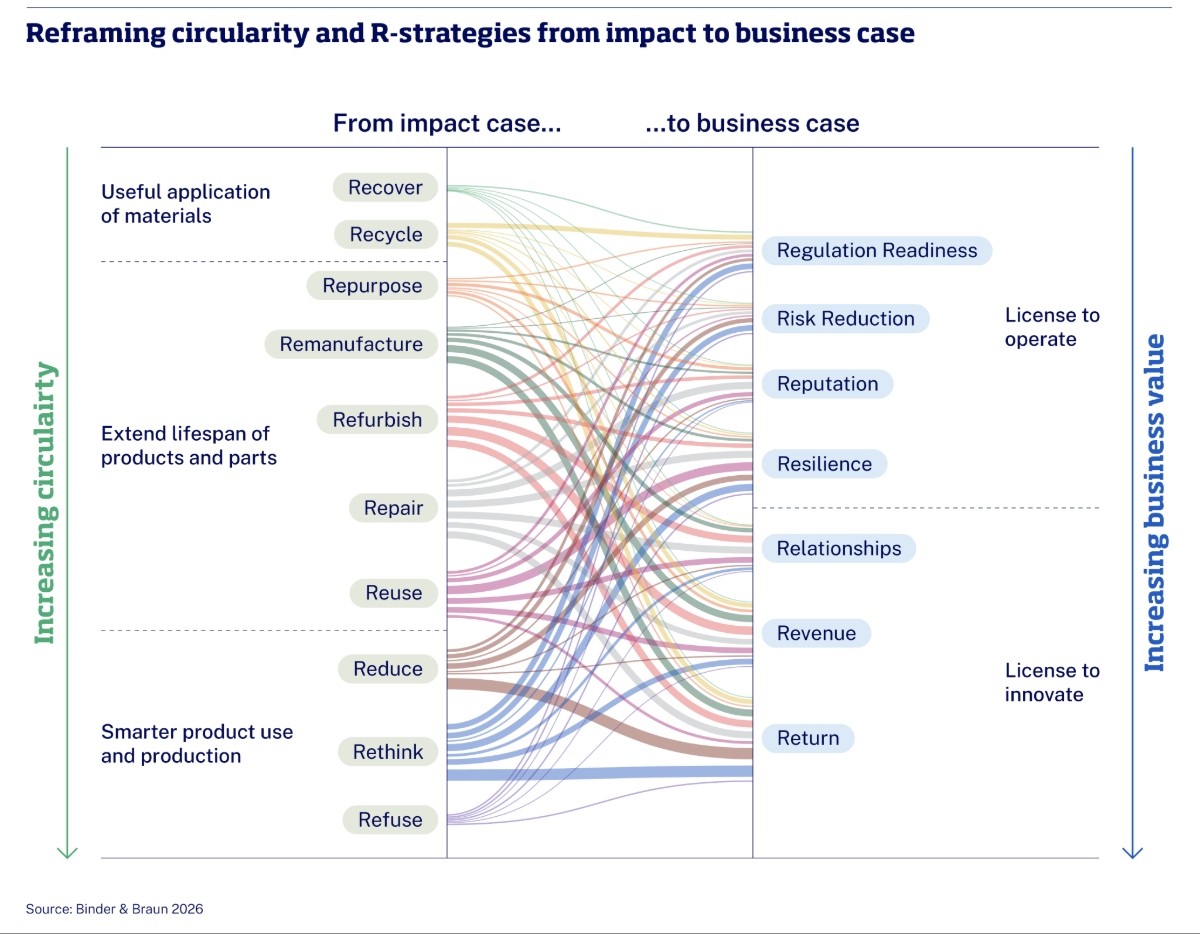
The first business outcome circularity delivers is regulatory readiness. Companies that actively reduce material complexity, avoid substances likely to face restriction, and design products for traceability are better positioned when regulation tightens or diverges across regions. This advantage is not theoretical. As chemical, trade, and critical materials regulations increasingly intersect, firms that can adapt quickly avoid costly redesigns, delayed market access, and stranded inventory. Regulatory readiness is not about compliance, but about anticipating changes in an uneven regulatory landscape.
Closely linked is risk reduction, which has moved from a procurement concern to a board-level issue. Circular strategies reduce exposure to volatile and concentrated supply chains by lowering dependence on virgin inputs and extending the usable life of existing assets. Responsible, controlled, and diversified sourcing strategies reduce risk exposure, whether to extreme weather events or supply shocks. This matters because the most damaging supply chain disruptions today are not short-term price spikes, but prolonged shortages that halt production. Companies that reuse, refurbish, or remanufacture components reduce both the frequency and severity of these shocks, because fewer critical inputs need to be sourced at exactly the wrong moment.
As firms progress, circularity begins to generate reputational advantage, but not in the way it is often discussed. In volatile markets, reputation is increasingly tied to reliability rather than virtue. Customers, governments, and partners value firms that can deliver consistently under constraint. Companies that demonstrate control over their material flows, rather than dependence on fragile upstream systems, earn trust that translates into preferred supplier status, faster permitting, and deeper partnerships. Circular business models such as repair, resale, or rental typically signal a quality commitment of the brand and manufacturer to the customer: products should have a long life and are ready for that, signaling trust and a long-term partnership.
This feeds directly into resilience, which is where circularity starts to separate leaders from laggards. Firms with internal loops, such as remanufacturing capacity, take-back systems, or secondary material streams, are better able to absorb external shocks without halting operations. When supply chains break, these companies do not wait. They reroute, recover, and redeploy. Resilience in this sense is not redundancy. It is the ability to keep operating when others cannot.
At higher levels of maturity, circularity becomes a driver of relationships rather than simply an operational capability. Repair, refurbishment, and reuse models keep companies connected to products long after the initial sale, creating ongoing touchpoints with customers and partners. This proximity generates data, insight, and loyalty that linear models structurally lack. Over time, products shift from transactions to platforms for service, performance, and long-term engagement.
From there, circularity opens the door to revenue growth. Product-as-a-service (PaaS) models, performance-based contracts, secondary markets, and refurbishment programs all depend on extended product lifetimes and retained material value. A circular business model has the potential to deliver more customer lifetime value and more profit over product life. A brand may sell a product two to three times, with a refurbishment step in between. Circular services unlock new revenue streams, such as repair or extended warranty offerings. These models also create recurring revenue streams that are often more stable than traditional sales, particularly in markets where customers value uptime, reliability, and cost predictability.
Finally, circularity delivers return, which is where the conversation ultimately lands with boards and investors. Lower material costs, optimized waste management fees, reduced downtime, improved asset utilization, and more predictable margins all contribute directly to financial performance. Investors increasingly recognize that companies capable of operating under constraint are better positioned for long-term value creation. Circularity, at this point, is no longer a sustainability narrative. It is a capital-efficient narrative.
The critical task for business leaders is not to increase circularity for its own sake, but to convert circular levers into measurable business outcomes. That conversion requires financial discipline. The direct business case may be visible in resale margins, lower material inputs, or improved asset utilization. But the real economic impact often lies beyond those immediate effects. Leaders who evaluate circularity narrowly risk underestimating its value. The full business case includes reduced exposure to volatile supply chains, greater delivery reliability, stronger customer retention, and higher lifetime value.
If your business depends on physical materials, energy, or complex global supply chains, circularity is already shaping your strategic future, whether you acknowledge it or not.
Apple’s trade-in, refurbishment, and resale model illustrates this logic. The obvious value lies in the margin of refurbished devices. The strategic value lies in what follows: lower effective upgrade costs, higher retention rates, and deeper integration into Apple’s hardware and services ecosystem, where recurring revenues accumulate over time. The circular lever is refurbishment. The economic outcome is expanded customer lifetime value and greater revenue predictability. Circularity does not automatically create profit, but when connected deliberately to revenue models and risk management, it strengthens competitive position in ways that linear models cannot.
No industry is exempt from this shift. If your business depends on physical materials, energy, or complex global supply chains, circularity is already shaping your strategic future, whether you acknowledge it or not.
The real question is not whether you support circularity in principle. The question is whether you are systematically converting circular levers into economic advantage. In a world where access, resilience, and lifetime value increasingly determine competitiveness, circularity becomes a source of control. This control, in volatile markets, is the foundation of your long-term business success.

Professor of Business Transformation at IMD
Julia Katharina Binder, Professor of Business Transformation, is a renowned thought leader recognized on the 2022 Thinkers50 Radar list for her work at the intersection of sustainability and innovation. As Director of IMD’s Center for Sustainable and Inclusive Business, Binder is dedicated to leveraging IMD’s diverse expertise on sustainability topics to guide business leaders in discovering innovative solutions to contemporary challenges. At IMD, Binder serves as Program Director for Creating Value in the Circular Economy and teaches in key open programs including Transition to Business Leadership (TBL), and Leading Sustainable Business Transformation (LSBT). She is involved in the school’s EMBA and MBA programs, and contributes to IMD’s custom programs, crafting transformative learning journeys for clients globally.

Entrepreneur & Author
Manuel Braun is a leading expert in the domain of sustainability and resource productivity. After eight years at McKinsey, he played a leading role in building up Systemiq Ltd, a global think tank focused on sustainable systems change. He co-authored the book The Circular Business Revolution and is a lecturer in the Creating Value in the Circular Economy course at IMD. He partners with pioneering companies, investors and entrepreneurs to drive change at the interface of sustainability and innovation. Manuel holds a PhD from the Technical University of Munich and is a nature enthusiast in the professional realm and beyond.
April 15, 2026 • by I by IMD in Innovation
How CFOs can lead digital transformation by focusing investments, aligning strategy with execution, and embracing agile planning to drive resilience and growth....

April 9, 2026 • by I by IMD in Innovation
Are you scaling or just burning cash? Learn how to validate demand, use data, forecast growth, and focus your strategy to build a sustainable, profitable business....

March 16, 2026 • by Michael R. Wade, Konstantinos Trantopoulos in Innovation
IMD’s AI Safety Clock shows tension between rapidly expanding artificial intelligence capabilities and lack of meaningful oversight, raising risk. ...

March 11, 2026 • by Heather Cairns-Lee in Innovation
AI may become one of the most significant leadership opportunities for women in decades. Its impact will depend on how capability, governance, and leadership are built around it....
Explore first person business intelligence from top minds curated for a global executive audience