
The long way to China: What chip smuggling reveals about trade today
A Taiwan chip-smuggling case reveals how export controls, geopolitical rivalry, and supply-chain governance are redefining the rules of global trade. ...

by Simon J. Evenett Published July 9, 2026 in Geopolitics • 16 min read
On 4 July 2026, the United States of America marked its 250th anniversary with two competing official commemorations. One emphasized civilizational pride, national industry, and providential destiny. The other, the gap between the founding promise (toward a more perfect union) and the lived reality.
Both cite the republic’s founding documents. Both claim to represent the real America. Neither is entirely wrong, as both can claim to represent a historical tradition.
The resulting discord should not be read only as a sign of dysfunction. It is the oldest American tradition: the argument about what America means has been running continuously since 1776. What makes the 250th anniversary different from the 100th, the 150th, and the 200th is not that the argument is louder.
For the first time, the argument has moved into the rules that have always contained power: judicial independence, the acceptance of electoral outcomes, and the public’s capacity to perceive threats to both.
The instinct of many busy executives is to treat this as noise: normal political turbulence that will pass once an election settles things.
The historical pattern argues otherwise, but not in an alarmist direction. The argument itself never ends – it has run continuously for 250 years and will outlast this anniversary too.
What matters is how each noisy era ends.
The post-1971 settlement that followed the Powell Memorandum governed the commercial environment for 40 years before the traditions it suppressed found new vehicles. The right question for 2026 is therefore not whether the drama passes, but what settlement is being locked in this time, and on what terms.
That shift bears on the commercial environment directly, not metaphorically: it is what underwrites contract enforceability, the cost of capital, and the credibility of dollar-denominated long-term commitments that any firm with US exposure relies on, American or otherwise.
The business leader who wants to understand where that environment is going needs to understand the arguments that got the US to its 250th anniversary: its cast of characters, its historical pattern, and the positions gaining and losing ground.
The argument that follows has a single thread. It introduces the six traditions that have contested the idea of America since the founding and shows, across four anniversaries, which combinations of them have prevailed, what each combination has demanded of capitalism, and which priorities were deferred.
It then turns to how commercial arrangements feed back into which traditions gain political ground, before asking what is genuinely different about the institutional position in 2026.
It closes with the factors a business leader can track in real time, and what the analysis implies for decisions made today.

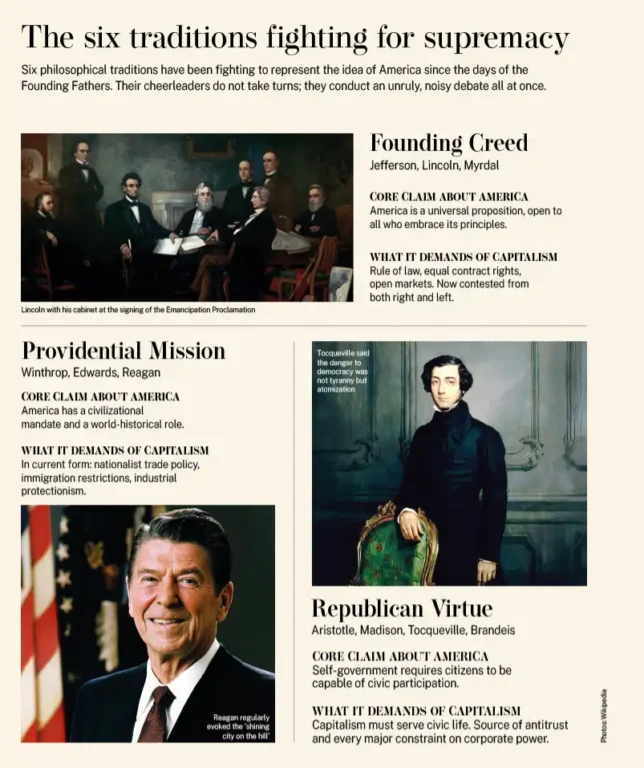
Six distinct philosophical traditions have contested the idea of America since the founding. Their proponents do not take turns; they argue simultaneously, with varying intensity. The operating environment for business at any one moment reflects the provisional balance among them.
The skill required to track the ensuing drama is recognizing which tradition is ascendant and what the historical record says it tends to do when it is victorious. The following labels are mine.
The Founding Creed, given its canonical form by Thomas Jefferson in the Declaration of Independence (1776) and restated by Abraham Lincoln at Gettysburg (1863), holds that America is a proposition.
Any person from any background can become an American by embracing the principles of liberty, equality, and self-government. Gunnar Myrdal’s An American Dilemma (1944) named this position the American creed and documented the gap between the creed and the practice.
The creedal tradition provides the justification for open markets, the rule of law, meritocratic access to opportunity, and the international order on which American commercial dominance has rested since 1945.
The Providential Mission tradition runs from John Winthrop’s A Model of Christian Charity (1630), the city on a hill sermon traditionally said to have been delivered aboard the Arbella (though historians dispute both the location and Winthrop’s sole authorship), through to Jonathan Edwards and into the political rhetoric of the 20th century.
Ronald Reagan invoked the city on a hill image in his farewell address of 11 January 1989. This tradition holds that America has a world-historical role assigned by providence, and that its economic power is the material expression of that mission.
Arguably, the institutional framework that has contained the argument for 250 years is under more stress than at any time since 1861.
In its current political form, it fuels the economic nationalism that is rewriting the commercial framework: tariff walls as civilizational self-protection, immigration restrictions as cultural preservation.
The Republican Virtue tradition holds that self-government requires citizens capable of civic participation, and that concentrated private power destroys the conditions in which that participation is possible.
Alexis de Tocqueville’s Democracy in America (1835) gave this its most penetrating expression: the danger to democracy was not tyranny but atomization, citizens retreating into private consumption and losing the civic capacity that self-government requires.
Louis Brandeis translated this into commercial terms in The Curse of Bigness (1934): concentrated economic power, regardless of its efficiency, corrupts the civic conditions on which democratic self-government and durable market legitimacy depend.
The tradition draws on Aristotle’s Politics, Cicero’s De Re Publica, and James Madison’s argument in Federalist No. 51 that the constitution must be designed so that the ambition of some checks the ambition of others. Major constraints on corporate power in American history have come from this tradition.
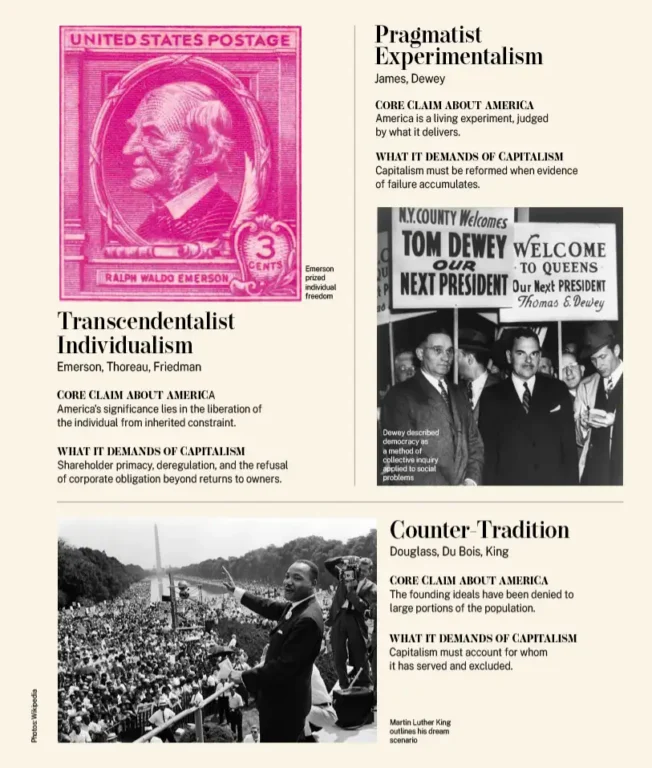
Transcendentalist Individualism, the tradition that prizes individual freedom above collective obligation, originates with Ralph Waldo Emerson’s Self-Reliance (1841) and Henry David Thoreau’s Walden (1854), and received its most commercially consequential expression in Milton Friedman’s New York Times Magazine essay of 13 September 1970, headlined “The Social Responsibility of Business Is to Increase Its Profits”.
Arguably, Friedman’s thesis drew on transcendentalist premises: the corporation, like the individual, owes its primary allegiance to its owners, not to the social whole. This tradition is the philosophical engine of the shareholder-primacy consensus and programs of deregulation.
Pragmatist Experimentalism was developed by William James in Pragmatism (1907) and given its civic form by John Dewey in The Public and Its Problems (1927). Dewey argued that democracy is, above all, a way of associated living, a method of collective inquiry applied to social problems.
On pragmatist terms, capitalism requires reform when evidence accumulates that it is not delivering. This tradition is the basis for the New Deal, the Great Society, and evidence-based policy intervention.
Its political representation in Washington is weak. Its evidentiary case is the strongest it has been since the 1930s. Keynesian macroeconomic management policy is associated with this tradition.
The Counter-Tradition begins with Frederick Douglass’s address to the Rochester Ladies’ Anti-Slavery Society on 5 July 1852, What to the Slave Is the Fourth of July? It continues through W E B Du Bois’s The Souls of Black Folk (1903) and finds its most politically consequential expression in Martin Luther King Jr’s Letter from Birmingham Jail (1963).
This tradition does not reject the founding ideals, rather it holds them to account. The gap between the creedal promise and the material reality reflects choices made and which, in principle, are capable of being unmade.
The energy of this tradition, when denied institutional outlets, finds political vehicles that impose constraints on business. Having written this, this tradition has driven genuine expansions of American freedom.
Six philosophical traditions have been fighting to represent the idea of America since the days of the Founding Fathers. Their cheerleaders do not take turns; they conduct an unruly, noisy debate all at once.
The four milestone anniversaries of the Declaration of Independence serve as useful vantage points on this continuing argument. Think of them as acts in a grand Shakespearean play. Each act shows which traditions were winning, what operating environment that produced, and what the deferred cost of suppressing the others eventually came to.
The Philadelphia Centennial Exhibition drew nearly 10 million visitors, a fifth of the country’s population, to celebrate industrial power. The Corliss steam engine, 45 feet high and over 600 tons, powered the entire exposition from a single shaft.
The transcendentalist-individualist and providential traditions were in agreement: individual genius was being rewarded, continental destiny was being fulfilled, and the market was the instrument of Providence.
The republican virtue tradition had no effective political voice. The counter-tradition’s demands were being answered in part by organized violence that ended the post-Civil War American Reconstruction.
The scholar David Blight, in Race and Reunion (2001), documented how the centennial served as the occasion for a white sectional reconciliation that set aside the moral unfinished business of the Civil War.
The deferred cost arrived within 20 years: the progressive revolt, trust-busting, the revival of the Sherman Act, and the labor movement.
“After all, the chief business of the American people is business,” from Calvin Coolidge’s address of 17 January 1925, is not merely a description. It is a declaration that the philosophical question had been settled: the transcendentalist-individualist tradition has won, and the market is its own justification.
The providential tradition supported this with the Immigration Act of 1924, which established national-origin quotas that defined American identity in ethnic rather than creedal terms. The pragmatist tradition’s argument for evidence-based correction had no institutional expression.
The republican virtue tradition’s argument for accountability had no political vehicle. The Philadelphia Sesquicentennial Exposition of 1926 was, by contemporary accounts, a financial failure.
The operating environment of the decade was nevertheless one of the most profitable in American commercial history. Then came October 1929. The deferred cost of disabling the self-correcting mechanisms the pragmatist and republican virtue traditions would have activated required a decade, and a fundamental rebalancing of the philosophical settlement, to pay.
The Bicentennial arrived after Vietnam and Watergate had damaged both the creedal and providential traditions. The pragmatist tradition was in crisis, having provided the justification for both the New Deal and the expansion into Vietnam.
Into this philosophical vacuum, Lewis Powell’s memorandum to the United States Chamber of Commerce (23 August 1971) launched the most disciplined philosophical counter-revolution in American commercial history.
Powell argued that the free enterprise system was under attack not from foreign powers but from within the traditions of American thought, and that the business community needed to contest those traditions at the level of ideas.
The Heritage Foundation (1973), the Cato Institute (1974), and the Federalist Society (1982) were established to advance and substantiate transcendentalist individualism and a specific reading of the founding creed, and to delegitimize other rival traditions.
The business climate that resulted served capital for 40 years. Where did the claims of the traditions that lacked an institutional vehicle go?
The claims of the traditions that lacked an institutional vehicle did not disappear; they found expression in the new political formations. The republican virtue tradition’s argument that concentrated private power corrupts democratic self-government has found expression in a bipartisan antitrust renaissance and, more unexpectedly, in a nationalist politics that has concluded that corporate globalism is incompatible with civilizational sovereignty.
The pragmatist tradition found expression in a populist anger that distrusts the expertise on which evidence-based policy depends. The counter-tradition’s grievance has found expression in a progressive politics some in the business community find uncomfortable – and in a politics of accountability for unfulfilled promises, that it finds alarming when it moves outside institutional channels.
At present, all six traditions have noisily advanced their causes. Arguably, the institutional framework that has contained the argument for 250 years is under more stress than at any time since 1861.
The moments of most acute commercial damage in American history have not been moments of excessive philosophical conflict. They have been moments of false resolution.
What makes 2026 different from 1876, 1926, and 1976 is not the intensity of the philosophical contest, which was high at all four moments, but the fact that the contest has moved on to the merits of the republic’s institutional framework.
During previous anniversaries, by and large, the competing traditions fought over policy within agreed institutional rules: courts were independent, elections were accepted, and the norms of democratic transfer of power held. In 2026, those norms are part of the contest.
The creedal tradition’s commitment to the rule of law and electoral legitimacy is being challenged not from outside the system but from within it, by actors who hold or have held the highest office.
For the business leader, this is the critical distinction. A philosophical contest conducted within a stable institutional framework is manageable. One that puts the framework in question changes the risk calculus for every long-dated commitment in the American economy.
And that includes faith in the US dollar and in the full faith and credit of the United States, which has given American firms access to capital on favorable terms.
Institutional durability is not a single property that either holds or breaks; it constitutes several separable load-bearing elements – an independent judiciary, an accepted electoral transfer of power, federalism, and a press capable of informing the public when the others are under strain – that have historically degraded and recovered unevenly and on different timelines.
Of these, the element closest to the breaking point in 2026 is arguably the last. The collapse of the press as a profitable, independent commercial institution, distinct from any question of its editorial bias, removes the sense-making mechanism upon which the other three elements depend: courts, elections, and federal arrangements are defended by a public that can perceive threats to them.
Social media has not filled the gap. In contrast, it has fragmented the shared factual environment into incompatible versions of events and become a vector for misinformation. This is not a claim that the discipline brought about by a vibrant free press has failed irreversibly.
It is a claim that this particular strand has been stretched closer to its limit than at any of the three previous anniversaries. In the absence of a professional, independent press, business executives must actively search out other reliable sources of facts, evidence, and insight.

There is a two-way relationship between the six traditions and the business community. The prevailing tradition shapes which commercial arrangements are treated as natural and legitimate.
The shareholder-primacy consensus was not a discovery; it was a philosophical choice made by certain individuals investing in specific institutions. They succeeded in changing the shared understanding of a professional class. That “common sense” is now contested.
Commercial arrangements, in turn, reshape which traditions are politically viable.
Decades of wage stagnation for the bottom half of earners, deindustrialization of communities that organized their civic life around manufacturing employment, and the concentration of prosperity in a small number of metropolitan areas generated the conditions Karl Polanyi identified in The Great Transformation (1944): unembedded markets were said to destroy the communities and shared meanings on which democratic self-government depends.
In turn, this induced the political backlash Polanyi called the double movement, a demand for protection that finds expression in social democracy or in nationalism, depending on which traditions are available to give it form.
A tradition that lacks an institutional vehicle – a party, a court doctrine, a funded lobby, or an organized caucus – may not lose its adherents. But it does lose the means of translating their claims into policy, and that claim remains available for capture by whichever vehicle does exist once conditions change.
The capture need not be a great match: the vehicle that eventually absorbs a claim does not necessarily represent it well. Three traditions lacked institutional vehicles of their own at the close of the post-Powell era.
Their claims found the vehicles that were available, and some are less compatible with durable commercial activity than others.

The business community has not been a passive observer of this loop. The Powell Memorandum was the document of a community that understood it was engaged in a philosophical contest and chose to engage.
The post-Powell institutions were built by people who grasped that commercial arrangements and philosophical traditions shape each other. One lesson the four-anniversary pattern teaches is not that the business community was wrong to engage.
It is that engagement on behalf of two traditions only, over a period of 40 years, at the cost of disabling three others, that has produced the backlash now visible in the operating environment. And so on, and so on.
John Dewey, in Democracy and Education (1916), argued that democracy requires the capacity to hold competing values in productive tension rather than to resolve them by suppressing some.
Isaiah Berlin argued that some things people and societies care about pull in opposite directions, and that the attempt to resolve that tension permanently by declaring one value the winner has historically produced the worst outcomes.
The moments of most acute commercial damage in American history have not been moments of excessive philosophical conflict. They have been moments of false resolution, when one tradition silenced the others and disabled the mechanisms that correct capitalism when it fails.
The division evident at the 250th anniversary is not evidence that the eternal argument has gone wrong.
The business community’s interest is not in ending the debate but in ensuring that the institutional foundations, namely the courts, the regulatory framework, and the norms of democratic deliberation, are strong enough to hold.
Those foundations are the precondition for the planning horizons and the contractual predictability on which long-term investment depends.
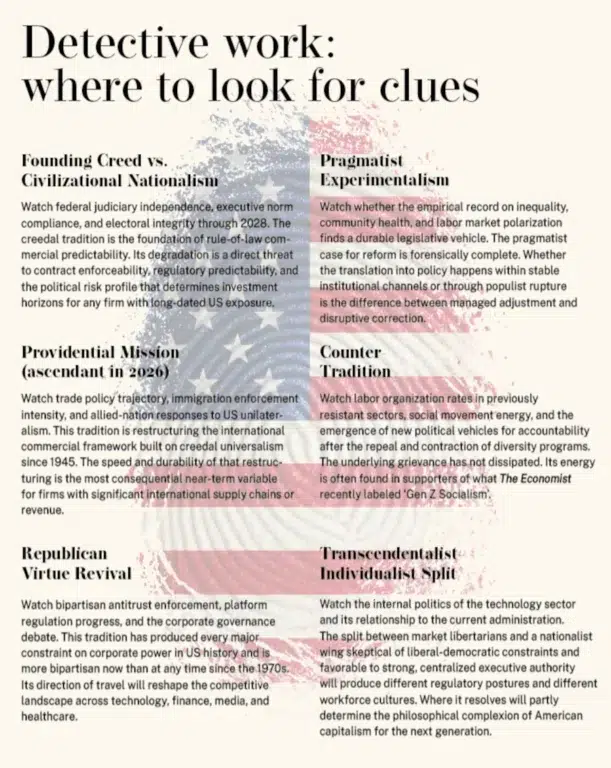
The six traditions are not abstractions for the business leader to admire from a distance; they translate into variables to track.
Each is a live process generating signals that show up first in politics and only later in contracts, tariffs, and the cost of capital.
Tracking philosophical traditions is an unfamiliar discipline for most corporate risk functions, which are built to monitor emergent regulatory, tax, and tariff developments, not arguments about the nature of the republic.
But the pattern traced above suggests that the indicators worth watching are downstream of exactly these contests, and that a firm tracking them only once they have hardened into legislation or executive order is already several years late.
The table below is not a forecast, but offers valuable guidance on where to look.
The Constitutional Convention of 1787 adjourned after four months with a document that James Madison acknowledged was an imperfect resolution of competing interests and values. Madison did not claim the document had resolved the tensions among the traditions.
He claimed it had built a framework within which the tensions could be managed without destroying the new republic. That claim has been tested, with varying results, for 250 years.
In July 2026, it is as if the delegates are back in the Convention room, arguing aggressively. The constitutional arrangements that have managed the argument are under more stress than they have faced since the start of the Civil War in 1861.
The business community has a direct interest in this framework holding, a direct responsibility for some of the stress it is under, and the capacity to support its repair.
The practical implication is simple: change what you track. Most executives follow American politics administration by administration, asking what the current White House wants. The argument developed here suggests a better question: which traditions are gaining durable institutional power, and which are not?
Some traditions are backed by 40 years of institutional construction – think tanks, court appointments, party infrastructure – and are likely to survive a change of administration.
This distinction matters directly for decisions firms make today: how they allocate capital with US exposure, how they plan supply chains and reshoring, and how they read workforce and sustainability policies as signals of which tradition is winning, rather than as one administration’s passing preferences.
This matters at least as much for foreign firms operating in the US as for American ones, and arguably more so: a domestic firm has other channels –lobbying access, political donations, local relationships – through which to manage the risk this essay describes.
A foreign firm typically does not and relies more heavily on the very institutions under strain: contract enforceability, regulatory predictability, and the credibility of the dollar. The firms best positioned over the next decade will not be the ones that guessed correctly which tradition wins in 2026.
They will be the ones who built the organizational capacity to read the traditions and the ensuing battle of ideas as they unfold.

Professor of Geopolitics and Strategy
Simon J. Evenett is Professor of Geopolitics and Strategy at IMD and a leading expert on trade, investment, and global business dynamics. With nearly 30 years of experience, he has advised executives and guided students in navigating significant shifts in the global economy. In 2023, he was appointed Co-Chair of the World Economic Forum’s Global Future Council on Trade and Investment.
Evenett founded the St Gallen Endowment for Prosperity Through Trade, which oversees key initiatives like the Global Trade Alert and Digital Policy Alert. His research focuses on trade policy, geopolitical rivalry, and industrial policy, with over 250 publications. He has held academic positions at the University of St. Gallen, Oxford University, and Johns Hopkins University.
October 9, 2026 • by José Caballero in Geopolitics
A Taiwan chip-smuggling case reveals how export controls, geopolitical rivalry, and supply-chain governance are redefining the rules of global trade. ...

August 20, 2026 • by David Bach in Geopolitics
IEA chief Fatih Birol on the age of electricity, Europe’s strategic energy mistakes, the Hormuz shock – and why trust is now an energy asset....

July 24, 2026 in Geopolitics
How can leaders stay competitive amid geopolitical uncertainty? David Bach explores resilience, AI, energy security, trust and European reform...

July 15, 2026 • by Lindsay Sarah Krasnoff in Geopolitics
Once the preserve of men in pinstripes, international sports stars have redefined the art of diplomacy. Lindsay Sarah Krasnoff explains the new rules of the game and how business leaders can benefit...
Explore first person business intelligence from top minds curated for a global executive audience