Share
Facebook Facebook icon Twitter Twitter icon LinkedIn LinkedIn icon Email
Record-High-Stocks-Featured

Finance

What market records signal – and what they don’t

Published March 27, 2026 in Finance • 6 min read

Elevated equity markets unsettle investors. But whether record highs are meaningful signals depends less on the headline index level than on fundamentals and long-term context.

In recent months, equity markets have repeatedly reached record highs before pulling back amid the recent geopolitical escalation in the Middle East. When major indices reach record levels, many investors instinctively begin to question their next move: whether caution is now warranted, whether it is time to take profits, or whether those still on the sidelines have already missed their opportunity. The recent correction has sharpened the underlying question: are record highs meaningful warning signals for investors, or simply a normal feature of rising markets?

New highs are often portrayed in sensationalist terms, framed as moments when markets have overshot reality. Yet this interpretation is too simplistic. In broad equity markets, all-time highs are often a natural feature of growing economies In economies shaped by population growth, technological progress, reinvestment, and moderate inflation, corporate earnings tend to rise over time. Equity indices, which ultimately reflect those earnings, therefore spend a considerable portion of their history near or at record levels.

This perspective is familiar to senior executives in their own domains.

Companies rarely abandon expansion plans simply because revenues or profits have reached new highs. Record results are more often a reflection of successful strategy, rising demand, and improving productivity, rather than excess. Financial markets, for all their noise, are not that different. Over time, higher index levels often reflect an expanding earnings base, not simply overheated sentiment. Importantly, this argument applies to diversified equity markets in economies with positive long-run growth, not to individual stocks, narrow sectors, or speculative manias.

The psychological discomfort of investing at record levels

Despite this logic, many investors struggle emotionally with investing at market highs. Two well-documented behavioral biases are at work.

Loss aversion: The tendency to experience losses more acutely than gains. A short-term market pullback after investing at the top of a bull market will feel particularly painful, even if it has little bearing on long-term outcomes.

Anchoring: The tendency to mentally anchor to past price levels, usually lower ones, and perceive current prices as too expensive, regardless of whether fundamentals have improved in the meantime.

Together, these biases create the impression of being too late.

Yet markets do not know or care where an individual investor last considered investing. Prices reflect the collective assessment of future cash flows, not regret over missed opportunities.

Valuations: elevated does not mean ungrounded

Of course, not every all-time high is identical. But whether markets are expensively valued cannot be inferred from index levels alone. It requires an examination of underlying fundamentals, particularly earnings. The relevant distinction is not between high and low index levels, but between price moves driven by durable earnings growth and those driven mainly by multiple expansion.

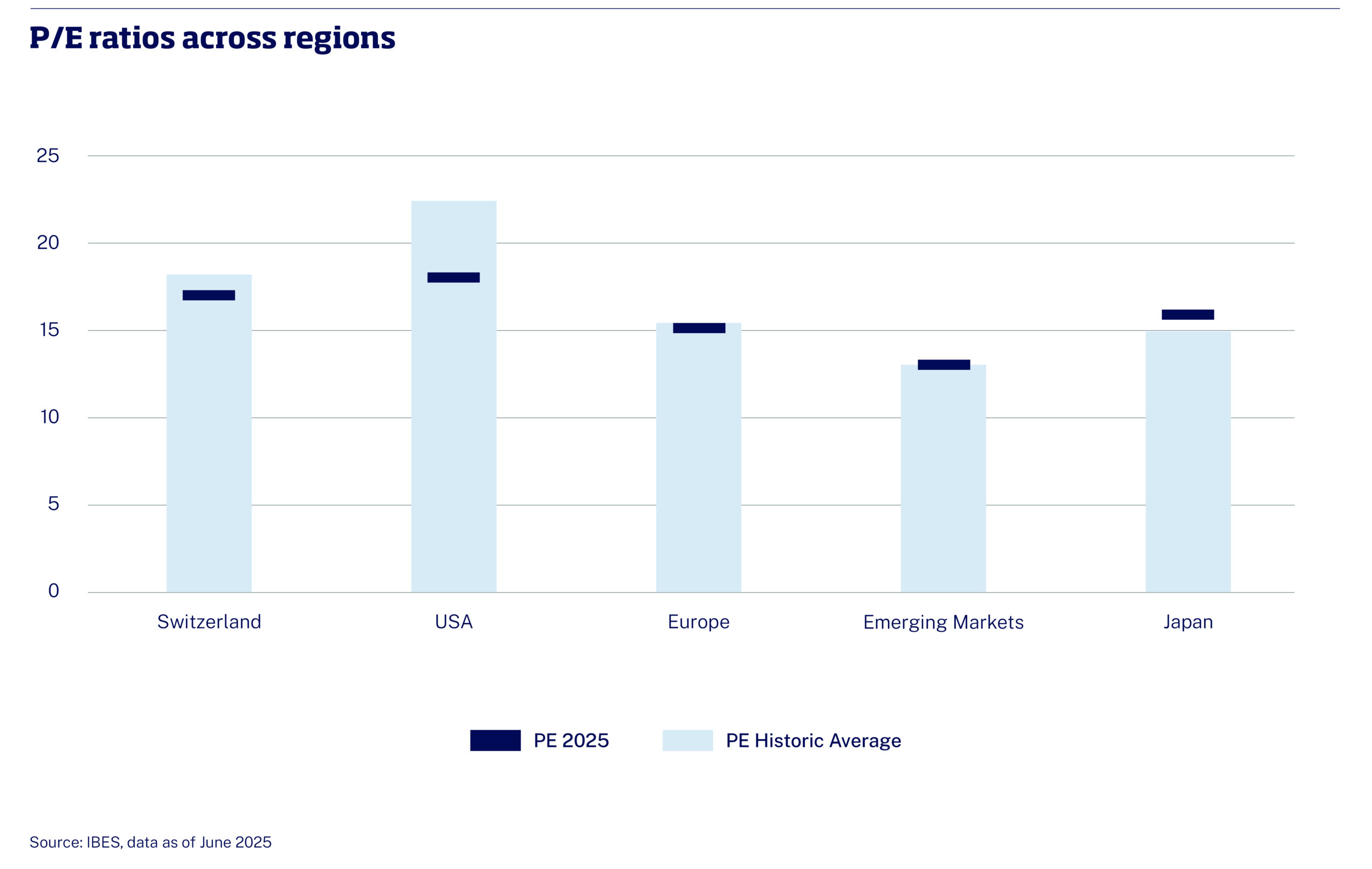
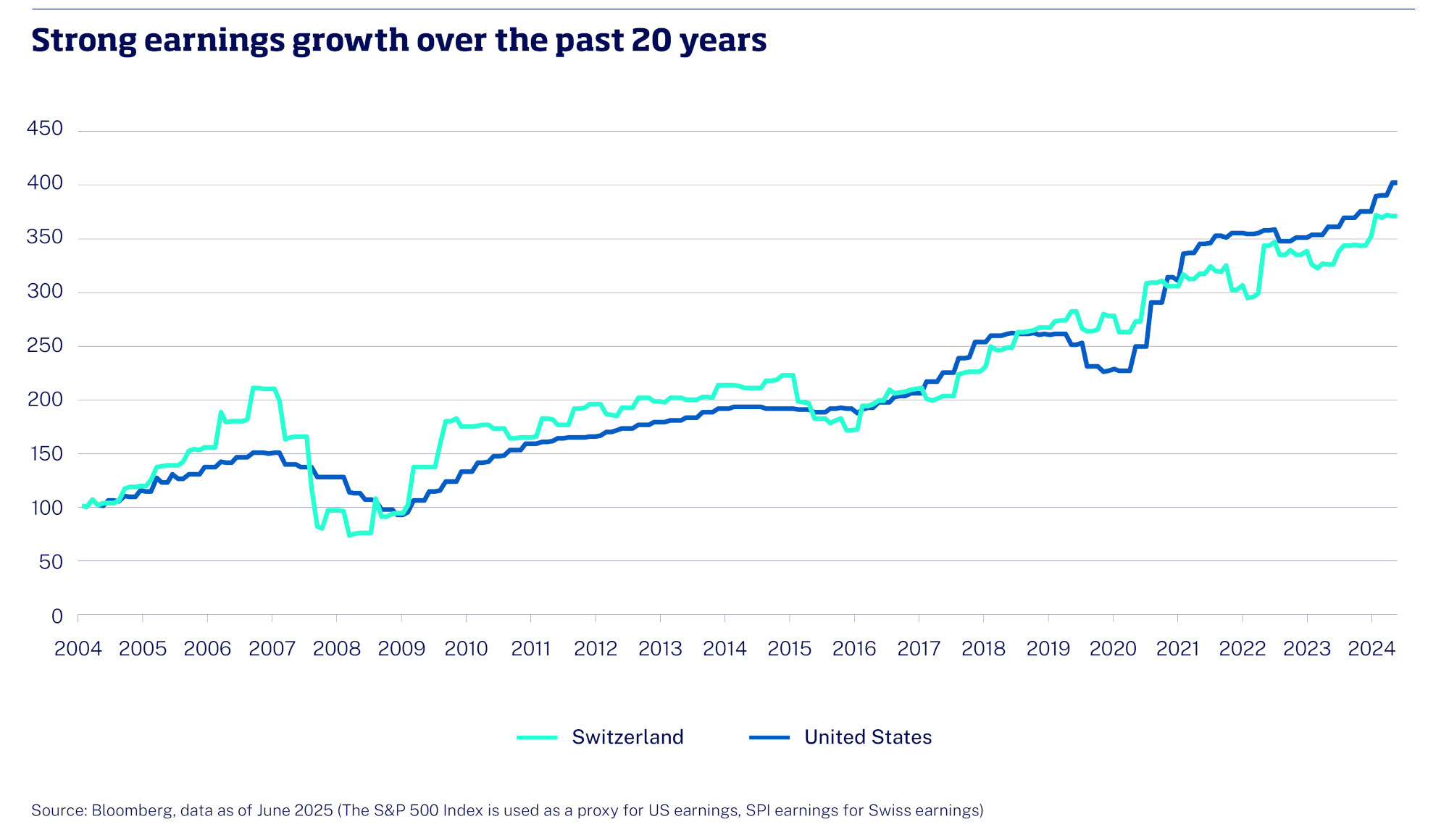
By this measure, much of the global equity market was, even at those recent highs, trading at close to long-term valuation averages (see Chart 1). The Swiss Performance Index (SPI), for example, is valued at a price-to-earnings (P/E) ratio of about 18, broadly in line with its historical norm. Since 2020, the index has risen by roughly 30%, while aggregate corporate earnings have grown by more than 40% over the same period. In other words,

the rise in prices appears to have been broadly supported by earnings growth.

Chart 1: P/E ratios across regions. Sources: IBES, data as of June 2025

The US stands out as the main exception, with valuations meaningfully above long-term averages. Yet this, too, requires context. Since 2020, earnings among companies in the S&P 500 Index have more than doubled, by far the strongest growth among major regions. It is therefore unsurprising that the index itself has roughly doubled over that period. Moreover, many of the companies driving this growth have strong balance sheets, high returns on capital, and favorable long-term growth prospects.

High valuations may temper long-term expected returns and increase sensitivity to disappointments, but they do not, in themselves, imply imminent reversals.

Chart 2: Strong earnings growth over the past 20 years. Sources: Bloomberg, data as of June 2025 (The S&P 500 Index is used as a proxy for US earnings, SPI earnings for Swiss earnings)

What history says about all-time highs

History offers a powerful corrective to investor intuition. Far from being rare or destabilizing events, all-time highs are a recurring feature of equity markets over long periods of economic expansion. In the US, where the S&P 500 Index provides a particularly rich historical record, an estimated 7% of all trading days since 1950 have closed at a new all-time high; that is, roughly every 14th trading day.

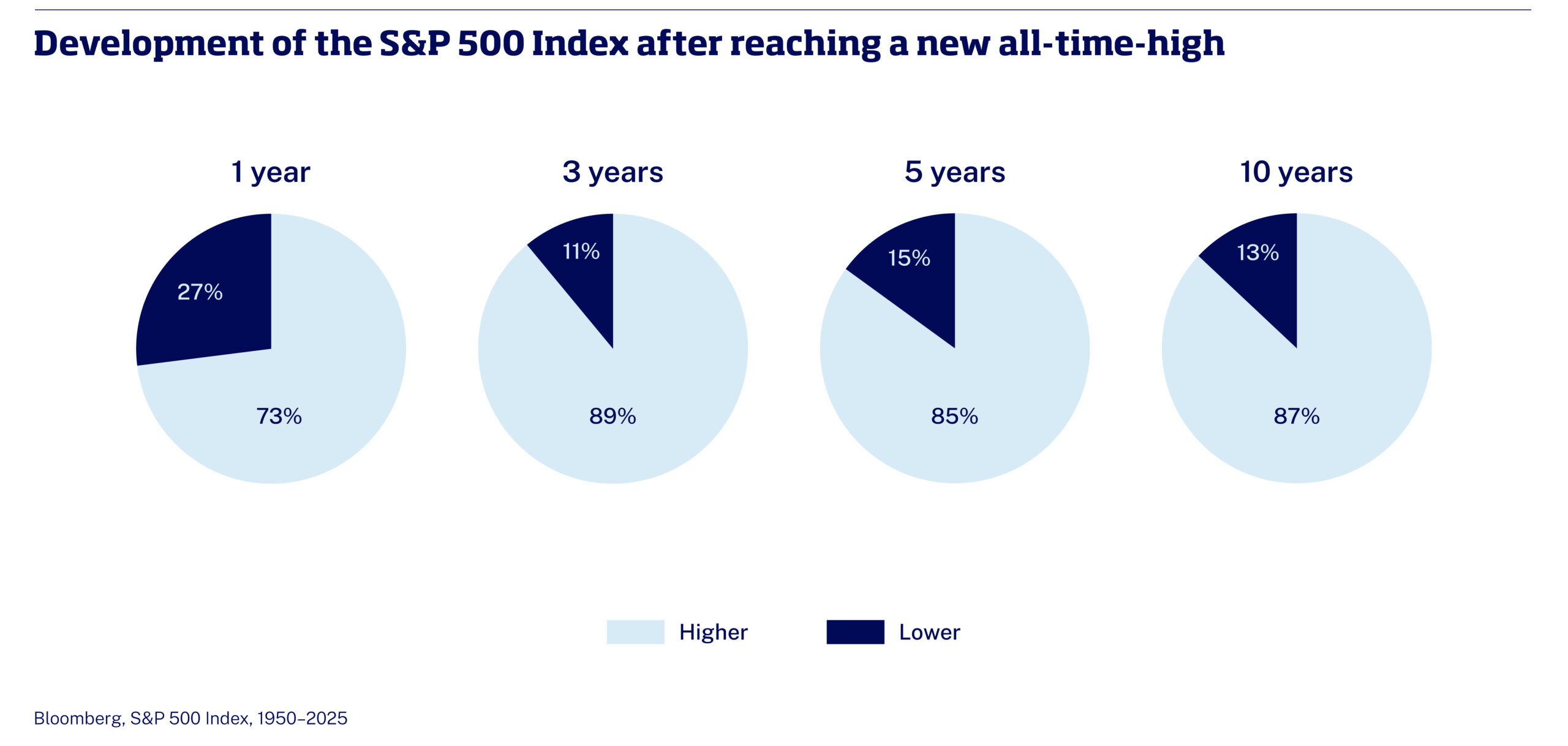
Furthermore, the data offer little support for the notion that investing at record highs have, in themselves, been reliable signals for poor return outcomes. Across short, medium, and long horizons alike, investors who entered the market at an all-time high have historically fared well. As shown in Chart 3, investments made at record levels have resulted in positive returns after one, three, five, and even 10 years in the vast majority of cases.

Chart 3: Development of the S&P 500 Index after reaching a new all-time-high. Sources: Bloomberg, S&P 500 Index, 1950–2025
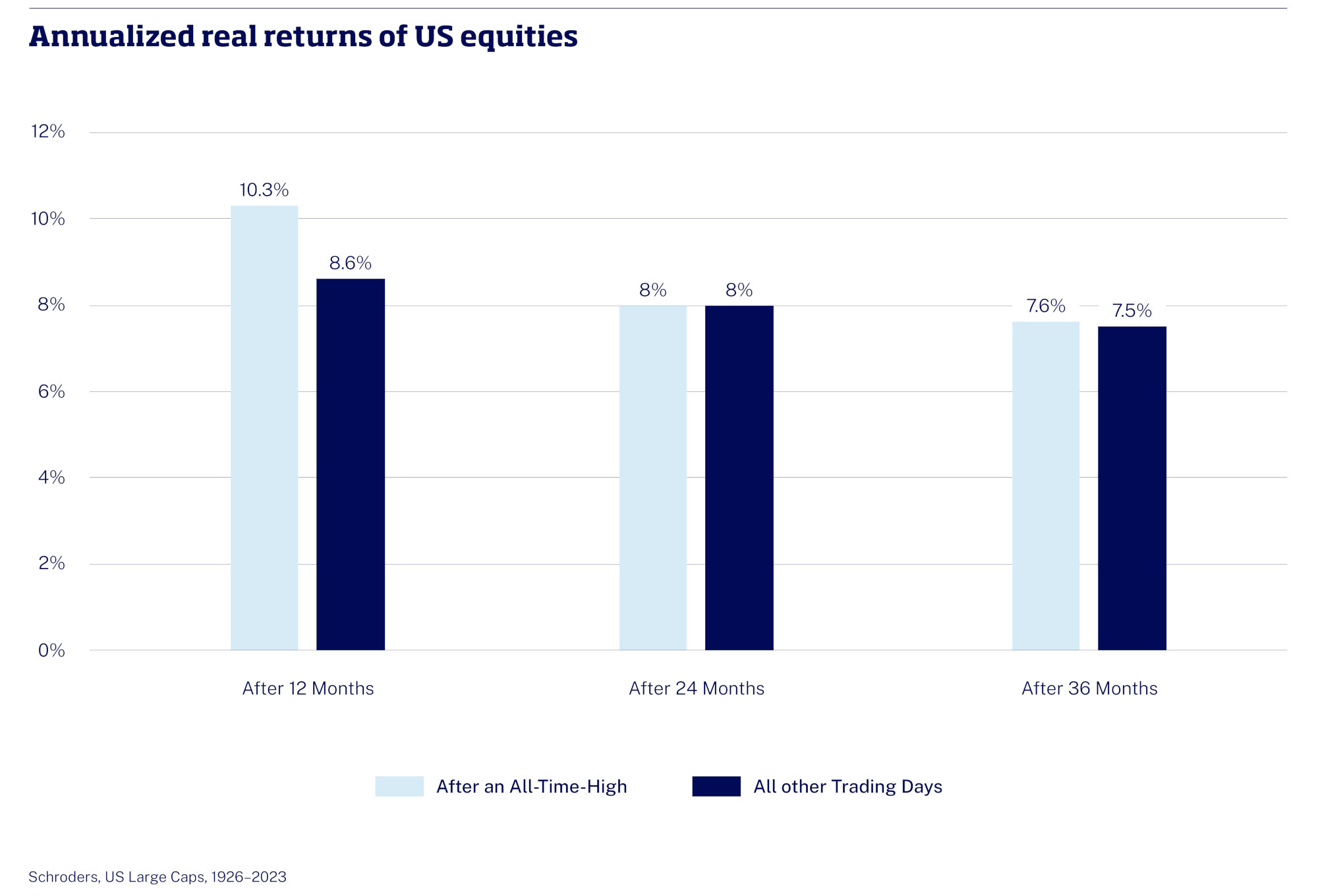
Extending the analysis further back strengthens this conclusion. Using US equity data going back to 1926, the average annual returns one and three years after an all-time high have been higher than the average returns following all other possible entry points (see Chart 4). Contrary to the intuition that new highs should prompt caution or retreat, they have historically coincided with periods of above-average subsequent performance. Similar dynamics can be observed in Swiss equities, based on SPI data since 1987, as well as in global markets as represented by the MSCI World since 1986.
Chart 4: Annualized real returns of US equities. Sources: Schroders, US Large Caps, 1926–2023

Why momentum often persists after new highs

Statistics alone, however, are only part of the story. What matters just as much is why markets often continue to perform well after reaching new highs.

New record levels typically coincide with improving fundamentals: earnings revisions trend upwards, balance sheets strengthen, investment increases, and confidence among corporate decision-makers rises. Such developments tend to unfold over years rather than weeks. The forces that push markets to new highs, such as innovation, productivity gains, or scale effects, rarely reverse abruptly.

In this sense, all-time highs are often less a signal of speculative excess than a confirmation that a favorable economic and corporate earnings environment is in place, although the fundamental strength and breadth of that environment still need to be examined case by case.

Attempts to time markets around perceived “tops” rarely succeed.

Navigating markets around record levels

For those allocating capital in such environments, a few principles have proved consistently useful.
  1. Avoid market timing: Attempts to time markets around perceived “tops” rarely succeed. Waiting for a pullback often means missing extended periods of positive performance. For investors concerned about short-term volatility, phased investments or regular savings plans can help smooth entry points without abandoning long-term exposure.
  2. Systematic rebalancing: Maintaining target allocations forces investors to trim positions after strong advances and add exposure after setbacks, which imposes discipline where emotions might otherwise dominate.
  3. Diversification: Exposure across regions, sectors, and asset classes reduces reliance on any single market narrative and increases the resilience of portfolios over time.
All-time highs are neither default warning signals nor evidence of irrational exuberance.

All-time highs in perspective

All-time highs are neither default warning signals nor, by themselves, evidence of irrational exuberance. More often, they reflect cumulative progress: growing economies, rising productivity, and expanding corporate earnings.

For long-term investors, the key issue is not whether markets are at record levels, , but whether the underlying drivers are strong enough to sustain returns over time. Markets will continue to experience setbacks and corrections. That is their nature. But the record suggests that record highs have rarely been reliable reasons to step aside.

Record highs may feel like a warning. Historically, they have more often been a poor reason to lose one’s nerve.

Authors

Mischa-Riedo-1

Mischa Riedo

Head of Portfolio Management and Deputy Chief Investment Officer at Valiant

Mischa Riedo is a Chartered Financial Analyst (CFA) and an investment professional with more than 15 years of experience in wealth and asset management. As Head of Portfolio Management and Deputy Chief Investment Officer at Valiant, the largest regional bank in Switzerland, he is responsible for the investment oversight of discretionary mandates and multi-asset strategies serving retail, high net worth, and institutional clients. Riedo completed his MBA at IMD in 2019.

Karl Schmedders - IMD Professor of Finance

Karl Schmedders

Professor of Finance at IMD

Karl Schmedders is a Professor of Finance, with research and teaching centered on sustainability and the economics of climate change. He directs the Strategic Finance (SF) program and teaches in the Executive MBA programs. Passionate about sustainable finance, Schmedders believes that more attention needs to be paid to on the social (S) and governance (G) aspects of ESG to ensure a fair transition and tackle inequality.

Related

Learn Brain Circuits

Join us for daily exercises focusing on issues from team building to developing an actionable sustainability plan to personal development. Go on - they only take five minutes.
 
Read more 

Explore Leadership

What makes a great leader? Do you need charisma? How do you inspire your team? Our experts offer actionable insights through first-person narratives, behind-the-scenes interviews and The Help Desk.
 
Read more

Join Membership

Log in here to join in the conversation with the I by IMD community. Your subscription grants you access to the quarterly magazine plus daily articles, videos, podcasts and learning exercises.
 
Sign up
X

Log in or register to enjoy the full experience

Explore first person business intelligence from top minds curated for a global executive audience