Share
Facebook Facebook icon Twitter Twitter icon LinkedIn LinkedIn icon Email
First-Abu-Dhabi-Bank-2

Finance

Navigating the future of sustainable finance: A scenario-based strategic framework for financial institutions

Published February 11, 2026 in Finance • 9 min read

How banks can position themselves across multiple futures to deliver on sustainability commitments while maintaining financial performance.

Rapid read:

  • Sustainable finance has moved from niche to strategic core, but uncertainty is rising. Fragmentation, geopolitical risk, and uneven transition progress require banks to rethink sustainable finance as an adaptive, long-term strategic capability, not a static ESG add-on.
  • Five interconnected forces are reshaping the market. Social pressure, climate risk, regulation, capital markets, and technology are jointly redefining risk, opportunity, and competitive advantage in sustainable finance.
  • Scenario planning is essential for strategic resilience. A four-scenario framework helps financial institutions stress-test strategies, balance profitability and purpose, and remain effective across radically different future market conditions.

The concept of “sustainable finance,” which emerged in the 1990s, has evolved rapidly from a niche initiative to a strategic imperative for many banks. Sustainable finance refers to the process of taking environmental, social, and governance (ESG) considerations into account when making investment decisions in the financial sector, leading to more long-term investments in sustainable economic activities and projects.

Sustainable finance enables financial institutions to influence corporate behavior, accelerate innovation, and promote collective progress toward a net-zero, resilient economy, all while ensuring that profits are aligned with purpose. This has prompted financial actors to reconsider their models, risk management frameworks, and long-term strategies.

However, as the world becomes increasingly fragmented, competitive, and unpredictable, the transition to a more sustainable economy remains uncertain. This uncertainty demands a new approach to strategic planning – one that is adaptive, resilient, and capable of navigating multiple potential futures.

This article presents a scenario-based framework, inspired by a strategic foresight analysis from First Abu Dhabi Bank (FAB). It is designed to help financial institutions develop robust strategies in an evolving and highly dynamic sustainable finance landscape.

“At FAB, we see sustainable finance as a powerful lever for positive change, enabling our clients, communities, and the wider economy to accelerate the transition to a low-carbon, inclusive future. By mobilizing capital, innovating new financial solutions, and embedding ESG at the core of our strategy, we are not only meeting our own ambitious goals but also empowering others to achieve theirs. Together, we are shaping a resilient and sustainable tomorrow.” Shargiil Bashir, EVP & Chief Sustainability Officer, FAB.
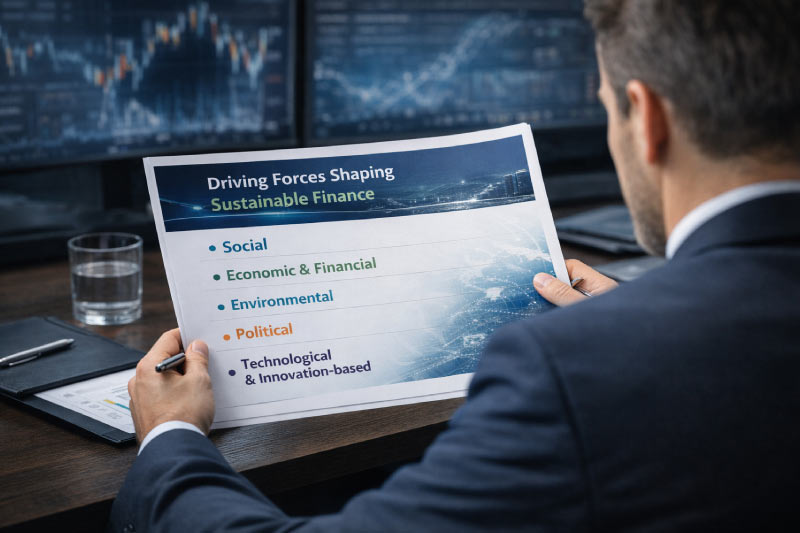
driving-forces-shaping-sustainable-finance
The trajectory of sustainable finance is being shaped by a complex interplay of driving forces

The five categories of driving forces shaping sustainable finance

The trajectory of sustainable finance is being shaped by a complex interplay of driving forces.
  • Social: Increasing consumer awareness, shifting demographics, and a growing demand for corporate transparency and leadership in ESG (Environmental, Social, and Governance) are creating a powerful pull for sustainable finance.
  • Economic & financial: The integration of climate change policies and risk management into financial models, the growing demand from investors and corporations for sustainable assets and their innovative potential, and the potential for lower cost of capital for green projects are making sustainable finance an increasingly attractive proposition.
  • Environmental: The physical impacts of climate change, the growing scarcity of resources, and the degradation of ecosystems and loss of biodiversity are creating a powerful impetus for a transition to a low-carbon economy, driving demand for green and sustainable investments.
  • Political: Demanding regulatory frameworks and policies that promote ESG are creating a more favorable environment for sustainable finance. This is being driven by government policies, international agreements and cooperation, and rising geopolitical interest, with incentives for sustainable investments and penalties for environmentally harmful activities
  • Technological & innovation-based: Technological advances in fintech, data analytics, artificial intelligence (AI), the Internet of Things (IoT), smart grids, and renewable energy technologies are creating new opportunities and efficiencies in the sustainable finance market. These forces and their related elements are deeply interconnected, creating a dynamic and often unpredictable environment. Financial institutions must monitor these forces and their interactions to anticipate market shifts and adjust their strategies accordingly.
stock market crash caused by economic graph with diagrams business and financial concepts and reports abstract blue technology communication concept vector background
“To navigate the inherent uncertainty of the sustainable finance market, a scenario-based approach is an invaluable strategic tool for envisaging a range of plausible futures and developing more resilient and adaptive strategies.”

Four scenarios for the future of sustainable finance

To navigate the inherent uncertainty of the sustainable finance market, a scenario-based approach is an invaluable strategic tool for envisaging a range of plausible futures and developing more resilient and adaptive strategies.

To construct a 2×2 scenario matrix, we have selected two forces based on their high impact on business and degree of uncertainty: the level of funding available for sustainable projects and the number of startups and SMEs focused on sustainability entering the market. This matrix yields four distinct scenarios.
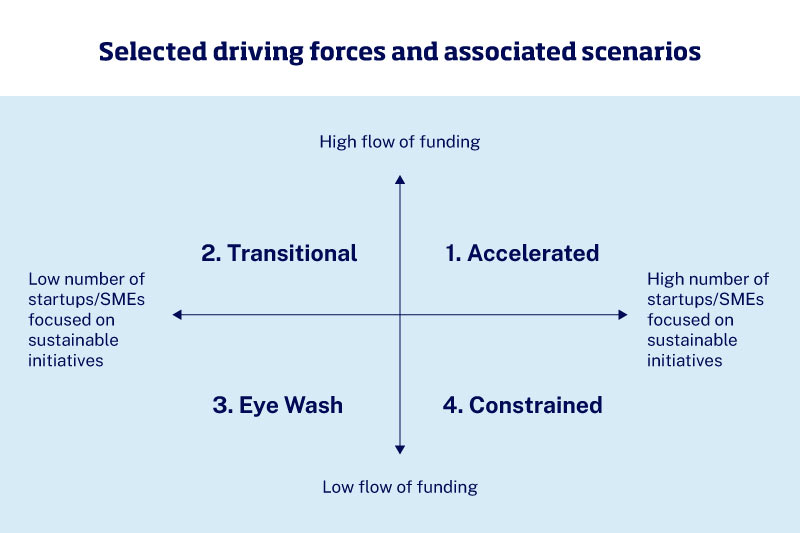
Selected-driving-forces-and-associated-scenarios-5
A 2x2 matrix illustrating the four scenarios for the future of sustainable finance, based on funding levels and the number of startups and SMEs focused on sustainability

Scenario 1: Accelerated

Characteristics

  • High flow of funding, high number of startups and SMEs focused on sustainable initiatives.
  • This represents the ideal scenario for sustainable finance – a vibrant market with both high levels of funding and a proliferation of startups and SMEs. This environment is characterized by intense competition, driving financial institutions to differentiate themselves based on the quality of their services and the breadth of their sustainable finance product offerings.

Implications and paths for financial institutions

  • The strategic focus is on achieving market leadership through differentiation. This involves providing a comprehensive suite of sustainable financial products and a positive customer experience, as well as making equity investments in promising startups and offering SMEs value-added services such as transition risk management and long-term support on their sustainable journey.
  • This has an obvious impact on the structure of financial institutions, which set up dedicated divisions to launch new products and business lines, such as sustainability products, derivatives, services, financing and advisory services. While this scenario offers the potential for significant revenue growth and the development of new markets, such as carbon exchanges, the increased competition can lead to tighter margins.
High flow of funding, low number of startups and SMEs focused on sustainable initiatives.

Scenario 2: Transitional

Characteristics

  • High flow of funding, low number of startups and SMEs focused on sustainable initiatives.
  • In this scenario, the market is characterized by high levels of investment in sustainable projects but a relatively low number of new startup entrants or SMEs adopting sustainable practices. This suggests a market dominated by established players with an appetite for sustainability standards and a cautious approach to innovation. As a result, indicators such as higher carbon emissions, continued dependence on fossil fuels, and lower levels of foreign direct investment (FDI) can be expected.

Implications and paths for financial institutions

  • For financial institutions, the strategic focus here would be to establish an incubator by carefully selecting investments to pursue, forging strategic partnerships with large, established customers on their sustainable journey, providing incentivized financing for promising new or emerging technology in sustainability, investing in the equity of select excellent start-ups or joint ventures, and offering green mortgages, finance for clean transportation and finance for energy efficiency projects.
  • The risk–return profile of the selected niche investments is favorable, with the potential for higher profitability due to less competition and the potential for long-term partnerships. However, the limited market exposure and potential misalignment with broader government initiatives for a more dynamic, startup/SME-driven ecosystem are the key challenges.

Scenario 3: Eye Wash

Characteristics

  • Low flow of funding, low number of startups and SMEs focused on sustainable initiatives.
  • This is the most challenging environment for scaling up sustainable finance. The limited market appetite for sustainability and the small number of high-quality projects make it difficult to launch and scale sustainable finance initiatives.

Implications and paths for financial institutions

  • Here, the strategic focus is on building credibility, as financial institutions must maintain their commitment to sustainability through selective strategic partnerships with a few leaders with a proven track record. It is also important to raise awareness and encourage other players to do the same, thereby sparking a ‘snowball effect’ where successful projects can inspire broader market change.
  • While this approach can help to build a foundation for future growth and promote sustainability leaders, it is a high-cost, low-return strategy in the short term, with a limited product offering that may not meet the full spectrum of market needs.
The strategic focus is on achieving profitability while having a clear sustainability agenda integrated into the strategy.

Scenario 4: Constrained

Characteristics

  • Low flow of funding, high number of startups and SMEs focused on sustainable initiatives.
  • This scenario is characterized by a high number of startups and SMEs eager to enter the sustainable market, but a reluctance from investors to provide the necessary funding. This creates a highly competitive environment where financial institutions must be discerning in their investment choices.

Implications and paths for financial institutions

  • The strategic focus is on achieving profitability while having a clear sustainability agenda integrated into the strategy. This also involves a hybrid approach, combining conventional financing to maintain profit margin with a dedicated sustainable finance division or subsidiary. In this scenario, leveraging data analytics and AI is critical to identifying the most promising investment opportunities first and managing risk effectively.
  • This strategy enables institutions to remain profitable while participating in the green economy or supporting ESG practices, positioning them to benefit from economies of scale as more funding becomes available.
The concept of sustainable finance, which emerged in the 1990s, has evolved rapidly from a niche initiative into a strategic imperative for banks and financial institutions globally.

Key takeaways

Scenario planning is a powerful strategic tool that enables organizations to navigate uncertainty by exploring multiple plausible futures shaped by different assumptions and drivers of change. When applied to the design of sustainable solutions, scenario planning supports decision-makers in better understanding – and proactively responding to – the complex challenges of reducing carbon emissions, conserving natural resources, and fostering inclusive and equitable economic development.

The concept of sustainable finance, which emerged in the 1990s, has evolved rapidly from a niche initiative into a strategic imperative for banks and financial institutions globally. Sustainable finance refers to the systematic integration of environmental, social, and governance (ESG) considerations into financial decision-making. This allows long-term value creation while strengthening resilience against climate and societal risks.

More importantly, sustainable finance enables financial institutions to influence corporate behavior, accelerate innovation, and mobilize collective action toward a net-zero and climate-resilient economy, while ensuring that profitability remains aligned with purpose. As a result, financial actors are increasingly reassessing their business models, risk frameworks, governance mechanisms, and long-term strategic priorities.

Background and contributors

The four scenarios presented in this article illustrate how financial institutions can apply scenario planning to stress-test assumptions, expand strategic options, and develop robust strategies for sustainable finance, ultimately strengthening their ability to make long-term investments that generate both financial returns and sustainable impact.

The article is based on the work and interpretations developed by the team listed below as part of their assignment in the FAB program Frontiers in Sustainability in 2024.

FAB Team

  • Arun Mehta, Head of Data Analytics and Artificial Intelligence, FAB
  • Mohammed J Abbas, SVP & Head of Privacy, BCM, IDM, and Security Awareness, FAB
  • Muhammad S. Hassan, SVP & Head of Audit Operations and Support Function, FAB
  • Juma Alhameli, Chief Operating Officer and former FAB Group Chief Technology Officer, DFSA

IMD Team

  • Catherine Agamis, Senior Advisor and Learning Manager
  • Hischam El-Agamy, Strategic Insight and Scenario Planning

Authors

Catherine Agamis

Catherine Agamis

Learning & Transformation project lead, IMD

Catherine is Learning and Transformation project lead at IMD. She is an advisor and action learning designer. A strong advocate of digital and collaborative approaches as powerful levers of value creation and efficiency, her practice also includes academic research on innovation ecosystem and community building.
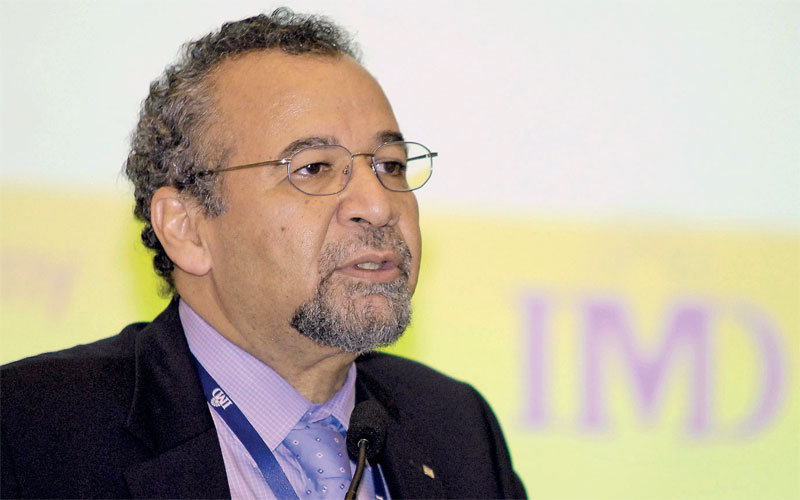
Hischam

Hischam El-Agamy

IMD Executive Director, Middle East, Africa and Turkey

As Executive Director of IMD, Hischam El Agamy is responsible for IMD’s activities in Africa, the Middle East, and South-Central Asia, where he teaches and leads development programs. El Agamy’s expertise and teaching experience include scenario planning, business transformation, family business transformation, public-private partnership, and stakeholder engagement. He teaches regularly in IMD custom programs and has taught several IMD open programs, including its EMBA and MBA programs.

For over 14 years, El Agamy has occupied various international functions in seven European countries as part of a long career with major Swiss multinational corporations in Zürich. During these years, he has driven a number of business transformation initiatives in several European countries.

He has contributed to several advisory assignments for governments in the Gulf region and in the area of competitiveness and human capital development for the government of South Africa.

El Agamy obtained two master’s degrees in applied science from the University of Fribourg and Lausanne in Switzerland. He received his Doctorate from the University of Pierre & Marie Curie in Paris.

Related

Learn Brain Circuits

Join us for daily exercises focusing on issues from team building to developing an actionable sustainability plan to personal development. Go on - they only take five minutes.
 
Read more 

Explore Leadership

What makes a great leader? Do you need charisma? How do you inspire your team? Our experts offer actionable insights through first-person narratives, behind-the-scenes interviews and The Help Desk.
 
Read more

Join Membership

Log in here to join in the conversation with the I by IMD community. Your subscription grants you access to the quarterly magazine plus daily articles, videos, podcasts and learning exercises.
 
Sign up
X

Log in or register to enjoy the full experience

Explore first person business intelligence from top minds curated for a global executive audience