Why women’s leadership matters in the age of AI
AI may become one of the most significant leadership opportunities for women in decades. Its impact will depend on how capability, governance, and leadership are built around it....
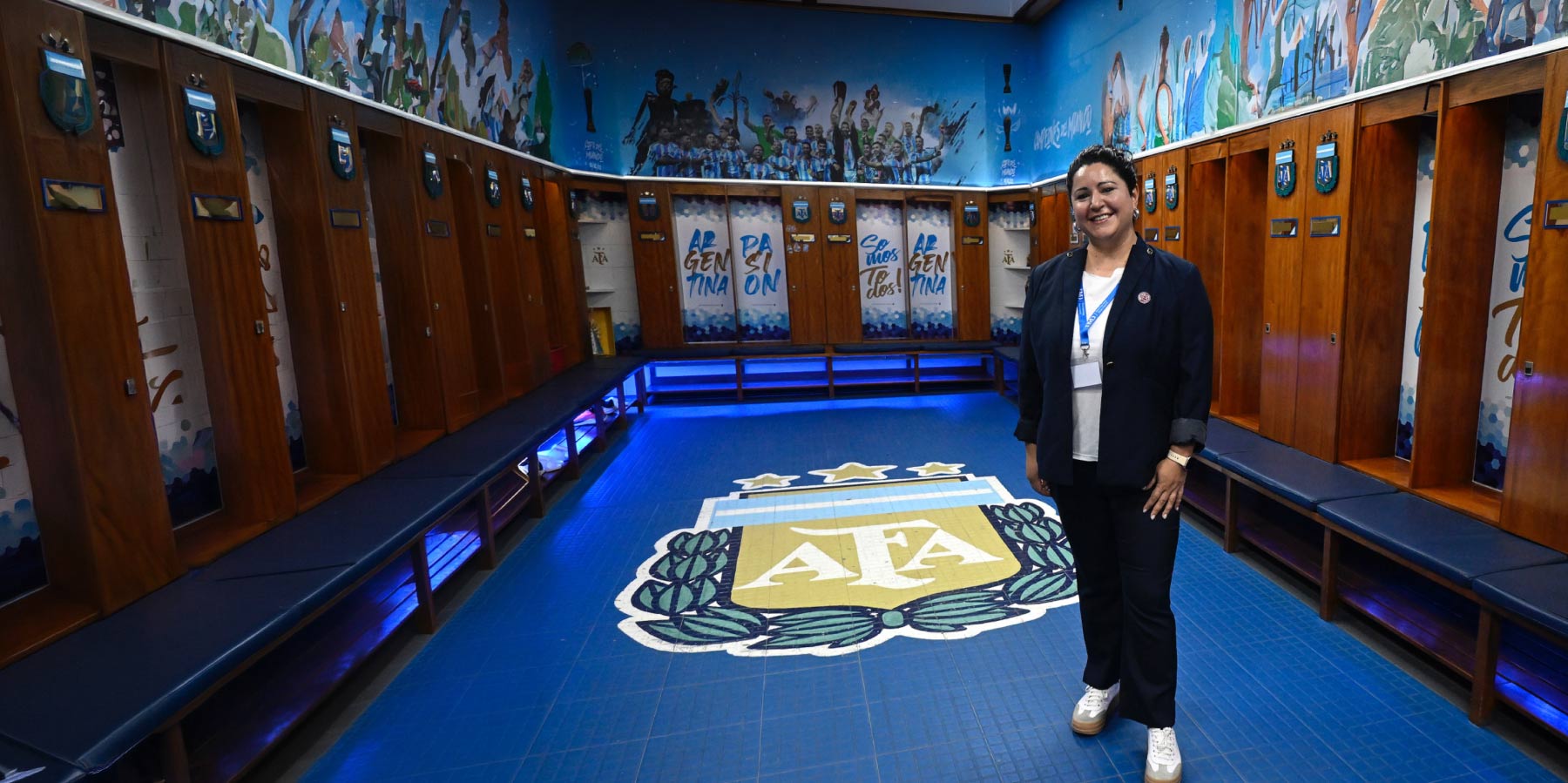

by María Soledad Bernachea Published March 31, 2026 in Women's empowerment • 8 min read
It has always been my belief that sport and education can change the way people live – not just improving lives at the margins, but fundamentally transforming them. That conviction runs through everything I do.
I am a headmistress at a secondary school in Lanús and a professor at the Universidad Nacional de Lanús, and General Secretary of Club Atlético Lanús – a role I have held three times since first taking it on at 26.
These are not separate paths, but different expressions of the same purpose: to create opportunities for people to grow, learn, and build better lives.
My work at Club Atlético Lanús has always been voluntary. I have never received a salary for it, nor have I done it for recognition. I do it because it is inseparable from who I am.
My grandparents were members. My parents were members. My sister and brother, too. I was registered the day after I was born. I grew up here, and Club Atlético Lanús is woven into how I understand myself, my family, and the city where I was born.
Being part of it is not something I chose in the way you choose a job. It is part of my identity. But identity alone does not sustain 20 years of voluntary work. What sustains it is purpose.

That conviction has been tested over the years. Working as a woman in football is not easy, and it has never been. There have been moments when the effort felt difficult to sustain. But I was repeatedly reminded why I chose this path. The clearest reminder of all did not happen during a final or a big match. It happened quietly over time.
When I was vice president of youth football, I was responsible for the residential facility where young male players live. At any given time, around 70 boys and teenagers live there – training, studying, eating, and growing up together. Many of them come from very difficult environments, marked by poverty, instability, and limited opportunities.
When they arrive at the club, something changes. They enter a safe environment – with structure, proper nutrition, and people who take care of them. Many of them are living away from home for the first time, sharing rooms, adjusting to routines, and learning what it means to be part of something bigger than themselves.
Over time, I saw how their lives began to shift – not only on the pitch, but in how they carried themselves, how they spoke about the future and what they believed was possible.
Some went on to become professional football players. Others did not, but that was never the only measure of success. Many continued their studies. Some built careers in sport and coaching. Others created opportunities that had not existed for their families before.
The club gave them a foundation. They built on it. That is when I understood what we were really doing. We were not just developing players – we were helping to build lives.

“As women in leadership, we carry both professional and personal demands at once – and are expected to manage both without difficulty.”
The challenges of being a woman in this space are real, and they have not disappeared with time. Three in particular have stayed with me.
The first is being heard – truly heard. In environments like ours, a woman’s voice can still be overlooked, regardless of experience. We are expected to prove, constantly, that we are ready for responsibility.
The second is responsibility toward other women. If we have pushed a door open, we cannot allow it to close behind us.
The third is harder to define: the weight of expectations does not fall equally. Society does not ask the same of men. As women in leadership, we carry both professional and personal demands at once – and are expected to manage both without difficulty. And we do, but we should not have to do it alone.
My approach to leadership in difficult moments: not confrontation, but the kind of questioning that creates space for better thinking.
Over the years, I have developed my own way of navigating situations that arise in this environment.
There is a dynamic I know well: a male colleague, sometimes with far less experience, taking it upon himself to explain how something should be done – how to read a situation, assess a player, or make a decision.
Early in my career, I found this frustrating in ways that were difficult to manage. Over time, I found a different approach: I ask questions like: do you know something about this player’s personal history? What do you understand about the environment where he grew up? Do you know anything about the difficulties he faced before he came here?
These questions are not confrontational. They are genuine. But they change the conversation. They invite reflection. They introduce doubt. And once doubt appears, people become more open to other perspectives – to possibilities they had not previously considered.
That has become my approach to leadership in difficult moments: not confrontation, but the kind of questioning that creates space for better thinking.
Football is a public sport. Everything is visible, and the pressure is constant. In the build-up to a major final, decisions must be made quickly, and the consequences are immediate.
In those moments, I return to one principle: focus on the team.
I believe deeply that nothing of value is created alone. We build with others – colleagues, community, and the people we work with every day. When pressure is high, that is where I pay attention. Not on my individual role, but on the collective, on shared purpose, on the people I trust. That sense of alignment is what allows us to keep going, even in the most demanding situations.

To understand what I do, and why, it helps to understand the nature of Argentine football clubs.
Lanús is not a company. We are a civil association. We exist not to generate profit, but to serve our community. This model is very different from the commercial structure of many European clubs. That distinction matters.
Our club brings together education, culture, and sport under one roof. We have a kindergarten, a primary school, and a secondary school. We have cultural activities and social programs for people of every age. We have the Foundation, which carries out charitable work throughout the region, and more than a dozen sports disciplines.
Families come here together: children, teenagers, parents, grandparents. It is a space where people can grow, connect, and belong to something larger than themselves.
In Argentina, in a country facing genuine economic and social hardship, this role is not a luxury. It is essential. Clubs are part of the social fabric that keeps communities connected. They give young people somewhere to be, something to work toward, someone to become. Sport here does not only mean competition. It means shared dreams.
What gives me confidence is that visibility itself is changing something.
When I look at the club today, I see more women than ever before. We have women working across many areas of the organization. In our committee of 38 members, six are women, and two of us, including myself, hold senior leadership positions.
It is progress, but I am careful not to treat it as finished work.
Change of this kind does not happen once and hold. It requires continuous effort. The moment we stop, we risk losing what has already been gained.
What gives me confidence is that visibility itself is changing something. When women are present, not just participating but leading, it changes what others believe is possible. Young women preparing for these roles can see a path that, not so long ago, was much harder to imagine.
For me, leadership carries that responsibility clearly. It is not only about what I do in my own role. It is about the doors I help open for those who come after me.
If I could offer one piece of advice to women who want to build careers in sport or in leadership, it would be this: learn to trust yourself.

Board Member, Board of Directors at Club Atlético Lanús, serving in a senior leadership capacity as General Secretary.
María Soledad Bernachea is a member of the Board of Directors at Club Atlético Lanús, where she holds senior leadership responsibilities as General Secretary. Across youth development football, she served as Vice President of the Youth Football Department, overseeing talent development and coordinating the club’s residential program for players, and also she co-led the Women’s Football Department as part of the club’s executive team.
She has held multiple senior governance roles within Club Atlético Lanús, including General Secretary of the Club (now she is in her 3rd period in charge) and its Foundation. She was founder of the Granate Museum and has led the club’s Department of Historical Heritage and Museum. In parallel, she is Director of the Inmaculada Concepción Institute of Lanús, a university lecturer at UNLA, and she was an inclusion advisor at UNSAM. She holds a degree in Political Science, a Master’s degree in Research Methodology, and she is Certified in Educational Leadership and Management, Gender, Disability and Autism.

March 11, 2026 • by Heather Cairns-Lee in Women's empowerment
AI may become one of the most significant leadership opportunities for women in decades. Its impact will depend on how capability, governance, and leadership are built around it....
March 6, 2026 • by Ginka Toegel in Women's empowerment
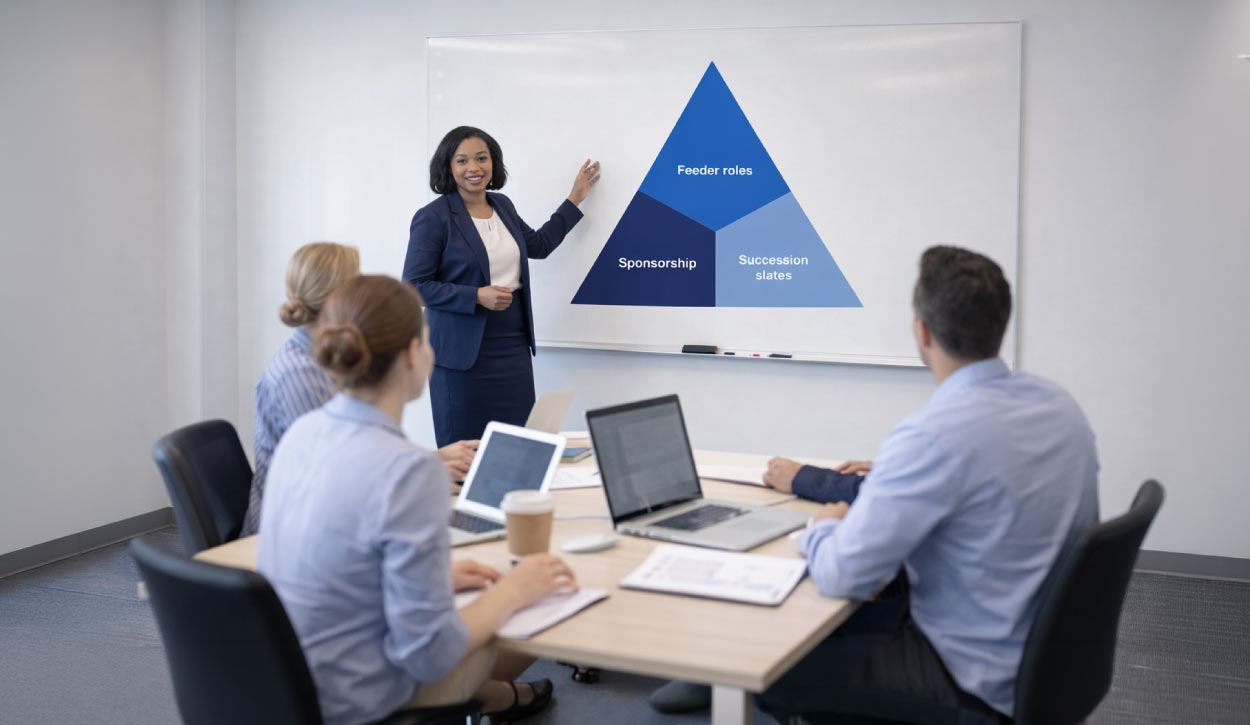
Women’s progress has stalled because organizational systems fail them. Fixing this means recalibrating three things: succession slates, sponsorship, and executive feeder roles....
February 23, 2026 • by Ginka Toegel in Women's empowerment
In her latest book, The Confidence Myth, IMD Professor Ginka Toegel examines why confidence is so often misinterpreted at work – and how organizational systems shape who is seen as confident and...

January 30, 2026 • by Qi Zhang in Women's empowerment
Striving to be a superhero has backfired professionally and personally for ambitious Frances. It’s time to ease her foot off the gas, says Qi Zhang...
Explore first person business intelligence from top minds curated for a global executive audience