How elixir of longevity will alter life as we know it
Aging is now seen as a modifiable biological process. Longevity science is reshaping healthcare, careers, and society for longer, healthier lives....
Audio available
by Paul Strebel Published December 10, 2025 in Innovation • 8 min read
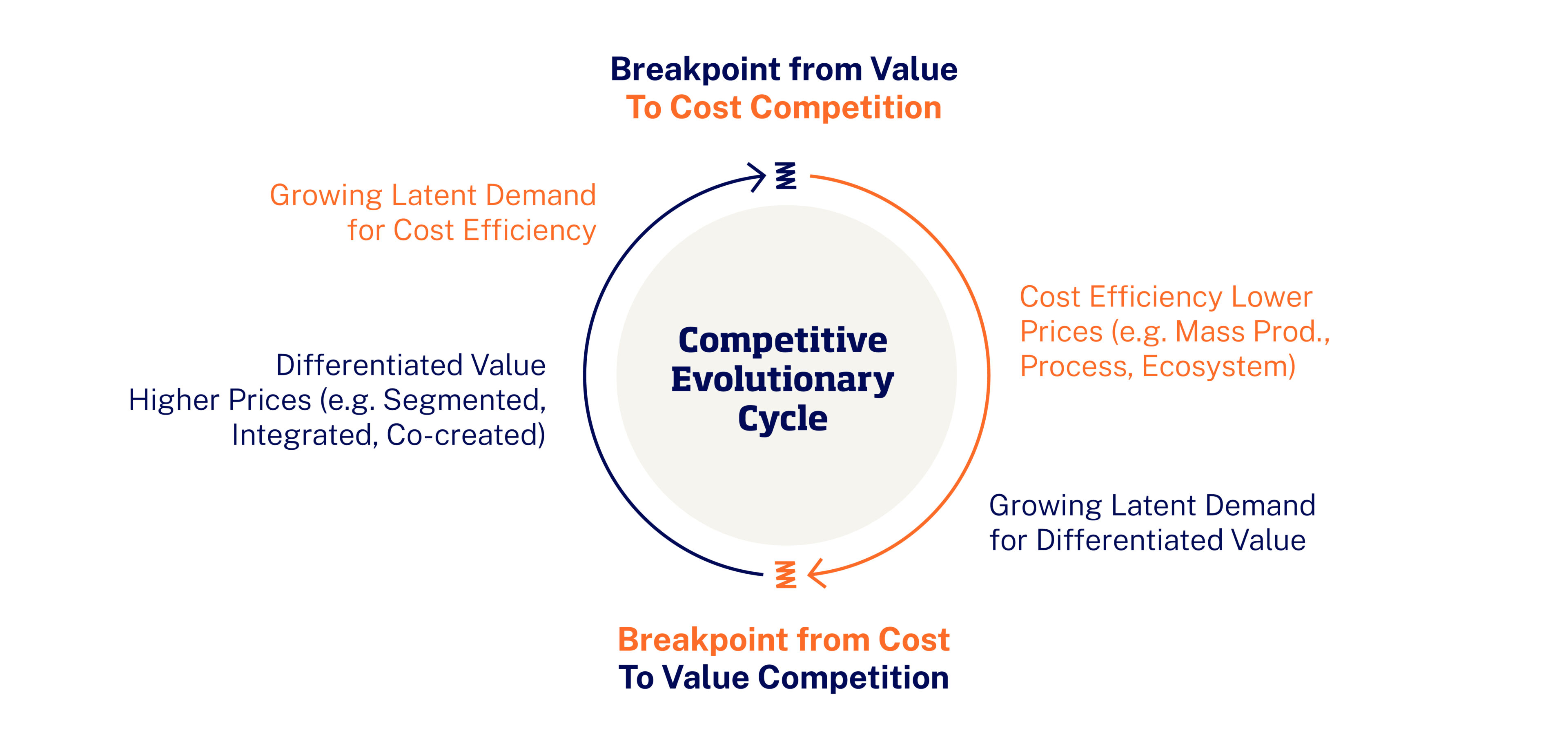
Between bursts of disruptive innovation, industries move through competitive cycles – first divergence and variety creation, emphasizing differentiation to stand out, then shifting towards convergence around the best variants, emphasizing efficiency to cut costs. Companies that successfully manage the transition points between value differentiation and cost efficiency, and, conversely, can outperform the competition. This is what my colleague Xavier Gilbert and I have termed outpacing strategy.
Take the automotive industry as an example. With the mass production of electric vehicles, Tesla’s disruption of this sector has been followed by a scramble among existing American and European players to catch up. The Chinese market, on the other hand, is full of startups competing ferociously to attract a growing middle class of restless consumers, providing the natural breeding ground for the evolutionary breakpoints companies can exploit to get ahead.
Leading Chinese companies, like BYD, are outpacing competitors by shifting the focus in the lower end of the market from differentiation to manufacturing efficiency, thanks to their low-cost batteries and charging times. In the upper end of the market, Xiaomi is shifting the competitive focus in the other direction, to differentiated distribution, by integrating the car into a lifestyle system of interconnected mobile and home appliances.
Outpacing strategy shares two key features with what Chan Kim and Renée Mauborgne refer to as Blue Ocean strategy, defined as, “The simultaneous pursuit of differentiation and low cost to open up a new market space and create new demand.” The first key feature is the objective of creating an uncontested market space rather than fighting over existing demand, and the second key feature is unlocking new demand rather than stealing rivals’ customers. But rather than the simultaneous pursuit of differentiation and low cost advocated by Blue Ocean strategy, Outpacing strategy highlights the importance of alternating between differentiation and cost to create competitive advantage by capitalizing on the opportunities created by the evolutionary cycle of competition.
During periods when companies compete through value differentiation and higher prices, a hidden demand begins to build for cost efficiency and lower prices. Over time, the various “value” offerings start to look increasingly alike, and customers become less persuaded by claims of differentiation. This restlessness opens the door to competitors offering lower prices, even if their products are initially less appealing. As these challengers refine their cost-efficient models, one eventually achieves a breakthrough, delivering a compelling combination of value and affordability that appeals to the market. This is illustrated by what is currently playing out in the EV industry: After the high prices of Tesla, BYD is now offering the Chinese market very attractive value with a lower-cost business system.
Conversely, after periods of cost efficiency and lower prices, a hidden willingness emerges to pay more for differentiated value. Restless customers turn to new players experimenting with higher value offerings. Initially, these do not provide sufficient value to break through, but after enough iterative improvement, a competitor emerges with a sufficiently differentiated offering to create a breakpoint. Back in the early days of the automotive industry, Alfred Sloan’s General Motors managed to break through the dominance of Henry Ford’s Model-T by offering higher-priced automobiles tailored to different market segments. Today, Xiaomi is creating a breakpoint in the upper end of the Chinese auto market by using its mastery in smart devices and software ecosystems to turn EV cars into connected lifestyle products. This has allowed it to challenge traditional luxury automakers and achieve higher margins by selling not only a vehicle but an integrated lifestyle experience.
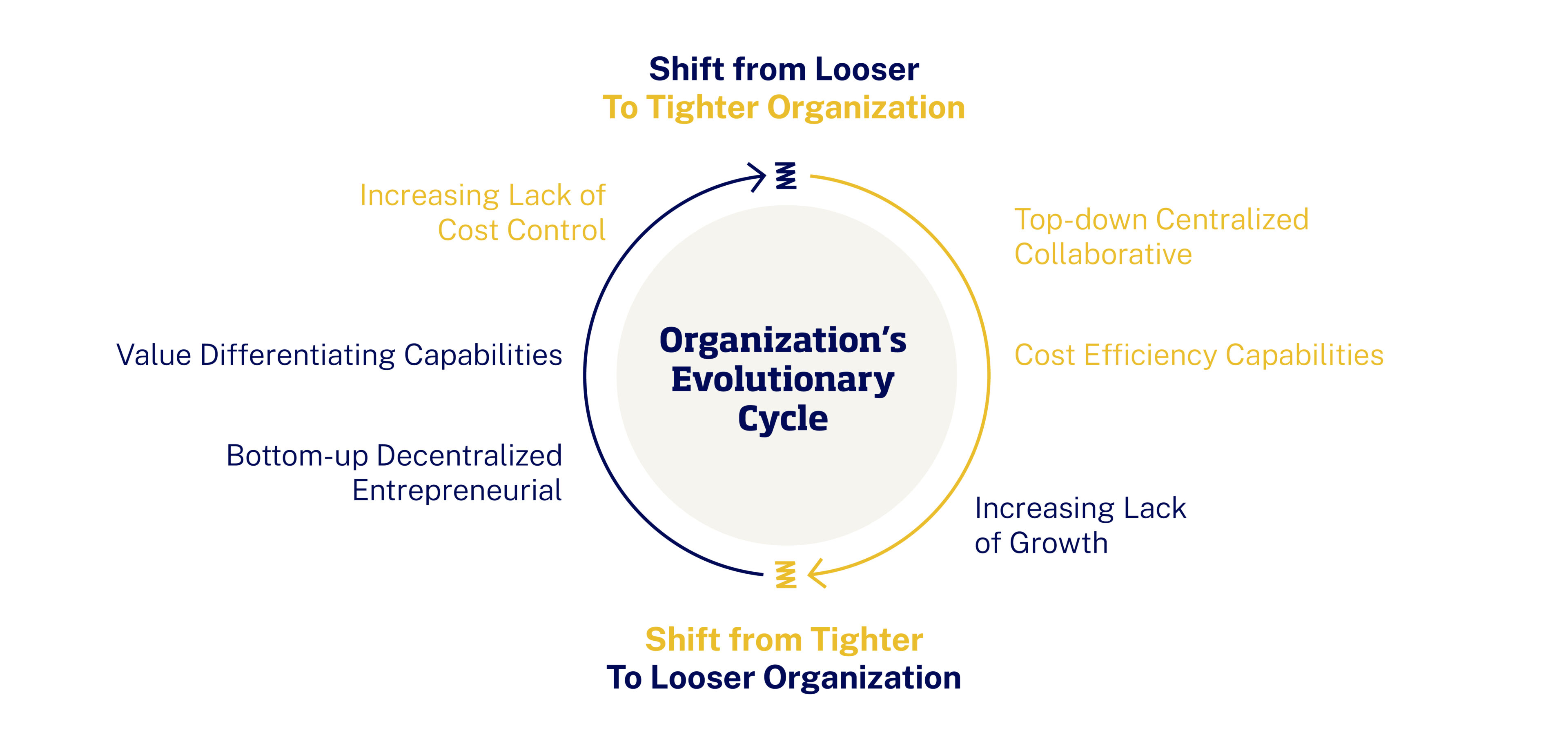
Breakpoints in the automobile industry have been facilitated by different types of organization, looser or tighter. Tesla Motors was a loosely organized, unprofitable startup when it was founded by Martin Eberhard and Marc Tarpenning in 2003. In the drive towards profitability, Musk, who became CEO in 2008 (after having joined Tesla in 2004), imposed a tight top-down centralized style on Tesla Inc. This turbo-charged efficiency surges and rapid prototyping from combined collaborative teams of design and production. Henry Ford’s highly profitable mass production line was also a tightly organized system. In contrast, to get growth and outpace Ford in a slowing market, Alfred Sloan created a looser organization by decentralizing his top team and mandating his divisional managers to run their brands as entrepreneurs.
“Facing customers, it has a brand-based organization for product management.”

Promoting cost efficiency requires a management mindset committed not to cutting costs across the board, but to improving the efficiency of an organization’s competitive advantage. This requires the willingness to make the improvements and investments needed throughout the business and its ecosystem to achieve cost leadership. The organization’s structure and process improvements must include systems of coordination and central control to get the best return on its competitive advantage. The reward system must support a culture of cooperative group effort to get cost efficiency within work units, like quality circles, as well as channels for suggested cost reduction.
BYD is leading the breakpoint in the low end of the EV market with tight vertically integrated manufacturing. It is leveraging its hard-asset competitive advantage in access to critical minerals and advanced battery chemistry. The intensely competitive Chinese market drove BYD’s fast research into stable, low-cost battery chemistry and its breakthrough in cost and charging time.
BYD has built on the cost breakthroughs made in previous competitive cycles: Ford’s mass production incorporating the latest automation, Toyota’s kaizen-style process efficiency, VW’s platform and modular design, but with local, not globally distributed inputs, Tesla’s rapid R&D iteration, high-speed operations and deep vertical integration of the supply chain, but with access to Chinese rare earth metals and hence better control of battery production and research.
Facing customers, it has a brand-based organization for product management. The company has a long-term industrial mindset with pragmatic cost discipline and strategic direction driven by strong central leadership and a tight executive team. The culture is hierarchical, top-down, and performance-driven.
To promote value differentiation, the management mindset must be open to experimentation on the frontline, open to providing for innovation and tolerating failures, and open to the role of sponsors who nurture and protect innovators. The organization must allow for decentralized decision-making on the frontline, flexible controls that permit access to resources via multiple channels, and intensive communication of information, both internally and within the ecosystem of partners. The culture must accommodate a diversity of subcultures and divergent points of view that allow for intuition, as well as product champions free to form informal teams and networks.
Having started with mobile phones, Xiaomi has a soft-asset competitive advantage in network software, incorporating over 400 million users. Its competitive advantage is based on an entrepreneurial mindset that emphasizes speed, facing the market with empowered small cross-functional teams driven by rapid experimentation, customer feedback, and frontline managers often operating like startup founders. The market organization comprises business units run with operational autonomy, but with collaboration to drive innovation in the product ecosystems.
Upstream, Xiaomi relies on outsourced contract manufacturing using its market power to impose fast development times on its suppliers. At the top, Xiaomi’s CEO provides the vision, sets strategic priorities and focuses the frontline energy on value for money. Xiaomi’s culture emphasizes speed and agility, based on open communication, internal sharing, and meritocratic, fast promotion for high performers.
To adapt to competitive cycles, companies must manage the evolutionary cycle of the organization, especially in terms of capabilities.
To adapt to competitive cycles, companies must manage the evolutionary cycle of the organization, especially in terms of capabilities. This is challenging because the looser organization, favoring topline growth, is the opposite of the tighter organization needed for bottom-line profitability. Many organizations tend to get stuck in one or the other and fail to adapt to the competitive cycle.
Outside of the automotive industry, Toys “R” Us and Sears provide examples of what happens when a company fails to make this shift. After a leveraged buyout, Toys “R” Us pursued cost-cutting so single-mindedly that later, when online demand began growing, no resources were available to compete, and they filed for bankruptcy in 2017. On the other side of the cycle, Sears remained so committed to quality brands and full service that when demand shifted to low cost and high convenience, it too was unable to compete. Its parent company, Sears Holdings Corporation, ultimately filed for bankruptcy in 2018.
Ford, on the other hand, is an excellent example of how a company, established over a century ago, has evolved successfully through at least three organizational cycles. When the Model-T started losing its market appeal, Ford acquired the up-market Lincoln and introduced higher quality models with V-8 engines. But volumes were too small for mass production, the profitability was uneven, and frequent restructuring was needed. In pursuit of growth after WWII, Ford finally shifted its organization to GM’s looser management of divisions serving separate segments with multiple brands.
The oil price shock forced Ford to restructure in the 1970s and 1980s and tighten its organization by adopting Japanese process management and reinventing itself for fuel efficiency. In the first decade of the new century, after incorporating aspects of Volkswagen’s modular approach, Ford was ready with a global platform for a looser, streamlined organization downstream with new segments for SUVs and trucks.
Following the 2008 financial crisis, the company was forced into a period of restructuring and tighter organization. The result was a profitable core based on the internal combustion engine. This provided the financing in the next phase of the cycle for a new looser organization and strong growth in the US with the F-Series and an aggressive move into electric vehicle production.
Keeping up with competitive cycles requires managing the organizational cycle to develop an evolving portfolio of relevant capabilities. Capabilities take time to acquire; they involve expertise embedded in process and culture. Culture evolves slowly and, coming from outside, is difficult to integrate. The best chances of success are with existing and new capabilities that are complementary. Ford has repeatedly reorganized to remain competitive, but it has also been in the same industry throughout its existence, with the advantage of always having related capabilities either upstream or downstream for the next phase of the competitive cycle.
Emeritus Professor
Paul Strebel works with boards of directors and top management teams as an advisor on strategic vision and the resolution of boardroom conflicts. He has twice received the Award for Research on Leadership from the Association of Executive Search Consultants and has won several case study awards from the European Foundation for Management Development. His books include Breakpoints: How Managers Exploit Radical Business Change and Smart Big Moves: The Story Behind Strategic Breakthroughs.
December 4, 2025 • by Jennifer Borrer, Saule Serikova in Innovation
Aging is now seen as a modifiable biological process. Longevity science is reshaping healthcare, careers, and society for longer, healthier lives....
December 1, 2025 • by Tomoko Yokoi in Innovation
Vibe coding lets anyone build apps in plain English using AI, unlocking innovation and speed—but businesses must manage security, compliance, and quality risks....
November 26, 2025 • by Milda Mitkute in Innovation
From clearing out her wardrobe to building Lithuania’s first tech unicorn, Vinted founder Milda Mitkute reflects on what it takes to grow responsibly...
November 24, 2025 in Innovation
Professor Amar Bhidé challenges AI hype, arguing that LLMs flatter rather than enlighten and that executives must distinguish calculable risk from true uncertainty....
Explore first person business intelligence from top minds curated for a global executive audience