An adventure is a crisis you accept, and a crisis an adventure you refuse
Explorer Bertrand Piccard explains why leaders should motivate rather than convince, and know when to let go of what they think they know....
9 hours ago • by Stefan Michel in The Interview
In many industries, a great product is no guarantee of competitive advantage. Daniel Bossard, CEO of Bossard Group, tells Stefan Michel how the 195-year-old family business grew into a strategic partner for...
For locals in Zug, the Swiss town where Bossard Group was founded, the 195-year-old business is known as “the company that sells screws”. That might capture how Bossard started, but it’s far from the whole story and not what its customers value most today.
Bossard sells more than a million different kinds of fasteners that are critical for industrial products ranging from aircraft and electric vehicles to semiconductor manufacturing equipment and machinery. Individually, they are small; collectively, they determine whether production runs smoothly or grinds to a halt, or whether the parts of a car hold together.
For CEO Daniel Bossard, a seventh-generation member of the founding family, the question has never just been how to sell more fasteners. As products became harder to differentiate in the market, it was no longer enough to supply them.
“Very early on we thought we had to build something around it to make it more interesting for customers, and to look at the whole process instead of just the product,” he says.
Building on a generational passion for customer service, Bossard began asking how it could help manufacturers build more efficient, productive businesses, looking beyond the traditionally transactional relationship between a supplier and its customers.
“I remember my forefathers telling us that it was always about service,” Bossard adds. Exceeding customer expectations “is in the company’s DNA”.
Today, that broader proposition supports a global business that ranks in the top three in its industry. In the first half of 2026, sales increased by 5.3% to CHF 575.7m ($708m), and EBIT increased to CHF 72.9m ($90m), reflecting an EBIT margin of 12.7%, substantially above the industry average.[SM1.1] The company employs around 3,300 people across 33 countries and serves more than 45,000 customers worldwide, including Tesla, John Deere, and ABB.
The thinking behind that success is captured in what everybody at Bossard knows as the iceberg principle. The fastener product price sits above the waterline: the part customers specify, purchase, and install. But that represents only a fraction (15% of the cost) of the overall picture. Beneath the surface are the activities customers rarely think about: designing and sourcing the part, inventory management, production planning, quality assurance, traceability, and the cost of disruption when something goes wrong.
Looking beneath the surface changed the conversation with its customers. Bossard chose to compete by solving more of the problems surrounding the fastener. It developed engineering expertise, logistics systems, and technical consulting capabilities to address the hidden costs. In 2012, the company formalized this total cost of ownership approach in the Proven Productivity brand tag, later expanding it to include digital tools and software.
The fastener product price sits above the waterline ... but that represents only a fraction of the overall picture.
One example is Tesla. The group’s presence in Fremont, California, Bossard says, put it at the “right place, at the right time” when Tesla was developing its next generation of electric vehicles and needed a fastener supplier.
“Fasteners were the least of Tesla’s concerns. They were more concerned about designing the car,” Bossard explains.
To counter the de-industrialization of some of its traditional markets, Bossard defined a few “sunrise” industries. Electric vehicle manufacturing was an industry where production facilities needed to be built and where companies were more innovation-focused than price-focused. What sustained the relationship with Tesla was Bossard’s ability to act as a reliable, reassuring long-term partner capable of solving increasingly complex engineering and production challenges.
The group works with many of its customers in the same way. Instead of waiting for a completed design and responding with a quotation, its engineers collaborate with the customer from the earliest stages of product development.
“We built up knowledge over many decades,” Bossard says. “Instead of just reactively responding to customers’ demands, we thought, ‘Why don’t we go out proactively and support the design and development departments to bring in that knowledge from the very beginning?’, trying to avoid costs instead of just receiving a bill of materials.”
Customers are not buying a component at the lowest possible price. They are buying confidence.
The real measure of Proven Productivity is not the number of fasteners sold, but the efficiency, reliability, and resilience customers gain. Importantly, while value can be measured in faster assembly, lower inventories, and lower total cost of ownership, those metrics only tell part of the story.
“We do measure the benefits,” he says. “But it’s really the peace of mind customers get. They don’t have to care about fasteners. They can sleep well.”
That insight changes how value is defined. Customers are not buying a component at the lowest possible price. They are buying confidence that an entire part of their production process will run reliably, allowing them to focus on designing aircraft, manufacturing semiconductors, or building industrial equipment instead of worrying about fasteners.
Develop key leadership capabilities and accelerate your impact as a leader
In 2020, Daniel Bossard announced the Strategy 200 initiative in anticipation of the firm’s 200th anniversary in 2031, bringing together more than 100 “change agent” employees from different countries, business units, and levels of seniority to help shape the company’s strategic priorities: “Instead of just putting up a PowerPoint slide saying, ‘Please collaborate more’, we said, ‘Let’s also do this’. We said, ‘Let’s involve as many people as possible in developing the strategy’.”
The process exposed employees to different cultures, perspectives, and ways of working. As he reflects, “The journey is more important than the goal. We didn’t radically change the strategy, but a lot of people worked on it, so it was less necessary to communicate it. It had already started to be lived during the process.”
As technology evolves, Bossard is not looking to adopt AI for its own sake, but to improve responsiveness and free people up to focus where they add the most value.
That also means knowing when to let go of your own ideas. Bossard scrapped an internally developed AI tool just weeks after Microsoft Copilot launched. “Things are evolving gradually,” he explains. “Start small, scale fast, use the tools you have. Will you make mistakes? Yes, but that’s part of the journey.”
AI helps the group improve pricing, forecasting, inventory management, and customer service. But, Bossard says, “We shouldn’t just ask where to use AI, but where we need to use humans. You still need people. It’s also so important to have personal interactions with CEOs and other decision-makers because that creates trust.”

That same pragmatism shapes his approach to leadership. “If someone talks about visiting customers, we have to feel that they are truly out with them and interested in their business,” Bossard says. “We have to know that people mean what they say – so it’s walk the talk.”
Bossard recalls asking the manager of an acquired German business what lay behind his team’s success in winning new customers. The answer was disarmingly simple: “I go and see customers. It’s not magic; we just have to do it.”
The people of Zug may still think of Bossard Group as “the company that sells screws”, and they are not wrong – fasteners remain at the heart of the business. What has changed is where and how the company creates value. Customers judge the group not just by the screw itself but by the engineering expertise, logistics, digital tools, responsiveness, and peace of mind that keep their operations running. The results speak for themselves: about 90% of its large and medium-sized customers have been working with the group for more than 10 years.
The lesson extends well beyond industrial manufacturing. In markets where products increasingly resemble one another, sustainable competitive advantage rarely comes from the product alone. It comes from understanding the problems customers face and solving them better than anyone else.
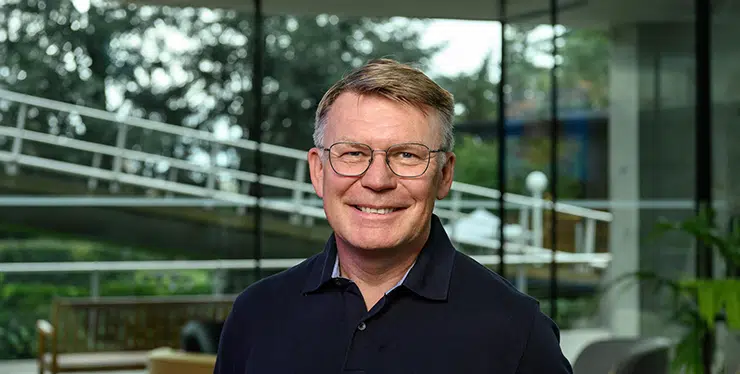
CEO of the Bossard Group
Daniel Bossard is CEO of the Bossard Group and has held leadership roles across the company for more than two decades. After joining Bossard in 2000, he served as CEO of Bossard Denmark, Sales & Marketing Manager, and CEO Northern and Eastern Europe before being appointed Group CEO in 2019. He holds a degree in business administration and a doctorate in technology management from the University of St. Gallen (HSG).
Professor of Management, Dean of Faculty and Research
Professor Stefan Michel‘s primary research interests are AI’s impact on strategy, pricing, and customer-centricity. He has written 13 books, numerous award-winning articles and ranks among the top 40 bestselling case study authors worldwide by The Case Centre. He is currently Dean of Faculty and Research at IMD. He co-directs the Breakthrough Forum for Senior Executives and is also Program Director for two IMD programs: the 10-day Breakthrough Program for Senior Executives (BPSE), guiding leaders in defining their next breakthrough; and Strategic Thinking, an 8-week online program with 1-1 coaching, helping professionals become better strategists while working on a concrete strategic initiative for their organizations.
13 hours ago • by Kartik Ashta in The Interview
Explorer Bertrand Piccard explains why leaders should motivate rather than convince, and know when to let go of what they think they know....
August 14, 2026 • by Mark J. Greeven in The Interview
How COFCO International rebuilt trust under Chi Jingtao (Johnny) with alignment, values, and visible leadership....
July 28, 2026 • by Alfredo De Massis in The Interview
The Frescobaldi formula: humility, reinvention, and stewardship across 30 generations - how to sustain a family business in changing times....
April 21, 2026 • by Marleen Dieleman in The Interview
Chef Pam transformed a 120-year-old family business into a Michelin-starred restaurant, showing how heritage can fuel innovation and competitive edge...
Explore first person business intelligence from top minds curated for a global executive audience