Leaders who won’t let go
Family businesses often have leaders who continue working well into their later years. Do they offer a template for non-family companies? I contacted Peter Vogel, IMD’s Professor of Family Business and Entrepreneurship and Director of the Global Family Business Center. He confirmed that family business heads tend to have longer tenures. One reason is that there are fewer governance structures pushing leaders to go – family companies often don’t have official retirement ages. Another reason is that owner-managers, who have devoted decades to building and growing their businesses, often struggle to let go.
An absence of pressure from outside investors can allow family business leaders to go on well beyond the traditional retirement age, Vogel said. “In families, it is rarely the case that there is someone who will be in a position to tell the patriarch or matriarch that it is time to step down and, in most cases, even if they were to ‘retire’, they would then often be pulling the strings from behind the scene because they remain the main shareholder or chairperson of the board.”
Like Dawkins, Vogel believes the benefit of leaders who stay for many years is that they take a longer view and benefit from decades of experience when it comes to crisis management. “A long-tenured CEO tends to pursue sustainable growth over short-term gains,” he said. “This can lead to stable investment patterns, strong stakeholder relationships, and a reputation for reliability.” They can also preserve the company’s values and culture. Their continued presence provides stability. “Frequent CEO turnover is disruptive and expensive,” he added.
“Overall, family firms also have the advantage of tacit, institutional knowledge with regard to how things are done or how crises are handled. Wisdom that is passed down from generation to generation. A luxury that non-family business CEOs rarely have.”
What of Dawkins’ point that those benefits can turn into disadvantages if the long-serving CEO fails to spot changes in technology or consumer behavior? Vogel points to research suggesting an inverse U-shape when CEOs spend a long time at the helm – performance improves in the early years but “can decline after too long in office, as learning plateaus and external perspectives diminish.”
In both family and non-family businesses, long-serving CEOs can become overly powerful, Vogel said, weakening board oversight. Their staying on can also result in talent bottlenecks. “When a CEO remains in place for decades, it may limit succession planning and discourage capable next-generation leaders from engaging or staying within the firm,” he added.
There are, of course, younger leaders who are shaking up the business world. Meta’s Mark Zuckerberg is 41. OpenAI’s Sam Altman is 40. Like Buffett and Murdoch, they built their companies. Whether they are still leading their organizations in 50 years depends on how successful those companies are over that very long term. That Buffett and Murdoch are more than twice the age of the younger business pioneers shows just how resilient they have been. Many more leaders have crashed out before they did, just as Murdoch came close to doing in the early 1990s.
Those nonagenarian business leaders are exceptional. There aren’t many of them. What we do know is that, with an aging population, companies will have more older leaders to choose from – and a few might prove to be outstanding.

 Audio available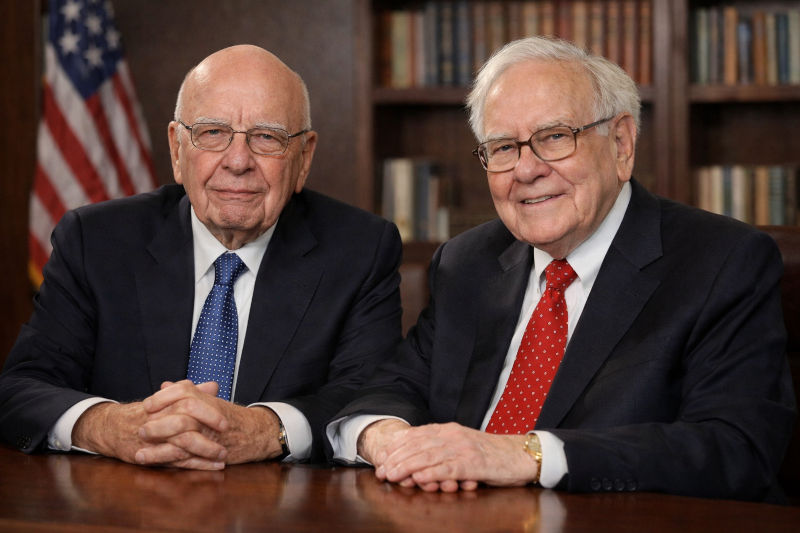


 Audio available