At a glance
- Most sustainability strategies trap themselves in a niche: a premium product for values-driven customers that never threatens – or transforms – the conventional market around it.
- Slow Forest Coffee asked a different question. Can regenerative impact be scaled to the mainstream, rather than priced for the few who can afford to care?
- The answer was structural, rather than promotional. Vertical integration and disciplined sequencing let the company compete on price while still funding ecosystem restoration.
- Slow Forest Coffee’s journey offers four principles for leaders trying to move sustainability from a niche differentiator to a default standard.
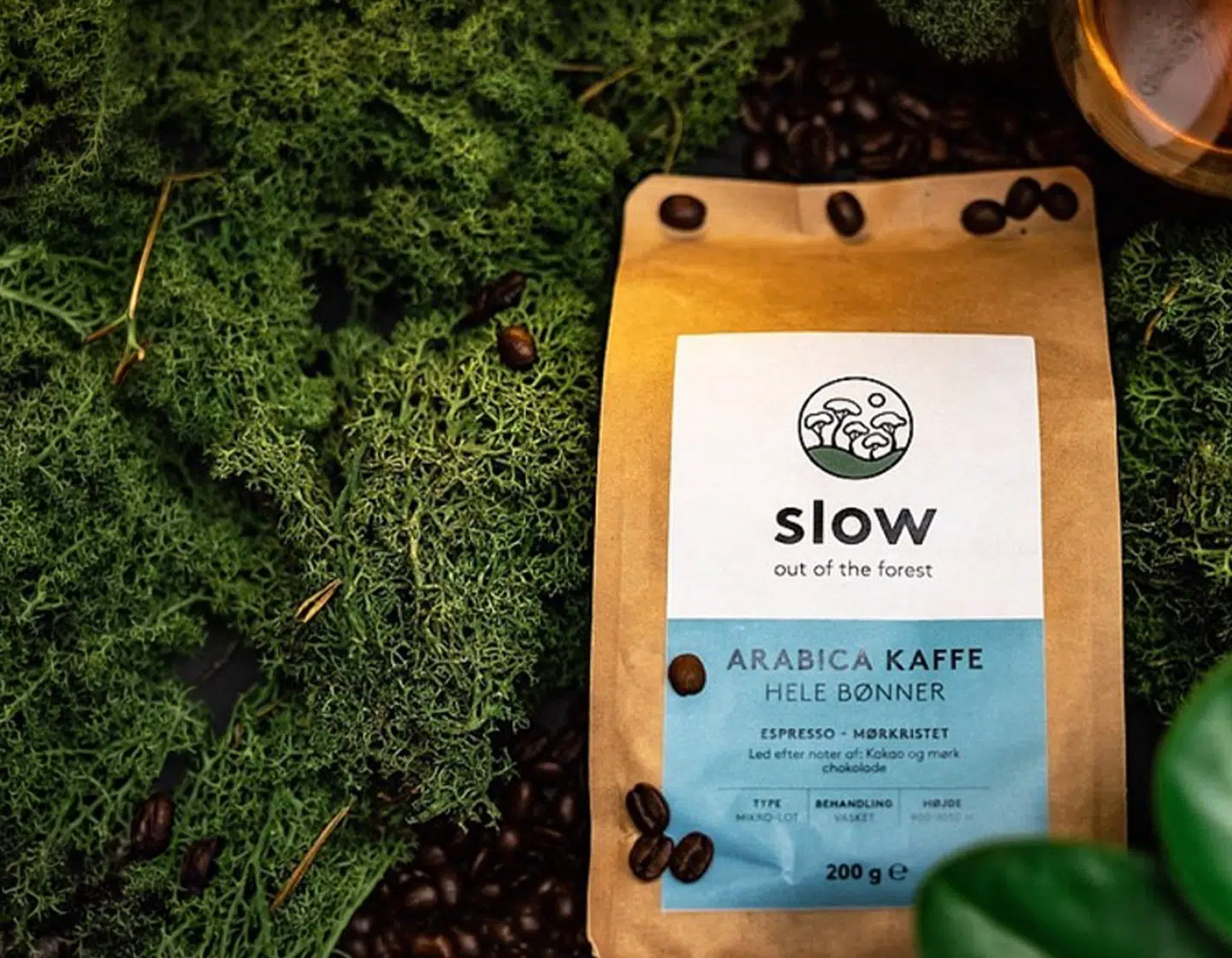
Slow Forest Coffee (Slow) was born from the conviction that lasting environmental change would only happen if it could also make sound financial sense. Its founder had spent years watching well-intentioned development projects in Southeast Asia struggle and fail – not for lack of effort, but because government, business and local community motives never aligned. A different approach was needed; one that made doing good for the environment the economically rational choice.
The breakthrough came when a group of advisors and co-investors brought the missing pieces – deep expertise in ecosystem restoration and agroforestry alongside hands-on coffee farming experience spanning several generations. Together they landed on the founding insight: Coffee, a familiar crop with a vast global market and deeply engaged consumers, could be grown regeneratively on degraded land in Laos, restoring ecosystems while creating stable livelihoods for local farmers.
But turning conviction into a scalable business meant confronting a deeper question. Most sustainable businesses ask consumers to pay more for doing less harm. Slow turned the question around 180 degrees – could a business democratize the sustainable choice by aligning financial and environmental incentives so closely that scale and impact reinforced, rather than competed with each other?
The broader issue
The problems Slow set out to address are not unique to coffee. Across food production globally, value chains are structured to concentrate rewards at the consumption end while pushing environmental and social costs onto the production end. Across commodity after commodity, farmers receive a fraction of the final retail price, while the majority of value is captured by processors, traders, brands, and retailers in consumer markets. The system leaves producers economically vulnerable, with little incentive or capacity to invest in the health of their land.
This structure is also increasingly fragile. Industrial food production has relied on monoculture farming systems that, over time, boost short-term yields but deplete soils, reduce biodiversity, and damage waterways. As climate change intensifies, these systems are proving inadequately resilient: Droughts, heatwaves, and erratic rainfall rapidly translate into price shocks that cascade through global supply chains. Food price volatility, once an occasional disruption, is becoming a structural feature, affecting producers and consumers alike.
A value chain broken in the middle
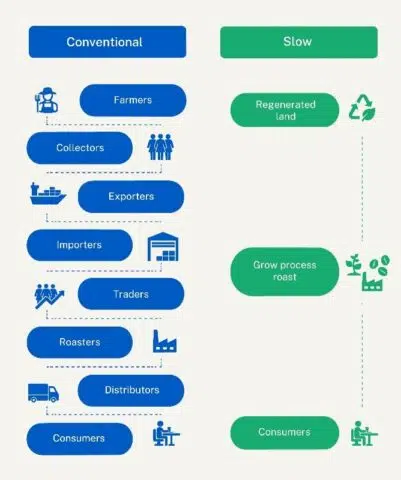
In coffee, these dynamics are especially visible. As Slow’s CEO described the problem, the value chain is effectively severed between production and consumption. On one side, growers and traders optimize for short-term yield. On the other, roasters and brands buy from commodity markets with little visibility into how their product was grown and limited mechanisms to direct investment toward the upstream resilience the system urgently needs. Each actor optimizes within their own link in the chain: The incentives never align.
The sustainability premium trap
The most common response to this dysfunction has been to carve out a premium niche: certifications, sustainability labels, “ethical” product lines – that sit alongside conventional products without changing the underlying structure. The assumption is that a subset of consumers will pay more to feel better about their purchase. The result is products that occupy a small corner of the market while the dominant model continues unchanged. Pricing sustainability as a luxury both restricts who benefits and caps the scale of any positive impact. If the only route to better outcomes is a higher price tag, industry transformation may remain permanently out of reach.
As Slow Forest Coffee CEO, Sebastian Nielsen recalled,
“If you want to change the food system you can’t build a niche. The first hypothesis we set out to test was whether we could deliver a superior product at a competitive price – otherwise it would not be a business. We did not want to build another pilot or a project for a single village, we wanted to change the system and you cannot do that with a niche product priced at a premium.”
A new approach
Slow’s founding insight was structural. The problem could not be solved by layering a premium onto a broken model. The only response was to redesign the entire model. The approach rested on two pillars in combination: regenerative farming and vertical integration.
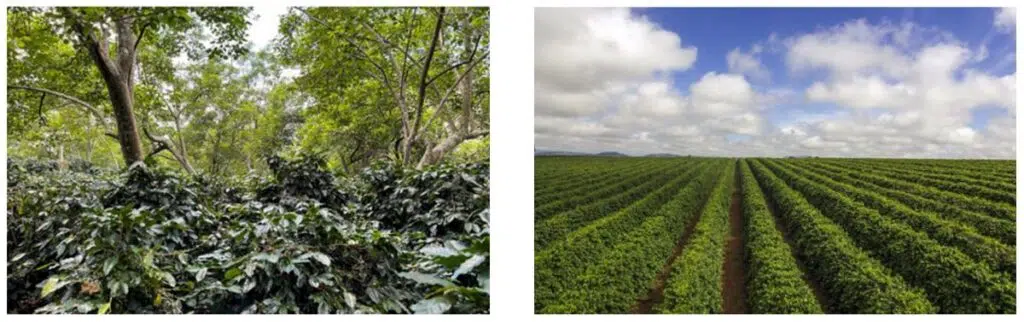
Regenerative farming. On the farming side, the company developed a systematic method for converting degraded monoculture plantations into layered agroforestry systems, mixing coffee with native trees, shade canopies, and diverse plant species. Full conversion typically took several years – long enough to meaningfully restore soil health, water retention, and biodiversity. The transition was managed collaboratively with customers who committed to purchasing the coffee and received regular updates on the farm’s progress.
Vertical integration. From the outset, full vertical integration was central to the vision of owning each step of the value chain, from farm management and processing through to roasting, packing, and delivery to the consumer market. By eliminating the layers of intermediaries that typically absorb the majority of value in commodity supply chains, the model could redirect what would otherwise be captured by traders and middlemen toward environmental investment and competitive pricing. Control over the full chain also meant comprehensive traceability. Every batch of coffee could be tracked back to the farm it came from, giving customers verified impact data instead of marketing claims.
Slow did not attempt to build this model at scale from day one. Each element was tested before significant capital was committed – from working with smallholder cooperatives before directly acquiring or leasing its own farms, to using shared roasting facilities before moving to larger contract roasters, to piloting routes to market prior to locking in a commercial strategy. This approach kept early capital requirements manageable and allowed the team to learn and adjust before scaling.
The commercial model that emerged from this process was built around large corporate clients buying coffee for their offices. Long-term supply contracts with these clients provided the predictable revenues needed to access financing, which in turn funded land tenure and the upfront costs of ecosystem restoration. The proposition resonated: by switching to Slow, companies could continue serving employees with quality coffee while simultaneously delivering on climate commitments, with a transparent supply chain story to share with both employees and external stakeholders. The subsequent acquisition of a Kenyan roastery further deepened this integration, adding at-source processing capacity close to the growing regions, introducing access to East African coffee, and providing established relationships with European retailers which reopened a route to market that had once proved premature.
Did it work?
The results are tangible. Hundreds of hectares of degraded plantation have been converted into thriving agroforestry farms, with further land preserved through smallholder partnerships. Slow’s sales were forecast to double again in 2026 from the 1,000 tons delivered in 2025. The company’s carbon footprint has been independently validated as net negative, and customers can trace their coffee to the specific farm it came from: a level of transparency that few in the industry can match. At a time when established players were reassessing sustainability commitments under margin pressure, Slow’s integrated model provided a structural buffer against the commodity price swings that threatened competitors.
The path was not straightforward. Finding the right customer segment required trial and error and early attempts to communicate impact to consumers in a retail environment showed how difficult it is to differentiate on values alone when the purchasing decision happens in seconds. The leadership transition from a founder-led startup to a professionally managed organization was another inflection point that many mission-driven ventures navigate too late or too reluctantly.
As the company looks ahead, the challenges multiply. Re-entering retail – now with stronger brand credentials and a sharper ability to communicate impact and tell Slow’s unique story – is back on the agenda, alongside questions of how to expand the product range, how to grow the supply base in East Africa at the pace that market demand requires, and whether to seek institutional capital that could accelerate expansion but might also introduce pressures that sit uneasily with a model built on patient, regeneration-led investment. Each choice entails a genuine trade-off. Moving from niche to norm is not about doing more, it’s about doing the right things in the right order.
Takeaways
Slow’s experience points to four principles for companies seeking to turn environmental ambition into commercial advantage:
- Build a model that finances sustainability. Premium pricing limits your market and leaves the system unchanged. Structural efficiency, which captures more value at source, makes sustainability affordable without asking customers to subsidize it.
- Earn credibility, don’t claim it. Independent validation, rigorous measurement, and honest reporting, including on what is not yet working, build trust that marketing alone cannot.
- Test before you commit capital. Validate the farming model, the customer segment, and the route to market at small scale. Lessons learned early are far cheaper than misfits discovered late.
- Sequence growth deliberately. Credibility must come before scale and supply-side integrity before demand-side expansion – or the model that generates both the impact and the returns begins to erode.
This article is based on IMD case IMD-2736, available from The Case Centre at www.thecasecentre.org.






Research Information & Knowledge Hub for additional information on IMD publications
Research Information & Knowledge Hub for additional information on IMD publications
Research Information & Knowledge Hub for additional information on IMD publications
Research Information & Knowledge Hub for additional information on IMD publications
Research Information & Knowledge Hub for additional information on IMD publications
Research Information & Knowledge Hub for additional information on IMD publications
Research Information & Knowledge Hub for additional information on IMD publications
Research Information & Knowledge Hub for additional information on IMD publications
Research Information & Knowledge Hub for additional information on IMD publications
Research Information & Knowledge Hub for additional information on IMD publications