
September marks the beginning of the academic year for most of the northern hemisphere. It is the time to make decisions over what courses to take and which disciplines to study. In recent years, this task has become more complex with the proliferation of the digital technologies that have transformed rapidly the labor market in terms of both traditional jobs and new jobs available.
A most intense interest has been placed in the so-called STEM disciplines: science, technology, engineering, and mathematics. These majors, the ‘Techies,’ are needed in order to manage and expand the digital economy, so the argument goes. There are, however, more and more voices suggesting that the digital economies will also require the collaboration of the ‘Techies’ with humanities majors, the so-called ‘Fuzzies’ in order to complement their understanding of the social challenges and creativity among other elements.
In this issue of the Criterion of the Month, I explore the World Competitiveness Dataset to address the above matters. I begin with the assumption that the capacity of individuals to accommodate and manage new technologies gives us an indication of their ability to adjust to new realizations. This is captured by the Adaptive Attitudes sub-factor in the recently introduced IMD World Digital Competitiveness Ranking.
As a proxy for the quantitative capacity of an economy, we take the PISA test scores for math. This variable captures the performance of 15-year-olds in mathematics in each country. If we relate the Adaptive Attitudes sub-factor with the PISA test scores for math we find a positive but not as strong a relationship. The correlation coefficient is 0.63, which may point out that quantitative proficiency may be a necessary but nor a sufficient condition to build the flexibility and adaptability competencies.
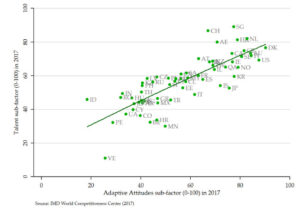
In order to broaden the scope to include additional aptitudes in the quantitative capabilities of an economy, we turn to the concept of Talent. We measure Talent by evaluating competencies like the existence of international experience, the presence of foreign skilled personnel as well as technological skills. The relationship between Talent and Adaptive Attitudes is strong: 0.8. Graph 1 outlines that countries with high Talent availability are also exhibiting high Adaptive Attitudes as well.
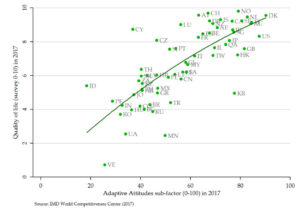
To qualify further the importance of these findings, I explore the relationship of these variables to the variable Quality of Life. This is based on a survey question where mid- and upper-level managers reflect as to whether the Quality of Life in an economy is high or low. Graph 2 captures the positive relationship: countries, which exhibit high levels of Adaptive Attitudes also display high levels of quality of life. The correlation coefficient is 0.76.
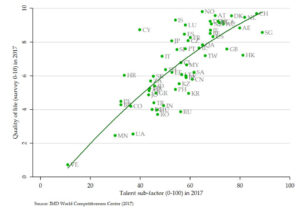
Equally positive is the relationship between Quality of Life and Talent demonstrated in Graph 3; the correlation coefficient is 0.79. Countries that developed the local talent pool or appeal to the international talent pool are the ones that also reveal high Quality of Life.
Deciding what course to take or what major to follow is a stressful undertaking for students and their parents alike. Even though it is very important for an economy to have competent and knowledgeable members, concentrating on math or science may not be the only path to success. Additional competencies that reflect an open attitude or the ability to integrate different experiences are also very important. The humanities have not yet become irrelevant.




After being hit with US tariffs that climbed to 50 per cent over its purchases of Russian oil, India has now struck a deal with the world’s largest economy to cut those duties to 18 per cent, sending the rupee and local markets sharply higher. All...


Research Information & Knowledge Hub for additional information on IMD publications
Research Information & Knowledge Hub for additional information on IMD publications
Research Information & Knowledge Hub for additional information on IMD publications
Research Information & Knowledge Hub for additional information on IMD publications
Research Information & Knowledge Hub for additional information on IMD publications
Research Information & Knowledge Hub for additional information on IMD publications
Research Information & Knowledge Hub for additional information on IMD publications
Research Information & Knowledge Hub for additional information on IMD publications
Research Information & Knowledge Hub for additional information on IMD publications
Research Information & Knowledge Hub for additional information on IMD publications