
At a glance
- ABB faced long-standing challenges: financial underperformance, declining market confidence and inefficiencies in its complex matrix structure.
- The organization underwent a radical transformation: decentralizing operations, optimizing headcount, enhancing accountability and empowering divisions to operate as independent businesses.
- The company’s new operating model − “the ABB Way” − formalized the transformation and acted as the glue that held the group together.
ABB, a Swiss industrial conglomerate and leading producer of heavy electrical equipment, had struggled for some time with underperformance, declining market confidence and inefficiencies in its complex matrix structure. In response to the challenging situation, the company initiated a restructuring, aiming to simplify the organization’s top-heavy structure and accelerate decision making. One of the first decisions was to sell the Power Grids business and streamline ABB’s four remaining business areas. After a change in CEO, the restructuring accelerated and ABB underwent a radical transformation: decentralizing operations, optimizing headcount, enhancing accountability and empowering divisions to operate as independent businesses.
The broader issue
When companies face underperformance, low market confidence and stagnating profits, the common response is to initiate a sweeping restructuring – often accompanied by board changes and a clean-slate approach. However, research by McKinsey reports that a significant proportion of transformations – more than two-thirds – fail.
Anand and Barsoux argue in their article “What everyone gets wrong about change management” that effective transformation efforts are characterized by a three-layered architecture composed of two imperatives and a choice. These layers represent the “why,” the “what” and the “how” of transformation.
1. The catalyst: The “why” of transformation
At the heart of every transformation lies a catalyst: a recognition that the organization can create significantly more value than it currently does. This realization typically leads to efforts aimed at increasing efficiency − through streamlining operations and cutting costs − and reinvesting in areas that foster growth.
2. The strategic quest: The “what” of transformation
Transformation is not merely about doing things better but about doing different things to unlock new value. Organizations must define a clear focus, or “quest,” that aligns with one of the five value-generating areas:
- Global presence: Expanding market reach and increasing internationalization across leadership, innovation, talent, capabilities and best practices.
- Customer focus: Deepening customer understanding to deliver superior experiences, insights or integrated solutions beyond standard products or services.
- Nimbleness: Enhancing strategic, operational and cultural agility by accelerating processes and simplifying work structures.
- Innovation: Leveraging fresh ideas − both internal and external − to broaden opportunities and exploit new growth avenues.
- Sustainability: Improving environmental and social responsibility in both positioning and execution.
Focus is key and a common mistake is to choose more than one quest, or worse, try to tackle the five value-generating areas at once, which typically leads to a loss of focus.
3. Leadership capabilities: The “how” of transformation
To support the chosen quest, the company must develop leaders who can see it through. Unlike traditional change efforts, corporate transformation demands shifts in how people perceive, think and act across the organization. Executives and managers must model the new mindsets and behaviors consistently, acting as multipliers of change. Sustained progress depends on leaders at all levels embodying and promoting the cultural shifts that drive transformation forward.
ABB’s restructuring journey
The “why”: A complex and slow structure
ABB’s once well-known yet complex triple-matrix organizational model − with overlapping divisional, functional and country layers − hampered operations and reduced efficiency. Multiple department heads, redundant processes and excessive reliance on corporate functions further delayed decision making and diluted accountability. The additional layer of country-level administration only added to the complexity. As the organization grew increasingly top-heavy and slow, ABB found itself at a crossroads; to remain competitive, it did not just need improvement, but rather a complete transformation.
The “what”: Radical decentralization
ABB focused on nimbleness, radically simplifying operations and accelerating execution. At the core of the transformation was a bold shift: eliminating the matrix structure and empowering the divisions within ABB’s four business areas to become the primary operating units. The traditional authority of regional and country executives, who had reported directly to the CEO, was dismantled, and the corporate headcount was significantly downsized, with central functions and global business services reduced to essentials.
The divisions were granted entrepreneurial freedom, with full ownership of their strategies, operations and performance; they were also expected to meet performance goals. Based on its market conditions, each division was given a specific mandate: stability, profitability or growth. The logic was clear – a business was required to be stable and profitable before focusing on growth. Accountability, transparency and speed became the new hallmarks of ABB’s culture, enabling faster decision making and execution.
The “how”: The ABB Way – the glue that holds the group together
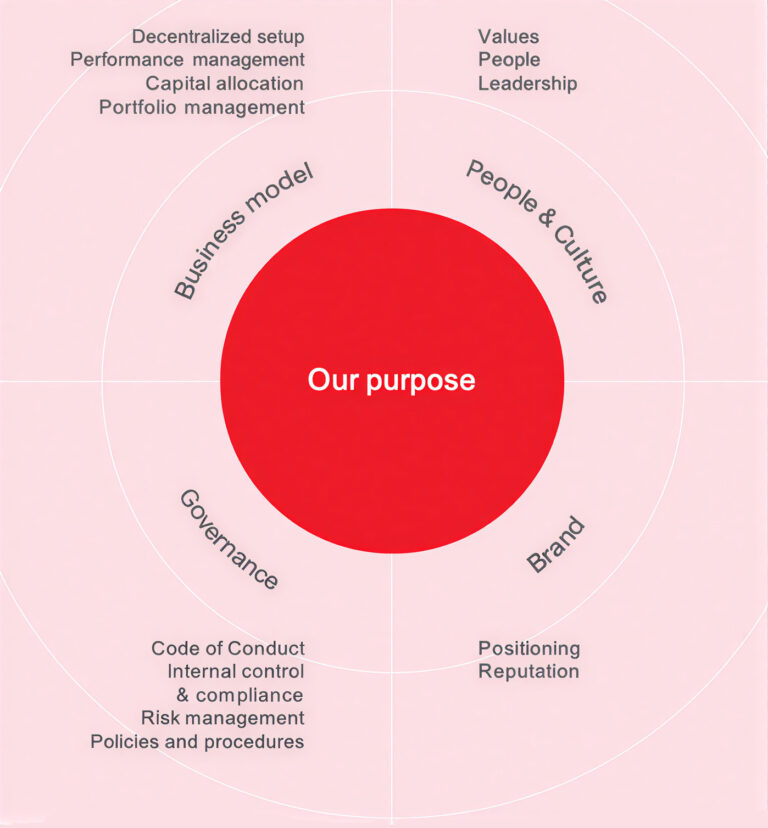
As ABB decentralized, the company recognized the need for a unifying framework to maintain cohesion. It introduced the ABB Way, a clearly defined operating model that was designed to align the decentralized organization while reinforcing its core values (see Figure 1). The ABB Way became more than just a governance framework: it shaped how ABB approached its business model, people, culture and brand, providing the glue that held the company together through significant structural and strategic changes.
Through this radical transformation, ABB did not lose sight of its deeper mission: to drive progress through technology, and to empower industries to become more sustainable, productive and efficient. The ABB Way ensured that even in a decentralized setup, every part of the organization remained grounded in a common purpose − serving customers, accelerating innovation and shaping a better world through electrification and automation.
Implementation
A focus on simplicity characterized the implementation. The roll-out was led directly by the executive team, who collaborated closely with both the business and corporate functions to identify which corporate roles and teams should be integrated into the business. ABB rolled out the ABB Way using a collaborative “circles” approach. Workshops were first held with managers to explain the business model, governance, culture and brand. Managers then cascaded the workshops down to their teams, who were encouraged to provide feedback, thus helping to refine the implementation.
Employees’ acceptance
The reorganization was largely welcomed by ABB employees since it resonated with the company’s entrepreneurial DNA. In the 1990s, ABB had grown by acquiring numerous companies, and the rigid matrix structure that followed had never been a natural fit. The shift to decentralization was seen as a return to ABB’s roots. The new operating model clarified roles, reduced corporate interference, enabled faster decision making and brought the company closer to its customers. Managers were eager to take ownership and responsibility for businesses that were struggling.
The streamlining of corporate functions restored ABB’s entrepreneurial spirit and customer focus, which many felt had been diluted in recent years. However, the changes also faced resistance within corporate functions since their scope was significantly diminished. While some corporate employees transitioned into roles within the businesses, others had to leave the company.
“In ABB we say that culture eats strategy for breakfast but speed eats synergy for lunch.” Morten Wierod, ABB CEO
Did it work?
The shift significantly improved financial performance, increasing revenue as well as profitability and restoring investor confidence. The results were remarkable. Over four years, ABB increased its revenue from US$26 billion in 2020 to almost $33 billion in 2024 and achieved significantly improved profitability, delivering an operational EBITA margin of 18.1% (up from 11.1% in 2020 – excluding portfolio changes), which propelled its share price to record highs. In the same period, it consistently delivered on its commitments, regaining the trust of employees, customers and investors alike.
Takeaways
ABB’s transformative journey provides valuable insights into the key elements that drive successful transformation and the fundamental role of a structured approach.
- Effective transformation requires clarity on the three dimensions of why, what and how: A clear value-creation imperative that drives the need for change, a focused choice among value-creation areas (e.g. global presence, customer focus, nimbleness, innovation or sustainability) and strong leadership that models new mindsets and behaviors consistently, acting as a multiplier throughout the organization.
- Strategic alignment with company purpose: ABB’s transformation was built on a well-defined company purpose. Without this foundational work, decentralization alone would not have delivered the same level of performance and impact.
- Aligning transformation with the organization’s DNA fosters acceptance: ABB’s move to decentralization resonated with its entrepreneurial roots, leading to strong internal support and reduced resistance among business managers.
- A clear operating model is essential to maintain cohesion in a decentralized setup: ABB introduced the ABB Way as a unifying framework to align governance, culture and brand, ensuring consistency while enabling divisions to operate independently.
- Simplicity and ownership drive successful implementation: The transformation emphasized simplicity, with active leadership from the executive team. ABB’s collaborative “circles” approach empowered managers and engaged employees directly in shaping and refining the change.
This article is based on IMD cases IMD-2682 and IMD-2683. They are available from The Case Centre at http://www.thecasecentre.org.







Research Information & Knowledge Hub for additional information on IMD publications
Research Information & Knowledge Hub for additional information on IMD publications
Research Information & Knowledge Hub for additional information on IMD publications
Research Information & Knowledge Hub for additional information on IMD publications
Research Information & Knowledge Hub for additional information on IMD publications
Research Information & Knowledge Hub for additional information on IMD publications
Research Information & Knowledge Hub for additional information on IMD publications
Research Information & Knowledge Hub for additional information on IMD publications
Research Information & Knowledge Hub for additional information on IMD publications
Research Information & Knowledge Hub for additional information on IMD publications