IMD business school for management and leadership courses

How one rejected Chinese engineer, and thousands like him, built America’s AI empire
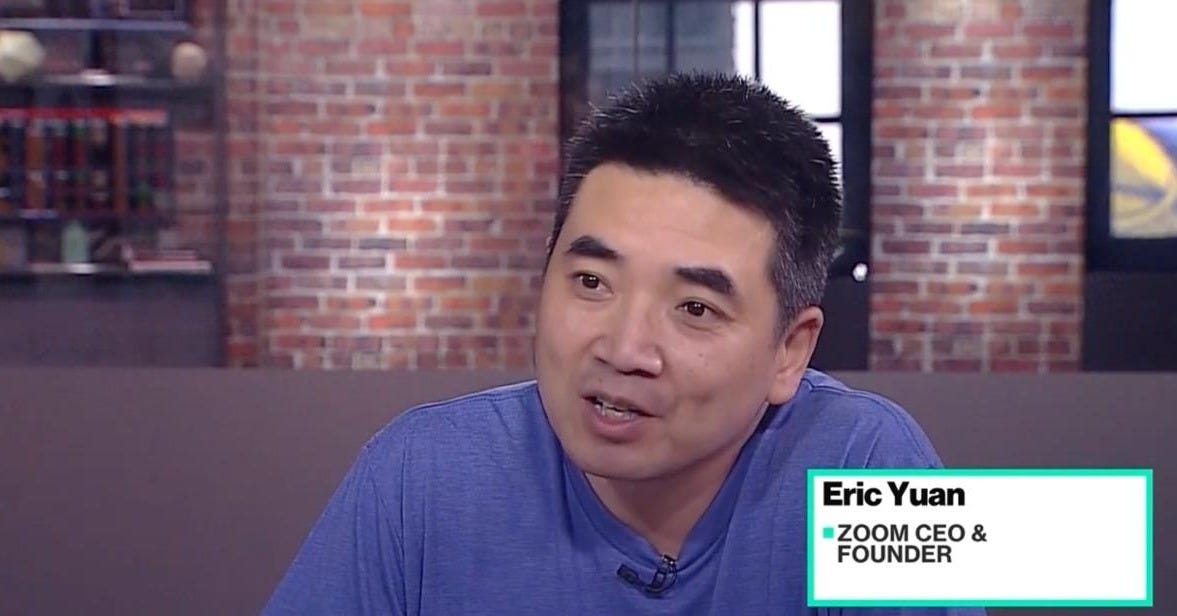
It’s 1997. A young engineer from Shandong Province in China sat in a drab U.S. consulate waiting room, clutching a stack of documents. Rain streaked the window like a thousand impatient fingers. The fluorescent light made everyone look tired. Eric Yuan sat perfectly still on a hard plastic chair, passport in his hands.
Attempt number nine.
Eight times over two years, American officials had stamped his dreams with a single word on his visa application: DENIED. Eight times he’d returned to his tiny apartment, the rejection notices pinned to the wall like a scoreboard. The internet boom was tearing through Silicon Valley, but for Eric, it’s a distant dream, blocked by bureaucratic walls. Bill Gates’s face smiled back at him from a dog‑eared magazine cover. He couldn’t forget Gates’s speech about the future of the internet. That was the America he needed to reach.
No one told him why he was being rejected. But in 1990s China, young professionals seeking U.S. work visas faced notoriously high rejection rates. “Hey, as long as you allow me to try,” he told himself, “even if I was refused entry 20 to 30 times, I would be willing to continue to try.”
On the ninth attempt, he was approved. He arrived in California at age 27 in 1997. “When I came here, I realized, wow, this is the first wave of the internet revolution,” he said later, though by then, the wave was already cresting.
He landed in Silicon Valley speaking little English with about $200 in his pocket. But he could write software. The language barrier shaped his career path. “I couldn’t join a marketing team or a sales team,” he explained. While he could follow conversations around him, he couldn’t participate in them. “I had to go back to writing code.”
Fourteen years later, Eric was vice president of Engineering at Cisco, overseeing the WebEx organization, the video conferencing startup he’d joined fresh off the plane. Users complained about clunky interfaces and dropped calls. Eric saw the same frustration in his wife’s face every time a call froze mid-sentence. He pitched a better system: simple, reliable, smartphone‑friendly. Cisco said no.
So Eric walked away, risking everything to start another company out of a tiny office. Forty engineers from Cisco followed him, betting on his vision.
The company is called Zoom.
Before Zoom became a verb, it was a visa application.
How Silicon Valley Actually Runs on Foreign Passports
Walk through the glass-walled corridors of OpenAI in San Francisco or Google’s Mountain View campus and listen to your surroundings. You’ll hear Mandarin in the break room, Hindi over lunch, and Cantonese by the espresso machine.
On paper, the United States still leads the world in tech. We have the largest companies, the biggest venture capital, the top AI research labs. Politicians boast of American dominance in artificial intelligence. But there’s a story they know well but don’t tell out loud.
This story starts with who’s doing the research. In 2022, China accounted for 47% of the world’s top AI researchers, a staggering leap from 29% just three years prior. The U.S., by comparison, is treading water at 18%.
But there is a “ghost share” in these numbers. Inside U.S. institutions, China-origin researchers make up 38% of top-tier talent, slightly more than the 37% who are U.S.-origin.
Read that again. The majority of cutting-edge AI research happening in the United States is being done by people America didn’t raise.
It’s not just in research. Immigrants are at the helm of America’s most influential tech companies. Look at the CEOs and top execs: Nvidia, the $4 trillion semiconductor giant powering the AI boom, was co-founded by Jensen Huang, who immigrated from Taiwan at age nine. Google is led by Sundar Pichai from India, Microsoft by Satya Nadella from India, Adobe by Shantanu Narayen from India, and IBM by Arvind Krishna from India.
These were once exceptions. Now, they’re the rule.
Most of America’s AI breakthroughs come from people America didn’t raise.
Sit with that.If that ghost share vanished tomorrow, what would the engineering team still ship?
Translate this into an everyday office scene. A Taiwanese engineer explaining a breakthrough to a colleague from Bangalore. Badges from everywhere.
There’s a viral joke making the rounds in Asia’s tech circles that captures the situation perfectly: “It’s Chinese people in China versus Chinese people in Silicon Valley.”
The growth engine of America is not White.
The Immigrant’s Grit: Hunger, Drive, and the “Triple Package”
So why do these stories repeat? Why are immigrants so uniquely dominant in America’s tech engine room?
It is not because immigrants are magically “better.” And it’s not because every immigrant shares the same psychology. Where local talent sees a career, an immigrant sees a bridge across a chasm. Fall and you lose everything.
Yale Law professor Amy Chua calls this the “Triple Package.” It’s a potent cocktail of cultural pride, a deep-seated insecurity, and a whole lot of impulse control.
In plain terms: You believe you’re capable. You know you’re not yet safe. And you are able to wait longer than anyone around you for the payoff.
Consider Fei-Fei Li. In the mid-1990s, as Eric Yuan was facing his eighth visa rejection, a teenage Fei-Fei Li was standing over a bin of clothes in her parents’ tiny dry cleaning shop in New Jersey. She spoke little English. The neon “Open” sign flickered off hours ago. Her middle-class family had uprooted from China for her to have better opportunities in life, only to face money problems and a mother in failing health.
Though financially strapped, her parents supported “that nerdy science-y kid,” encouraging her love of physics and math. She sorted laundry between calculus problems, homework spread on a folding table, dryers humming like white noise. She would head home well past midnight, then wake at dawn for school. Somehow, she kept getting straight As.
Then, a fat envelope with Princeton’s crest in the corner arrived at their house. She ripped it open. She was being offered a full scholarship. She read the letter twice. Three times. She couldn’t process it. She brought the letter to her school counselors and asked them to confirm it was real. They told her it was. Only then did she let herself cry.
Everything her parents sacrificed—the uprooting, the humiliation, the midnight shifts—suddenly had a reason.
You believe you’re capable. You know you’re not yet safe. And you can wait longer than anyone around you for the payoff.
That’s the “triple package” formula.
At Princeton, she found the emerging, dismissed field of artificial intelligence. She carried an outsider’s insight: to teach machines to see. After her PhD at Caltech, she dared a nearly impossible idea: ImageNet, a vast database to train vision algorithms.
For two years, she and a tiny team painstakingly crowdsourced and labeled 14+ million images. Many nights, she was the last person leaving the lab, eyes red from scanning pictures. “Being a scientist is about resilience,” she later said, “just as being an immigrant is about exploring the unknown.”
In 2009, ImageNet was released. For three years, almost nobody cared.
Then, in 2012, a neural network trained on her dataset crushed every previous record for computer vision. The “Big Bang” of deep learning had arrived. And her data was the fuel.
The girl from the dry cleaners had ignited the machine learning revolution. They now call her the “godmother of AI.”
In the Land of Plenty, Why America Forgot How to Wait
Fei-Fei Li’s hands still smelled of bleach when she opened that Princeton letter. A thousand miles southwest, in the hollows of Kentucky, another teenager’s hands were sticky with Golden Corral barbecue sauce.
Same nation. Same decade. Opposite worlds.
His name was J.D. Vance.
While Fei-Fei sorted laundry at midnight, JD Vance sat in a plastic booth watching his mother swipe a maxed-out credit card. In Middletown, Ohio, and the Kentucky hills where his family had roots, the avoidance of pain—emotional, physical, economic—had become the organizing principle of daily life.
“We spend our way into the poorhouse,” Vance would later write in Hillbilly Elegy. “We buy giant TVs and iPads. Our children wear nice clothes thanks to high-interest credit cards and payday loans. Thrift is inimical to our being.”

Christmas in Vance’s world wasn’t about saving. It was about the binge. Cheap toys piled under the tree, financed by payday loans, justified by a single mantra: We’ll pay it off with the tax refund. Buy now. Worry later. The debt would linger long after the ornaments were packed away, but for one morning, the hollow felt like plenty.
If the immigrant’s journey provides thrust, that gritty, delayed gratification which propels outsiders like Eric Yuan and Fei-Fei Li to the top of AI, then America’s homegrown culture is its mirror opposite: the relentless pursuit of pleasure. The running-from-pain at any cost.
The immigrant formula: I am capable. I am not yet safe. I must work harder.
The formula Vance describes: The system is rigged. My choices don’t matter. Might as well enjoy today.
Psychologists have a name for this: learned helplessness. “I believed, as I did during my youth, that the choices I made had no effect on the outcomes in my life,” Vance admits. Hard work wasn’t absent; people labored brutally, but it was reactive, not strategic. Neighbors scoffed at classmates who studied too hard. Who does he think he is? Small luxuries became the only reliable pleasure. The next meal. The next holiday. The next screen.
Vance eventually escaped, but not on his own.
One formula builds. The other consumes. Both are responses to uncertainty.
Which one did you learn growing up?
He joined the Marines. They broke him down and rebuilt him with something his culture had never provided: external discipline. “If I had learned helplessness at home,” he writes, “the Marines were teaching learned willfulness.” Pain became a teacher, not an enemy. Delayed gratification became possible. His choices began to matter.
He clawed through Ohio State while working multiple jobs. And then, against every statistical probability, he arrived at Yale Law School. There, the hillbilly needed a guide. Someone who understood both the mechanics of elite success and the psychological architecture that made it possible. He found one.
Her name was Amy Chua.
Yes. That Amy Chua. The “Tiger Mother” who had codified the “Triple Package” we just read about. The architect of immigrant psychology became the hillbilly’s mentor.
Under her tutelage, Vance learned what the immigrants already knew. He describes feeling like “an awestruck tourist” in the world of high achievement. It’s the same alienation Zoom’s Eric Yuan felt arriving in Silicon Valley with broken English. Vance had to reverse-engineer the mindset that others absorbed in childhood.
He had to become what he calls a “cultural emigrant.” He became someone who left one worldview for another without ever crossing a border. Then, in 2024, J.D. Vance walked onto a stage in Milwaukee and accepted the Republican nomination for vice president of the United States.

The architect of immigrant psychology became the hillbilly’s mentor.
Sometimes the map you need was drawn by someone from a completely different territory.
But Vance is the exception that proves the rule. For every hillbilly who makes it to Yale, a thousand stay in the hollow. They are scrolling, waiting, wondering why the American Dream passed them by.
The Grand Bargain
So here is the quiet truth that no politician will say aloud: America runs two operating systems at once: one that consumes, and another that builds.
Capitalism ensures this will always be a consuming society. The market gives people what they want, and what people want is pleasure without pain. Comfort without effort. Results without waiting.
Call them Engine A and Engine B.
Engine A is the Consumption Engine: dopamine-fueled, pain-averse, focused on health care that masks symptoms, education that prioritizes esteem over rigor, and entertainment that numbs. This engine serves the market. It prints money. It wins elections. It is what it is.
Engine B is the Build Engine: powered disproportionately by those on immigrant visas or with immigrant psychology, running on delayed gratification, insecurity turned into fuel, and a tolerance for the painful, lonely, red-eyed nights of building something that doesn’t exist yet.
Silicon Valley sits at the strange intersection where both engines fire at once. The same campus manufactures the infinite scroll and the technological breakthrough. The product serves Engine A. The engineers run Engine B.
This has always been the silent bargain of American capitalism. We outsource the grit. We import the delayed gratification. We borrow the hunger from foreign shores while our own culture chases the next dopamine hit.
As long as we’re clear-eyed about the arrangement, that’s a choice. Not a good one or a bad one. Just a choice.
And yet, we are breaking the system without a replacement.
Here is the bargain. America runs on a dual economy: one for consumption, one for building. We outsource the grit.
Can a country keep winning when the mindset it takes to build gets raised somewhere else?
The Stamp Turns Around
The stamp used to say APPROVED in the consulate waiting room. But lately, those stamps are coming down differently.
In August 2025, Terence Tao sat in his office at UCLA, reading an email that made no sense.
His National Science Foundation grant had been suspended. The funding that paid his graduate students, supported his summer research, and kept discovery running was now frozen.
Tao is not obscure. He is the “Mozart of Math,” the Fields Medal winner who was teaching older kids to count with number blocks when he was two years old. During a dinner party in Adelaide, his parents, immigrants from Hong Kong, found Tao, who was a toddler at the time, lecturing five-year-olds on arithmetic. By nine, he was doing university calculus. By 13, he was the youngest gold medalist in International Mathematical Olympiad history.
He came to America at 16 for a PhD at Princeton. At 24, he became the youngest tenured professor UCLA had ever hired. His algorithms made MRI scans 10 times faster. His work on prime numbers solved problems that had been open for a century.
And now his graduate students had no funding. Then, someone asked if he’d consider leaving the country.
A year earlier, the question would have been absurd. “I have roots here. I raised my family here.” He paused. “But these days, it’s hard to make predictions. This wasn’t even on the radar, and now every possibility has to be considered.”
Tao isn’t alone.
In the first half of 2025 alone, about 50 tenure-track scholars of Chinese descent left American universities for China. That’s in the top 900 of those who’d already left since 2010, and more than 70% in STEM.
The names read like an honors list of American science:
- Lin Wenbin: University of Chicago’s James Franck Professor of Chemistry, work contributing to a Nobel Prize. Early retirement. Now in Westlake University, Hangzhou.
- Jun Liu: Harvard statistician, global reputation. Now chair at Tsinghua. “Choosing to return now is driven by a love for education and scientific research,” he said.
- Alex Liu: PhD from Auburn, mosquito research. Couldn’t find opportunities in the U.S. Now in Shenzhen Bay Laboratory since 2023. Closer to family. Further away from frustration.
At a conference in Suzhou last May, Harvard immunologist Jonathan Kagan kept hearing the same thing from Chinese scientists: “We hope Trump is president for life. It is the best thing to happen to Chinese science.”
They weren’t joking. They were stating strategy.
A grant freeze is not just lost money. If the “Mozart of Math” can be paused, it sends a message.
And when your best people start hedging, you’ve already lost something.
American politics has turned research funding into weather. Sunny today, thunderstorms tomorrow. No forecast you can trust. China responded by doing something simpler: removing friction. New visa categories for young STEM talent. Priority housing. School placements for kids. Lab budgets without ceiling.
The math works like this: America spends 20 years training an elite PhD. Federal agencies fund her most productive decade. Then, the ground shifts. The grant freezes. The lab closes. And an offer arrives from Hangzhou with a number attached and no visa complications.
A Stanford analysis found that Chinese developers now account for 17% of downloads on Hugging Face, the main repository for open AI models, already slightly ahead of American developers. Alibaba’s Qwen family has surpassed Meta’s Llama as the most downloaded open-weight model on the platform.
Now of course, China’s biggest disadvantage in AI is hardware: restricted access to Nvidia chips, no advanced ASML lithography machines. Its biggest advantage is people. And that advantage was made in America, by American policy, through American instability.
Washington is building Beijing’s recruiting office with its own hands.

Before Zoom became a verb, it was a visa application. The next Zoom might file its paperwork in Shenzhen.