IMD business school for management and leadership courses

A 20-Minute Exercise That Names the Real Problem
Find out what’s really blocking your team from working together. In just 20 minutes, with one simple survey.
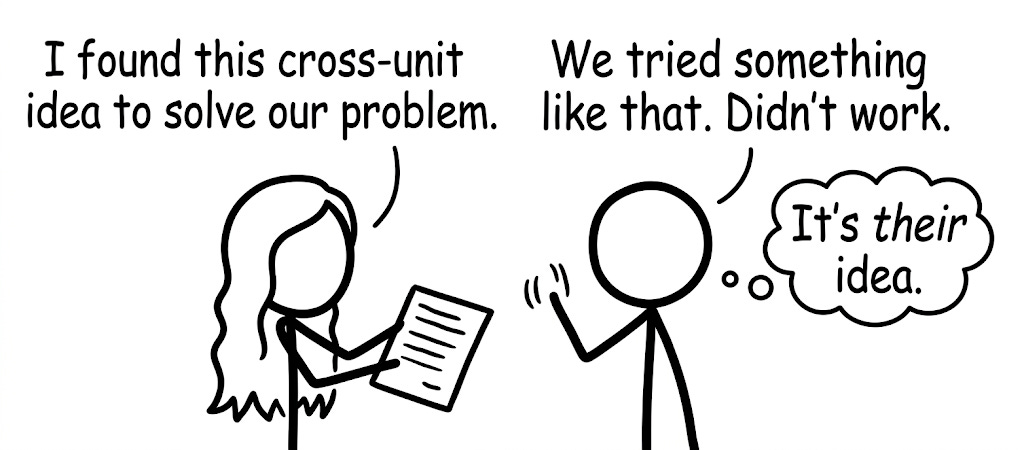
Ever walked out of a meeting thinking “why don’t we just talk to each other?” This guide won’t tell you to collaborate more. It’ll show you why you’re not.
What follows is a simple exercise that will reveal the hidden reasons your team isn’t collaborating well. It takes 20 minutes. No consultants, no special software, no corporate program. Just honest conversation and a one-page survey.
Where this comes from. The survey is based on the research of Morten Hansen, Dean of Apple University, who spent over a decade studying why collaboration fails inside organizations.
His book Collaboration identified four barriers that kill teamwork from within. I’ve simplified his diagnostic survey into a single-page exercise you can run with your team today.
No consultants, no software, no corporate program.
How to use this guide: Read Part 1 to understand the concepts (5 min read).
Then run the 20-minute exercise in Part 2 with your team.
You can share this entire page with your team, or just walk them through the exercise live.
Part 1: The Big Idea
There’s a simple and counterintuitive finding from Hansen’s research.
Bad collaboration is worse than no collaboration at all.
Most leaders, when told “we need to collaborate more,” do the obvious: more meetings, more committees, more shared Slack channels. This usually makes things worse.
The goal of collaboration is not to collaborate. It’s to get better results. And you can’t get better results until you understand what’s actually blocking people.
That’s what this survey does. It gives your team a shared language for naming the problem. And once you can name it, you can stop arguing about symptoms and start fixing root causes.
The Four Barriers (Quick Overview)
Hansen’s research identified four distinct barriers that prevent people from collaborating across teams and units. The first two are motivation problems — people won’t collaborate. The last two are ability problems — people can’t collaborate, even when they want to.
🚫 Barrier 1: Not-Invented-Here
What it means: People are unwilling to reach out to others for input or help.
You’ll recognize this when someone says: “We tried that already,” about something they never actually tried.
Why it happens: Hansen found this barrier typically stems from an insular culture where communication stays within the team; status gaps where higher-status groups won’t ask “lower” ones for help (and vice versa); a strong sense of self-reliance (”I should be able to solve this myself”); and fear that asking for help signals incompetence.
🔒 Barrier 2: Hoarding
What it means: People have valuable knowledge or expertise but won’t share it with others.
You’ll recognize this when the person who holds critical knowledge is also the person who’s “too busy” to join the cross-functional meeting.
Why it happens: Internal competition between units fighting for the same resources or recognition; narrow incentive systems that only reward your own unit’s output; people being simply too busy to help others even if they’d like to; and fear of losing power. If I’m the only one who knows this, I’m indispensable.
🔍 Barrier 3: Search Problems
What it means: People can’t find the information they need or the right person to talk to.
You’ll recognize this when a new hire asks “who should I talk to about X?” and gets three different answers.
Why it happens: As a company scales (the bigger the organization, the harder it is to know who knows what); physical distance between teams across geographies; information overload (too much information scattered across too many systems); and a lack of networks or channels that connect people across units.
🤝 Barrier 4: Transfer Problems
What it means: People find it difficult to work with unfamiliar colleagues to move knowledge across team boundaries, even after they’ve found each other.
You’ll recognize this when two teams technically “shared” knowledge but nothing actually changed in how either one works.
Why it happens: The most valuable knowledge is often tacit. It lives in people’s heads and is hard to put into words (think: how to close a tough sale, or how to find the right formula). Add to that teams who don’t share a common working culture or vocabulary, and weak personal ties that make trust-building slow. Then knowledge simply won’t transfer.
Part 2: Run the Exercise (20 Minutes)
What you’ll need:
- Your team (3–12 people)
- The survey below (printed or on screen for each person)
- Pens and a whiteboard or flip chart
- 20 minutes of uninterrupted time
- Willingness to be honest
1) ⏱ 2 min
Explain the Exercise
Hand out the survey. Tell your team:
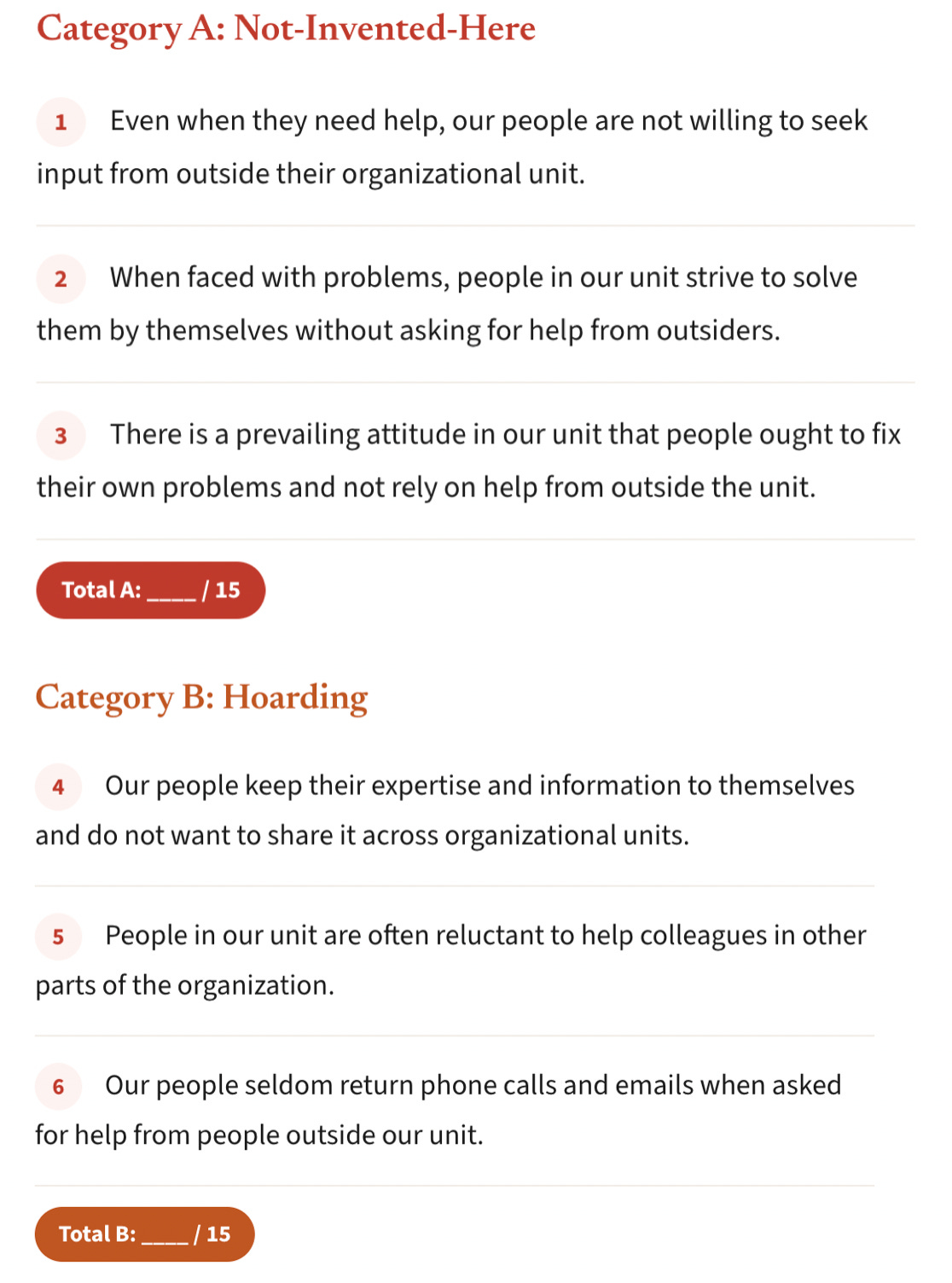
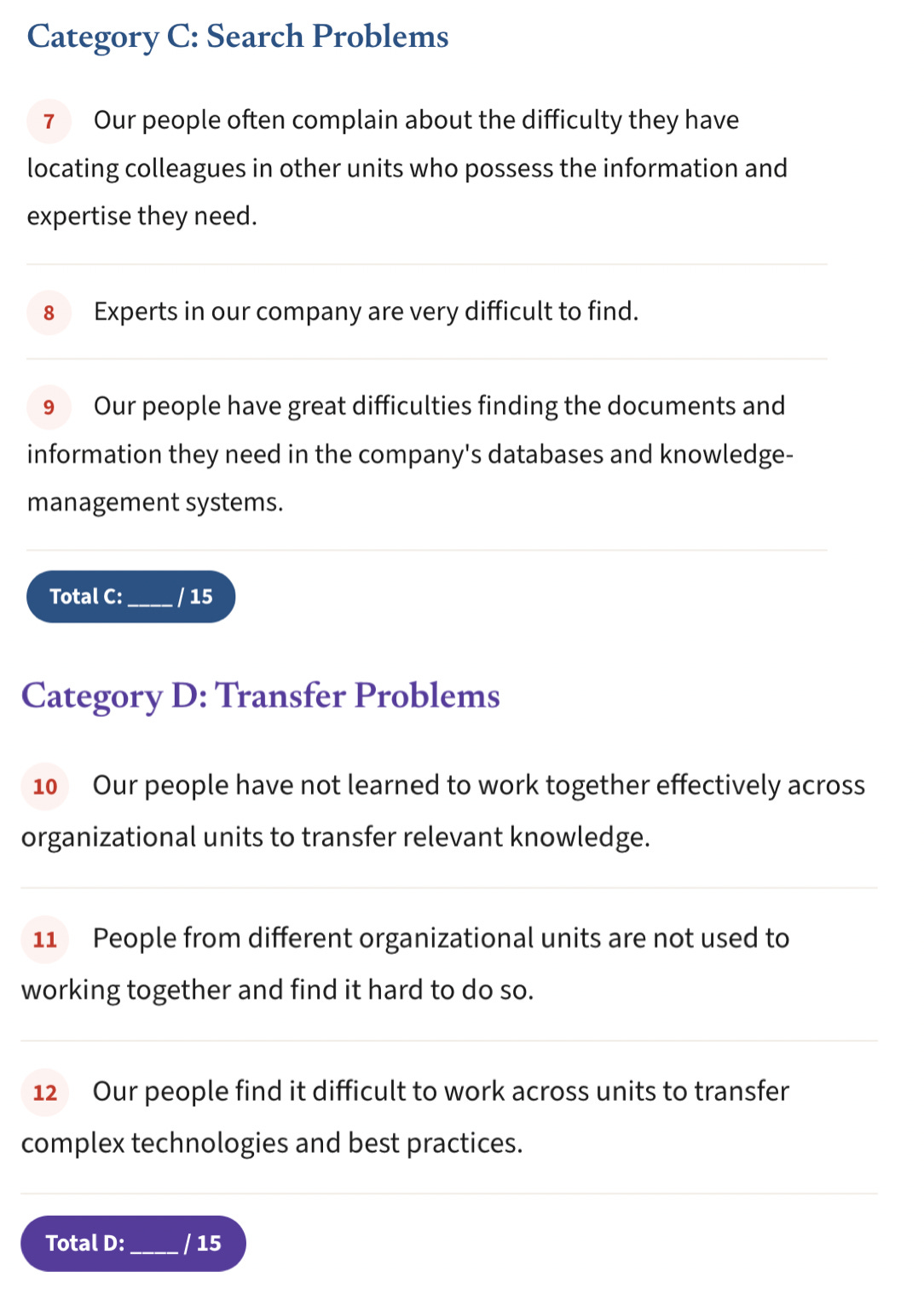
“We’re going to spend 20 minutes figuring out what’s actually making it hard for us to collaborate across teams. There are 12 statements, grouped into 4 categories. Rate each one from 1 (strongly disagree) to 5 (strongly agree). Then add up the three scores in each category to get a total out of 15. The higher the score, the bigger that barrier is for us. There are no right or wrong answers. Just be honest.”
2) ⏱ 5 min
Take the Survey, Silently
Each person rates the 12 statements individually. No talking. Let people think. Then they add up the three scores in each category.
Here is the survey:
Rate each statement from 1 (strongly disagree) to 5 (strongly agree). Add up the three scores in each category.
3) ⏱ 3 min
Share and Compare
Go around the room. Each person reads out their four category totals. Write them on a whiteboard in a simple grid.
Names down the left, four barriers across the top. You’ll see the pattern within 30 seconds. The column with the highest numbers is where your real problem lives.
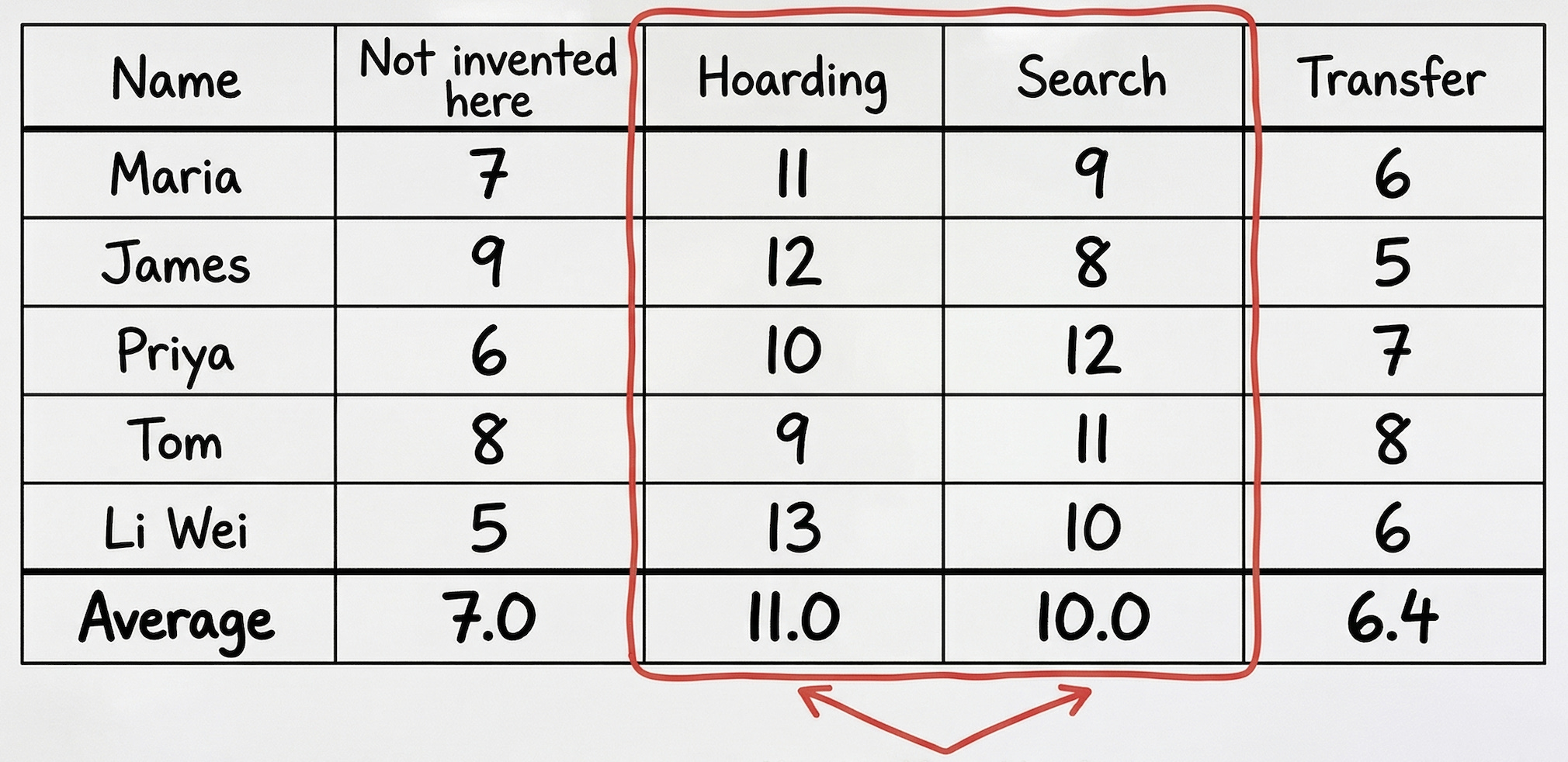
Circle the two highest-scoring categories. These are your team’s biggest collaboration pain points. Don’t debate the numbers yet. Just observe the pattern.
4) ⏱ 10 min
Discuss Your Top Two Barriers
Take your two highest-scoring categories and discuss them as a team. For each one, work through these three questions:
1. “Can someone share a recent example where this barrier actually hurt us?” Make it concrete. A specific project, a specific moment. Not abstract.
2. “Why does this keep happening?” Push past the first answer. If someone says “we’re too busy,” ask: Busy doing what? What gets in the way specifically? Is it our incentives? Our tools? Our geography? Our culture?
3. “What’s one small thing we could try this month to reduce this barrier?” Don’t try to solve everything. Pick one experiment. One concrete action. That’s enough to start.
Write that one action on a Post-it or in your team chat right now. Set a calendar reminder for 30 days. When it fires, ask: did we do it? That’s your accountability. No follow-up workshop needed.
That’s it! You’re done. In 20 minutes, you’ve named the barriers, shared real examples, identified root causes, and committed to one action.

That’s more than most teams ever do.
Facilitator tip: Don’t run this exercise the day after a conflict or a reorg announcement! You want people honest, not reactive.
A normal Tuesday works best. And if you’re the most senior person in the room, share your scores first. And make sure at least one of your categories is high.
That gives everyone else permission to be honest.