
At a glance
- HP launched Amplify Impact in 2021 to support its channel partners on their sustainability journey.
- The team overcame challenges including limited resources and tight timing to create a program that did not rely on financial incentives to engage channel partners.
- The program scaled globally, involving 4,800 partners and influencing billions in sustainability-driven sales.
In just 12 weeks and with limited resources, a small team of two at HP Inc., the American multinational information technology company, launched a global sustainability program for its vast network of channel partners. The goal? To encourage sustainability-driven sales and a systematic inclusion of sustainability in the strategies of HP’s partners, many of whom lacked the expertise or capacity to take on sustainability by themselves. The team faced a tough task: winning internal support across HP’s large, complex organization while also creating a program compelling enough to engage busy, commercially focused partners without offering direct financial incentives.
The broader issue
The influence of Gen Z in the workplace has pushed “purpose” to the forefront of discussions in business and in life. Younger generations want to help create a better world and for their work to matter. They are more socially conscious, seeking employers whose values align with their own and jobs that offer a sense of purpose.
Businesses increasingly recognize that long-term competitiveness depends on their ability to respond to global sustainability challenges. Awareness of environmental and social issues continues to grow around the world, yet turning that awareness into concrete and scalable action has been much harder. Many companies acknowledge the importance of acting, but the path forward is often unclear and the operational changes required can be complex. While some multinationals have set ambitious targets, progress across industries remains uneven, partly because organizations lack the skills and capacity needed to implement sustainability initiatives at scale. Research by the World Economic Forum and Kearney shows that 94% of companies do not have the workforce required to effectively carry out their environmental, social and governance (ESG) agendas. To close this gap and advance toward 2030 goals, as many as 150 million workers may need training in sustainability-related skills.
HP Amplify Impact program
Integrating sustainable impact into the value chain
HP aims to become the world’s most sustainable and just technology company by 2030; a bold vision anchored in the conviction that doing good is both ethically right and good for business. This is no mere rhetoric but driven by the beliefs of its founders, Bill Hewlett and Dave Packard, who said, “The betterment of our society is not a job to be left to a few. It is a responsibility to be shared by all” – a reflection of the need for collective action and foundational for the company’s philosophy, The HP Way. To achieve this, the company announced ambitious and comprehensive goals to integrate sustainable impact through every aspect of its business and ecosystem, in the three areas where it can do the most good: climate action, human rights and digital equity, and community impact. But HP cannot achieve this vision alone; a significant share of HP’s revenue is driven by channel partners, so meaningful progress will require many actors working together. Although HP’s larger channel partners often have the means to build dedicated sustainability teams and strategies, smaller partners do not have the same resources.
“Our goal is to educate, support and empower HP partners in their sustainability journey, to maximize their sustainable business, help drive a more circular and low-carbon economy, cultivate a more diverse, inclusive and equitable company culture and improve the vitality and resilience of local communities.”— Isabella Phoenix
A challenging brief
In the fall of 2020, the CEO asked for a global program to support channel partners on their sustainability journey. The path to success was anything but straightforward. A team of two led by Isabella Phoenix, the head of HP global channel partner programs, was given 12 weeks and a limited budget to design and launch the program. Although the CEO backed the initiative, the team had to rally support across the organization by aligning stakeholders, navigating priorities and making sustainability matter to a time-strapped, results-driven salesforce. They also had to create a program compelling enough to capture the attention of external business partners who had little time, limited capacity and no financial incentive to participate. Although interest in sustainability was high, participation in the program would require partners to invest additional time and resources.
Leveraging resources
The small team sought support from across the organization, collaborating with over 50 colleagues and partnering with HP University to adapt and repurpose training content specifically for channel partners.
External partners played a crucial role. When internal capabilities were unavailable, the team sought out experts from outside. To help partners track their carbon footprint, they collaborated with SWEEP, a start-up offering a sustainability data platform to collect and report carbon data in a centralized, standardized and digital format. To support partners with their diversity, equity and inclusion (DEI) work, they partnered with Blue Door, a specialist creative agency.
A simple and scalable design
The program was designed to be as simple as possible. Partners began by signing the HP Amplify Impact pledge, committing to work with HP toward specific sustainability goals. Each partner then completed a self-assessment to evaluate their current sustainability practices. HP analyzed the results, benchmarking each partner’s performance against industry peers and providing a customized report that highlighted strengths and areas for improvement. Based on these insights, HP offered personalized recommendations, empowering partners to track and report on sustainable business opportunities over time. In addition, Amplify Impact participants were given access to HP’s extensive resources, such as educational material and sales and marketing tools.
Securing internal buy-in
The team developed targeted motivation plans – often tied to performance review and bonuses – for stakeholders including the CEO, board, senior executives, program managers and sales representatives. At the executive level, Amplify Impact metrics were integrated into the board’s Management by Objectives (MBO) to align them with key performance indicators. At the country level, local influencers were identified and empowered to act as program champions. This brought them global visibility and recognition, a powerful motivator.
Ensuring partner engagement
The team understood that to engage partners meaningfully they needed to clearly communicate the benefits of the program and its impact on the business. Amplify Impact did not offer financial incentives. Instead, it had to show that sustainability was both the right thing to do and good for business. Partners’ sales teams were encouraged to use the HP Amplify Impact platform to log how much of their new commercial business was driven by sustainability.
“We are very proud to work with HP on important and exciting sustainability initiatives. These actions will help us to achieve a better future for generations to come.”— Partner’s testimonial
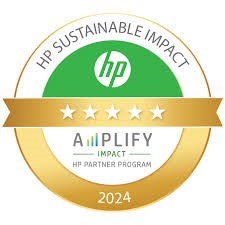
To further motivate engagement, a badge system was introduced. Partners could earn one to five stars based on the sustainability goals they achieved. As partners began to recognize the business value of higher levels of recognition, striving for more stars became a key motivator.
Each year HP highlights top-performing partners at its Amplify Impact partner conference, celebrating those leading with purpose rather than simply meeting requirements. HP also launched Amplify Impact awards, offering partners internal recognition and public, marketable proof of their achievements.
Did it work?
The first phase of the Amplify Impact partner program was launched in early 2021 across a small number of selected countries. More than 1,400 HP Amplify Impact pledges were signed in pilot countries in the first year, representing 20% of HP’s partners and exceeding the target of 10%. HP estimated that US$3.5 billion of its new sales in fiscal year 2021 were influenced by sustainability initiatives, a significant increase from the previous year, and the company named the Amplify Impact program as a key driver of this success.
The following year, HP expanded the program to 24 new countries and witnessed significant growth. In early 2025 HP announced that the Amplify Impact program had surpassed its enrollment targets, reaching 59% of channel partners in 43 participating countries, ahead of the goal of 50% set for 2025. Over four years HP’s sustainability score increased from 28% to 44% and participating partners reported a 70% increase in win rates, resulting in a twofold increase in sustainability-driven sales.
Takeaways
Keep it simple: HP’s Amplify Impact program’s design was intentionally straightforward, making participation easy. Data collection and management were seamless, enabling a simple but scalable approach.
Leverage collaboration and existing resources: A core team of only two people mobilized support from many colleagues across the organization. They repurposed existing training materials and avoided “reinventing the wheel.”
Incentivize internal stakeholders: Connecting sustainability performance to incentives and recognition within the sales organization helped embed sustainability into day-to-day business priorities.
Link sustainability to business results: A clear case was made to partners that investing in sustainability would directly support business growth, turning sustainability into a commercial opportunity rather than an exercise in compliance.
Provide tangible advantages for partners: Participating partners gained access to valuable data, practical tools and resources to support their sustainability journeys.
Recognition: Celebrating achievements with awards helped maintain momentum and provide recognition.
This article is based on IMD cases IMD-2681 and IMD-2695 available from The Case Centre at http://www.thecasecentre.org.









Research Information & Knowledge Hub for additional information on IMD publications
Research Information & Knowledge Hub for additional information on IMD publications
Research Information & Knowledge Hub for additional information on IMD publications
Research Information & Knowledge Hub for additional information on IMD publications
Research Information & Knowledge Hub for additional information on IMD publications
Research Information & Knowledge Hub for additional information on IMD publications
Research Information & Knowledge Hub for additional information on IMD publications
Research Information & Knowledge Hub for additional information on IMD publications
Research Information & Knowledge Hub for additional information on IMD publications
Research Information & Knowledge Hub for additional information on IMD publications