
At first glance, it seems obvious that brain drain is a significant cost to emerging economies. However, some academic observers (e.g., Mountford, 1997; Beine, Docquier and Rapoport, 2001) have argued that brain drain is beneficial. They posit that the possibility of migration encourages investment in education because of the potential high returns abroad from educated migrants. Arguably, brain drain can thus eventually increase income equality in the country of origin.
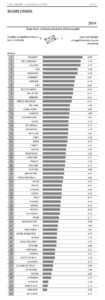
Our unique competitiveness data, however, enlighten this picture. In some countries there seems to be a correlation between their position in the overall competitiveness ranking and their ranks in the brain drain indicator. The USA ranks 1st in the overall ranking and 4th in brain drain, Switzerland 2nd and Germany 6th in both rankings. In the mid rankings, Australia reaches the 17th spot and the 18th respectively. Elsewhere, South Africa ranks 52nd in the competitiveness ranking and 51st in brain drain.
It is necessary to consider that any given criterion does not function in a vacuum. There are several other variables that impact outcomes. For example, attracting highly skilled foreign labour may compensate for the decline of home-grown human capital.
The data thus suggests that one of the greatest challenges that countries face to maintain or advance their competitiveness levels is to ensure a flowing and sustainable human capital accumulation. The challenge is not only to invest and develop local talent but also to provide opportunities for that talent to realize its full potential and to continuously improve the set of skills available. In addition, the data shows that, ultimately, countries that accumulate their home-grown human capital with a balanced intake of overseas talent are able to achieve higher levels of competitiveness. In this sense, brain drain seems to deprive countries of the necessary human capital which would enable them to safeguard their competitiveness.









Research Information & Knowledge Hub for additional information on IMD publications
Research Information & Knowledge Hub for additional information on IMD publications
Research Information & Knowledge Hub for additional information on IMD publications
Research Information & Knowledge Hub for additional information on IMD publications
Research Information & Knowledge Hub for additional information on IMD publications
Research Information & Knowledge Hub for additional information on IMD publications
Research Information & Knowledge Hub for additional information on IMD publications
Research Information & Knowledge Hub for additional information on IMD publications
Research Information & Knowledge Hub for additional information on IMD publications
Research Information & Knowledge Hub for additional information on IMD publications