IMD business school for management and leadership courses

Technology, Finance and Automotive
Released on 19 May 2026
Future Readiness Indicator 2026
Technology, Finance and Automotive
Released on 19 May 2026
Future-ready companies: in volatile markets, strategic breadth beats single track execution
- Nvidia, Microsoft, Alphabet, and Apple dominate the tech sector; their strategic decisions set its cost of capital, compute supply, and regulatory agenda.
- Mastercard, DBS and Visa, are finance’s most future-ready companies. Visa and Mastercard’s trusted infrastructure and reputation has allowed them to expand into new fee streams driven by agentic commerce and tokenization. DBS’s sustained investment in AI has demonstrated tangible economic value, estimated at over S$1 billion ($785 million) in 2025.
- Tesla, BYD, and Geely are leaders in an auto industry that is transforming into a technology-driven platform industry, where software, AI, batteries, and manufacturing systems are becoming as important as the vehicles themselves.
Lausanne, Switzerland, Tuesday, 19 May 2026 – The ability to move towards asset-heavy models and control value chains now determines which companies will lead in an era of high tariffs, geopolitical tensions, and AI disruption.
“One thing you can’t miss is vertical integration. Historically companies won by being asset-light, but today it’s by being asset-heavy,” said Howard Yu, Director of the IMD Center for Future Readiness. “The top companies have realized that outsourcing the fastest-moving parts of the technology curve now costs more than owning them.”
The 2026 Future Readiness Indicator measures how 49 technology companies, 39 financial services companies, and 27 automotive companies, stack up against a fragmenting world order, shifting power dynamics, increased innovation, and trade barriers.
Future readiness by sector
Technology
The Future Readiness Indicator 2026 reveals a reordering of the global tech sector. Technology is no longer driven by product cycles but increasingly by infrastructure dominance: the asset-light model is receding; it is now simultaneously an infrastructure, capital and geopolitical business, and it is not going back.
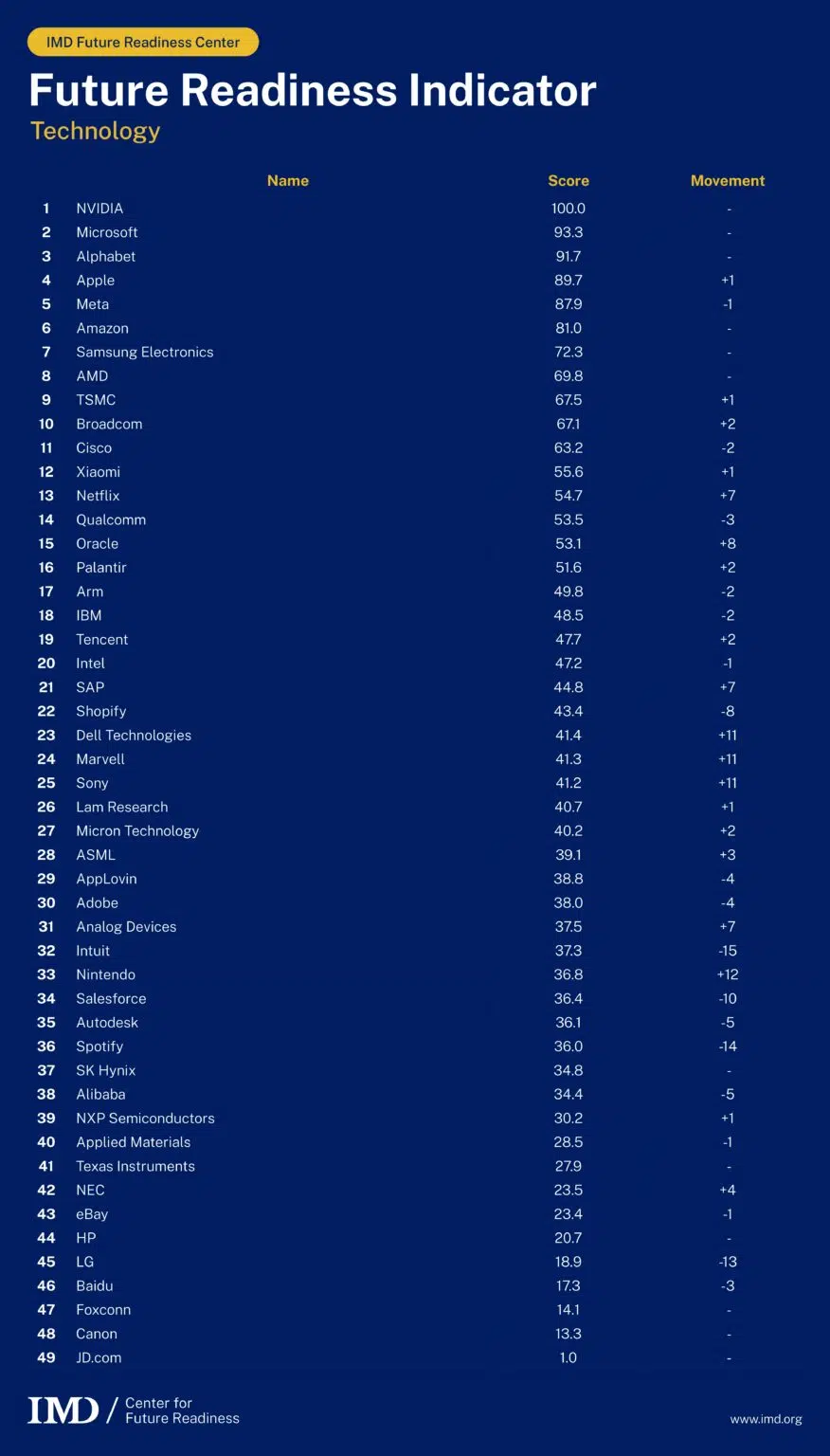
- Nvidia (100.0), Microsoft (93.3), Alphabet (91.7) and Apple (89.7) are the top four ranked tech companies. The score spread from Apple to Nvidia reveals how Nvidia defines the supply curve, while Apple lags on the demand side.
- Meta and Amazon top the second cluster at positions fifth and sixth, respectively, followed by Samsung in seventh place for the second consecutive year. Meta and Amazon have powerful AI flywheels, but they act as disciplined deployers of capital, rather than setting the pace for it. While Meta’s capital expenditures are predicted to exceed Alphabet’s (ranked third overall) in absolute terms in 2026, its business model, unlike Alphabet’s, remains anchored in advertising rather than the development of core infrastructure.
- AMD, TSMC and Broadcom, all major players in the global semiconductor industry, complete the top ten positions, with little movement amongst these companies since 2024.
Financial Services
AI agents are no longer just comparing products; they are buying them too. Software has dissolved banks’ monopoly on moving money. The era of one dominant rail (SWIFT) for international payments is over. The companies that top the Future Readiness Indicator 2026 for Finance are those trusted by regulators to enter new product categories and that have the business models to do so. Meaningful investment in AI is also translating into economic value for market leaders.
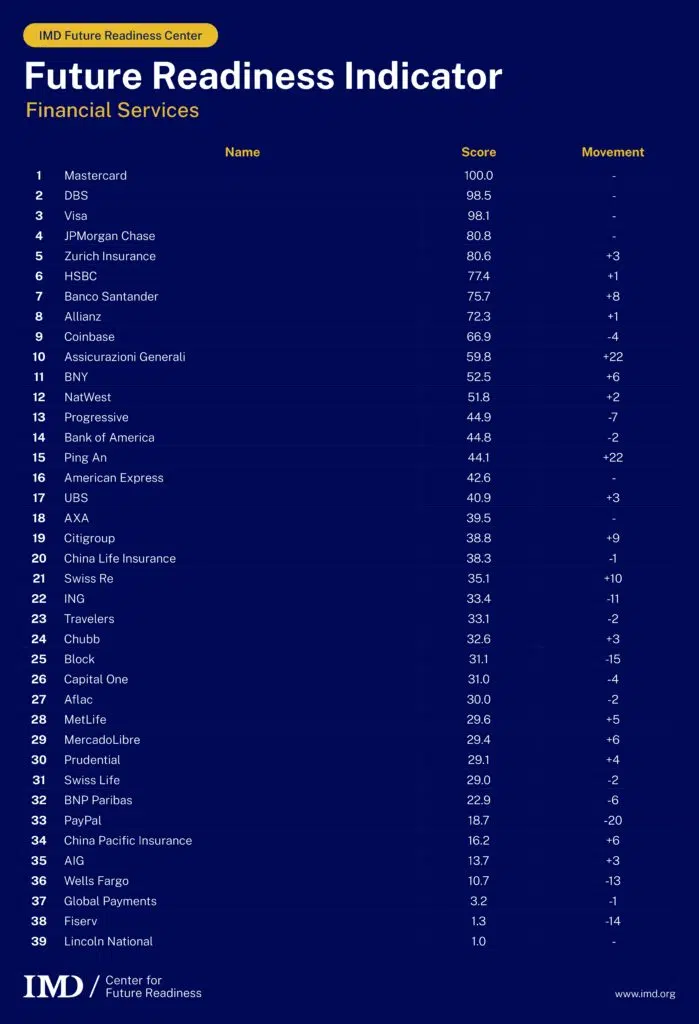
- Mastercard stays on top (100.0), its success driven by its nimble business model and its trusted reputation, which has allowed it to quickly add two new fee streams. Through Mastercard Agent Pay it now clears OpenAI Instant Checkout transactions, and with its announced intent to acquire BVNK, it is positioning to own stablecoin rails end-to-end. Fellow payment network giant Visa (98.1) also continues to lead (third), responding to the era of AI agent buying by launching Trusted Agent Protocol.
- Southeast Asia’s most digitally advanced bank, DBS (98.5), holds firm in second place. Its massive investment in AI has demonstrated tangible economic value, estimated at over $1 billion in 2025. Its return on equity stayed above 17 percent, well above the global banking average.
- Universal banking franchises JPMorgan Chase, HSBC, and Banco Santander all feature in the top ten, by holding or improving on different axis including AI expenditure, restructuring, and digital execution.
- Insurance giants Zurich and Allianz are also amongst the most future-ready finance companies. Zurich’s climate-adjusted underwriting saw it limit its exposure to the Californian wildfires to just $200 million, a fraction of what many other insurers reported.
- Coinbase, the secure online platform for buying, selling, transferring, and storing cryptocurrency, looks set to maintain its future-ready title. The signing of the GENIUS Act into law in July 2025 was a watershed moment for the company, significantly impacting its revenue model and legal standing.
Automotive
The Future Readiness Indicator 2026 reveals an auto industry defined by transition and fragmentation, splitting along regional lines, pursuing divergent strategies, and advancing toward electrification at markedly different speeds depending on the market
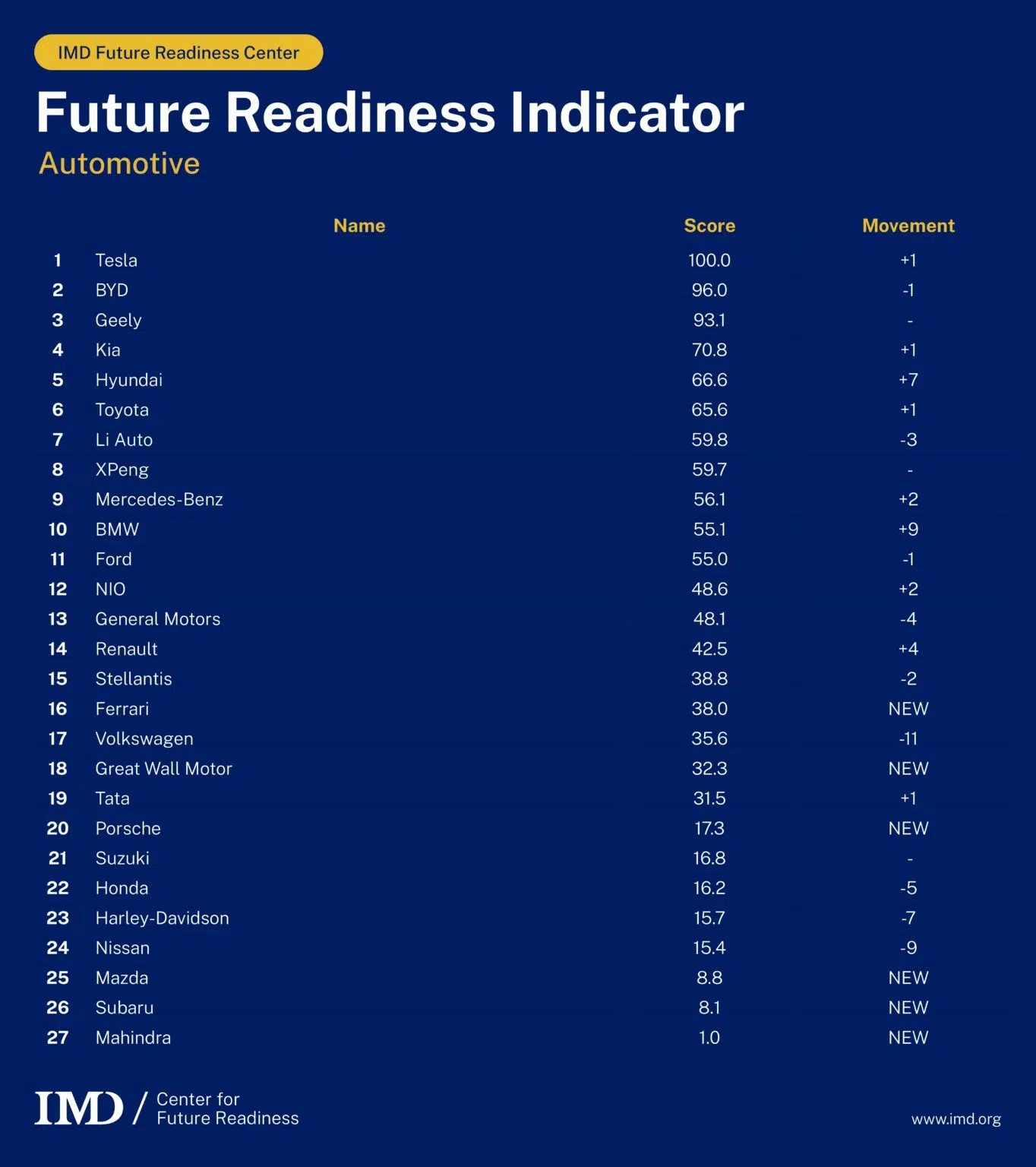
- Tesla takes first place in 2026 with a perfect 100.0 score, moving ahead of BYD in the ranking. It leads on energy storage, AI talent, and manufacturing simplicity.
- In second position, BYD (96.0) remains hot on Tesla’s heels. BYD delivered a stellar performance in overtaking Tesla in battery-electric vehicles (BEV) sales. It leads on cost, vertical integration, charging infrastructure, and global factory footprint.
- Geely (93.1), third in the ranking for the second consecutive year, leads on portfolio orchestration.
- Kia and Hyundai, ranked fourth and fifth respectively, are also influential Asian players in the global electrification race. Hyundai’s rise is notable, moving up from 12th position in 2025.
- Sixth placed Toyota continues to dominate in hybrid sales, as it inched up one position in this ranking. It sold a record of over 11 million units in 2025, with hybrids being the dominant powertrain in its largest markets.
REPORT
Future Readiness Indicator report: The Great Reintegration: Why integrated companies keep winning when the world fragments
The Future Readiness Indicator report takes a deep dive into the data and highlights how technology, financial services, and auto companies have performed in this year’s indicator. The report looks at the forces transforming these sectors in 2026 and offers insights into what companies can do to prepare. It also takes an in-depth look at which companies are leading the pack and those that are falling behind.
Read the full 2026 report here: https://www.imd.org/future-readiness-indicator/home/