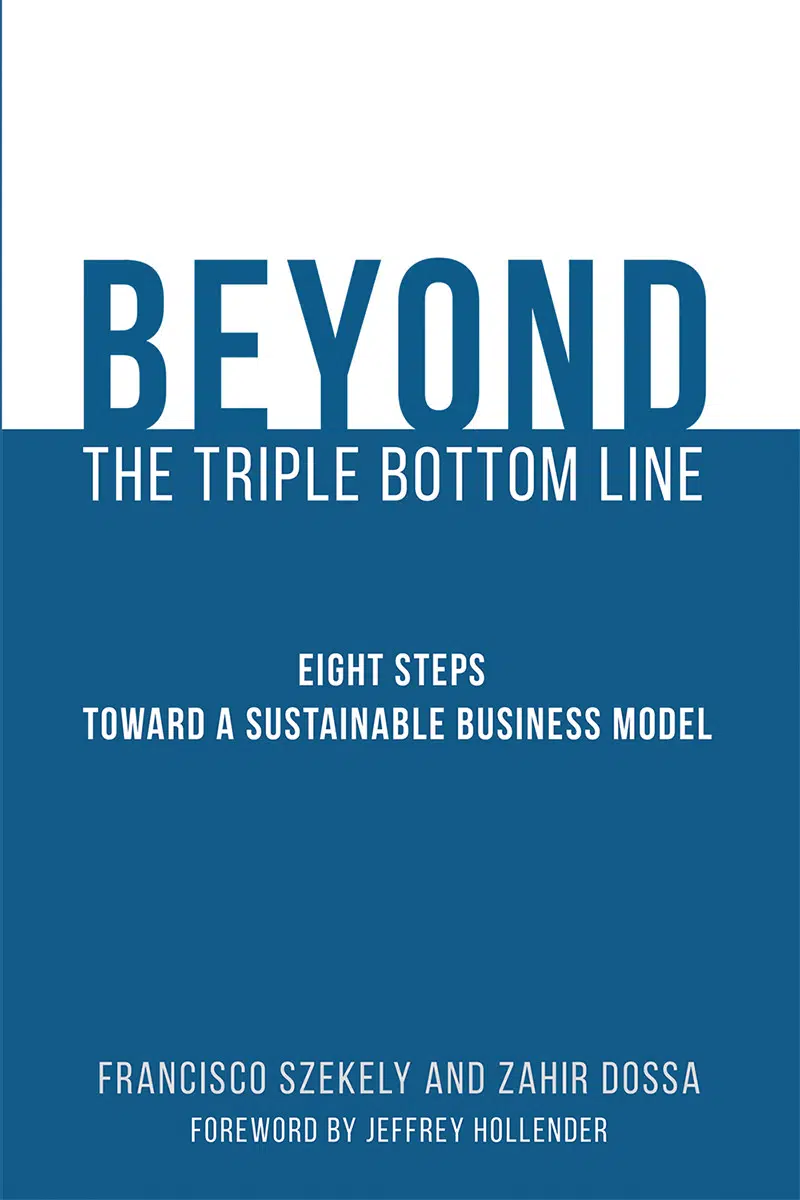
Many recent books make the case for businesses to become more sustainable, but few explain the specifics. In this book, Francisco Szekely and Zahir Dossa offer a pragmatic new business model for sustainability that extends beyond the traditional framework of the triple bottom line, describing eight steps that range from exploring a vision and establishing a strategy to implementing the strategy and promoting innovation.
Szekely and Dossa argue that businesses and organizations need to move away from the business case for sustainability toward a sustainable business model. That is, businesses should go beyond the usual short-term focus on minimizing harm while maximizing profits. Instead, businesses on the path to sustainability should, from the start, focus on addressing a societal need and view profitability not as an end but as a means to support the sustainable organization.
Szekely and Dossa explore key problems organizations face when pursuing a sustainability agenda. Each chapter presents one of the eight steps, describes a business dilemma for sustainability, provides a theoretically grounded strategic framework, offers case studies that illustrate the dilemma, and summarizes key findings; the case studies draw on the experiences of such companies as Tesla Motors, Patagonia, TOMs, and Panera. The book emphasizes leadership, arguing that leaders who question the status quo, inspire others, and take risks are essential for achieving sustainable business practices.
Category: Sustainability
Bronze medal









Research Information & Knowledge Hub for additional information on IMD publications
Research Information & Knowledge Hub for additional information on IMD publications
Research Information & Knowledge Hub for additional information on IMD publications
Research Information & Knowledge Hub for additional information on IMD publications
Research Information & Knowledge Hub for additional information on IMD publications
Research Information & Knowledge Hub for additional information on IMD publications
Research Information & Knowledge Hub for additional information on IMD publications
Research Information & Knowledge Hub for additional information on IMD publications
Research Information & Knowledge Hub for additional information on IMD publications
Research Information & Knowledge Hub for additional information on IMD publications