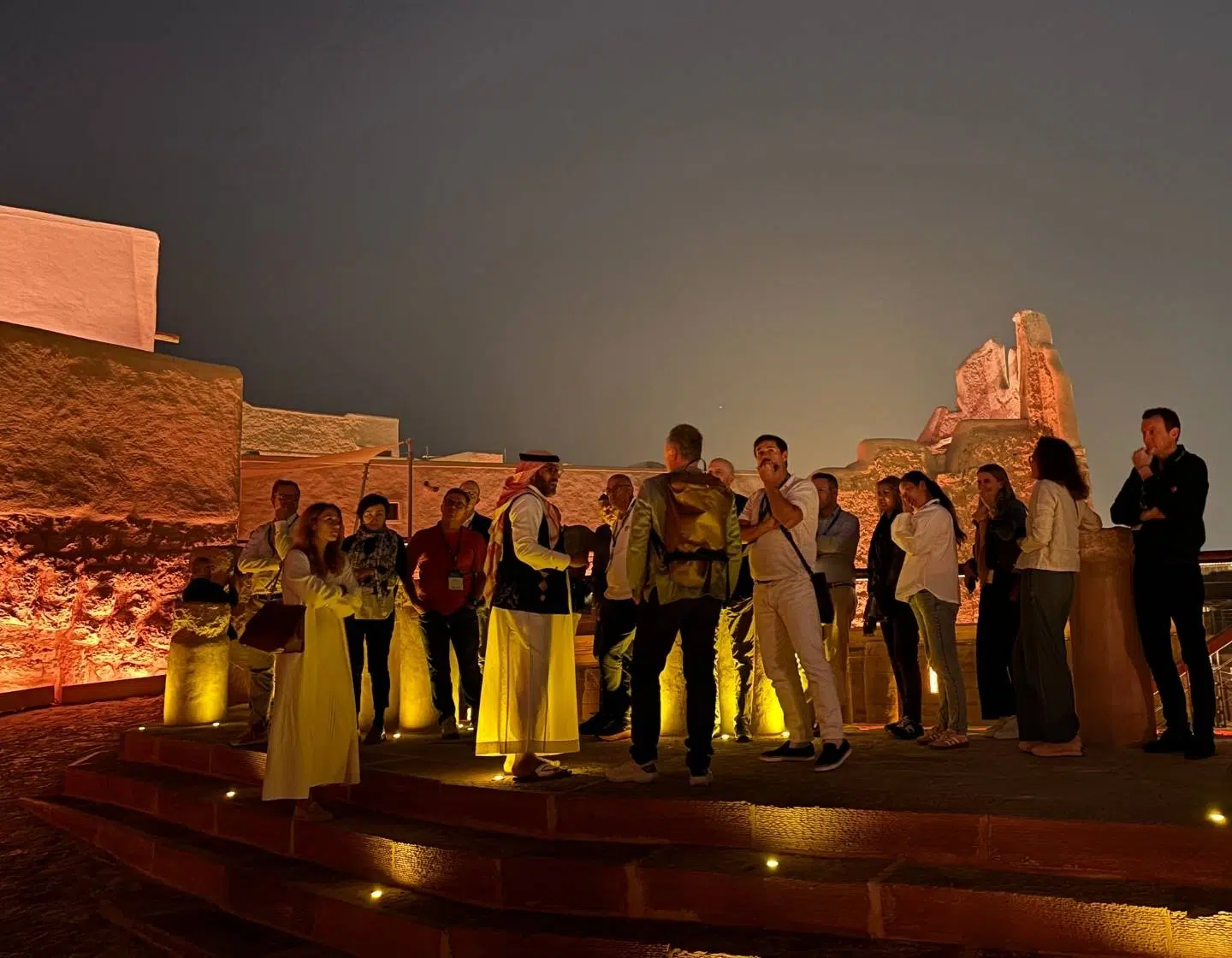
More than 30 IMD alumni and alumni team members traveled to Riyadh for the latest IMD Alumni Association Discovery Days and took a deep dive into the workings of the multi-billion-dollar Saudi Arabia Vision 2030 transformation.
The event was co-chaired by Hend Al Rumaithi, Senior Director at Emirates National Oil Company Group (ENOC), IMD EMBA, IMD Alumni Association board member and Adel Baraja, who is a former deputy minister of investment promotion and current CEO of Publicis Communications KSA, IMD EMBA and Alumni Club president of Saudi Arabia.
The sessions and visits offered participants direct access to government officials and private sector leaders, as well as infrastructure project executives, startups, and heritage sites.
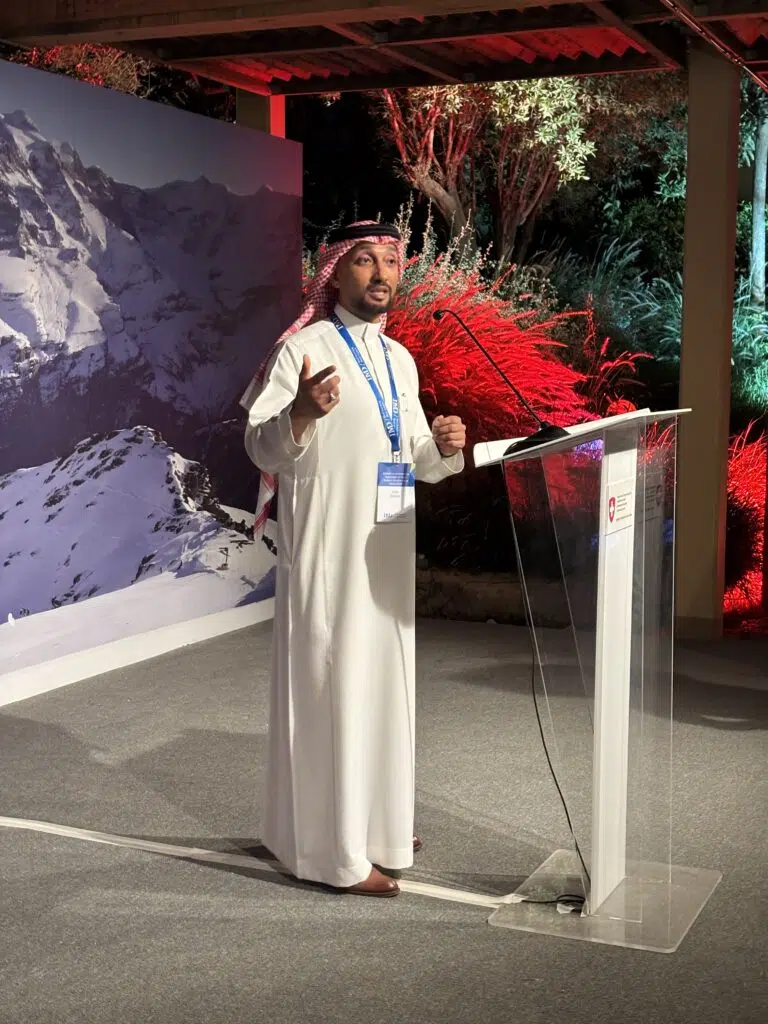
The three-day program revealed both the scale of Saudi Arabia’s economic restructuring and the complexity of executing such fundamental nationwide change. Participants heard how leaders in Saudi Arabia are working across three Vision 2030 themes – a vibrant society, a thriving economy, and an ambitious nation – aligning government policy, private capital, and infrastructure investment to achieve its diversification targets by 2030.
“The most impressive part is not the investment scale but the alignment: government, private sector, youth foundations, startups, airlines, fintech, AI companies, heritage projects… all moving in the same direction with clarity and discipline.”– Ashraf Kordy, IMD EMBA alumnus
The structural shift in progress
Hans-Peter Huber, Chief Investment Officer at Riyad Capital, presented data showing Saudi Arabia’s evolution from oil dependency toward a more diversified economic base.
Between 2010 and 2025, Saudi Arabia’s non-oil activities surged from 42% to 56% of real GDP while oil declined from 38% to 27%. The shift accelerated post-2016, driven by non-oil sector growth of 5.8% annually versus oil’s 1.4%. Reaching the Vision 2030 target of 65% requires closing a nine-percentage-point gap.
Government debt remains manageable at 25% of GDP, and Saudi Arabia maintains net creditor status with investments in international assets exceeding 60% of GDP. This should provide fiscal capacity for continued investment, subject to oil price stability.
“Saudi’s transformation is not only economic; it’s structural, cultural, and generational.”– Luis Checa, IMD EMBA alumnus
Since 2017, the economy has generated 2.7 million new jobs for Saudi nationals and 4.5 million positions for expatriates since 2021. Female workforce participation represents 34% of Saudi workers. The Kingdom also benefits from a demographic advantage over some developed economies, with an average age of 25.4 years for Saudi nationals and 33.9 years for non-Saudis.
Primary drivers of non-oil growth
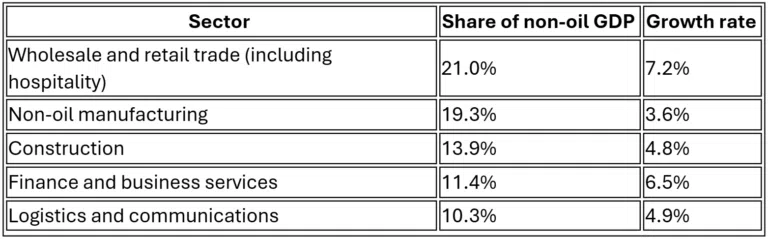
Giga-projects and FDI
Alumni were briefed on the current and planned capex on giga-projects amounting to approximately $120bn to boost non-oil growth and provide employment and housing, including:
- NEOM, a new city covering 26,500km2
- Red Sea and Amaala Project of 90 islands and 50 hotels for tourism covering 37,000km2
- Qiddiya – a 360km2 sport and leisure complex of theme parks, an F1 venue, and an international stadium
- Roshn – a 200 km2 mixed-use residential project of 400,000 homes as part of ambitions to boost home ownership
Special Economic Zones, designed in part to attract foreign direct investment (FDI), also form part of Vision 2030, and offer a rate of 5% corporate income tax for 20 years and zero withholding tax on profit repatriation. FDI currently stands at 2.5% of GDP against a Vision 2030 target of 5.7%.
Realizing potential and maintaining momentum
Sessions with Thamer Al Ghamdi of HUMAIN on AI infrastructure, Mody Alkhalaf of Riyadh Air on aviation strategy, and ALJohara ALMandli of Jeel on fintech innovation all demonstrated Saudi Arabia’s commitment to building its own broad technological capability. Participants also visited The Garage, a startup hub and incubator for early-stage and growth-stage startups offering corporate matching capability.
The implementation challenge
Saudi Arabia’s progress from 42% non-oil GDP in 2010 to 56% in 2025 is a solid track record and is a good indication that the country and its partners have delivered what they promised and seem to be on track to close the nine percent gap to reach the 65% of non-oil GDP target by 2030.
However, developing the capabilities to deliver this ambition at the required pace and scale requires the ability to attract and retain technical talent in a highly competitive global market.
Alumni also heard that part of bringing Vision 2030 to reality is Expo 2030 Riyadh, which is building and operating the facilities of this world-class expo site. According to Thamir Alsadoun, deputy CEO, the project spans six million square meters, integrates with Riyadh’s urban fabric, and is built with legacy at its core. Once the expo has finished in 2030, it will transform into a global village that will serve the local and global community over the long term.
For business leaders, this transformation demonstrates how strategic alignment and institutional coordination can drive rapid and sustainable large-scale economic and cultural change. Thanks also to the Swiss Ambassador to the Kingdom of Saudi Arabia, Yasmine Chatila Zwahlen, for hosting the IMD Alumni at the Swiss Embassy in Riyadh during the visit.