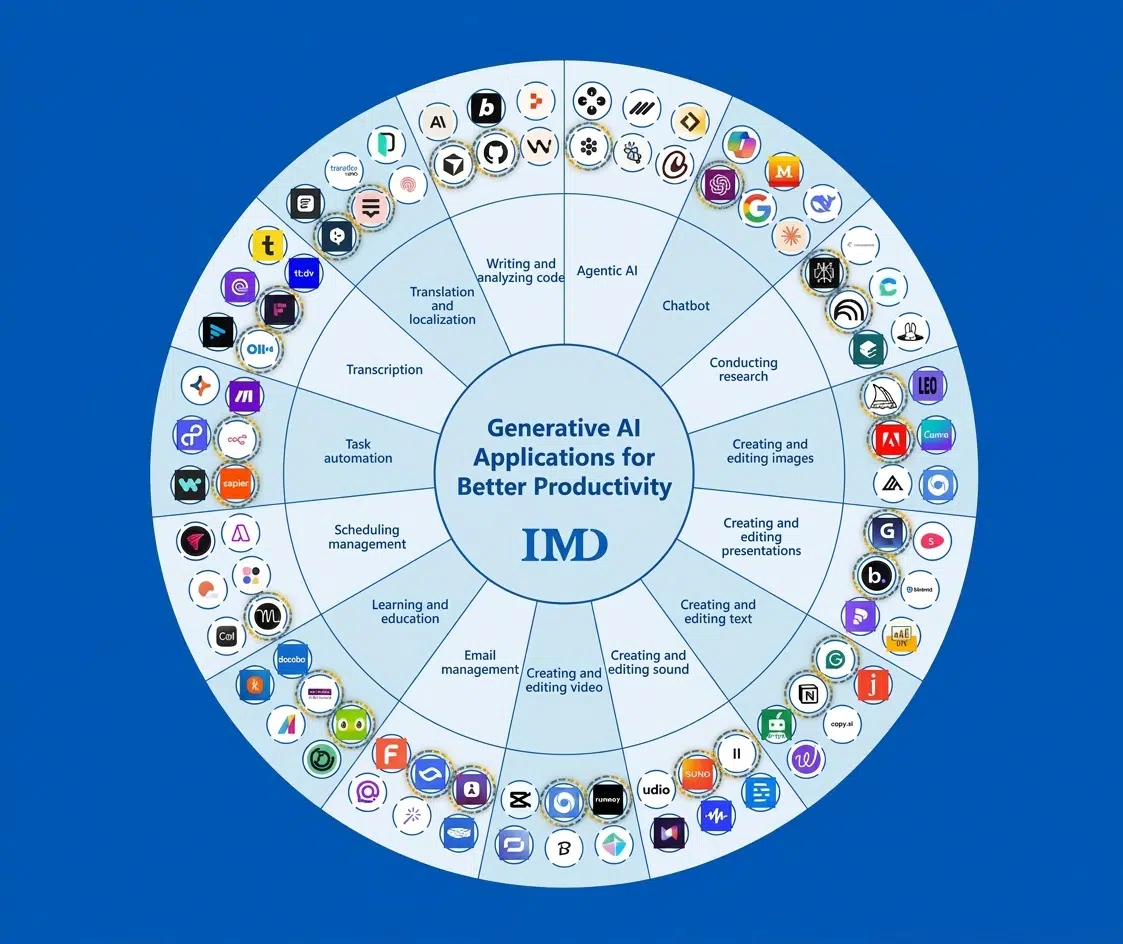
In September 2025, IMD’s Global Center for Digital and AI Transformation published a ‘wheel’ chart mapping the GenAI productivity landscape across 15 categories. It was designed as a practical reference for executives who wanted to understand which tools mattered and where they could be used.
It became outdated as soon as it appeared.
New AI services and products appear daily, established tools add generative capabilities, startups change direction, and seemingly prominent platforms disappear. Any static overview will inevitably struggle to keep pace.
Therefore, we rebuilt the wheel as a resource that updates itself.
The 15 categories remain an editorial choice, defined and curated by us. We built an AI (of course) algorithm to evaluate the tools within each category. It checks whether tools remain active, assesses recent news coverage, removes products that have gone quiet, identifies emerging candidates, and highlights the two highest-scoring tools in each category. We then manually validate the changes.
Comparing the current wheel with the version published last September provides a revealing picture of what has changed. The broad productivity needs have remained remarkably stable. The tools competing to address them have not.
The framework has held up
The 15 categories represent our view of the main productivity categories that GenAI can help people address. Fourteen of the categories remain exactly where they were last September. People still use AI to conduct research, draft and edit text, create images, build presentations, transcribe meetings, manage schedules and translate between languages. The products may change, but the underlying needs do not.
This is partly because the wheel was deliberately built around durable activities rather than individual technologies. The way people perform knowledge work evolves, but the basic jobs they are trying to accomplish are relatively consistent.
The one addition made nine months ago was Agentic AI, which became the fifteenth category. At the time, autonomous agents were beginning to emerge as a distinct approach, although it was not yet clear whether they would become a category in their own right or simply be absorbed into chatbots and workflow-automation platforms.
The evidence since then suggests that the category deserves its place. There is now a steady stream of new entrants, growing enterprise interest and a clearer distinction between conventional automation and systems that can pursue goals, make decisions and execute tasks with a degree of autonomy.
The structure of the wheel has therefore proved reasonably robust. The movement is taking place inside it.
The tools are changing constantly
A static chart can show the market at a particular moment. What it cannot show is how quickly the tools within each category come and go.
Tome was once one of the most prominent products in the presentation-creation category. It has since moved away from consumer slide creation and repositioned itself around enterprise sales workflows and automation.
Clockwise had become a familiar name in scheduling, optimizing calendars for tens of thousands of organizations. Salesforce acquihired the company in early 2026, and the standalone Clockwise product closed in March.
This kind of turnover is common, but it is only part of the story. The boundaries between categories are also shifting as products expand their capabilities and definitions become more precise.
Canva now appears in the image-creation and editing section of the live wheel. A year ago, many people would have described it as a design platform that happened to include some AI features. Its generative capabilities have since become significant enough for it to compete directly with AI-native image tools.
The opposite has happened with n8n. In the previous version of the wheel, we placed it in Agentic AI. We now believe it belongs more naturally in task automation, where it acts as an integration and workflow layer.
This does not mean that n8n has become less capable. It is increasingly used to orchestrate AI agents and connect them with other organizational systems. What has changed is the meaning of Agentic AI. The term is gradually becoming more specific, referring to autonomous decision-making and goal-driven execution rather than any workflow that connects a sequence of predefined steps.
These changes are making the apparently simple question, “What is the best tool for this task?”, much harder to answer. The strongest candidate may be an AI startup built specifically for the problem, but it may equally be an established platform that has incorporated GenAI into a product employees already use.
Even the newest category is turning over
The greatest movement can be found inside Agentic AI, even though it is the newest category on the wheel.
Several of the original names, including Manus, Sana, Beam and Devin, remain relevant. They are now being joined by a growing number of credible alternatives.
Lindy, for example, positions itself as a platform for building autonomous “AI employees” that can perform tasks such as email triage, scheduling and CRM administration across thousands of applications. CrewAI has gained traction as an open-source framework through which developers can coordinate teams of specialized AI agents.
Neither tool was prominent enough to appear on the wheel nine months ago. Both are now difficult to ignore.
These shifts illustrate how quickly leadership positions can change, even in an emerging market. Agentic AI may represent the leading edge of enterprise technology, but that does not make its current leaders permanent. Nine months is already long enough for new entrants to emerge and the competitive landscape to shift.
How the recommendations are produced
Each category on the live wheel contains one or two tools surrounded by a golden dashed outline. These are the current recommended starting points for someone who wants to explore that category.
The recommendations are generated automatically rather than selected by the Center’s editorial team. Each tool is assessed using two public signals: the health of its website and the volume of recent news coverage it has received. The two highest-scoring tools in each category receive the dashed outline.
The scores are recalculated whenever the wheel is updated. A tool that loses visibility, experiences persistent website problems or is overtaken by faster-growing competitors can lose its recommended status without waiting for the next editorial review.
We adopted this approach because the market is moving too quickly for conventional recommendation lists. By the time an editor has researched, tested and approved a set of tools, the underlying market may already have moved on. Handpicked recommendations can also be shaped, often unintentionally, by personal familiarity, product preferences or commercial relationships.
An automated score is not free from limitations, but it is transparent and reproducible. The same criteria are applied to every product, and the result changes as the public evidence changes.
It is important to be precise about what the recommendations mean. The highlighted products are not tools formally endorsed by IMD, nor does their position prove that they are the best products for every organization or use case. They are the tools that currently appear most active and visible according to the signals used by the system.
Visibility is not the same as quality. It is, however, a useful indication of momentum, relevance and continued market activity.
Why the map needs to update itself
The live wheel addresses a structural problem in the GenAI market.
The categories change slowly because they represent enduring productivity needs. The tools change quickly because they are shaped by investment cycles, technical advances, competitive pressure and customer adoption. A static chart places these two layers together and consequently becomes outdated at the speed of the faster one.
Separating them gives executives a more useful way to think about the market.
An organization can plan around stable needs such as AI-assisted software development, customer communication, research or content creation. These are likely to remain relevant next year and for several years beyond that.
The individual products selected to address those needs are much less predictable. A tool chosen today may be acquired, repositioned, overtaken or discontinued before an organization has completed its rollout. Vendor selection therefore needs to be treated as a more dynamic decision than the underlying capability strategy.
This is perhaps the clearest lesson from the past nine months. We now have a reasonably stable view of the main areas in which GenAI can improve productivity. We have much less certainty about which products will lead those areas six or twelve months from now.