Pierre Wüst has never been drawn to easy targets. From an early age, he pursued goals most people would have walked away from. At sixteen, he decided he wanted to become a military pilot. In Switzerland, roughly 20,000 people are considered each year for a handful of places. His parents encouraged him to have a backup plan. He enrolled in business school and made it to the final hundred candidates for pilot selection before having to choose between the two paths.
He chose university. During his studies, a single professor redirected his ambition entirely. “It’s the kind of professor who changes your life. They teach you with such passion that you think: I want to work in that.”
The subject was financial markets. It stuck.
Looking back, Wüst says his motivation was never really about the destination. “It’s not about the goal. The goal is part of the motivation. It’s about how you get there and what you learn during that journey.”
Into the deep end
Wüst entered the industry at one of its most turbulent moments. His first role was at Santander’s private bank in Geneva in July 2008 – just months before Lehman Brothers collapsed and the global financial system was thrown into crisis.
“It was a crash course in crisis management,” he said. Markets were in freefall, clients were in distress, and decisions carried real weight. It was a baptism few would have chosen – and exactly the kind of environment in which Wüst discovered he could thrive.
Over the years that followed, he built expertise across several institutions, eventually advising substantial client portfolios at JPMorgan. At 26, he was responsible for managing more than $3 billion in client assets. He was competitive, technically rigorous, and effective. By most measures, he was succeeding.
“I had a lot of fun in my career. I really enjoyed the jobs I had,” he reflected. “Even in stressful periods.”
But the same drive that had propelled him forward was beginning to reveal its limits.
The gap no hard skill could close
The higher Wüst rose, the more clearly he saw what his training had not prepared him for. Technical expertise could solve analytical problems. It could not explain why a colleague was struggling, how to guide a team through uncertainty, or what it meant to truly earn someone’s trust.
“I knew that I lacked leadership skills,” he said. “I needed to grow as an individual.”
Covid accelerated the realization. Managing a team through that period – the intensity, the communication, the human dimension of it – made clear what he had largely been navigating on instinct. He enrolled in the IMD Executive MBA shortly afterwards.
His expectations going in were modest. He imagined something practical, almost procedural. “I wanted a kind of manual – if the team does this, you do this. If they do that, you do that.”
What he found was something he had not known he needed.
The discipline of self-reflection
The most significant shift the EMBA produced was not strategic or analytical. It was personal. For the first time in his career, Wüst began examining his own behaviors – the assumptions he carried, the patterns he repeated, and the ways his own history shaped how he showed up with other people.
“I managed to do self-reflection, which I had never done before,” he said. “I had never observed how I was behaving.”
He offers one moment as a measure of the change. A colleague had reacted badly to a change in how a key performance metric would be calculated. For Wüst, the logic of the decision was clear. It made sense from the bank’s perspective, and his instinct was to move on quickly.
“The previous me would have said: it is what it is. Just move on.”
But the colleague was not reacting to the logic. They were reacting to what the change meant for a deal they had spent years working on. When they explained it, Wüst sat down with them.
“The new me said: I’m so sorry to hear that. I spent time with them, trying to comfort them.”
The situation had not changed. But the way he responded had. “That empathy is something I would never have done before.”
Learning from peers
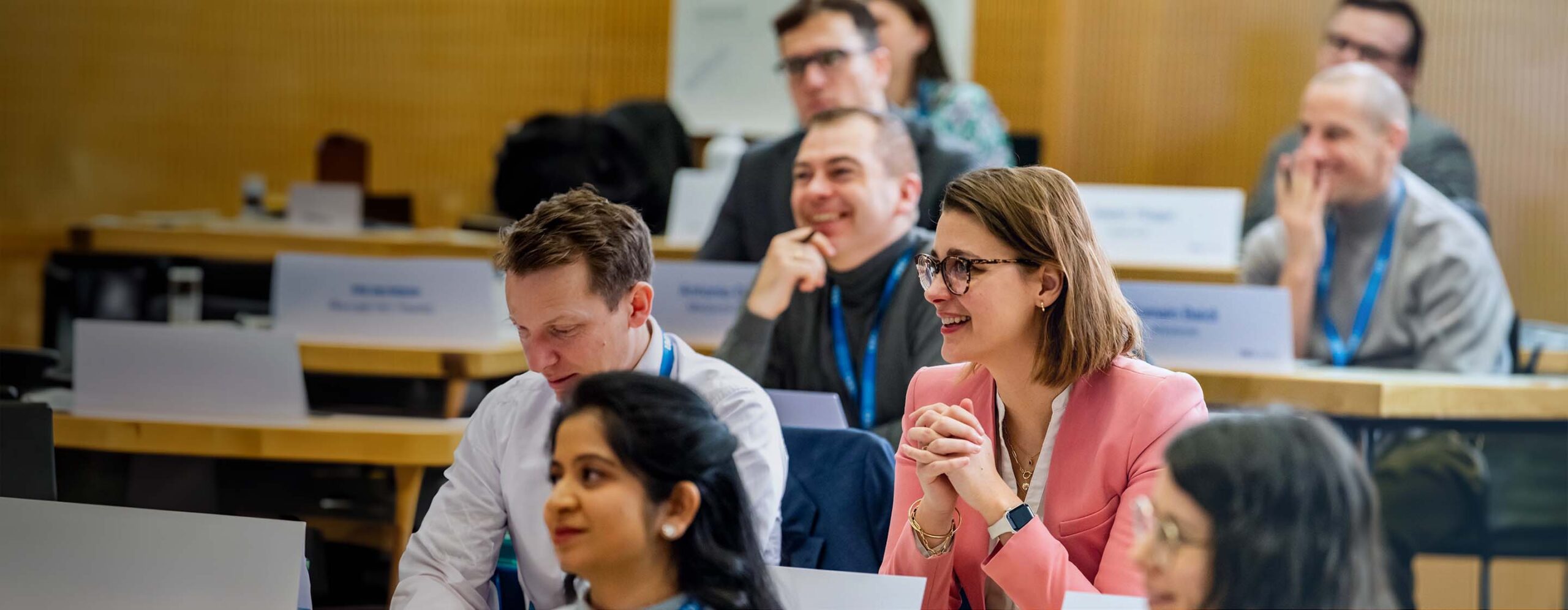
The cohort was as formative as the curriculum. Participants came from across industries and countries, and the program created conditions in which they were genuinely challenged and genuinely known.
“You learn a lot more from your peers than from the professors,” Wüst said. “I would say it’s probably 20–80. The professors help put a framework to facilitate the exchange and learning, and also guide us through the process with their insight and experience.”
What made the difference, he believes, was vulnerability – the willingness to share not just professional experiences but personal ones, including the difficult or unresolved parts of people’s lives.
“The more you share with other people without being afraid of being vulnerable, the more bonding you create,” Wüst said. The relationships that formed during the program have proven more durable and more intimate than many he has built over decades.
“The people from the EMBA know me better than many of my friends.”
Beyond financial markets
Since completing the program, Wüst has applied that broader perspective to new professional territory.
Alongside his role as the managing director at Commostone, where Wüst has been advising several companies it has invested in – from Swiss drones to Middle -Eastern men’s health product – he has also helped co-found Verretex, a Lausanne-based startup tackling a material challenge that most of industry has overlooked: what happens to fiberglass after it is recycled.
For Wüst, the venture reflects the curiosity the EMBA helped him cultivate – an appetite for problems that do not have obvious answers, in fields where he is still learning.
Lessons from the journey
Across two decades in financial markets, Wüst has accumulated plenty of professional milestones. But the EMBA stands out as a period of unusually rapid personal growth, one that compressed years of experience into a much shorter period.
“It’s like growing by 20 years without aging,” he said. For Wüst, that quality is the clearest measure of what the program produces, not frameworks or credentials, but a fundamental shift in how people show up. It is a shift he recognises in others because he experienced it himself.
There is a moment at alumni events, he said, that he has come to recognize. Within the first few seconds of meeting another EMBA graduate, something feels familiar: a quality of presence, an openness with other people that is immediately distinctive.
“I can tell in 15 seconds whether someone has done the EMBA or not,” he said. “It’s really magical.”