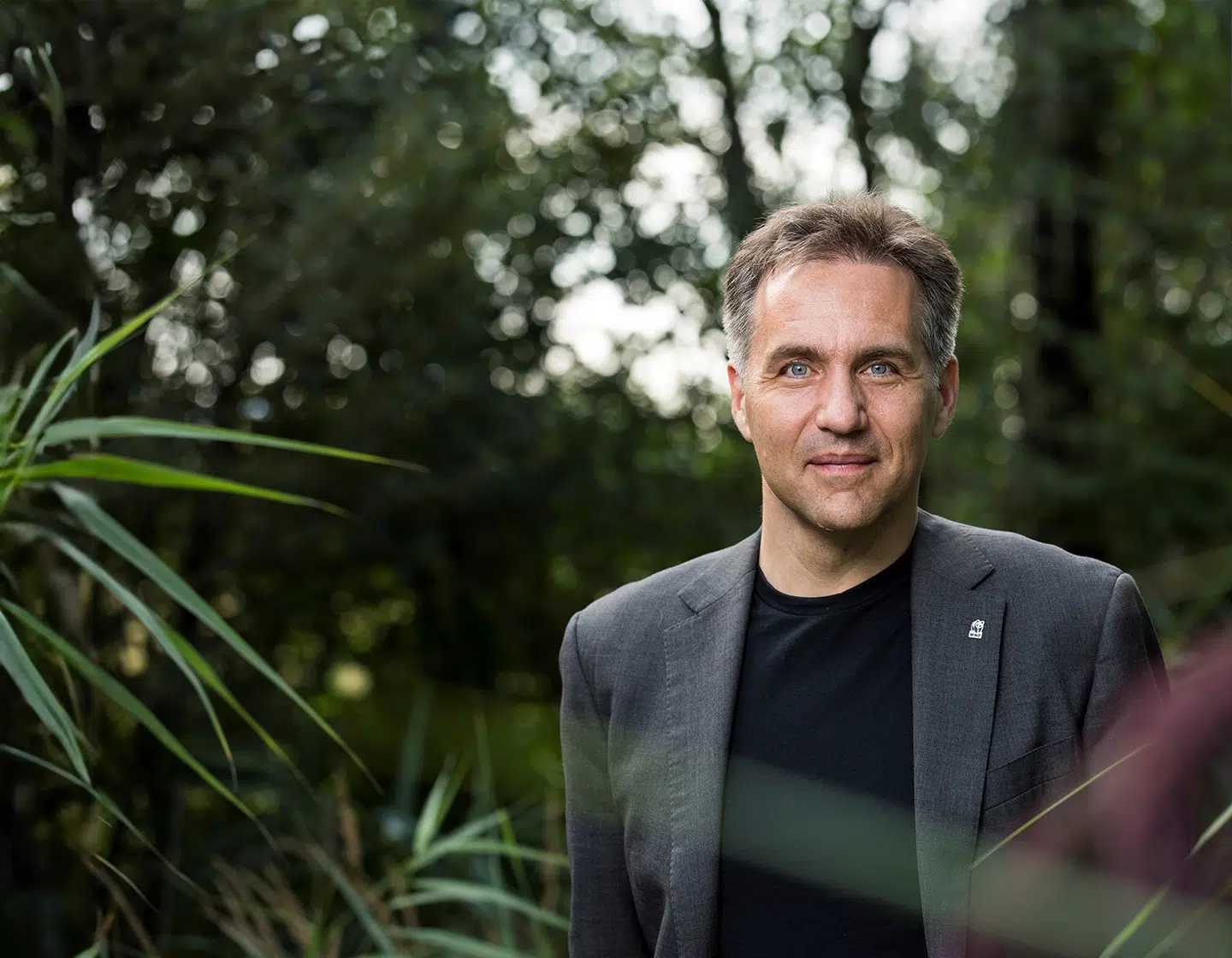
For Thomas Vellacott, leadership has never been about standing at the center. It is about creating the conditions for others to act, enabling ideas to emerge from across the organization, and measuring success not by personal recognition but by what the organization achieves together – often far beyond Switzerland’s borders.
That perspective has shaped a career spanning private banking, strategy consulting, and 25 years of environmental advocacy at WWF Switzerland, where Vellacott has been CEO for the past 14 years. It was also a mindset that crystallized during his Executive MBA at IMD, an experience he undertook to step back and become more effective in a role he was deeply committed to.
A non-linear journey shaped by purpose
Vellacott is the first to point out that his path was anything but straight. In the Boy Scouts, he was given the nickname “Panda,” though nobody could have known then quite how fitting it would become. His academic path wound through Arabic and Middle Eastern studies and international relations before he started his career in private banking and then strategy consulting.
What connected each move was a search for what made work meaningful. Early in his career, he developed a simple personal framework: to feel fulfilling, a role had to offer continuous learning, a sense of purpose, and the chance to work with people he enjoyed spending time with. “I can settle for two out of three for a certain period of time,” he shared. “But in the long run, it has to be three out of three.”
After McKinsey, he joined WWF, drawn by the opportunity to work at the intersection of business and conservation, a move that involved quite a degree of serendipity. “It worked out by happy coincidence.” Decades later, he is still there. “It’s still three out of three.”
Over time, that search for alignment also reshaped how he thought about leadership itself and prompted him to pause and reassess how he was showing up in the role.
Stepping back to lead better
By the time Vellacott enrolled in IMD’s Executive MBA, he was already CEO of WWF Switzerland. “It wasn’t a road-to-Damascus moment,” he said. “But I’d been out of formal education for 15 years, and I felt I could probably do better as a CEO than I was doing.”
The EMBA offered a structured opportunity to step out of what he calls the “constant busyness” and reflect, not just on the organization he was leading, but on how he was leading it.
IMD appealed because of its location in Switzerland, its ties with WWF, and crucially, its intellectual ambition. He was not looking for a program specifically focused on sustainability – that was already his daily reality. He wanted rigorous thinking, strong faculty, and peers who would genuinely challenge his assumptions.
Three shifts that changed how he leads
Going in, Vellacott expected to gain new knowledge and helpful tools and frameworks. What surprised him was how profoundly the experience reshaped his thinking. Towards the end of the program, he identified three shifts that mattered most.
The first was deceptively simple: learning to listen. “At that point in one’s career, there’s a danger that you feel you know it all, that you come up with an amazing vision and just drag everyone along with you.” That instinct, he found, needed checking. Today, listening also shapes how WWF engages with corporate partners. “If I don’t understand what keeps a CEO awake at night, I’ll be pitching things to them – or worse, preaching – when what they’re looking for is a partner to solve problems together on the road to a sustainable business model.”
The second shift was the discipline of reflection. Through journaling and structured pauses built into the program, Vellacott discovered the value of slowing his thinking down. “I’d done very little journaling before. I’ve done a lot more since.” The habit has endured. “The faster things move, the more I benefit from taking time to reflect.”
The third shift was a move away from grand strategy and towards experimentation. “If someone has an idea, let’s see how people react to it. If it works, let’s take it from there. If it doesn’t, let’s pivot.” This emphasis on testing ideas, learning quickly, and adapting felt both more realistic and more humble. “It’s about feeling your way forward in a very uncertain world.”
Letting go of local metrics to build global impact
One example shows how these shifts translated into action. Traditionally, WWF country offices raise funds only within their own borders, an arrangement that has left many offices in the Global South chronically undercapitalized and has skewed resources towards Europe and North America.
Under Vellacott’s leadership, WWF Switzerland began providing grants and loans to WWF offices in emerging economies to build their own fundraising capacity. It also meant accepting that the results would not be immediately visible – or attributable to his own organization.
“As CEO of an NGO, there’s a temptation to focus on vanity indicators – how big is my organization’s income? The returns on the investments we’re making now don’t show up in our books. They show up in WWF Colombia, or WWF Madagascar, for example… What counts in the end is the impact we achieve together, not where funds get booked.”
Leadership beyond the individual
Today, Vellacott describes his role less as setting direction and more as enabling change. “It’s not the lone hero who charges ahead and leads the troops. It’s about building coalitions, providing solutions, and increasing the probability that positive change will happen.”
That philosophy extends to how WWF works with business – focusing on alliances rather than confrontation, and on the growing recognition among business leaders that their operations depend on stable ecosystems. “The understanding of how dependent businesses are on nature has never been as high as it is today. There’s no better time than now to be building alliances for the regeneration of nature.”
Asked what he is most proud of, he is cautious not to claim ownership of success. “When things go wrong, we tend to attribute the result to external factors, such as the market. When something goes right, it’s of course entirely due to my brilliant leadership. No, seriously: In complex systems like the ones we operate in, results can rarely be attributed to a single actor.” He points to a twelvefold growth in WWF’s volunteer base since 2015 as an example. “It’s a development I am incredibly grateful for. But it’s not something I would say I’m proud of, because it’s the result of many people coming together to shape a positive future.”
That restraint runs deep. “It’s not me throwing a stone into the water and watching it ripple out and touching everyone else. It’s more like rain falling on water, lots of ripples going in all directions. I cause ripples. But thank goodness I’m equally touched by other people’s ripples.”
For Vellacott, the EMBA at IMD did not change who he was overnight. But it helped him articulate and act on a philosophy of leadership grounded in humility, reflection, and collective impact. “It would not be hyperbole to call it a life-changing experience.”

