
Moreover, what has been the impact of the financial crisis on the attention that governments have given to medical care to the population?
Since 2008, the average economy analyzed in the IMD World Competitiveness Yearbook has increased its total health expenditure per capita by 30%. This compares to an average GDP growth (not annualized) of 13.5% between 2008 and 2012. Generally speaking, in a period of crisis governments seem to prioritize healthcare. Of course the data hide significant differences among countries. Emerging economies such as China, Brazil, and Russia, all have seen increases in expenditure by more than 50%. In contrast, most European countries (and significantly among them, the U.K., France, and all peripheral countries in the Euroland) have witnessed mild, if not negative, changes in health expenditure. These are all countries where the starting levels of public expenditure are significantly higher. In the average economy, total healthcare expenditure was about $2,000 per capita in 2008; in Europe it was $3,000.
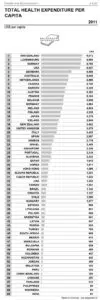
Where do we stand as we begin 2014? Our latest rankings show that countries that spend the most in healthcare are Switzerland ($9,072 per capita), Luxembourg ($8,900), Norway ($8,795), and the USA ($8,627). It does not necessarily follow that it is in these countries where healthcare is the best. Belgium ranks number one in the question “Health infrastructure meets the needs of society,” but it is only 12th in public healthcare expenditure. And while the USA is the fourth country by healthcare expenditure, it ranks 30th in health infrastructure.
The countries that spend the least in healthcare are: China Mainland, Ukraine, Thailand, Philippines, Indonesia, and India. What the data show are dramatic differences among countries. The highest spending economy in our rankings (Switzerland) spends 150 times more in healthcare than the lowest-ranked country (India). Italy (ranked 20th) spends almost four times as much as Poland (40th). Countries that spend the least in absolute terms also spend little relative to GDP. So it is not just that they are poor—they do not prioritize healthcare.
Our conclusion is that differences in health policies are creating a significant gap in competitiveness between rich and poor economies.




Switzerland has reached an uncomfortable conclusion: that UBS has become too large for the state to comfortably stand behind. The government’s plan to force the bank to hold roughly $20 billion more in capital is an attempt to close that gap, even...

Latin America and the Caribbean (LAC) has made real gains over recent decades in education, health, democratic governance, and poverty reduction. The region, however, remains stuck. Not because progress is absent, but because advances in some area...

As oil prices have soared following the outbreak of war in Iran, electric vehicles are back in focus. But the biggest beneficiaries are not American or European brands. They are Chinese manufacturers and, increasingly, Japanese carmakers building ...
Research Information & Knowledge Hub for additional information on IMD publications
Research Information & Knowledge Hub for additional information on IMD publications
Research Information & Knowledge Hub for additional information on IMD publications
Research Information & Knowledge Hub for additional information on IMD publications
Research Information & Knowledge Hub for additional information on IMD publications
Research Information & Knowledge Hub for additional information on IMD publications
Research Information & Knowledge Hub for additional information on IMD publications
Research Information & Knowledge Hub for additional information on IMD publications
Research Information & Knowledge Hub for additional information on IMD publications
Research Information & Knowledge Hub for additional information on IMD publications