Some of the most useful conversations happen with people you would not ordinarily meet.
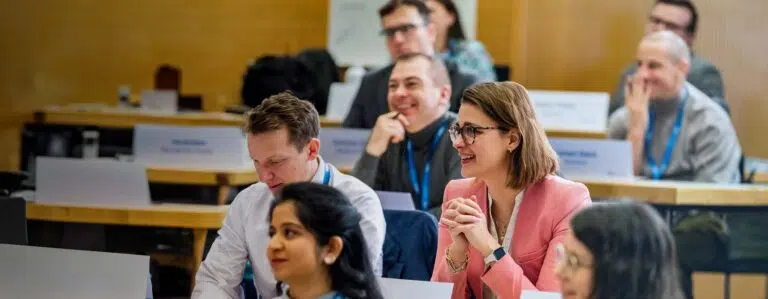
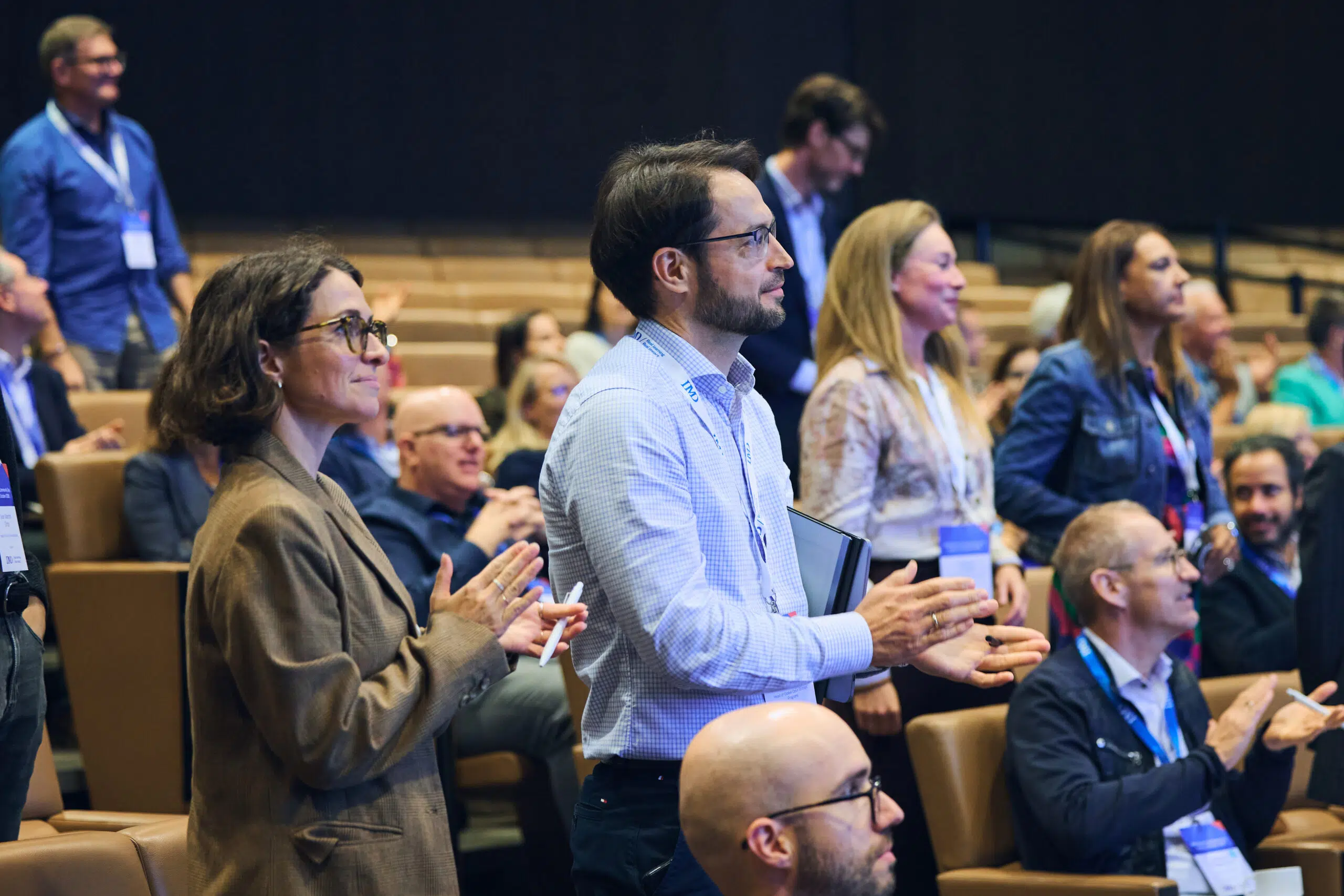
The first IMD Alumni Community Day created an opportunity to do just that, bringing six communities together in Lausanne and online: Tech, Life Sciences, TOGETHER, Entrepreneurship, Inclusive Leadership and the Luxury 2050 Forum.
The communities create opportunities for alumni to hear perspectives they might not encounter in their usual professional circles. “We create a space for the conversations happening behind the scenes sharing perspectives, insights and emerging ideas that you would not necessarily hear through traditional communications,” said Renaud Falgas of the Luxury 2050 Forum.
They also provide space to ask questions outside their own areas of experience. “A good leader knows when to ask for help, and we’re not all born knowing everything,” said Luis Ornelas of the Inclusive Leadership Community.
When the communities began planning their first joint event, that interest in learning from others shaped the program itself. Agathe Schwaar, IMD Alumni Community Coordinator, said the original idea had been to create separate streams for the different communities. The alumni had other ideas.
“Every community wanted to work together on a transdisciplinary topic,” she said. “The agenda was created entirely by the alumni community.”
The result was a program that moved from longevity and health to artificial intelligence, human judgment and impact.
Knowing is not the same as doing
Simone Gibertoni, CEO of Clinique La Prairie, opened the program with a deceptively simple problem. We have access to more information about our health than ever before, yet knowing what is good for us does not necessarily change what we do.
“We are very good now in information, but information is not transformation,” he said.
Improving healthspan – the years people spend in good health – therefore requires more than better diagnostics or more data. Gibertoni highlighted the importance of movement, nutrition and well-being, but also mindset, personalization and continued human support in helping people turn knowledge into sustained changes in behavior.
The panel that followed brought together perspectives from medicine, healthcare and longevity research to ask who gets to benefit from longer, healthier lives. Moderated by Carlos Cordón, Professor of Strategy and Supply Chain Management at IMD, the conversation ranged from the science behind longevity and the proliferation of unproven claims to the role of healthcare systems, incentives and public policy.
As interest in longevity grows, the panelists stressed the importance of distinguishing established evidence from emerging interventions. “I think it’s very important to stay very close to science,” said Damien Ng, Research Analyst, Future Health & Extended Longevity at Julius Baer.
He pointed to nutrition, exercise and sufficient sleep as areas where the evidence is well established, contrasting them with emerging interventions where promising results may still come primarily from animal rather than human studies.
The conversation also moved beyond individual choices. Longer, healthier lives depend not only on what people know or do, but on the healthcare, incentives and wider conditions around them – raising the question at the heart of the session: who gets access to the benefits of longevity?
More intelligence – but whose judgment?
The afternoon turned to artificial intelligence and the changing relationship between human and machine judgment. Capital meets AI: What makes us irreplaceably human?, moderated by Oksana Bober, EMBA Alumna and Entrepreneurship Community Member, brought together perspectives from investment, entrepreneurship, healthcare, academia and the creative industries.
The discussion showed how AI is already changing work in very different settings – from investment analysis and company processes to personalized health decisions and musical composition.
It soon moved beyond what AI can do to a harder question: how much judgment should people hand over to it?
Murat Tarakci, Professor of Innovation Strategy at IMD, described an experiment involving around 250 executives. Asked who should lead organizations, participants chose humans or humans working with AI – never AI alone. Yet when they were subsequently placed in a team with a human and an AI, 78% identified the AI as having the most influence.
“We should not abdicate our leadership and blindly follow AI all the time,” Tarakci said. “What we need is new skill sets and capabilities that will help us walk on that narrow critical path, which combines AI agency and human judgment.”
Composer and Music Technologist Silvio Buchmeier had encountered the limits of AI in his own work. It helped him draft a grant proposal for an opera project, pulling together information and identifying points he had not considered. But it also suggested a change that would have weakened the proposal because it failed to understand an important distinction within his field.
Bringing different skills to the problem
EMBA alumna Natalija Iniakina brought a different perspective to the closing plenary. After more than 20 years in banking, she joined IMD’s Driving Innovative Finance for Impact program wondering what a banker could contribute to humanitarian finance.
She found that skills she already had – assessing risk, structuring finance and working across organizational silos – could be applied in an unfamiliar setting. The learning also went in the other direction: business leaders could learn from humanitarian practitioners accustomed to making decisions amid uncertainty.
For Vanina Farber, Professor of Social Innovation at IMD, humanitarian finance offered an example of what can happen when skills and perspectives cross traditional boundaries.
“You can still put people at the center not only with empathy or not only with pity … but also with your market skills,” she said. “I think for me that’s the biggest leadership challenge. So how we bridge these two worlds and behave differently.”
For Karine Richard, Co-Leader of the Life Sciences Community, one of the most valuable parts of the day was encountering perspectives outside her own field.
“I would not have met the people that I met today without the community,” she said. “It’s really cool to hear different perspectives also from different people, and also sometimes on issues that I’m not exposed to myself.”
The first Alumni Community Day brought that exchange across the communities themselves – creating space for alumni to contribute their own expertise while seeing familiar questions through someone else’s perspective.