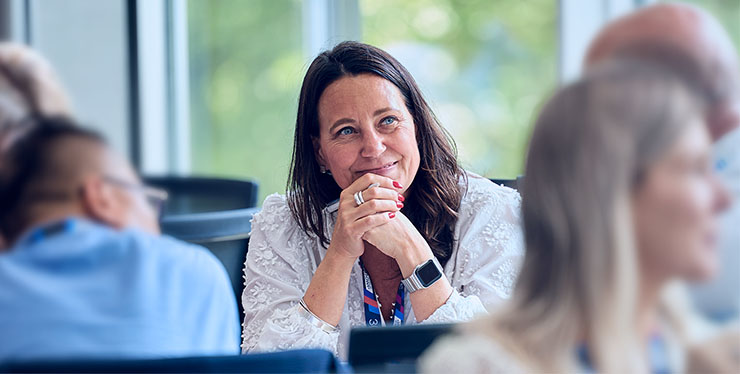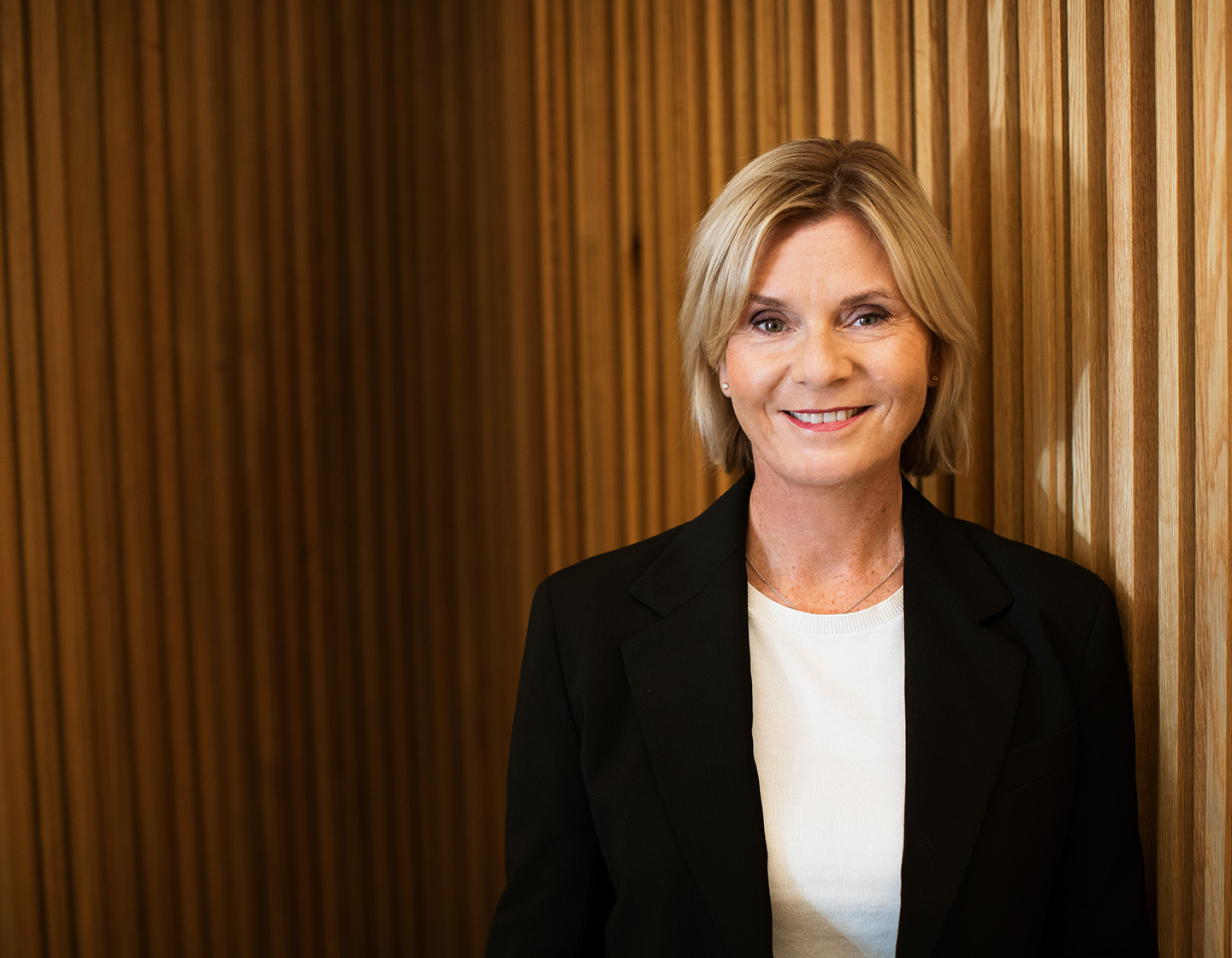
For more than three decades at Sweco, Åsa Bergman has grown alongside the organization she now leads. Progressing through roles of increasing responsibility before becoming President and CEO, she has steered the business through economic downturns, rapid technological change, and a global pandemic – each experience reshaping what leadership means to her.
A key moment in her journey came last year, when Bergman was named Leader of the Year 2025 by Swedish business magazine Affärsvärlden. It was the latest in a series of recognitions reflecting her leadership impact. She has previously been named one of Sweden’s most influential business leaders by the financial daily Dagens Industri and received a diversity leadership award for her work in building inclusive teams.
For Bergman, such recognition offers a rare pause for reflection. “You focus so much on your daily operations, and driving success, and there’s always room for improvement – that takes up your whole time,” she said. “But when someone sees you from the outside, it’s also time to stand still a little and think that it kind of pays off to work with the leadership and the culture.”
Recognition that reflects leadership, not titles
With around 23,000 architects, engineers, and specialists across Europe, Sweco is the continent’s leading architecture and engineering consultancy, designing sustainable cities, transport networks, and critical water and energy systems. Bergman’s influence extends beyond Sweco: she also serves on the boards of Securitas and Svenska Cellulosa (SCA), broadening her perspective on governance and strategy across sectors.
Leading an organization of this scale requires clarity of purpose. “It’s very much about making sure that you try to focus, and are clear on what your company’s role is in society and the environment,” she explained.
That sense of purpose has deep roots. Trained as a civil engineer, Bergman grew up seeing how the built environment shapes everyday life. “It was part of my childhood to talk about building construction sites and having an education and also a work life or a job that really contributed to the society,” she said. “So you can really look at the impact that you actually made on society.”
When she joined the company, then known as FFNS Arkitekter, it was still a small, locally focused organization. As the company expanded across Europe, so did her responsibilities. “You grow into it. Every step you take prepares you for the next one,” she reflected.
Learning to lead at the next level
That steady progression was complemented by moments of reflection on how she leads, including time spent on IMD’s Breakthrough Program for Senior Executives. The experience gave Bergman the space to step back and reflect not just on who she is as a leader but how she communicates direction at scale.
“Professionally, it gave me clear views of where I’m really strong and where I had my strengths,” she said. “We had to do a strategy piece from our own world – to define what we wanted to implement next in our company. To be able to describe and outline that strategy so I could explain it clearly, and make sense of the strategic rationale, was really good for me.”
The program also brought lifelong connections. “It gave me colleagues that I still keep in touch with. One of them became a really close friend that I meet every year, and she’s from Birmingham in the UK, and that was very valuable.”
When experience becomes your advantage
When asked about the most defining leadership challenge of her career, Bergman gives an unexpected answer: it depends when you ask. What once felt like a pivotal test fades as new, larger challenges take its place. “If you would have asked me 10 years ago, I would have had an event that I could describe for you, and now I don’t remember what that could be,” she said. “And then, 15 years ago, I would have told you another story.”
Each difficult situation adds to a leader’s ability to handle the next. The COVID-19 pandemic, for example, forced her to guide a decentralized European organization through unprecedented disruption.
Looking back, she sees those moments as formative. “All of the very difficult situations during my career have taught me: What stresses me? How do I need to act? What tools do I have in hand?” she said. “You cannot have all the answers, but you need to create confidence and direction,” she added.
Creating stability in a world that won’t stand still
For Bergman, providing stability inside the organization is what allows it to adapt externally. “I think it’s about having this stability on one hand, then it’s easier to adapt and change on the other hand,” she said.
At Sweco, that means reinforcing a shared sense of purpose in the work employees do – from energy systems and critical infrastructure, to sustainable urban development and more resilient communities. “We are doing great work, so we also work to create an environment where people are coming into work and working together and feeling that this is our role, and we need to be here.”
While digitalization and AI is used to streamline internal operations and create value in client projects, it is the human connection that plays an important role in building the culture. “We meet each other, we have a lunch, and what we call, in Sweden, fika, where you have a cup of coffee and a cinnamon bun together,” she said. “That also creates this feeling of purpose, belongingness and safety.”
Why leaders must keep evolving
Leading an organization of highly educated specialists requires a particular leadership approach. “It’s really about getting that knowledge out to our clients in the very best way,” Bergman noted. Her role is less about control and more about unlocking the expertise within the organization. “The answers are there within the organization, the innovation is happening. It’s really about unleashing the power and the knowledge that is in there.”
When asked what advice she would offer other leaders today, Bergman points first to self-awareness. “Invest in yourself so you can understand yourself and develop the parts of you that you know are not really fulfilling what is needed today,” she shared. In turbulent times, she adds, leaders must stay focused: “It’s really about keeping your eye on the ball.”
Ultimately, Bergman sees her legacy as ongoing work. The recognition she has received reflects the impact of that leadership journey, not just on business performance, but on how organizations can contribute to society while navigating uncertainty.
Leading Sweco’s contribution to the green transition and Europe’s resilience is part of that story. “Only by being able to and still able to work for a company like Sweco… I think I have so far done my part in creating something, a better place, at least in Europe,” she said, before adding, “But I’m not done yet.”