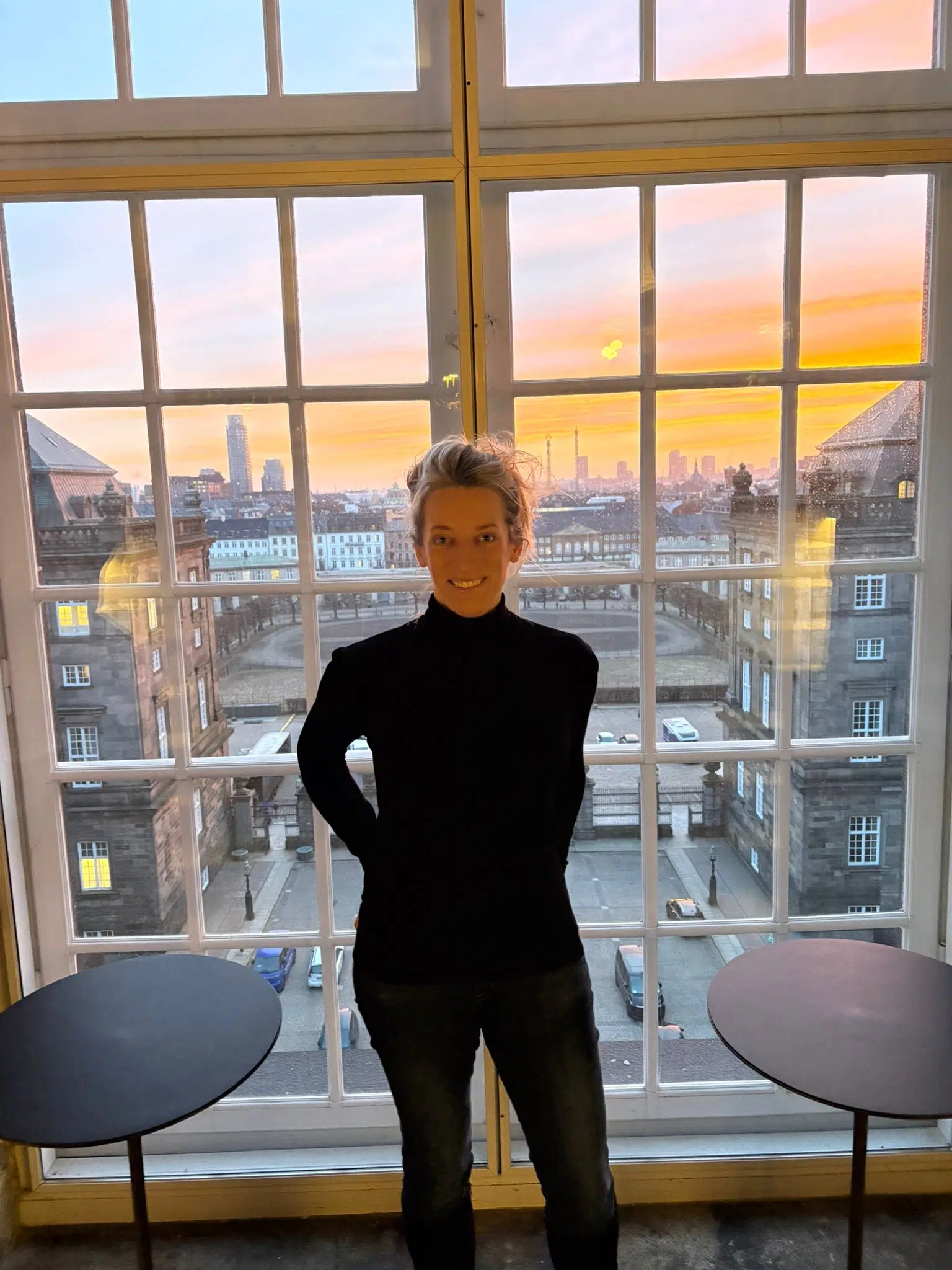
Sarah Merkes-Nielsen says that the industries she has worked in – across logistics and oil and gas – are in constant need of transformation. After university, she started in logistics before moving into oil and gas, gaining insights into both sectors. “I got to see the best of both worlds, but also the need for change in both industries,” she says. In logistics, the focus was on margins; in oil and gas, on safety, compliance, and maintenance excellence. “Different priorities,” she adds, “but both driven by continuous change and adaptation.”
Her career has led her into renewable energy, where she is now Vice President and Digital Business Transformation Lead at the Danish wind turbine manufacturer Vestas. She says that the industry is even more in need of transformation than oil and gas, largely due to its maturity stage and the speed of its growth.
“In times of rapid change, it is easy to scale without standardizing, and that is what we are working on addressing now, to secure more repeatability and scalability.”
A key challenge for her is ensuring IT is involved from the start, not added as an afterthought. Too often, she says, solutions are built before fully understanding the real business problem or its root cause – and that leads to several versions of the very same process. “Are we treating the symptoms or are we preventing them from arising? Too often, all someone wants is ‘just’ quick pain relief.”
She has now been in the digital world for the last 14 years and has found that there is usually a love-hate relationship between IT and the rest of the business: “Just give me a system, you don’t know my process, I know my problem, just fix it now.”
However, if the IT team understands the problem space, they can also help with addressing it better, rather than just implementing a system and starting to support it – only to realize afterwards that they already had three other systems that could have done the same job.
“That’s why I say IT actually should be included from day one, though this can be a challenge. We are often ‘last to the party’, when somebody believes they have already found a solution and often has fallen in love with a specific system of choice.”
“IT is important, but not always welcome. Hence, bridge building, or at times even ‘marriage counselling’, is where I spend a lot of my time.”
How her interest in leadership was sparked
Sarah has always enjoyed working with people, and what she enjoys most is delivering through others. “I find that a lot more rewarding. But it is also harder than just doing it yourself, which often can be done faster (though usually not better). It is seeing others grow that gives me energy.”
She says it is sometimes forgotten to ensure that the team functions well without you. She has started to think more about handing over the baton in her role – not necessarily because she is “that old,” but because at some point leadership is also about making sure that succession pipeline is strong, so that not everyone always needs you to be there. “I see it every single day. All of a sudden people are leaving, and nobody can take over. And that’s actually quite disappointing. Hence this is also something I am keeping my eye on.”
Time for change
When she lived in Canada some years ago, working for Seaspan Shipyards as director for the company’s technology solutions, she started reflecting on her future more and more. Her husband had completed an EMBA at IMD almost 10 years before her, and during that time she had followed him closely through that experience.
She really enjoyed the culture and learning approach at IMD. A positive aspect of the EMBA was that she could continue working alongside her studies. “Of course, it took a little more time, but it also allowed me to bring that learning into my workday, every day.”
One person who stood out to her was Professor Ben Bryant. She appreciated his focus on leadership and the sessions she had with him – and so did her husband. “He couldn’t stop talking about him. So I was very curious to experience the leadership stream myself and maybe thought he oversold it, but he absolutely did not.”
During her leadership course, the class worked through George Kohlrieser’s book Hostage at the Table, and the book has followed her ever since. Her leadership team members have it, and they have all worked with many of the key messages, which has been especially important in times of organizational change.
Talking and listening
She has often used the book when dealing with conflict, because what her department does can be quite conflict-heavy. And the goal is to manage conflict in a kind but also firm way, which requires practice. “Conflict management has been one of my biggest development points, because it’s the one thing I have previously strived to avoid most in my life.”
Now, she follows a couple of steps when faced with a difficult situation. “When somebody brings a difference of opinion to the table in, let’s say, a less than charming way, stay calm, and assume best intent, along with competence, and ask: ‘How can I help?’”
She says this approach usually helps people lower their shoulders. Of course, it can also lead to a flood of complaints about unmet expectations, delays, and everything in between, but at least it opens a conversation, rather than resulting in silent hostility. The value of talking things through and listening – really listening – is often forgotten. People in the line of business and also in IT – including in her own team – often already think they know the solution before having listened to what the actual problem is. And the solution they have in mind may not be the right one. Hence, staying unbiased, asking curious questions, and listening can not only help build stronger bridges, but also better solutions.
From screen to turbine time
From a change management perspective, she says that if you have not really listened to the people affected, the solution will not get adopted – no matter how good it may be. So it is important to invest the time to listen and understand, whether that means going to the factory, visiting the shop floor, or spending a day with stakeholders to really experience their day.
“Many people in our team have never visited a turbine or been inside a factory. They often look at computer screens or sit in meetings, without seeing what people are actually exposed to in their daily work.”
And often, she says, getting closer to how their products are being built or seeing them in operation helps when it comes to partnering more effectively. It helps with understanding the problem and solution space better, and especially helps with building rapport, which in turn helps people relax and open up. Sometimes being able to say, “Okay, I think I understand. Let me read it back to you,” and really meaning it and being able to relate, is the most effective transformation catalyst of them all.
“Conflict is not always unhealthy; in the end, all we are trying to do is to understand someone else’s perspective. You don’t have to always love it, agree with it, or accept it, but at least you must listen to it. I think that’s very important.”