IMD business school for management and leadership courses

Published on November 25th, 2025
Future Readiness Indicator: Technology, Pharmaceutical, and Fashion
Published on November 25th, 2025
Built for shocks: The companies that keep winning when the game changes
What the 2025 Future Readiness Indicator reveals about tech, pharma and fashion
A report by the IMD Future Readiness Center
by Howard Yu, Jialu Shan, Lawrence Tempel, Alexandre Sonderegger and Anqi Miao
Contents
- Executive summary
- About the Future Readiness Indicator: Measuring who can win the next game
- Technology: The new race to own the AI stack
- Pharmaceuticals: From pills to platforms
- Fashion: When heritage meets hype and AI
- Conclusion
Executive summary
Who is really ready for 2026?
In 2025, winners and losers have emerged against a backdrop of geopolitical uncertainty and mass AI implementation.
In 2025, the gap between future-ready and future-fragile companies stopped being a theory and started to show up in the numbers. Against a backdrop of geopolitical tension and mass AI deployment, some firms have turned disruption into an advantage. Others are discovering that yesterday’s strengths now trap them in yesterday’s game.
This instalment of the 2025 Future Readiness Indicator ranks 49 technology companies, 27 pharmaceutical companies, and 41 fashion companies in terms of their future readiness. Those who dominate the top of this year’s indicator combine supply chain agility with an ability to adapt fast to shifting regulations. The winners move capital, talent, and capabilities across borders and product lines faster than the world can throw up new constraints.
These companies have proved their resilience because they often have the deep capabilities to orchestrate the entire ecosystem, as opposed to relying on one product or a single service. They are laser-focused on performing in the near term, while transforming the enterprise at the same time.
Leading the way does not correlate with who spends the most, but who executes the best to ensure they stay one step ahead of the competition. In a world where AI is breaking barriers, the future belongs to companies that give customers the seamless experiences they now take for granted.
The IMD Future Readiness Indicator is designed to gauge a company’s readiness for deep, long-term, secular trends. We assess preparedness for the future through a scorecard that covers seven factors: Financial Fundamentals, Investors’ Expectations of Future Growth, Business Diversity, Employee Diversity/ESG, Research & Development, Early Results of Innovation Efforts, and Cash & Debt Management. Together, these variables provide a comprehensive view of how well a company is positioned to prosper in the new game.
In the technology sector, the US tech giants Nvidia, Microsoft, Alphabet, and Meta have proved that mastery of the entire AI stack (i.e., infrastructure, software, and data) and building the capabilities that flow from it is what it now takes to stay ahead, where technological advancement and global trade tension are moving at unprecedented speed. They stand in sharp contrast to firms that did not diversify or stayed tied to legacy hardware systems and now find themselves without the capacity to shift as technology and geopolitics evolve.
In pharmaceuticals, the leaders also have greater control over the value chain, alongside robust financials and relentless innovation. The top-ranked companies – Johnson & Johnson, Roche, and AstraZeneca – have mastered the full pharmaceutical value chain and are building next-generation therapeutic platforms. By contrast, companies that are still anchored to legacy products and that are slow to adapt to an AI-driven, biocentric future are coming under pressure as patent expirations erode pricing power and cost pressures squeeze margins.
In fashion, the top of the indicator is dominated by models of platform-based resilience, while companies that have been slow to adapt and remain culturally relevant fail to resonate with the modern consumer. The diversified luxury “super-conglomerate” LVMH reclaims the top spot, demonstrating that a portfolio of iconic brands provides an unparalleled moat against volatility. It is joined by the vertically integrated, data-driven ecosystem models of Inditex (Zara), which rises to second place, and Hermès. These companies are insulated from market shocks by their non-negotiable brand equity, mastery of their supply chains, and vast cash reserves.
We’re seeing a sharp divergence. The companies that rely on one hero product are the ones suffering the most. Those that diversify across entire ecosystems are turning volatility into an advantage. Every CEO should be asking a basic question: if my core business collapsed tomorrow, would anything else keep us alive? For most mid-market companies, the answer is still no. That’s the story behind this year’s rankings.
Howard Yu
Director of the IMD Center for Future Readiness
What does it take to be future-ready in 2026?
Our research shows that the companies leading this year’s indicator in the technology, pharmaceutical, and fashion sectors have succeeded in the following key areas:
Supply chains that can move faster than the rules
In technology, for decades, software was the barrier to entry; now it’s silicon and the supply chains that produce it.
Today, the most future-ready companies have mastered the full AI stack and control every layer of the AI ecosystem: chips, cloud infrastructure, and the user interface. This ability to rebuild from the inside out translates into the ability to shift capabilities at the necessary speed to stay ahead. The US tech giants have committed to investing billions in infrastructure, including data centers, across the US. This signals a shift from offshoring manufacturing to onshoring the infrastructure that powers AI, cloud computing, and the digital economy.
In China, companies are racing to build self-sufficient AI ecosystems of their own but have struggled due to limited access to much-needed AI hardware amid growing geopolitical tensions. That pressure is also forcing a rapid push toward domestic stacks, from chips to data centers, often powered by relatively cheap energy and large-scale state-backed infrastructure. That means that smart tech companies, even when competing outside China, keep a close pulse on what is happening inside the mainland. Meanwhile, companies that have worked out how to play on both sides (like Samsung) are thriving in this environment.
In pharmaceuticals, those companies that are moving beyond a pill-only model and embracing next-generation integrated health platforms are best placed to navigate upheavals such as the Inflation Reduction Act of 2022 (IRA), one of the most disruptive U.S. policy shifts in decades. With apps, in-home monitoring, and connected services, they can justify the value of treatments not just as drugs but as embedded outcomes. Meanwhile, supply-chain security is now as critical as scientific innovation: a sizable portion of the world’s active pharmaceutical ingredients (APIs) originate in China (estimates suggest roughly 20% of global production, with China supplying about 40% of global API exports). Supply chain security has increasingly become as vital as scientific innovation for pharmaceutical companies. If China were to impose export controls on key APIs, Western manufacturers currently would not be able to ramp up production overnight.
The fashion industry data shows that supply-chain transformation is accelerating, not slowing. Fast-fashion leaders thrive on fast-cycle innovation and global agility, using their thousands of stores as a real-time sensing network that lets them translate runway looks into shelf-ready products in a matter of weeks. Trend forecasting has become just as critical. Some brands now deploy AI to analyze millions of social media images every day to spot emerging styles before consumers even articulate them. The result: fewer misses, less overproduction, and far less stale inventory clogging the system.
Building more than one engine of growth
In technology, companies that stay tethered to legacy hardware are finding it harder to adapt to the AI-centric world. Those that have failed to diversify struggle to escape commodity traps: hardware-heavy and consumer electronics firms are particularly guilty of this. Meanwhile, those tech companies that have a diversified offering are able to shift focus as technology evolves. As AI changes the way users interact with platforms, those companies that have a diversified offering have been able to shift their attention to where users are.
In pharma, legacy giants, clinging to the pill-only model and weighed down by patent expirations, are struggling to keep up with the leaders, whose competitive edge lies in broad diversification, spanning traditional drugs, biologics, and medical devices. Future-ready companies are leveraging their broad diversification, from drugs to medical devices, to cross-pollinate innovation and buffer risk. Highly concentrated companies, like those focused on a single blockbuster drug, fall in this year’s ranking because, while their single-track model has huge upside, it also makes them vulnerable to competitors, supply chain constraints, and regulatory changes. Drugmakers with blockbuster products are entering an era where pricing is more tightly regulated or negotiated in the US. To compete, leading companies are striking R&D partnerships or acquiring biotech companies to reset their trajectory because it’s impossible to predict what the next blockbuster will be, and very costly to manage innovation through your accounting system.
In fashion, leading companies show that a diversified model provides high resilience in tough times. Companies with diverse customer bases and broad portfolios that offer multiple engines for growth are more insulated against a single market downturn. By contrast, narrowly focused brands cap their own potential, and one bad season or one fading trend can knock out their entire momentum.
Making innovation pay for itself
In technology, the leading companies are not necessarily those that spend the most, but rather those that execute the best. Rapid risers in this year’s ranking have made strides the old-fashioned way: by fixing problems and meeting deadlines. The leaders have successfully implemented AI initiatives that deliver measurable business value. This contrasts with those that have let innovation run riot, with no clear revenue streams. In the AI era, innovation must pay for itself. The leaders not only demonstrate why controlling the production of AI matters, but they are also using AI to transform the way they work to generate more revenue growth.
In pharma, the leading companies have discovered that AI will augment their ability to overcome some of the biggest challenges facing the sector, including the speed and cost of the drug trial process. AI is emerging as a promising answer here, and companies that are harnessing its power to speed up the process through tech partnerships can get one step ahead.
In fashion, the companies at the top are the ones that turn ideas into tangible results. They use data and digital tools to improve hit rates, tighten inventories, and raise full-price sell-through. The best performers are not experimenting for the sake of it. They are using technology to reduce waste, lower returns, and move products faster through the system. Their execution shows up in revenue growth and stronger margins, which is why they are pulling ahead of brands that treat innovation as a slogan rather than a working practice.
Owning the whole user journey
In technology, future-ready companies are not just removing friction. They are eliminating entire steps in the user journey. The winners own the interface, the data, and the workflow, and they turn what used to be a series of separate apps into one continuous experience.
China’s WeChat demonstrated this early. A simple chat window became the entry point for paying bills, booking medical visits, buying groceries, and managing daily life. Western platforms are now following the same path. In India, WhatsApp already offers an end-to-end grocery shopping experience where users can browse, order, and pay without leaving the conversation. Once people stay inside your interface, you control the whole journey.
The strongest performers in our ranking are doubling down on this approach. As hardware, software, and AI come together, the advantage goes to companies that orchestrate the entire ecosystem and sit at the most frequent points of user interaction. Whether consumer-facing or enterprise, the pattern is consistent. The companies that embed themselves into daily activity and become the interface people rely on are the ones moving ahead.
In pharmaceuticals, the same blurring of boundaries is taking place. The most future-ready companies no longer define themselves as pill manufacturers. They pair therapies with devices, apps, and data services to improve outcomes and strengthen patient engagement. For example, launching a new asthma treatment with a smart inhaler sensor and a companion app so that patients and clinicians can monitor usage and symptoms in real time. The treatment is no longer just a drug. It functions as an integrated service. These leaders also lower the barriers for startups and technology partners to join their ecosystem. As healthcare shifts toward a connected and patient-centered ecosystem, companies that hold on to a narrow pill-only strategy and remain internally siloed risk losing relevance.
In fashion, the leaders stand out by making the entire customer journey feel effortless, both online and in-store. The fast fashion leaders demonstrate a successful model where apps and stores operate as a single system. Customers can check real-time inventory, reserve fitting rooms, pick up online orders within hours, and use mobile checkouts that reduce waiting to almost zero. Its RFID-enabled logistics update online availability the moment an item is scanned in store, which keeps the experience consistent regardless of where the shopper starts. Luxury leaders have taken a different, yet equally customer-centric approach. Clients move smoothly from online browsing to in-store appointments to private clientele services that track preferences, purchase history, and upcoming product releases.
The pattern across these leaders is clear. They remove small points of friction and let customers move naturally between channels. This builds loyalty while keeping the technology in the background, which is how the strongest retail experiences now work.
In this report, we take a deeper dive into each of the three sectors, discover what key trends emerge from the data and what strategic lessons can be drawn, analyze which companies rank highest on this indicator and why, and look at why some companies are falling behind.
About the Future Readiness Indicator
Measuring who can win the next game
Future readiness refers to a company’s ability to anticipate and adapt to external changes. This is achieved through strategic foresight and tactical adaptability. As the world grows more ambiguous, however, companies must scale up new capabilities to maintain a competitive edge.
By focusing on long-term innovation and short-term adaptability (and noting that this is not an either-or choice, but both), companies can not only survive but thrive in extremely dynamic business environments. This proactive approach is key to success and resilience in an ever-changing economy.
This Future Readiness Indicator goes beyond pure financial performance. It rewards companies that show diversification, invest in innovation, uphold sustainability, and manage healthy cash flows.
Each of these dimensions comprises a combination of publicly available data – annual reports, press releases, corporate social responsibility and sustainability reports, third-party databases (e.g., Crunchbase for investments and acquisitions, Sustainalytics for ESG ratings, Factiva for press coverage), and specialized tools.
To gauge which companies stand poised to prosper in 2025 and beyond, we gather, consolidate, analyze, and interpret data in multiple rare variables (up to 47 in total) and assess their future readiness by analyzing the data across the seven factors detailed in the table below.
This approach enables researchers to look beyond quarterly profits and capture how well an organization can adapt to and invest in the future. Our goal is to give industry insiders and broader stakeholders an evidence-based snapshot of the extent to which firms are positioned to stay ahead.
| Factor | Description |
|---|---|
| Financial Fundamentals | Core financial health and performance, including profitability and revenue growth. |
| Investors’ Expectations | Market perceptions and valuations, often captured via stock market performance. |
| Business Diversity | Breadth of products, services, and geographic reach, enhancing resilience. |
| Employee Diversity/ESG | Commitment to diversity, equity, inclusion, and sustainability, impacting brand image. |
| Research & Development | Driving innovation and adaptability, ensuring long-term competitiveness and market relevance. |
| Early Results of Innovation Efforts | Success and scaling of new initiatives, such as prototypes and platforms. |
| Cash & Debt | Liquidity, free cash flow, and debt-to-equity ratios, indicating financial resilience. |
Technology
The new race to own the AI stack
The Future Readiness Indicator 2025 captures a global tech landscape in flux. The competitive edge in technology belongs to those companies that are able to control every layer of the AI ecosystem – chips, cloud infrastructure, and the user interface – while those tied to legacy hardware fall behind.
American AI giants continue to dominate, with Alphabet’s ability to monetize its AI initiatives paying off, while Samsung’s rise shows that the semiconductor revival is underway. Chinese tech firms are under pressure as sanctions limit their access to the hardware needed to power AI, but they are doubling down on self-reliance.
This report examines the factors behind these changes, the implications for industry players, and the strategic imperatives that separate the leaders from the laggards.
Forces reshaping technology in 2025
Several new industry dynamics emerged or accelerated in 2024–2025, reshaping competition across the tech sector:
From GPU scramble to custom AI chips
The global battle for AI infrastructure has escalated. What began as a dependence on Nvidia’s general processing units (GPUs) has morphed into a wave of vertical integration.
The major players now want to design or control their own specialized computer chips, rather than relying entirely on off-the-shelf processors from other manufacturers.
A signal that the landscape was changing came in October 2025, when OpenAI announced a multi-year partnership with Broadcom to develop and deploy 10 gigawatts worth of custom AI chips. The move effectively transforms OpenAI from a software startup into a hardware contender. Its bespoke accelerators, designed specifically for reasoning tasks and the massive inference loads behind ChatGPT, mark a major turning point: the company is no longer content to rely on Nvidia’s general-purpose hardware.
Amazon has already taken this path, deploying its in-house Trainium and Inferentia chips across AWS, while deepening ties with Anthropic through a $4bn investment. The deal ensures Anthropic’s AI models primarily train on Amazon’s infrastructure, creating a feedback loop that strengthens AWS’s silicon performance.
Google continues to iterate its custom-developed tensor processing units (TPUs), now in their fifth generation, and is quietly seeding a network of AI chip startups. Microsoft, meanwhile, is developing its own internal chip project (codenamed Athena) for the data centers that host OpenAI’s models.
This collective shift marks a strategic shift, as companies race to gain control of the whole stack: infrastructure, software, and data. For decades, software was the barrier to entry; now it’s silicon and the supply chains that produce it.
Geopolitics rewires the tech map
If 2024 was the year AI went mainstream, 2025 has made one thing clear: geopolitics and technology can no longer be separated.
Despite increasingly strict US export controls, Chinese firms are racing to build a self-sufficient AI ecosystem, one shaped by different priorities and constraints than the West. Baidu (ranked 43rd) and startups such as Zhipu AI are rolling out large language models designed specifically for Chinese users and languages, backed by heavy state funding. Yet their biggest obstacle isn’t data or ambition; it’s hardware.
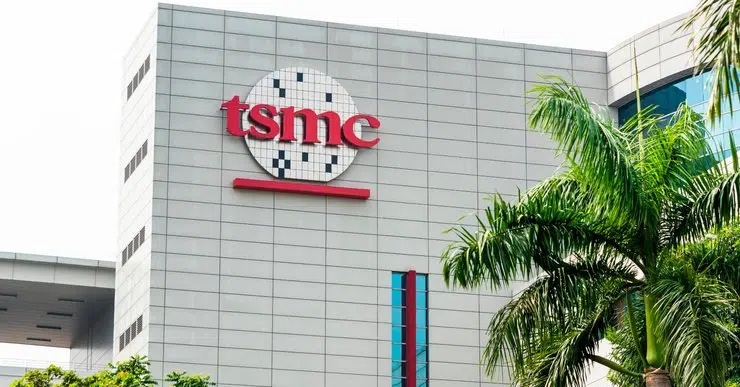
New US rules imposed in late 2023 prohibit sales of advanced GPUs such as the NVIDIA A100 and H100, two of the most widely adopted GPUs for large-scale AI workloads, to Chinese buyers. Suppliers are falling in line: TSMC, the world’s largest and most advanced chipmaker, has limited Chinese access to its most advanced chips (7nm and smaller nodes) to comply with these restrictions. That leaves Chinese AI developers short of the high-end silicon needed to train frontier models – a constraint that could slow progress relative to US firms, which enjoy virtually unlimited access.
China’s answer has been to double down on self-reliance. It’s pouring billions into domestic chip design, through Huawei’s HiSilicon, Alibaba’s T-Head, and others, while also building alternative supply chains and securing control over critical materials. In a symbolic countermove, Beijing introduced export controls on gallium and germanium, two minerals essential for chipmaking, underscoring the leverage embedded in its raw-materials dominance.
The Future Readiness Indicator captures this divergence clearly. US and allied-market firms continue to dominate the upper ranks, while most Chinese tech giants have slipped amid sanctions, tighter regulation, and a slower domestic economy. Still, it would be premature to count China out. Its firms command vast troves of user data and benefit from rapid, mass-market adoption. Tencent’s Hunyuan foundation model, embedded across WeChat’s ecosystem, has evolved quickly, proving that software ingenuity can partially offset hardware shortfalls.
Nowhere is the geopolitical tension more vivid than in Taiwan – both a flashpoint and a keystone of global supply chains. When Jensen Huang, Nvidia’s Taiwan-born CEO, called the island “the unsung hero, a steadfast pillar of the world” in his 2024 Computex keynote, he wasn’t exaggerating. Taiwanese firms like TSMC, Hon Hai Precision (Foxconn), and Quanta underpin the world’s tech ambitions, manufacturing chips and devices for both US and Chinese companies.
To navigate rising tension, they’ve adopted a policy of friendship with everyone: expanding production in the US, India, and Vietnam to support Western diversification, while maintaining large operations in China to serve its vast market. It’s a delicate dance, and one reason Taiwanese companies are rising in our index. TSMC climbed to 10th, and Hon Hai Precision entered at 47th as new coverage expands. Their performance underscores both resilience and fragility: a single disruption, political or natural, could reverberate through every level of the rankings.
In this era, geopolitical navigation has become a core competency. It’s no longer just about lobbying; it’s about supply-chain strategy, regulatory dexterity, and sometimes national security.
Firms like Samsung illustrate the new playbook: the company is investing in new chip plants in the US and South Korea to satisfy Western supply-chain demands, while simultaneously maintaining large operations in China (about one-third of its NAND flash output still comes from its Chinese factories). This dual-track strategy ensures Samsung stays indispensable to both Washington and Beijing, effectively hedging its bets in a bipolar-tech world. As the Former Under Secretary of the US Treasury for International Affairs, Lael Brainard said, Samsung is “the only leading-edge semiconductor company that is a leader in both advanced memory and advanced logic technologies.” Neither superpower can easily replace Samsung’s capabilities, granting the South Korean firm negotiating leverage that American or Chinese competitors lack.
The bottom line: the US–China tech decoupling is no longer a forecast; it’s a fact. Every global technology company must now decide how to operate in two increasingly distinct worlds.
The ability to thrive in both or to expand at least beyond the US to the Middle East will define resilience in the decade ahead.
The Gulf’s bid to power the AI world
Between Washington and Beijing, a new center of gravity is emerging. The Middle East is turning three natural advantages, cheap energy, deep capital, and strategic geography, to emerge as a new global AI infrastructure powerhouse with regional capacity expected to triple, from 1GW in 2025 to 3.3GW over the next five years. Power in the region costs roughly half the US average. That margin alone can determine who profits as global AI computing demand surges.
Saudi Arabia’s ambitions are on a scale of its own.
The Transcendence AI Initiative, worth around $100bn, aims to make AI contribute 12% of GDP by 2030. Global cloud giants are part of that plan: AWS is investing $5.3bn in new data centers starting in 2026, and Google Cloud is launching a major AI region through a partnership with the country’s Public Investment Fund. Projects like the Cloud Computing Special Economic Zone are positioning themselves to offer tax incentives and renewable power for hyperscale data centers, though full deployment timelines remain subject to implementation execution. Regional operators such as DataVolt and Ooredoo are adding hundreds of megawatts more.
Rather than taking sides in the US–China rivalry, the Gulf is positioning itself as a neutral hosting hub – renting compute capacity to Western hyperscalers while serving Asian clients where rules allow. From Abu Dhabi, more than half of the world’s population can be reached within milliseconds of network latency. A web of new submarine cables – including 2Africa, SEA-ME-WE 6, and Blue-Raman – now connects Asia, Europe, and Africa through the Gulf, turning it into the world’s newest digital crossroads. Land is cheap, regulation-friendly, and special economic zones fast-track foreign investment.
Still, the region’s climate is a major constraint. High temperatures drive up cooling costs, and water-energy interdependence could become a major constraint on data center expansion, despite the ambitious announcements. The workforce that builds these centers is also a concern, with a scarcity of skilled engineers. Furthermore, building a domestic semiconductor ecosystem, the foundation of AI sovereignty, would require hundreds of billions of dollars and decades of effort.
AI is eating the tech stack
While geopolitics pulls the tech world apart, AI convergence is pulling it together. The boundaries between hardware, software, and services are dissolving fast, as every company scrambles to own, or at least orchestrate, the full user experience.
The old model prized specialization: one firm built hardware, another provided software, and both relied on partnerships. The new model prizes control: whoever owns the interface, the data, and the workflow wins.
Consider OpenAI’s latest moves. In 2024, it hired Caitlin Kalinowski, Meta’s former AR devices lead, to spearhead robotics and hardware projects – a clear signal that OpenAI wants to expand beyond software into developing physical products. Jony Ive, Apple’s legendary design chief, is collaborating with OpenAI on a consumer AI device meant to redefine how humans interact with machines.
At the same time, the hardware giants are moving in the opposite direction – deeper into AI software. Apple, once quiet on AI, is developing advanced on-device models and an integrated AI layer built atop Siri and App Intents. Apple’s strength has always been precision timing: it rarely invents a category, but when it finally enters, as with the iPod, iPhone, or Watch, it redefines it. The same could now happen with AI.
In the enterprise world, convergence has been equally disruptive. Adobe’s attempted $20bn acquisition of Figma (ultimately blocked by regulators) revealed a strategic truth: competition isn’t the best tool anymore, but about who controls the entire workflow. Figma’s cloud-native collaboration platform threatened Adobe’s once-dominant Creative Suite by unifying ideation, design, and feedback in real time. The lesson was stark: integration beats iteration.
AI is accelerating this trend. As generative models collapse once-separate tasks into fluid, conversational experiences, the value shifts from discrete products to ecosystems.
No case illustrates this better than the emerging race to build the ‘AI super-app’. When OpenAI enabled ChatGPT to use third-party plugins and web access in 2023, it hinted at a broader ambition. By September 2025, ChatGPT Instant Checkout allowed users to search, compare, and buy directly inside a chat – a leap toward a conversational commerce platform.
Western users found this revolutionary. Chinese users, however, found it familiar. They’ve lived inside WeChat’s universe for years, booking flights, paying bills, shopping, gaming, all without leaving the chat. By 2021, its 3.5 million mini-programs generated roughly RMB 2.7tn (around $400bn) in transactions, and by 2024, 945 million people used them monthly. The West is now catching up to what China perfected: a single, sticky interface where third-party services become modular extensions of one platform. OpenAI’s ChatGPT is essentially attempting to become the WeChat of the West.
For businesses, this changes everything. The old mantra, “Bring users to your app,” is giving way to a new one: “Bring your service to where users already are.”
Companies that once fought for app installs now fight for integration slots inside dominant platforms. Retailers like Walmart are already adapting. In October 2025, it announced its partnership with OpenAI to enable shopping through ChatGPT – a stunning reversal for a company long intent on funneling traffic to its own site. Walmart’s calculus is clear: if the shopping journey begins inside ChatGPT, it must be present there or lose the sale. The move also shows a strategic split: Walmart allows ChatGPT to handle general merchandise but keeps groceries exclusive – deciding where to pay the ‘platform toll’ and where to preserve control.
Other Western players are racing to fuse commerce with their platforms as well. TikTok, for instance, launched an in-app TikTok Shop with one-tap purchasing and integrated checkout, effectively merging social media and online shopping. TikTok Shop’s integration demonstrates WeChat-style super-app features arriving in Western markets. The platform hosted over eight million hours of live shopping sessions in 2024, where 76% of consumers who engaged with TikTok Shop made purchases.
In travel, Expedia’s ChatGPT partnership now lets users plan trips and even complete bookings without ever leaving the conversation. It’s a radical blur of the line between chat and commerce, and this won’t slow down. OpenAI will continue to develop ChatGPT into a hub where other apps can be used seamlessly inside the chat. It will work, as WeChat already demonstrated a decade ago with its streamlined unified user experience.
This aggregator vs. participant dynamic will shape the next wave of competition. Companies that own ecosystems will enjoy network effects, richer data, and higher innovation scores on our indicator. Those that remain single-threaded risk invisibility as consumers and enterprises shift to all-in-one AI platforms.
As hardware, software, and AI converge, the spoils will go to two kinds of players: the platform orchestrators who control the ecosystem and the best-integrated participants who can thrive inside it. Everyone else will struggle for attention in an interface they no longer own.
The 2025 tech results
| Ranking 2025 | Company | Score 2025 | Movement |
|---|---|---|---|
| 1 | NVIDIA Corp. | 100.0 | 0 |
| 2 | Microsoft Corp. | 97.4 | 0 |
| 3 | Alphabet Inc. | 94.1 | +1 |
| 4 | Meta Platforms, Inc. | 91.4 | -1 |
| 5 | Apple Inc. | 87.7 | 0 |
| 6 | Amazon.com, Inc. | 86.2 | 0 |
| 7 | Samsung Electronics Co., Ltd. | 80.0 | +13 |
| 8 | Advanced Micro Devices, Inc. | 78.8 | -1 |
| 9 | Cisco Systems, Inc. | 69.2 | +8 |
| 10 | Taiwan Semiconductor Manufacturing Co., Ltd. (TSMC) | 65.9 | +2 |
| 11 | Qualcomm Inc. | 62.7 | -3 |
| 12 | Broadcom Inc. | 62.5 | +2 |
| 13 | Xiaomi Corp. | 61.8 | +11 |
| 14 | Shopify Inc. | 57.0 | NEW |
| 15 | Arm Holdings PLC | 56.9 | NEW |
| 16 | IBM Corp. | 54.7 | +3 |
| 17 | Intuit Inc. | 53.9 | +5 |
| 18 | Palantir Technologies Inc. | 52.3 | NEW |
| 19 | Intel Corp. | 50.5 | -6 |
| 20 | Netflix, Inc. | 48.9 | -10 |
| 21 | Tencent Holdings Ltd. | 48.8 | -5 |
| 22 | Spotify Technology S.A. | 48.0 | +1 |
| 23 | Oracle Corp. | 47.2 | -5 |
| 24 | Salesforce, Inc. | 45.8 | -13 |
| 25 | AppLovin Corp. | 45.5 | NEW |
| 26 | Adobe Inc. | 45.1 | -11 |
| 27 | Lam Research Corp. | 41.2 | +6 |
| 28 | SAP SE | 41.1 | -19 |
| 29 | Micron Technology, Inc. | 38.5 | -2 |
| 30 | Autodesk, Inc. | 37.1 | -5 |
| 31 | ASML Holding N.V. | 36.5 | 0 |
| 32 | LG Corporation | 31.0 | NEW |
| 33 | Alibaba Group Holding Ltd. | 30.2 | -5 |
| 34 | Dell Technologies Inc. | 28.0 | -4 |
| 35 | Marvell Technology, Inc. | 27.8 | -14 |
| 36 | Sony Group Corp. | 26.3 | -4 |
| 37 | SK Hynix Inc. | 26.3 | NEW |
| 38 | Analog Devices, Inc. | 26.1 | -12 |
| 39 | Applied Materials, Inc. | 21.4 | -4 |
| 40 | NXP Semiconductors N.V. | 20.1 | -6 |
| 41 | Texas Instruments Inc. | 19.8 | -4 |
| 42 | eBay Inc. | 18.2 | -4 |
| 43 | Baidu, Inc. | 15.3 | -14 |
| 44 | HP Inc. | 15.2 | -8 |
| 45 | Nintendo Co., Ltd. | 14.6 | -6 |
| 46 | NEC Corp. | 10.8 | NEW |
| 47 | Hon Hai Precision Industry Co., Ltd. (Foxconn) | 10.7 | NEW |
| 48 | Canon Inc. | 5.6 | NEW |
| 49 | JD.com Inc. | 1.0 | -9 |
Key findings
- US companies – Nvidia (100.0), Microsoft (97.4), Alphabet (94.1), and Meta Platforms (91.4) – continue to dominate. Their competitive edge comes from mastery of the entire AI stack (infrastructure, software, and data), their financial strength, and their ability to shift their capabilities from within at the speed necessary to stay ahead.
- Some of the world’s most recognizable brands and regional powerhouses form the mid-tier (ranks five through 19), including consumer-tech icons Apple and Amazon, chip leaders Samsung Electronics and TSMC, and enterprise specialists such as IBM. These firms excel in distinct domains but lag behind the top-tier companies either in innovation velocity or ecosystem reach.
- Chinese tech companies (TenCent, Alibaba, Baidu, and JD.com) have slipped amid sanctions (limiting their access to much-needed AI hardware), tighter regulation, and a slower domestic economy. However, it would be premature to count China out; its companies command vast troves of user data and benefit from rapid, mass-market adoption. Xiaomi stands out as a Chinese anomaly. It jumped 11 places to 13th, buoyed by a bold expansion into electric vehicles.
- Alphabet climbed to third position (improving its score from 80.7 in 2024 to 94.1), overtaking Meta (91.4). Alphabet’s monetizable AI execution is paying off, while Meta’s costly experiments are testing investor patience.
- Samsung transformed itself from a lagging supplier to a central player in the AI boom. It has experienced a meteoric rise from 20th place to seventh. Its persistence with its latest high-bandwidth memory chips paid off when it passed Nvidia’s tough qualification tests, after several failed attempts.
- Firms that remain tethered to legacy hardware are finding it harder to adapt to the AI-centric world.
Future-ready companies – and those falling behind
The 2025 Future Readiness Indicator for the technology sector reflects a market split into three worlds.
American firms still reign supreme with AI-first giants, Nvidia, Microsoft, Alphabet, and Meta leading in every metric that matters, while the likes of Apple, Amazon, and Samsung invest heavily in R&D to catch up. The semiconductor revival has shifted the center of gravity of the tech universe back toward companies that make the essential infrastructure for AI, with Samsung Electronics (Samsung) being one of its biggest winners, and this is reflected in its rise from 20th place in 2024 to seventh place in this year’s ranking. Meanwhile, hardware-heavy and consumer-electronics firms and legacy chip vendors continue to struggle.
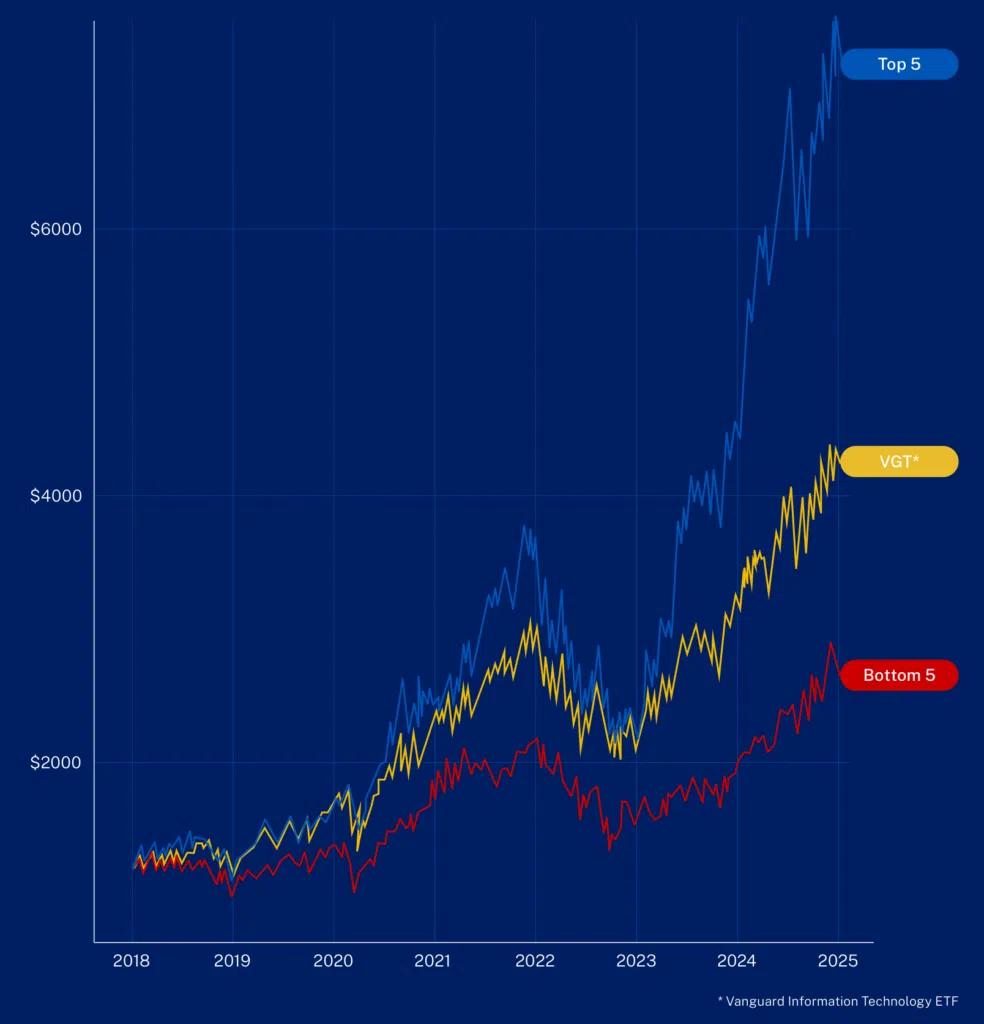
How much a $1,000 investment would be worth if you invested in…
The elite tier: The AI-first giants that set the pace (Scores >90)
American companies still reign supreme with AI-first giants Nvidia, Microsoft, Alphabet, and Meta leading in every metric that matters. Nvidia tops the indicator with a perfect score of 100.0; the company remains the undisputed backbone of the AI era. Microsoft holds firm in second (94.0), while Alphabet’s relentless momentum pushes it into third (94.1), overtaking Meta Platforms (91.4) in fourth.
These four companies have grown revenues at an average 24% CAGR, far above the around 16% industry baseline. Together, they dominate every metric that matters – financial strength, innovation speed, and ecosystem control. Their competitive edge comes from mastery of the entire AI stack – infrastructure, software, and data. Nvidia’s CUDA ecosystem, Google’s TPUs, and OpenAI’s Broadcom chip partnership show how control over infrastructure translates directly into margins and speed.
AI’s power doesn’t lie in automating steps; it lies in erasing friction. WeChat pioneered this years ago, letting users pay bills, book trips, and shop inside a single chat. OpenAI is now adopting this model: its Instant Checkout lets hundreds of millions of ChatGPT users complete purchases in one conversation. Alphabet’s AI Overviews, which boosted search queries by over 10%, and Microsoft’s Agent-to-Agent protocols are doing the same inside work and productivity tools. Apple’s on-device AI strategy, while privacy-focused, risks isolation from the broader cloud ecosystem.
The best companies know where to bet and when to stop. Alphabet invested nearly $80bn in AI infrastructure while keeping margins above 30%. This disciplined execution of AI on where it brings value contrasts with Meta’s costly experiments: its Llama language models have become the world’s most-downloaded open-source AI but have no clear revenue stream, and Reality Labs, the metaverse division, continues to burn money at historic levels.
Microsoft, meanwhile, diversified across multiple AI partners instead of relying solely on OpenAI. Nvidia turned its relentless chip release cadence into a predictable growth engine.
Alphabet vs. Meta: When focus beats endless moonshots
Amid the global AI shakeup, a quieter power shift unfolded within Silicon Valley itself. The reason Alphabet overtook Meta wasn’t luck; it was strategy. Alphabet’s disciplined execution of AI, where it can create value for the company, outperformed Meta’s scattershot bets and costly experiments.
For Alphabet, 2025 was a year when AI met earnings. In the second quarter alone, Google reported $96.4bn in revenue, up 14% year-on-year, with an operating margin of 32.4%, extraordinary for a company of that size. Operating income hit $31.3bn. CEO Sundar Pichai credited Google with “leading at the frontier of AI across products.” The company’s AI search overviews, concise, AI-generated summaries at the top of search results, reached two billion monthly users by mid-2025. Instead of cannibalizing Google’s ad business, these features supercharged it: users spent longer searching, generating over 10% more queries in markets where AI results were live.
Beyond search, YouTube and Google Cloud posted double-digit growth. Cloud revenue jumped 32% year-on-year to $13.6bn, achieving 17.8% margins – proof that Google’s decision to sell its custom TPU AI chips as a service was paying off. The cloud business hit a $50bn annual run rate, matching the scale of AWS far faster than analysts expected.
On the consumer side, Google’s Gemini AI model gained 450 million monthly active users within months, and over 85,000 developers began building on its Agents platform – a 35x increase in AI-ecosystem participation in one year. Yet expenses remained in check: R&D rose only 16%, slower than revenue. Alphabet managed what few tech giants do: expanding aggressively in AI without bloating costs or eroding profits. Its execution reinforced a new rule for the AI era: innovation must pay for itself.
Meta, by contrast, remains a paradox – an engine of innovation that leaks cash. Its Family of Apps (Facebook, Instagram, WhatsApp) remains immensely profitable, generating $41.9bn in Q1 2025, up 16% year-on-year, with free cash flow margins near 24%. Its ad targeting – powered by new AI recommendation models – is sharper than ever.
But elsewhere, the story is not so rosy. Meta’s Llama language models have become the world’s most-downloaded open-source AI – over 1.2 billion downloads by October 2025. However, Meta’s AI push has gained attention, but this hasn’t yet been translated into revenue. Then there’s Reality Labs, the metaverse division that continues to burn money at historic levels: $4.2bn lost in Q1 2025 and $4.5bn in Q2. Since 2020, cumulative losses have been close to $70bn. Meanwhile, headset sales are down 6% year-on-year despite price cuts. Even Apple’s Vision Pro, once seen as validation, has seen demand taper.
The market’s message is clear: the age of move fast and break things is over; this is the age of scale fast and pay for it. Both companies are world-class innovators.
Alphabet’s restraint, focusing on revenue-linked AI deployments and disciplined cost control, turned technological leadership into shareholder confidence. Meta’s boldness, open-sourcing models, and chasing long-horizon hardware bets won over the developers but are now testing investor patience.
The middle tier: Powerful, but still playing catch-up (Scores >50 and <90)
This is where the action and the tensions lie. Spanning ranks five through 19, the mid-tier includes some of the world’s most recognizable brands and regional powerhouses. It’s a diverse mix: consumer-tech icons, chip leaders, and enterprise specialists.
Apple (87.7) and Amazon (86.2) complete the top six, though a distinct chasm separates them from the leading quartet. The first non-US entrant is Samsung (80.0), which jumped from 20th to seventh place, having transformed itself from a lagging supplier to a central player in the AI boom. It did it the old-fashioned way: fixing problems, hitting deadlines, and shipping products. It has proved its chips can meet Nvidia’s standards and reaped the rewards. Intel (50.5), on the other hand, is at the bottom of this group thanks to its ambition without execution. Its new 18A chip technology, meant to rival TSMC and Samsung, simply didn’t work, and even its flagship PC chips had to be outsourced to TSMC.
In general, these companies excel in distinct domains yet remain vulnerable in other domains. Most are strong financial performers with clear areas of excellence, for example, Amazon in cloud and commerce, TSMC in advanced chipmaking, but they lag the top-tier performers in either innovation velocity or ecosystem reach. Their R&D spending is also above average, a signal of urgency to catch up. Apple, a master of hardware–software integration, is racing to weave generative AI into every product line. Samsung is expanding beyond hardware into software and semiconductor IP. And across Asia, from South Korea and Taiwan to China, this cohort plays a pivotal role in supply chains that underpin global AI, even as US firms dominate the software frontier.
Samsung vs. Intel: Execution beats ambition
The biggest drama in semiconductors was not innovation; it was about who could actually deliver. In just 18 months, Samsung transformed itself from a lagging supplier to a central player in the AI boom. It did it the old-fashioned way: by fixing problems, hitting deadlines, and shipping products. This saw it rise 13 places in this year’s FRI to seventh place. Meanwhile, Intel’s new chip technology didn’t work, projects were delayed or cancelled, factories closed, and its AI chip failed to make an impact; even its PC chips were outsourced. This is reflected in its six-place drop in this year’s ranking from 13th place to 19th place (score 50.5).
Samsung was a story of persistence. After a year and a half of failed attempts, its latest high-bandwidth memory chips, the 12-layer HBM3E, finally passed Nvidia’s tough qualification tests. This single win put Samsung back in the game. It can now supply the advanced memory used in Nvidia’s AI servers, one of the most lucrative contracts in tech.
The payoff was immediate. In the third quarter of 2025, Samsung posted ₩12.1tn ($8.5bn) in operating profit, its best in over three years. Revenue hit an all-time high of ₩86tn, and global memory prices surged as demand for AI hardware exploded. Samsung seized the moment, cutting prices to win new chip customers like Tesla, IBM, and Nintendo, and moving aggressively toward its next generation of 2-nm chips. It even launched an AI Computing Lab to design its own processors for future workloads.
Intel, on the other hand, once the standard-bearer of chipmaking, entered 2025 promising a comeback. But its new 18A chip technology, meant to rival TSMC and Samsung, simply didn’t work. Yields were around 10%, far below the 70% needed to make money. Projects were delayed or cancelled, two factories in Europe were shelved, and tens of thousands of jobs were cut. The company lost $18.8bn in 2024 and more than $8bn in 2025. Its AI chip, Gaudi 3, failed to dent Nvidia’s dominance.
Even its flagship PC chips had to be outsourced to TSMC, a symbolic blow to a company built on making its own.
By year’s end, Intel had become a cautionary tale of ambition without execution. Samsung, by contrast, proves that in the AI era, the winners are the ones who deliver.
The bottom tier: Stuck in yesterday’s game (Scores <50)
The bottom third, from rank 20 to 51, reveals the casualty of slow transformation. These companies face slowing growth, fragile innovation pipelines, or stalled business model pivots. Hardware-heavy and consumer-electronics firms dominate this space: Dell Technologies (34th) and HP Inc. (44th) struggle to escape commodity traps; these companies rely heavily on hardware sales, and their products are often seen as interchangeable with others, meaning that customers mainly choose on price, and not on brand, features, or innovation.
Meanwhile, legacy chip vendors like Analog Devices (38th), Texas Instruments (41st), and NXP Semiconductors (40th) are squeezed between the high-end AI silicon (chips optimized for AI tasks) and low-cost producers. They are simply not innovative enough to compete at the top end and not cheap enough to compete with low-cost rivals in China and Taiwan.
Chinese players such as Baidu (43rd) and JD.com (49th) slid down the ranks, due to a mix of internal inefficiency and external headwinds from Chinese government regulation, US export controls, and relentless domestic competition, which have combined to blunt their momentum.
Xiaomi stands out as a Chinese anomaly. It jumped 11 places to 13th, buoyed by a bold expansion into electric vehicles. In 2024, Xiaomi introduced its first EV model and rapidly scaled up production (delivering over 28,000 cars in May 2025 alone), convincing investors that the company has found a new growth engine beyond smartphones.
Beyond EVs, Xiaomi made critical moves to strengthen future readiness. In May 2025, the company announced a RMB 50bn ($6.9bn) semiconductor investment over 10 years, having already spent RMB 13.5bn ($1.9bn) on R&D. The XRing O1 chip, announced May 22, 2025, represents Xiaomi’s entry into elite 3nm process node technology with 19 billion transistors – joining only Apple, Qualcomm, and MediaTek at this manufacturing level.
The pattern is unmistakable: companies that remain tethered to legacy hardware are finding it harder to adapt to the AI-centric world. The new game rewards those who can rebuild from the inside out, those who can shift their capabilities as fast as the technology itself evolves.
Final thoughts on tech: what this year’s ranking really tells leaders
The 2025 rankings make one thing clear: success in the AI era isn’t about who spends the most; it’s about who executes best.
Market leaders Nvidia, Google, and OpenAI have proven that vertical integration: owning the full AI stack, from chips to cloud to the user interface, is what it takes to lead in the AI era. Samsung proved this in 2025; its mastery of memory, foundry, and devices powered a 13-position surge in this year’s Future Readiness Indicator. Intel had the ambition to lead in semiconductors, but it built semiconductor fabrication plants (fabs) without competitiveness and made unfocused investments – proof that vertical integration only works when backed by flawless execution and financial rigor.
AI’s power doesn’t lie in automating steps but in erasing friction, something that WeChat pioneered, and OpenAI is bringing westward, with Alphabet and Microsoft following suit. The leaders are those who don’t just add AI; they rebuild workflows around it.
What is the bottom line? Own the stack, master the workflow, show the returns.
Companies that invest wisely are getting ahead. Alphabet invested nearly $80bn in AI infrastructure while keeping margins above 30%. Microsoft diversified across multiple AI partners instead of relying solely on OpenAI. Nvidia turned its relentless chip release cadence into a predictable growth engine. Samsung pivoted fast, proved its chips could meet Nvidia’s standards, and reaped the rewards.
Geopolitics remains a wild card, so future-ready companies are hedging for either scenario – further decoupling or an unexpected easing of tensions. Notably, in mid-2025, Washington and Beijing struck a partial trade truce that eased some tariffs, a reminder that today’s adversaries can pivot to compromise when interests align. The lesson: firms must stay agile, diversify their supply chains, and keep options open so they can thrive whether trade barriers harden or suddenly fall. The news cycle is pure distraction because deep down, the dependency of America on China, starting with rare earths and running through the entire industrial supply chain, is far too deep for Trump’s remaining term to unwind. It’s not going to happen.
Pharmaceuticals
From pills to platforms
The edge goes to those who control multiple therapeutic platforms, from GLP-1s and antibody-drug conjugates (ADCs) to cell and gene therapies, while legacy giants weighed down by patent expirations struggle to keep up.
The Future Readiness Indicator 2025 reveals a pharmaceutical industry in rapid transformation. The most future-ready companies, Johnson & Johnson, Roche, and AstraZeneca, are those that have shifted from products to solutions. These companies pair therapies with devices, apps, and data services to improve outcomes and deepen engagement. A wide middle band excels in select domains or on the strength of blockbuster pipelines, but lags in offering the full solution and is actively restructuring or pursuing biotech acquisitions to catch up. Those that have made limited investments in data, digital, or next-generation science are being left behind.
This report examines the factors driving this transformation, the implications for industry players, and the strategic imperatives that separate the leaders from the laggards.
Forces rewriting pharma’s playbook in 2025
Three powerful dynamics have continued to accelerate in 2024–2025, impacting the global pharmaceutical landscape:
AI turns drug discovery from chance into design
The pharmaceutical industry faces an existential R&D productivity crisis. Drug development keeps getting slower and more expensive, straining even the biggest budgets. Artificial intelligence is emerging as the most promising answer. What started as a niche research tool has become the central engine of discovery, with AI expected to power 30% of new drug discoveries by the end of 2025.
By automating workflows, AI can cut the time to discover preclinical drug candidates by up to 40% and reduce costs by 30%. This is discovery by design, not by chance, which can shorten multi-year processes into months. Insilico Medicine, for instance, designed a novel compound and brought it to Phase 1 clinical trials in under 30 months, a journey that normally takes a decade.
The real breakthrough from AI is that it raises the odds of success, which have historically been stuck at around 10%. By scanning vast datasets, AI can pinpoint new therapeutic targets, predict toxicity early, and optimize trial design and patient recruitment, reducing costly late-stage failures. This shift has unleashed a wave of pharma-tech partnerships. Big drugmakers know they can’t build these capabilities alone, so they’re teaming up with AI-first startups to tackle declining R&D efficiency. The FDA is now actively engaged, hosting public workshops in 2025 to define how AI integrates into drug and biologic development. In today’s world, a company’s AI strategy is its R&D strategy.
Pricing squeeze meets supply shock
The pharmaceutical industry is being shaped by two powerful, intertwined forces: geopolitics, which impacts supply chains, and regulation, which impacts drug pricing. The US Inflation Reduction Act (IRA) is the most disruptive policy change in decades. Under the IRA, Medicare, a US government health insurance program that primarily covers people age 65 or older, can negotiate a maximum fair price (MFP) for high-cost drugs, fundamentally changing the economics of the world’s largest pharmaceutical market. The IRA, together with inflation rebates and a new $2,000 annual out-of-pocket cap for seniors, is compressing the commercial lifespan of every branded therapy. Companies now must launch faster, scale quicker, and reach peak sales sooner to sustain returns. Simply put, to deliver on expectations, manufacturers must drive faster uptake at launch. The pressure on R&D productivity (to refill pipelines before revenues dwindle) has never been greater.
Meanwhile, trade tensions and post-pandemic supply shocks have triggered a global wave of manufacturing reshoring. Dependence on Active Pharmaceutical Ingredients (APIs) from China and India, once seen as an efficient cost play, is now viewed as a strategic vulnerability. Today, supply chain security has become as vital as scientific innovation.
Beyond the pill: Building integrated health platforms
Pharma’s business model is shifting from selling standalone drugs to delivering integrated health platforms. The most future-ready firms are pairing therapies with devices, apps, and data services, for example, a smart sensor linked to an asthma inhaler, to improve outcomes and deepen engagement. Those clinging to the old pill-only model risk fading in relevance as healthcare converges into a connected, patient-centric ecosystem.
Advantage in the platform era lies in owning systems that can repeatedly generate new assets. Already, new modalities – spanning antibodies, cell and gene therapies, RNA-based treatments, and other novel platforms – account for roughly 60% of the global pharma pipeline’s projected value. As biology, chemistry, and data converge, the spoils will go to two types of players: platform orchestrators, those being the elite few mastering end-to-end development and manufacturing of complex modalities, and the best-integrated participants, namely the agile mid-tier firms that can plug into these platforms to keep their pipelines full. Everyone else risks being left behind. In 2025, we’re witnessing a deeper convergence across the entire healthcare landscape.
The traditional walls between pharma, medtech, and care delivery are collapsing into integrated ecosystems.
This is transforming not only how treatments are developed, but how patients experience care, pushing pharma beyond the pill. In the old world, roles were neatly divided: pharma made drugs, device makers built hardware, software firms handled health IT, and providers delivered care. Collaboration was episodic. The new world turns that model inside out. The winners will be those who can orchestrate the full patient journey, from diagnosis to treatment to continuous monitoring.
Pharma firms are responding by bundling therapies with digital and service layers. For example, Novo Nordisk and Eli Lilly pair their obesity drugs with coaching apps that help patients manage diet and side effects. Through its AMAZE program, AstraZeneca links inhalers to smart sensors and an asthma-management platform for real-time symptom tracking. Roche, through mySugr, connects glucose monitors with insulin-dosing advice to complement its diabetes drugs.
These are early glimpses of a future where the real value proposition is not just the drug, but the drug + device + data + service.
The 2025 pharmaceutical results
| Ranking 2025 | Company | Score 2025 | Movement |
|---|---|---|---|
| 1 | Johnson & Johnson | 100.0 | +5 |
| 2 | Roche Holding AG | 97.17 | -1 |
| 3 | AstraZeneca PLC | 95.44 | +1 |
| 4 | Novartis AG | 88.85 | +1 |
| 5 | Eli Lilly and Co. | 85.79 | -2 |
| 6 | Merck & Co., Inc. | 83.5 | +2 |
| 7 | Bristol-Myers Squibb Co. | 74.36 | 0 |
| 8 | Sanofi S.A. | 68.53 | +5 |
| 9 | GSK PLC | 67.6 | +5 |
| 10 | Pfizer Inc. | 64.97 | -1 |
| 11 | AbbVie Inc. | 64.51 | +1 |
| 12 | Novo Nordisk A/S | 64.38 | -10 |
| 13 | Gilead Sciences, Inc. | 58.86 | -3 |
| 14 | Amgen Inc. | 57.69 | +1 |
| 15 | Regeneron Pharmaceuticals, Inc. | 56.82 | -4 |
| 16 | Biogen Inc. | 56.55 | +5 |
| 17 | Takeda Pharmaceutical Co., Ltd. | 41.33 | +1 |
| 18 | Genmab A/S | 40.71 | -2 |
| 19 | Chugai Pharmaceutical Co., Ltd. | 38.02 | -2 |
| 20 | CSL Ltd. | 35.8 | +2 |
| 21 | Daiichi Sankyo Co., Ltd. | 35.73 | +2 |
| 22 | Vertex Pharmaceuticals Inc. | 35.53 | NEW |
| 23 | Bayer AG | 34.63 | -4 |
| 24 | Merck KGaA | 31.72 | -4 |
| 25 | Teva Pharmaceuticals Industries Ltd. | 14.1 | -1 |
| 26 | Sandoz Group AG | 1.38 | NEW |
| 27 | Lonza Group AG | 1.0 | NEW |
Key findings
- Johnson & Johnson (100.0), Roche (97.2), and AstraZeneca (95.4) are pharma’s most future-ready companies, according to the 2025 Future Readiness Indicator. Their edge lies in broad diversification, spanning traditional drugs, biologics, and medical devices, combined with massive R&D spending and early AI adoption. By integrating digital health and data analytics across their value chains, these companies continue to outpace peers in both innovation and growth.
- A wide middle band (ranks four through 16) includes major players like Novartis, Eli Lilly, Merck, Pfizer, Sanofi, and GSK. They excel in select domains or because of their blockbuster pipelines. However, they lag the elite group in innovation velocity, portfolio breadth, or ecosystem reach. Many are actively restructuring or pursuing biotech acquisitions and spinoffs to accelerate transformation and close the gap.
- Novo Nordisk, one of Europe’s most valuable companies, drops to 12th place in this year’s indicator, signaling risk. Novo Nordisk remains highly concentrated, deriving most of its revenue from diabetes and obesity care. This single-track model offers huge upside, but also vulnerability to competitors catching up (such as Eli Lily), and to supply chain constraints.
- Generic-drug manufacturers, old-line conglomerates, and smaller niche specialists are being left behind due to patent expirations eroding pricing power, cost pressures squeezing margins, and limited investment in data, digital, or next-generation science.
Future-ready companies – and those falling behind
The 2025 Future Readiness Indicator shows a widening gap between pharma’s platform pioneers and legacy laggards.
The best performers, Johnson & Johnson, Roche, and AstraZeneca, combine diversified therapeutic portfolios, AI-enabled R&D, and digital ecosystem integration. Behind them sit a large cohort of companies that excel in one area but lag in others, including Novartis, Eli Lilly, Merck & Co., Pfizer, Sanofi, Novo Nordisk, and GSK. This has resulted in a flurry of activity in the sector in the last couple of years as these companies rush to transform through divesting non-core units, striking R&D partnerships, or acquiring biotech pipelines to reset their trajectory. Those at the bottom remain trapped in outdated cost structures and overreliance on a few revenue sources, making them particularly exposed to external pressures.
The elite tier: R&D titans with multiple ways to win (Scores > 90)
American and European giants still dominate the top ranks, led by Johnson & Johnson (100.0), Roche (97.1), and AstraZeneca (95.44).
These three titans epitomize what future readiness looks like: robust financials, relentless innovation, and ecosystem control, as highlighted by their scores, which are all above 90.
Each company has outpaced the industry’s single-digit revenue growth and sustained deep pipelines that secure long-term success. Collectively, they invested tens of billions in R&D last year; AstraZeneca alone spent more than 25% of sales on R&D, fueling a steady stream of new medicines. Their edge lies in mastering the full pharmaceutical value chain and their success in building next-generation therapeutic platforms.
Johnson & Johnson, the world’s largest healthcare company, leverages its broad diversification from drugs to medical devices to cross-pollinate innovation and buffer risk. It has sharpened its focus on high-growth segments, spinning off its consumer health arm in 2023, and is planning to separate its $9.2bn orthopedics unit to double down on oncology, immunology, and novel therapeutics. Despite a major patent loss (Stelara), J&J’s pharmaceuticals arm still grew at about 7% in Q3 2025, powered by blockbusters like Darzalex, a cancer treatment drug, and what analysts call ‘steady growth across the core portfolio’, making it ‘one of the cleaner stories’ in an industry often full of complexity and volatility.
Roche, long an innovation leader, remains formidable, thanks to its biotech legacy (Genentech) and dual strengths in pharma and diagnostics. The company has faced ongoing revenue pressures over the last couple of years because many of its blockbuster drugs, including Avastin, Herceptin, and Rituxan, are facing growing competition from biosimilars, and because of declining COVID-19 test sales. However, the company is retooling fast. In early 2024, it cut eight underperforming projects and redeployed capital toward high-growth bets: next-generation eye therapy Vabysmo ($4bn in 2024 sales), and a $2.7bn deal with Carmot Therapeutics to enter the GLP-1 obesity race. Roche’s pipeline still counts nearly 150 new molecular entities, and it sealed three acquisitions in the first half of 2024 alone. In short, Roche excels at what defines future readiness: knowing where to bet and when to cut. By channeling resources into immunology, neuroscience, and novel oncology modalities, while pruning low-potential programs, it stays firmly in the top echelon.
AstraZeneca, now the UK’s most valuable company by market cap, has evolved into a genuine science powerhouse. Under CEO Pascal Soriot, it pivoted decisively toward biologics, gene therapy, and ADCs, and this has paid off. Oncology sales were up 19% year-on-year, mid-teens growth guidance for 2024, and a bold target of $80bn in revenue by 2030 from 20 new medicines in development. AstraZeneca is a textbook case of innovation that pays for itself, with disciplined R&D yielding explosive returns.
The middle tier: High-stakes specialists racing to diversify (Scores ~50–90)
Ranks four through 16 make up pharma’s middle tier. This diverse group includes multinationals, high-profile biotechs, and strong regional players. Each has notable strengths, but also areas of vulnerability, which is why their scores sit below the elite tier.
These companies are typically high-stake specialists that are betting everything on a single blockbuster or bracing for a patent cliff.
Leading this middle pack are Novartis (88.9), ranked fourth in this year’s indicator, andEli Lilly (85.8), ranked fifth. Both are on upward trajectories: Novartis completed its transformation into a ‘focused innovative medicines company’ in 2023. It executed the spinoff of Sandoz (its generic drugs division) in October 2023, freeing up management attention and capital to concentrate on high-value novel therapies. Eli Lilly, meanwhile, is the breakout story of the group. Long a steady player in diabetes and oncology, its fortunes have exploded with a breakthrough in metabolic medicine. Its dual-branded tirzepatide (sold as Mounjaro for diabetes and Zepbound for obesity) delivers unprecedented weight-loss efficacy, unlocking a vast new market. Analysts project the franchise to exceed $30bn in annual revenue by 2025–26, potentially overtaking Novo Nordisk in the GLP-1 race. Eli Lilly’s market cap and share price have surged to record highs in recent times, briefly making it the world’s most valuable pharma company. Crucially, it’s not a one-drug story: the 2024 FDA approval of donanemab (Kisunla) for early Alzheimer’s, shown to slow cognitive decline by approximately 29–35% (or 4.5–7.5 months over 18 months), opens another enormous market. In the first half of 2025, Eli Lilly’s revenues jumped so sharply that investors raised their valuation targets yet again.
Novo Nordisk (Rank 12, 64.4) has been the other headline grabber globally. Its GLP-1 drugs Ozempic (diabetes) and Wegovy (obesity) have turned obesity treatment into a cultural phenomenon and made Novo Nordisk Europe’s most valuable company for a time. In 2023, Novo Nordisk’s market value climbed so high (around $570bn at peak) that it exceeded the GDP of Denmark. In June 2025, it overtook SAP to become the most valuable company in Europe. However, our Index underlines a caution: future readiness rewards breadth as well as brilliance. Novo Nordisk’s extreme specialization (nearly all its revenue comes from diabetes and obesity care) poses a concentration risk. Competition from Eli Lilly’s rival GLP-1, supply bottlenecks, and the need to expand beyond metabolic diseases temper its long-term outlook.
Each player in this mid-tier excels in at least one area, be it therapeutic dominance, financial muscle, or pipeline depth, but few check every box. That’s why nearly all have been restructuring or deal-making in the past two years: divesting non-core units, striking R&D partnerships, or acquiring biotech pipelines to reset their trajectory.
Final thoughts on Pharma: Why breadth and integration now matter more than one blockbuster
The Pharmaceutical Future Readiness Indicator 2025 reveals an industry at a crossroads. The traditional pharmaceutical business model, characterized by broad therapeutic area coverage, blockbuster-focused commercialization, and incremental technological adoption, is increasingly vulnerable. The new paradigm rewards companies that demonstrate mastery across three dimensions: therapeutic innovation, technological integration, and ecosystem influence.
In the converged future, the spoils will go to two kinds of players:
01
Platform orchestrators Companies that control the ecosystem or interface through which patients and providers access health solutions. This could be a tech company (like an Apple Health platform coordinating an individual’s whole health data, meds, and care) or a pharma turned ‘health platform’ company (so far, none have fully done this alone, but some are trying in niches).
02
Best-integrated specialists Companies whose products seamlessly plug into these ecosystems and deliver superior outcomes. Pharma companies that ensure their drugs easily integrate with popular health apps, are compatible with home diagnostics, and can demonstrate outcomes in a value-based care model will be favored by payers and patients.
On the other hand, companies that insist on selling pharmaceutical drugs the old-fashioned way, without supporting services or data, may struggle for relevance. If a medication is great but doesn’t fit into the new care delivery workflow, which could include an app to ensure it is taken on time and correctly, and the ability for a doctor to monitor this remotely, it could lose out to a slightly less effective product that comes with a full-service solution.
Another aspect of convergence is data and personalization. Pharma historically made one drug for as many people as possible. Now, with genomic diagnostics (such as next-generation sequencing of tumors) and AI analysis of patient records, treatments can be tailored to ever-narrower populations and even individualized. We see companies like Roche and Novartis investing in companion diagnostics and genetic testing companies (Roche acquired Foundation Medicine, Novartis partnered with Caris Life Sciences) to ensure they are also part of the diagnostic journey, not just the treatment. This means a convergence of diagnostics and pharma: the value is in an integrated solution that finds the right patients and treats them optimally.
Ultimately, the lines between drug makers, tech companies, and healthcare providers are dissolving. The most future-ready pharmaceutical companies are no longer just tech companies, but part tech companies and part care providers. They will use continuous data feedback to refine outcomes, bundle drugs with digital services, and experiment with new business models such as outcomes-based contracts or treatment subscriptions.
Those that fail to evolve risk finding their medicines out of the loop, prescribed less often simply because they don’t fit into the new, integrated model of data-driven care.
Convergence is no longer optional; it is redefining pharma from an industry of products into an industry of solutions.
Fashion
When heritage meets hype and AI
The top of the 2025 Future Readiness Indicator ranking is dominated by models of platform-based resilience, while companies that have been slow to adapt and remain culturally relevant fail to resonate with the modern consumer.
The top-tier companies dominate because of their diversified models and strong brands. LVMH’s portfolio of iconic brands has shielded it in turbulent times, while Inditex and Hermès are also insulated from market shocks thanks to their non-negotiable brand equity, supply chain mastery, and financial strength.
The middle of the indicator is where sportswear giants battle it out for relevance, excelling in some areas but weaker than the top-tier companies in others. The lower third of the rankings, including off-price distributors and legacy brands, reveals the casualties of slow adaptation. Companies in this segment face slowing growth, compressed margins, and existential questions about their business models.
This report examines the factors driving this transformation, the implications for industry players, and the strategic imperatives that separate the leaders from the laggards.
Forces reshaping fashion in 2025
Two significant forces are reshaping fashion in 2024–2025 in an environment where brand equity dominates, while style convergence speeds up:
AI moves from side project to fashion’s mainstream
The AI shift in fashion is no longer a side project; it has become central to how brands design, produce, and convert shoppers.
By 2024, 28% of fashion companies were already integrating AI into their creative design workflows. Tools like DALL·E 3 – now reaching 67.6% implementation accuracy – show that designers are no longer experimenting for novelty; they’re using AI to increase hit rates and shorten production cycles.
Meanwhile, supply chain transformation continues at full speed. Fast-fashion giant Zara analyzes more than three million social media images daily through an AI partner to forecast trends. With 85% of its production happening in-season, the company significantly reduces overproduction and stale inventory.
E-commerce has accelerated in parallel. Global fashion e-commerce reached $781bn in 2024 and is projected to surpass $1.6tn by 2030. Mobile devices now account for 70% of all e-commerce transactions. But the sector still faces a major friction point: cart abandonment averages 70.22%. The implication is clear – brands will need AI-powered conversion tools that can personalize, predict, and close the sale at scale.
Luxury, streetwear, and digital collide
The fashion industry is undergoing a historic convergence; luxury, streetwear, and digital fashion are no longer separate lanes; they are merging into one ecosystem where aesthetics, communities, and business models collide.
Streetwear is projected to grow from $371.09bn in 2025 to $637.14bn by 2032 at a 7.89% CAGR.
Digital fashion is scaling even faster. NFT-enabled marketplaces are expected to jump from $2.86bn in 2025 to $36.42bn by 2034, a 32.7% CAGR that reflects both speculative interest and genuine utility in gaming, skins, and virtual identity. The luxury goods market continues its steady rise at 7.02% CAGR through 2033, driven by platform strategies and demographic shifts toward younger, digitally native buyers.
The forces blending these categories show up most clearly in the collaborations that have shaped the past two years. Across the industry, collaborations are merging, such as Travis Scott with Nike SB Dunk Low, Kendall Jenner with Calvin Klein’s Spring 2025 collection, Harry Styles with Gucci, Charli XCX with Skims, and Kendrick Lamar with Willy Chavarria. These are not mere endorsements; they are cultural flashpoints drawing luxury toward streetwear and pulling streetwear into high fashion. The boundaries are dissolving in real time.
Then comes drop culture, which works as a status machine. Drop culture has shifted fashion away from seasonal cycles toward event-based commerce. Scarcity is engineered, while anticipation is manufactured as products become financial assets as much as fashion items. The mechanics stay the same every time: tiny quantities, surprise announcements, one-off releases, and a short window to buy. A whole economy built on urgency and insider access has emerged.
The psychology runs deeper; scarcity increases perceived value, while fear of missing out accelerates demand. Ultimately, owning what others cannot obtain becomes a way to signal insider status. And in the digital age, every drop becomes a shared cultural moment, amplified by influencers, communities, and algorithms that reward urgency.
The 2025 fashion results
| Ranking 2025 | Company | Score 2025 | Movement |
|---|---|---|---|
| 1 | LVMH SE | 100.0 | +1 |
| 2 | Inditex SA | 91.44 | +1 |
| 3 | Hermès International S.A. | 87.17 | -2 |
| 4 | Adidas AG | 84.85 | +6 |
| 5 | Nike, Inc. | 81.95 | -1 |
| 6 | Kering S.A. | 73.47 | 0 |
| 7 | Moncler S.p.A. | 69.19 | NEW |
| 8 | Lululemon Athletica, Inc. | 68.34 | -3 |
| 9 | Ralph Lauren Corp. | 67.02 | NEW |
| 10 | Zalando SE | 65.26 | -1 |
| 11 | Prada S.p.A. | 63.36 | -3 |
| 12 | On Holding AG | 62.39 | NEW |
| 13 | Fast Retailing Co., Ltd. | 61.72 | +3 |
| 14 | ASICS Corp. | 58.71 | NEW |
| 15 | Richemont S.A. | 57.05 | -8 |
| 16 | Levi Strauss & Co. | 57.05 | NEW |
| 17 | Burberry Group plc | 56.29 | -3 |
| 18 | Tapestry, Inc. | 55.02 | 0 |
| 19 | Crocs, Inc. | 51.42 | NEW |
| 20 | The TJX Companies, Inc. | 50.84 | -8 |
| 21 | H&M Hennes & Mauritz AB | 50.5 | -1 |
| 22 | Next plc | 50.17 | +5 |
| 23 | VF Corporation | 48.67 | -10 |
| 24 | Anta Sports Products Ltd. | 43.14 | -2 |
| 25 | Victoria’s Secret & Co. | 42.06 | NEW |
| 26 | Gap, Inc. | 41.73 | -5 |
| 27 | Puma SE | 40.74 | -16 |
| 28 | Abercrombie & Fitch Co. | 37.69 | NEW |
| 29 | JD Sports Fashion plc | 36.03 | NEW |
| 30 | PVH Corp. | 31.71 | -13 |
| 31 | Ross Stores, Inc. | 31.66 | -12 |
| 32 | American Eagle Outfitters, Inc. | 28 | NEW |
| 33 | Misto Holdings Corp. | 27.02 | NEW |
| 34 | Macy’s, Inc. | 25.8 | -10 |
| 35 | Li Ning Co., Ltd. | 24.55 | NEW |
| 36 | Burlington Stores, Inc. | 24.19 | NEW |
| 37 | Capri Holdings Ltd. | 24.17 | -22 |
| 38 | Under Armour, Inc. | 21.38 | -15 |
| 39 | Urban Outfitters, Inc. | 21.21 | NEW |
| 40 | The Swatch Group Ltd. | 5.26 | -12 |
| 41 | Hanesbrands, Inc. | 1.0 | -12 |
Key findings
- The diversified luxury “super-conglomerate,” LVMH (100.0), reclaims the top spot, demonstrating that a portfolio of iconic brands provides an unparalleled moat against volatility. It is joined by the vertically integrated, data-driven “ecosystem” models of Inditex (Zara, Massimo Dutti, Bershka, etc.) (91.4), which rose to second, and Hermès (87.2). These companies are insulated from market shocks by their non-negotiable brand equity, mastery of their supply chains, and vast cash reserves.
- A wide mid-tier band (ranks ~4–10) is populated by sportswear giants and other multi-brand players. Nike, Adidas, Lululemon, Fast Retailing (Uniqlo), and Kering (Gucci/YSL/Balenciaga) all score well in select areas. These include Nike’s digital direct-to-consumer ecosystem, Lululemon’s community-driven brand fervor, and Fast Retailing’s global reach. But they lag the elite group in one dimension or another.
- After a rocky 2023 (its first net loss in decades), Adidas has rebounded under new CEO Bjørn Gulden by reigniting its brands and clearing excess inventory. It rises from #10 to #4 in this year’s indicator.
- At the bottom of the rankings, off-price distributors and legacy brands, including Macy’s, Ross Stores, and Burlington, are being left behind, many from innovation stagnation, high debt burdens, or narrowly focused brands that limit their prospects.
Future-ready fashion companies and those facing a reset
The 2025 Future Readiness Indicator for the fashion industry reveals a landscape fractured into three distinct, non-competing realities.
The ranking is no longer a simple ladder; a great divide now separates dominant platforms, including LVMH, Inditex, and Hermès, from a field of legacy models facing a systemic collapse. This includes the likes of Macy’s, Ross Stores, and Burlington. Battling it out for future relevance in the mid-tier are the sportswear giants, the likes of Nike and Adidas, and other multi-brand players like Fast Retailing and Kering.
The elite tier: Platform titans with unshakeable brands (Scores > 85)
It’s no surprise that LVMH (100.0) holds the indicator’s top spot: the French giant’s diversified model has proven highly resilient. LVMH’s portfolio spans haute couture (Louis Vuitton, Dior), fine wines (Moët & Chandon), jewelry (Tiffany), cosmetics (Sephora), and more, giving it multiple growth engines and insulation against any single market’s downturn. In 2024–25, this breadth paid off: when the US and Europe luxury spending cooled, Chinese demand returned, lifting LVMH’s Q3 2025 sales back to growth. While not the fastest mover in digital (LVMH scored lower on some tech-forward metrics historically, it has steadily ramped up efforts in e-commerce and data analytics, all while preserving the exclusivity of its luxury maisons. The Arnault-led firm’s massive R&D and marketing budgets have enabled bold moves from launching new brands (Fenty Beauty) to acquiring iconic houses (Tiffany’s $15.8bn takeover).
All these strategic actions position LVMH to shape consumer trends rather than chase them.
Just behind LVMH, Hermès (87.2) and Inditex (91.4) highlight two contrasting formulas for success. Hermès has built its future readiness on scarcity, heritage, and timeless appeal. The 186-year-old house only produces what its craftspeople can hand-make, famously capping supply of its Birkin and Kelly bags, and invests heavily in artisanal quality and its employees (it opened multiple new leather workshops in France, creating jobs). However, its insular focus means it scores lower on some innovation metrics. Hermès is cautious with digital initiatives and only recently dipped a toe into the metaverse/non-fungible token space. This move signals awareness of emerging trends while maintaining a deliberately measured approach. Still, the company’s methodical, long-term growth (it opens about 1–2 stores per year and avoids over-expansion) proves that focus and cultural relevance can trump scale.
By contrast, Inditex (Zara, Massimo Dutti, Bershka, etc.) thrives on fast-cycle innovation and global agility. With thousands of stores worldwide and a renowned ability to knock off runway styles in weeks, Inditex excels in Early Results of Innovation and Business Diversity. This diversity is not in terms of product categories (it’s mostly apparel), but in its flexible operations and brand portfolio, each brand targets different demographics. Even as consumer demand turned uncertain in 2025, it impressed analysts by maintaining gross margins of ~58%, indicating pricing power and operational efficiency. The company’s relatively new CEO, Óscar García Maceiras, has emphasized “cultural relevance” and localizing product mix, echoing a theme seen across the leaders. Indeed, both Hermès and Inditex, while opposites in product strategy, share a knack for reading consumer culture and building brand allure, one through exclusivity, the other through ultra-fast trend response. Each highlights how different pathways – one high-end and slow, one mass and fast – can yield future readiness if executed.
The middle tier: Sportswear’s battle for the next chapter (Scores 50 – 85)
The middle tier is the battleground of sportswear brands. The most significant story of the ranking is the rise of Adidas (84.9), which rocketed to #4 from #10 in 2024. This surge is the result of a perfect turnaround, which involved converting a cultural trend into massive financial momentum. One year ago, Adidas was reeling; the costly breakup with Kanye West’s Yeezy brand had led to its first annual loss in 30 years. Fast-forward to late 2024 and 2025, and Adidas is on the upswing, thanks to a return to sports-focused basics and viral product hits. Under CEO Bjørn Gulden (appointed 2023), Adidas went back to its archives and found gold in the retro Terrace sneaker trend (classic Samba, Gazelle, and Campus styles). By rapidly scaling up production of these sneakers, a move Gulden initiated within days of taking over, Adidas tapped into massive global demand.
Challenges remain: the North American market is still weak for Adidas, and it continues to clear leftover Yeezy inventory carefully. But the company’s trajectory shows how a strong learning culture can restore future readiness. One analyst quipped that Adidas, “Comeback King!” pointing to improving brand sentiment and fewer discounts needed to sell product.
Nike (82.0), the world’s largest sportswear maker, remains high on the future-readiness list (moving from number four last year to five this year). Nike continues to benefit from a combination that is hard to match: global brand strength and a long-running digital push. The company has spent years expanding the Nike Digital ecosystem. This includes the SNKRS app, Nike Plus membership, and an expanding base of owned stores that gives it a direct channel to consumers. The market has also priced in the structural challenges Nike is still working through. Analysts point to weaker style credentials and continued underperformance in financial returns. By 2025, Nike faced a 10% drop in sales and a 44% fall in profit. Even so, the company retains an elite Brand Value score of 93.9 (only LVMH ranks higher). Its Innovation score is strong at 90.8, reflecting the depth of Nike’s R&D pipeline. The gap appears in Financial Fundamentals. Here, Nike comes in at 36.1, falling below the industry average. The high Innovation score shows that Nike continues to build capabilities for the next chapter. The weak financial score shows that innovation efforts have yet to translate into tangible financial performance.
Emerging players like On show how fast the sportswear sector can shift. The Swiss running brand, co-founded by athlete Olivier Bernhard, only went public in 2021. Yet by 2025, it has already raced up the Future Readiness ranks, outpacing far older rivals in both growth and innovation. Its cloud-cushioned shoes have built a cult following among runners and weekend wearers. The company’s LightSpray™ technology, a robotic spray-on upper that needs no sewing, is an example of the sort of breakthrough product development that turns heads from elite athletes to everyday consumers. On makes its debut at #12, powered almost entirely by Investors’ Expectation of Future Growth, where it leads the 41 companies we assessed. The company also performs exceptionally well in Financial Fundamentals (#3) and in Cash & Debt (#1). The numbers paint a clear picture of a business that investors trust. More importantly, it has the financial execution to justify that confidence. The challenge ahead is different. On needs a loyalty ecosystem that can rival Nike and Adidas, and it needs to keep its innovation velocity high as it scales. That is where many fast-growing brands begin to slow, but for now, On looks like a company running well ahead of the pack.
The bottom tier: Retail models running out of road (Scores < 50)
At the bottom of the rankings, off-price distributors and legacy brands are being left behind, such as department store chains and off-price retailers, like Macy’s (25.8), Ross Stores (31.7), and Burlington (24.2). Many of these players suffer from innovation stagnation, high debt burdens, or narrowly focused brands that limit their prospects. Further, mall-based apparel sellers have faced years of declining foot traffic and overpriced leases, which have eroded their financial fundamentals.
The lower third of the rankings reveals the casualties of slow adaptation. Companies in this segment face slowing growth, compressed margins, and existential questions about their business models.
Under Armour (38th) and Puma (27th) used to be challengers going after Nike and Adidas, but are now mostly just struggling to stay relevant. Under Armour’s revenue dropped 5.5% as its North American wholesale business cratered. The brand has been trying to turn things around with restructuring efforts, but nothing’s really working. They’re stuck in Nike’s shadow while Adidas pulls ahead.
Puma is having an even rougher time. Sales in North America fell 9%, hammered by US tariffs and way too much inventory sitting around. They had to slash prices, which killed their margins. Their new CEO is calling 2025 a “year of reset”, but that’s basically code for, “We don’t know what we’re doing yet.” Puma seems to have lost its identity somewhere along the way, and the numbers show it. Like Under Armour, they’re getting squeezed by more innovative competitors and can’t seem to find their footing.
Capri Holdings (37th) might be in the worst shape of all. When Tapestry was going to buy them – that deal fell apart later – it exposed just how bad things were. Revenue tanked, losses piled up, and they had to write down the value of Versace and Michael Kors. For fiscal 2025, Capri posted a $1.18bn loss. Michael Kors’ revenue alone dropped from $3.52bn to $3.01bn. With management saying, “Don’t expect things to get better anytime soon,” it will take years, not months.
Swatch Group(40th) suffered the most dramatic decline in the rankings, falling from respectability to near bottom due to a catastrophic 74% profit decline in 2024.
The Swiss watchmaking conglomerate reported revenue of CHF 6.7bn (down 12.2% at constant exchange rates) with operating profit plunging to CHF 304m from CHF 1.2bn the prior year.
The sharp downturn was driven by a 33% sales drop in Greater China – including Hong Kong and Macau – amid weak consumer confidence and reduced luxury spending, along with softening demand across Southeast Asia, where Chinese tourism remains critical. Swatch’s choice to maintain production capacity and keep marketing spend intact further squeezed margins. Gains in the US, Japan, India, and the Middle East were not enough to counter the broader decline.
Final thoughts on Fashion: How deep moats are really built
The 2025 rankings reveal a fashion industry where competitive moats are deepening. The industry’s future will be written by companies that master seemingly contradictory demands: heritage and innovation, scale and exclusivity, global and local.
The top performers show that heritage combined with innovation wins. LVMH, Hermès, and Inditex prove that longevity and agility are complementary capabilities. LVMH leverages centuries of craftsmanship heritage while investing billions in AI and digital commerce infrastructure. Hermès maintains artisanal production methods while adopting sophisticated inventory management. Inditex built its fast-fashion empire on supply chain innovation but grounds it in Zara’s 50-year legacy.
AI productivity and digital transformation are table stakes, not differentiation. Every company has invested in e-commerce, social media, and data analytics, yet the difference lies in sophistication and integration. Leaders treat digital as core infrastructure woven throughout operations rather than a separate channel bolted onto traditional business.
Fashion’s bifurcation into ultra-luxury and value segments accelerates relentlessly. The strategic imperative is clear: commit to authentic luxury positioning or compete in value. The comfortable middle ground is vanishing.
China’s slowdown and the rise of domestic Chinese brands pose challenges for Western brands. However, opportunities remain, for example, ultra-luxury brands like Hermès, which serve the wealthiest Chinese consumers, continue to show resilience.
Conclusion
Who is really ready for 2026?
This report offers a simple question for every leadership team: Are you building a company that can keep winning as the game keeps changing? Future readiness shows up in how you allocate capital, design your supply chains, and organize people’s daily work. The leaders in this indicator point to a repeatable playbook.
Several clear lessons emerge from the technology, pharmaceutical, and fashion sectors.
Design for shocks, not for averages
Geopolitics is now part of day-to-day management. The ability to navigate geopolitical tension has become a core competency. Future-ready companies design supply chains they can reroute, and operating models that can live with fast-moving regulation.
They don’t just optimize one factory or one country. They learn to move across entire systems of suppliers, partners, and platforms so that a shock in one place does not stop the whole machine.
Build new engines before the old ones stall
The edge lies in having more than one way to win. The strongest companies don’t wait for a crisis before they diversify. They build second and third engines of growth while the core business is still healthy.
That means new categories, R&D partnerships, and targeted acquisitions, so that when technology shifts or regulation bites, they can pivot rather than start from zero.
Stay one inch ahead
You don’t have to be the biggest player to be the most future-ready. What matters is staying slightly ahead of the next turn and doing that repeatedly. The leaders in this report are ruthless about execution. They deploy AI where it changes outcomes, prune projects that do not, and keep redirecting capital to what works. In the AI era, innovation that cannot pay its own way is simply a distraction.
Treat the user journey as the real strategy
In markets crowded with choice, the experience is the strategy. The most future-ready companies make it effortless for customers and users to get things done, whether that means a single interface that handles an entire digital journey or a health pathway that runs smoothly from diagnosis to continuous monitoring at home.
Personalization is also the baseline. What sets leaders apart is the ability to orchestrate the whole journey so that technology disappears into the background.
As 2025 closes, geopolitics is still the biggest unknown. Trade barriers may harden or suddenly ease. Either way, the response from future-ready companies is the same: keep options open, build supply chains with built-in flexibility, and avoid bets that depend on a single country or policy.
The message from this year’s rankings is straightforward. You do not need to be miles ahead of the competition. One inch is enough, as long as you keep moving.
Acknowledgements
Authors and researchers
The IMD Center for Future Readiness Team:
Howard Yu
LEGO® Professor of Management and Innovation and Director
Jialu Shan
Associate Research Director
Lawrence Tempel
Data Specialist
Alexandre Sonderegger
Data Scientist
Anqi Miao
Data intern